


 Password Manager
 Identity Theft Protection

 Team / Business
 Enterprise
 Government
 MSP
MSP


Why Use Strong Authentication: The Complete Guide

Most cyber attacks exploit weak authentication, making this one of the biggest risks for both individuals and businesses today. As digital threats become more advanced, relying on passwords alone is no longer enough to keep sensitive information safe. Understanding what makes authentication truly strong clears up widespread misconceptions and helps you build a security approach that genuinely protects against unauthorized access and evolving risks.
Key Takeaways
| Point | Details |
|---|---|
| Strong Authentication | Goes beyond traditional methods, requiring multiple independent verification factors to enhance security. |
| Weak Authentication Risks | Presents significant vulnerabilities, leading to unauthorized access and potential data breaches. |
| Layered Approach | Combining various authentication methods can create a dynamic, responsive security ecosystem. |
| Continuous Verification | Utilizing behavioral and contextual signals allows for ongoing user validation, enhancing overall security measures. |
Defining Strong Authentication and Misconceptions
Authentication is the gateway to digital security, and strong authentication represents a robust approach to verifying user identity beyond traditional username and password combinations. According to research from ijstr.org, authentication mechanisms have evolved significantly, moving far beyond simple credential entry.
Strong authentication fundamentally differs from weak authentication by incorporating multiple verification layers. These advanced methods typically involve combinations of factors that dramatically reduce unauthorized access risks. Key characteristics include:
- Requiring two or more independent verification credentials
- Using complex validation techniques beyond static passwords
- Incorporating dynamic, context-specific verification processes
- Leveraging multiple authentication factors simultaneously
Contrary to common misconceptions, strong authentication isn’t just about complexity—it’s about intelligent security design. As research from arxiv.org explains, biometric and multi-factor authentication strategies represent sophisticated approaches that go beyond traditional security models. These methods analyze multiple contextual signals, making unauthorized access exponentially more challenging.
Practically speaking, strong authentication transforms security from a single-point vulnerability to a multilayered defense system. By integrating techniques like multi-factor authentication, organizations can create adaptive security environments that respond dynamically to potential threats while maintaining user convenience.
Types of Strong Authentication Methods
Authentication methods have dramatically evolved from simple password systems to sophisticated, multi-layered security approaches. According to research from ijstr.org, modern authentication mechanisms encompass a wide range of powerful techniques designed to protect digital identities.
Strong authentication methods can be broadly categorized into several key types:
- Knowledge-Based Authentication
- Passwords with complex requirements
- Security questions
- Personal identification information
- Possession-Based Authentication
- Hardware tokens
- Smart cards
- Mobile device authentication
- One-time password generators
- Inherence-Based Authentication
- Biometric verification
- Fingerprint scanning
- Facial recognition
- Voice pattern recognition
Research from arxiv.org highlights emerging behavioral biometric techniques, which analyze unique user characteristics like typing patterns, gait, and touch gestures. These methods create a continuous authentication environment that goes beyond traditional one-time verification.
By integrating multiple authentication methods, organizations can create robust authentication solutions that provide comprehensive security. The key is not just implementing these methods, but strategically combining them to create adaptive, intelligent authentication systems that balance strong protection with user convenience.

How Strong Authentication Protects Data
Data protection has become a critical concern in our increasingly digital world, with strong authentication serving as the first line of defense against unauthorized access and potential breaches. Research from arxiv.org reveals that robust authentication mechanisms are essential in creating multilayered security environments that protect sensitive information across various digital platforms.
Strong authentication protects data through several key strategies:
-
Preventing Unauthorized Access
-
Blocking malicious actors from entering systems
-
Verifying user identity through multiple verification layers
-
Creating dynamic authentication challenges
-
Reducing Identity Theft Risks
-
Limiting potential compromises
-
Creating complex verification processes
-
Tracking and logging access attempts
-
Implementing Contextual Security
-
Analyzing user behavior patterns
-
Detecting anomalous access attempts
-
Generating real-time security alerts
Specifically for mobile and financial technologies, arxiv.org highlights how strong authentication approaches provide critical safeguards for sensitive transactions. By implementing advanced security protocols, organizations can create adaptive security environments that protect data while maintaining user accessibility.
The ultimate goal of strong authentication is not just blocking access, but creating an intelligent, responsive security ecosystem that understands and adapts to evolving digital threats. This approach transforms data protection from a static barrier into a dynamic, intelligent shield that continuously evaluates and responds to potential security risks.
Risks of Weak Authentication Practices
Weak authentication practices represent a critical vulnerability in modern digital ecosystems, exposing organizations and individuals to substantial security risks. Research from arxiv.org highlights that inadequate authentication mechanisms create significant openings for sophisticated cyber threats across network infrastructures.
The most prevalent risks associated with weak authentication include:
1. Unauthorized System Access
- Easy exploitation of simple credentials
- Minimal barriers for malicious actors
- Rapid compromise of sensitive information systems
2. Identity Theft Vulnerabilities
- Simplified personal data extraction
- Increased potential for fraudulent activities
- Compromised personal and financial information
3. Data Breach Potential
- Minimal resistance against targeted attacks
- Simplified penetration of secure networks
- Rapid propagation of security compromises
According to arxiv.org, mobile and financial technologies are particularly susceptible to authentication vulnerabilities. Organizations can mitigate these risks by understanding weak password dangers and implementing robust, multilayered authentication strategies.
Ultimately, weak authentication is not just a technical problem—it’s a systemic risk that can compromise entire organizational security frameworks.
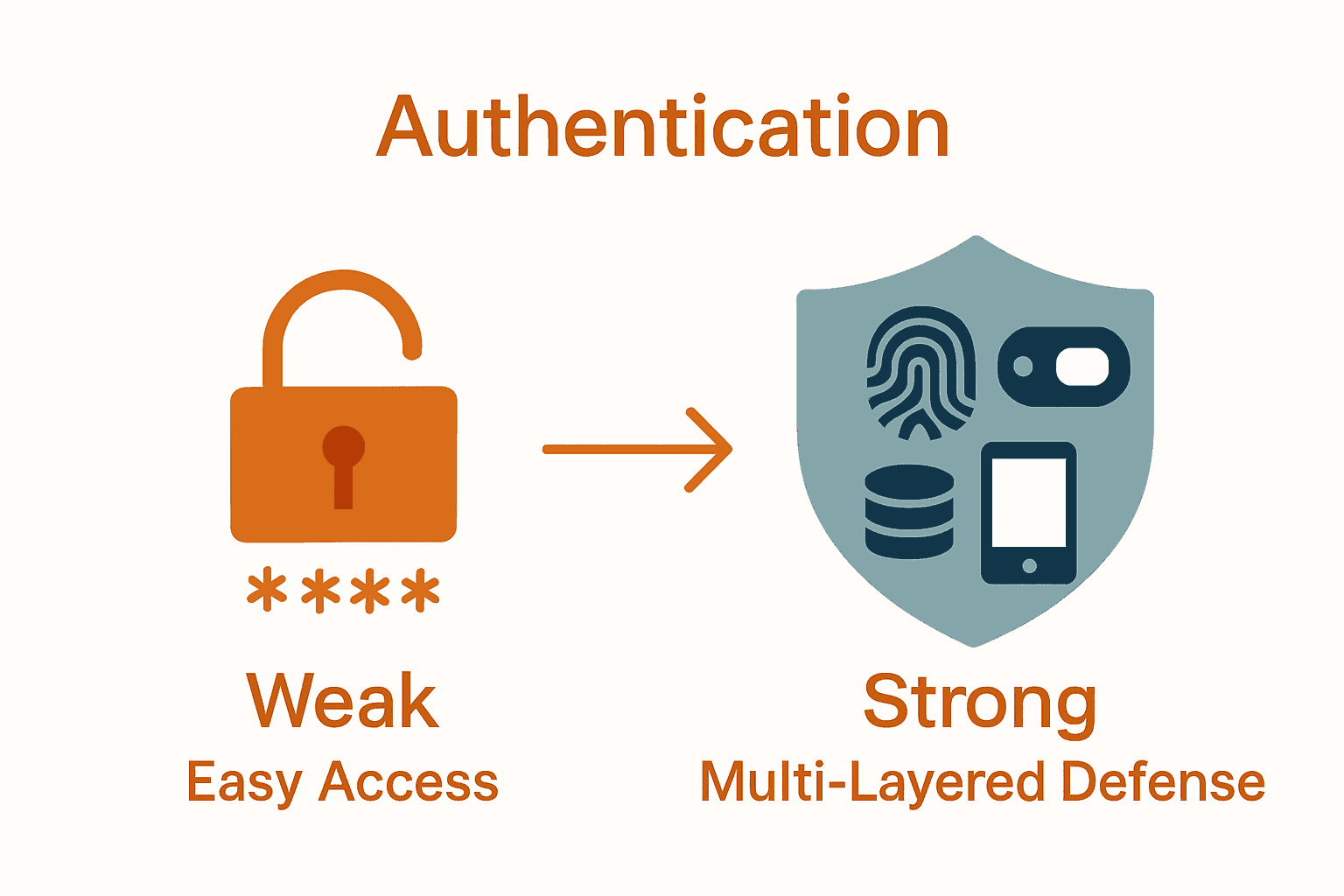 Proactive, intelligent authentication approaches transform security from a reactive measure to a predictive, adaptive defense mechanism.
Implementing Strong Authentication Effectively
Effective strong authentication requires a strategic, multifaceted approach that goes beyond traditional security measures. Research from arxiv.org emphasizes the importance of developing comprehensive authentication architectures that adapt to evolving technological landscapes and emerging security challenges.
Key strategies for successful implementation include:
1. Layered Authentication Approach
- Combine multiple verification methods
- Create interdependent authentication layers
- Implement context-aware authentication mechanisms
2. Continuous Verification Techniques
- Monitor user behavior patterns
- Develop dynamic authentication challenges
- Use contextual signals for ongoing verification
3. Technology Integration
- Leverage biometric and behavioral authentication
- Incorporate machine learning algorithms
- Design flexible authentication frameworks
According to arxiv.org, behavioral biometric approaches offer particularly promising methods for continuous user authentication, especially in mobile environments. Organizations can enhance their security posture by exploring enterprise password management strategies that balance robust protection with user experience.
Successful strong authentication is not a one-size-fits-all solution but a dynamic, intelligent system that evolves with technological advances and emerging threat landscapes. The most effective implementations create adaptive security environments that protect sensitive information while maintaining user accessibility and convenience.
Strengthen Your Security with Strong Authentication from LogMeOnce
The challenges outlined in “Why Use Strong Authentication: The Complete Guide” highlight the urgent need to move beyond weak passwords and single-factor verification. Many organizations struggle with protecting data from unauthorized access, identity theft, and evolving cyber threats. You need a solution that combines multiple authentication methods like biometrics, possession factors, and behavioral analysis to create a truly secure and adaptive environment.
LogMeOnce offers exactly that by delivering an easy-to-use platform with multi-factor authentication designed to prevent unauthorized access and reduce risks associated with weak security practices. Our innovative passwordless MFA and seamless identity management empower you to protect sensitive data without sacrificing convenience or user experience.

Don’t wait for a breach to happen. Take control of your digital security today with LogMeOnce and explore how our enterprise password management and authentication solutions can transform your organization’s defense. Start a free trial now and build a stronger security foundation that evolves with tomorrow’s threats.
Frequently Asked Questions
What is strong authentication?
Strong authentication refers to a robust security process that verifies user identity through multiple verification layers, significantly improving security beyond traditional username and password combinations.
What are the benefits of using strong authentication?
The benefits of strong authentication include preventing unauthorized access, reducing identity theft risks, and implementing contextual security that adapts to user behavior, enhancing overall data protection.
What types of strong authentication methods are available?
Strong authentication methods include knowledge-based authentication (like complex passwords and security questions), possession-based authentication (such as hardware tokens and smart cards), and inherence-based authentication (like biometric verification techniques).
How does strong authentication protect sensitive data?
Strong authentication protects sensitive data by blocking unauthorized access, creating dynamic verification challenges, and tracking user behavior patterns to detect and respond to anomalous access attempts.


