


 Password Manager
 Identity Theft Protection

 Team / Business
 Enterprise
 Government
 MSP
MSP


Over 80 percent of american organizations have experienced a data breach linked to weak authentication practices. Securing sensitive information is more critical than ever as threats continue to evolve and grow in complexity. By understanding how to assess security requirements and implement the right multi-factor authentication methods, you can safeguard your data and keep your organization a step ahead of cybercriminals.
Quick Summary
| Key Insight | Explanation |
|---|---|
| 1. Conduct Security Assessments | Start by evaluating your organization’s specific security needs to determine the most suitable MFA methods and factors to implement. |
| 2. Simplify User Experience | Ensure multifactor authentication is secure yet user-friendly to avoid barriers for legitimate users while maintaining strong protection. |
| 3. Define Access Control Protocols | Create clear protocols for user roles and permissions, implementing least privilege access tailored to job responsibilities. |
| 4. Prioritize User Education | Implement comprehensive user training and documentation to ensure smooth adoption and adaptation to new authentication processes. |
| 5. Regularly Monitor and Refine | Continuously track authentication patterns and review security protocols periodically to adapt to new threats and vulnerabilities. |
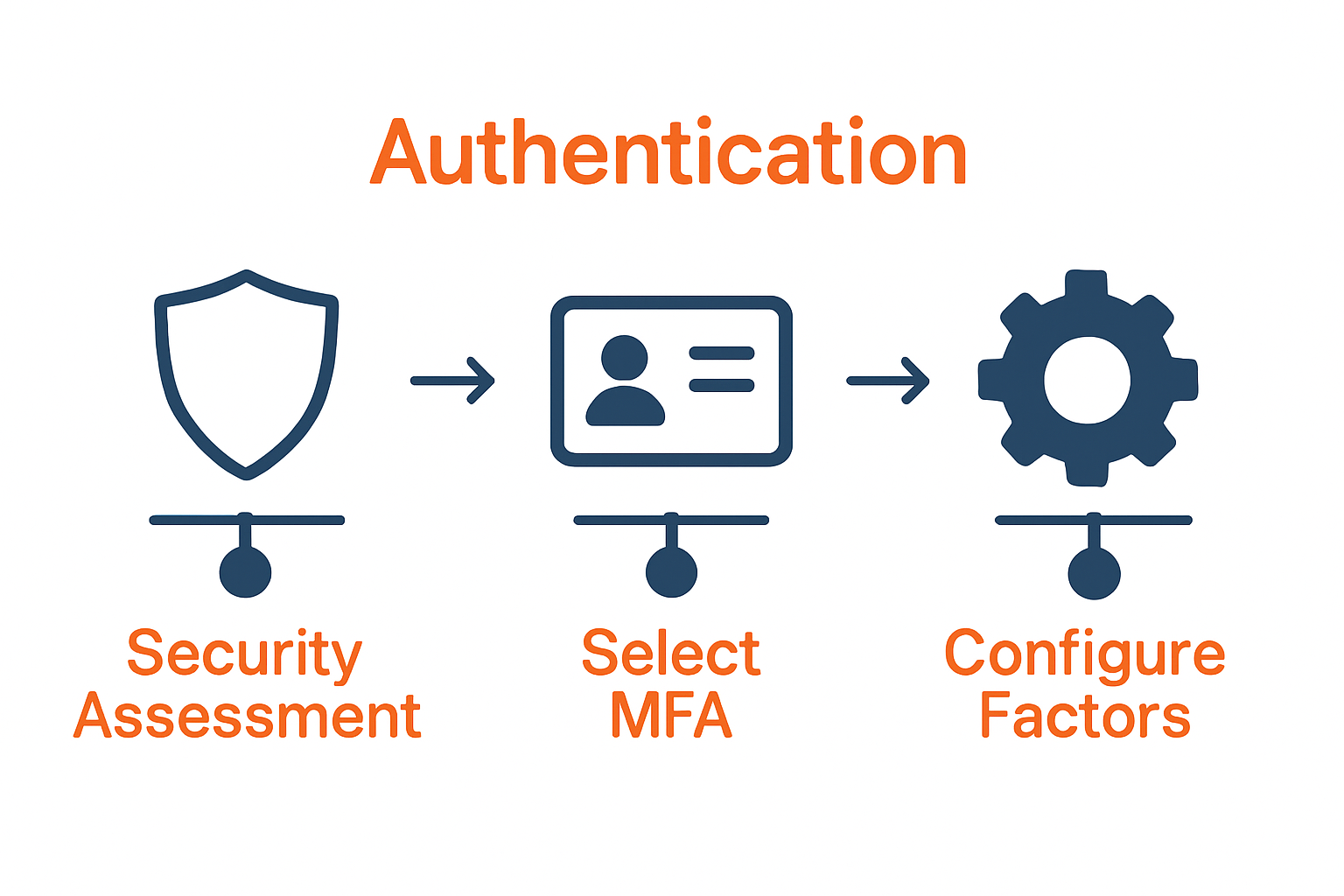
Step 1: Assess Security Requirements and Choose MFA Methods
Selecting the right multi-factor authentication methods requires strategic planning and a deep understanding of your organization’s unique security landscape. By carefully evaluating your specific security needs, you can implement robust authentication protocols that effectively protect sensitive data and minimize potential vulnerabilities.
To choose the most appropriate MFA methods, start by conducting a comprehensive security assessment. Research indicates that different authentication mechanisms offer varying levels of security strength. Carnegie Mellon University’s Information Security Office recommends ranking potential methods based on their resistance to common attacks. Some high-ranking authentication factors include biometric verification, hardware security keys, and time-based one-time passwords. When assessing your requirements, consider factors such as user accessibility, implementation complexity, potential user friction, and compatibility with existing systems.

Be cautious about over-complicating your authentication workflow. While advanced security measures are important, they should not create significant barriers for legitimate users. The goal is to strike a balance between robust protection and user experience. Your MFA strategy should adapt to your organization’s specific risk profile, considering elements like user roles, data sensitivity, and potential threat vectors. A nuanced approach that combines multiple authentication factors can provide comprehensive security without overwhelming your users.
Next, you’ll develop a detailed implementation strategy for your selected MFA methods.
Step 2: Configure Authentication Factors and User Access
Configuring authentication factors and managing user access are critical steps in establishing a robust multi-factor authentication system. Your goal is to create a secure yet flexible framework that protects sensitive information while maintaining user productivity and accessibility.
Begin by defining clear access control protocols that align with your organization’s specific security requirements. This involves mapping out user roles and permissions, ensuring that each team member has precisely the level of system access needed for their job responsibilities. Some key considerations include implementing principle of least privilege access, where users are granted minimal access rights necessary to perform their tasks. Systematically review and categorize user groups based on their security clearance levels, creating granular authentication pathways that prevent unauthorized system entry.
When selecting and configuring authentication factors, prioritize a combination of methods that balance security and usability. Consider integrating factors such as biometric verification, hardware security tokens, and adaptive authentication mechanisms that assess risk in real time. Be mindful of potential user friction point and aim to create a seamless authentication experience. A well-designed multi-factor authentication system should feel intuitive to users while maintaining rigorous security standards.
Next, you will validate and test your authentication configuration to ensure optimal performance and security.
Step 3: Integrate Multi-Factor Authentication Workflow into Systems
Integrating multi-factor authentication into your existing systems requires a strategic and methodical approach that balances security requirements with operational efficiency. Your primary objective is to create a seamless authentication workflow that protects critical infrastructure without disrupting user productivity.
Developing a robust cybersecurity implementation strategy involves carefully mapping out your organization’s technological ecosystem and identifying potential integration points. Begin by conducting a comprehensive audit of your current authentication mechanisms, analyzing each system’s compatibility with multi-factor authentication protocols. Focus on creating a standardized approach that can be consistently applied across different platforms and applications while maintaining flexibility for unique system requirements.
When implementing your multi-factor authentication workflow, prioritize user education and smooth transition management. Practical MFA solutions often succeed by combining technical implementation with comprehensive user training. Develop clear documentation and provide hands-on support to help users understand and adapt to the new authentication processes. Ensure that your implementation includes fallback mechanisms and support channels to address potential user challenges during the transition.
Next, you will validate and test the integrated multi-factor authentication workflow to ensure comprehensive security coverage.
Step 4: Test and Validate Authentication Workflow Functionality
Testing and validating your multi-factor authentication workflow is a critical step in ensuring the reliability and security of your system. This phase will help you identify potential vulnerabilities, verify the effectiveness of your authentication mechanisms, and confirm that your security implementation meets organizational standards.
Comprehensive testing protocols require a systematic approach that covers multiple scenarios and potential user interactions. Start by developing a detailed test plan that includes scenarios like successful authentication, failed authentication attempts, device registration, recovery processes, and edge cases such as network interruptions or temporary system failures. Simulate various user roles and access levels to ensure your multi-factor authentication workflow maintains consistent security across different user groups.
When conducting validation tests, pay close attention to user experience and system performance. Rigorous authentication workflow testing involves not just technical verification but also assessing the intuitiveness and responsiveness of your authentication processes. Create test scripts that cover both positive and negative authentication scenarios, ensuring that legitimate users can access systems quickly while simultaneously blocking unauthorized access attempts. Document any performance bottlenecks, user interface challenges, or security gaps discovered during testing.
Next, you will finalize your multi-factor authentication implementation based on test results and prepare for organization wide deployment.
Step 5: Monitor and Refine Security Processes Regularly
Continuous monitoring and refinement of your multi-factor authentication processes are essential for maintaining robust cybersecurity in an increasingly complex digital landscape. Your goal is to create a dynamic security strategy that adapts to emerging threats and technological advancements.
Proactive security monitoring requires establishing comprehensive tracking mechanisms that provide real-time insights into authentication patterns, potential vulnerabilities, and unusual access attempts. Implement automated logging and alert systems that can quickly identify suspicious activities, unauthorized access attempts, or deviations from standard authentication workflows. Regularly review authentication logs, analyze access patterns, and conduct thorough assessments of your current security infrastructure to identify potential weaknesses or areas for improvement.
Establish a systematic approach to security process refinement by developing a consistent review protocol that includes periodic security audits, user access reviews, and authentication method evaluations. Consider factors such as emerging technological capabilities, changes in organizational structure, and evolving cybersecurity threats when updating your multi-factor authentication strategies. Create a flexible framework that allows for quick adaptation of authentication protocols while maintaining stringent security standards.
Next, you will document and communicate your refined security processes to ensure organizational alignment and understanding.
Strengthen Your Security with Expert Multi-Factor Authentication Solutions
Mastering a multi-factor authentication workflow requires not only strategic planning but also powerful tools that simplify implementation while maximizing protection. This article highlights how balancing security needs with user experience is essential to safeguard sensitive data without causing disruption. If you want to move beyond manual configurations and complex setups, consider solutions designed for seamless integration, adaptive authentication, and continuous monitoring.

Take control of your organization’s identity security today by exploring LogMeOnce’s advanced MFA technologies. Our platform offers passwordless MFA options, encrypted cloud storage, and single sign-on capabilities that align perfectly with the secure authentication workflows discussed in the article. Do not wait to elevate your defenses against evolving cyber threats. Visit LogMeOnce to start your free trial and experience how effortless strong authentication can be.
Discover how to implement effective multi-factor authentication protocols and practical MFA solutions that protect your organization now.
Frequently Asked Questions
What factors should I consider when choosing multi-factor authentication methods?
Selecting multi-factor authentication methods requires evaluating your organization’s specific security needs. Focus on factors like user accessibility, implementation complexity, and compatibility with existing systems. Conduct a thorough security assessment to rank potential methods by their resistance to common attacks.
How can I ensure that my multi-factor authentication system is user-friendly?
To create a user-friendly multi-factor authentication system, balance security measures with user experience. Prioritize intuitive authentication factors, such as biometric verification or adaptive authentication, and provide training and support. Aim for a seamless experience that minimizes user friction while maintaining security.
What steps should I take to test my multi-factor authentication workflow?
Begin testing your multi-factor authentication workflow by developing a comprehensive test plan that includes various scenarios like successful and failed authentication attempts. Simulate different user roles to ensure consistent security across all user groups. Address any performance or usability issues found during testing.
How often should I monitor and refine my multi-factor authentication processes?
Regularly monitor and refine your multi-factor authentication processes to adapt to emerging threats and changes in your organization. Establish a system for periodic security audits and user access reviews, aiming to conduct these assessments at least every six months. This proactive approach will help you maintain strong security standards.
What is the principle of least privilege access in multi-factor authentication?
The principle of least privilege access means granting users the minimum level of access rights needed to perform their job tasks. Implementing this principle involves mapping out user roles and permissions, ensuring that sensitive data is only accessible by those who absolutely need it. Regularly review access levels to enforce this principle effectively.
How can user education enhance the effectiveness of a multi-factor authentication system?
User education enhances multi-factor authentication effectiveness by ensuring users understand the authentication processes and their importance. Provide clear documentation and training to help users adapt to new methods smoothly. As a result, you can reduce security incidents caused by user errors by about 30%.
Recommended


