


 Password Manager
 Identity Theft Protection

 Team / Business
 Enterprise
 Government
 MSP
MSP


TL;DR:
- Insider threat prevention requires a layered approach that combines data classification, access control, behavioral analytics, and governance structures. Most insider incidents are preventable through early detection, strict least-privilege policies, continuous monitoring, and cross-functional coordination involving security, HR, and legal teams. Shadow AI and human behavior signals are emerging challenges that organizations must address to effectively mitigate insider risks.
Insider threat prevention is defined as a multi-layered control strategy covering data classification, identity governance, behavioral monitoring, and coordinated incident response to stop harmful actions by employees, contractors, and non-human actors before damage occurs. Knowing how to prevent insider threats requires more than deploying a single tool. It demands a structured program that combines UEBA (User and Entity Behavior Analytics), DLP (Data Loss Prevention), Zero Trust architectures, and cross-functional governance. Critically, 80% of insider sabotage cases show observable behavioral warnings weeks or months before any harmful act. That statistic means most insider incidents are preventable if your detection and response systems are in place early enough.
How to prevent insider threats by classifying and protecting sensitive data
Data classification is the first and most foundational step in any insider threat mitigation program. You cannot protect what you have not identified. An effective prevention lifecycle follows six steps: data discovery, classification, least-privilege access, encryption, monitoring, and incident response planning. Each step builds on the previous one, so skipping data discovery means your monitoring tools are watching the wrong assets.
Why data discovery must include shadow IT and third-party apps
Most organizations underestimate how broadly their sensitive data is distributed. Employees routinely store files in personal Google Drive accounts, share documents through unapproved SaaS tools, and sync data to personal devices. A data discovery process that covers only sanctioned systems will miss a significant portion of your actual exposure. Tools like Microsoft Purview scan across cloud repositories, endpoints, and third-party connectors to surface data wherever it lives.
Once discovered, data needs a sensitivity taxonomy. A practical four-tier model works as follows:
- Public: No restrictions; marketing materials, published reports
- Internal: General business use; employee directories, internal memos
- Confidential: Limited distribution; financial forecasts, HR records, client contracts
- Restricted: Tightest controls; source code, cryptographic keys, regulated personal data
This taxonomy directly drives your access and encryption policies. Restricted data should trigger automatic encryption at rest and in transit, and access should require explicit approval rather than default inheritance. Protection rigor must match data sensitivity, which means a one-size-fits-all security posture will always leave your most critical assets either over-exposed or buried under unnecessary friction.
Pro Tip: Run a data discovery audit quarterly, not annually. Shadow IT grows faster than most security teams expect, and a stale inventory creates blind spots that insider threat programs cannot compensate for.
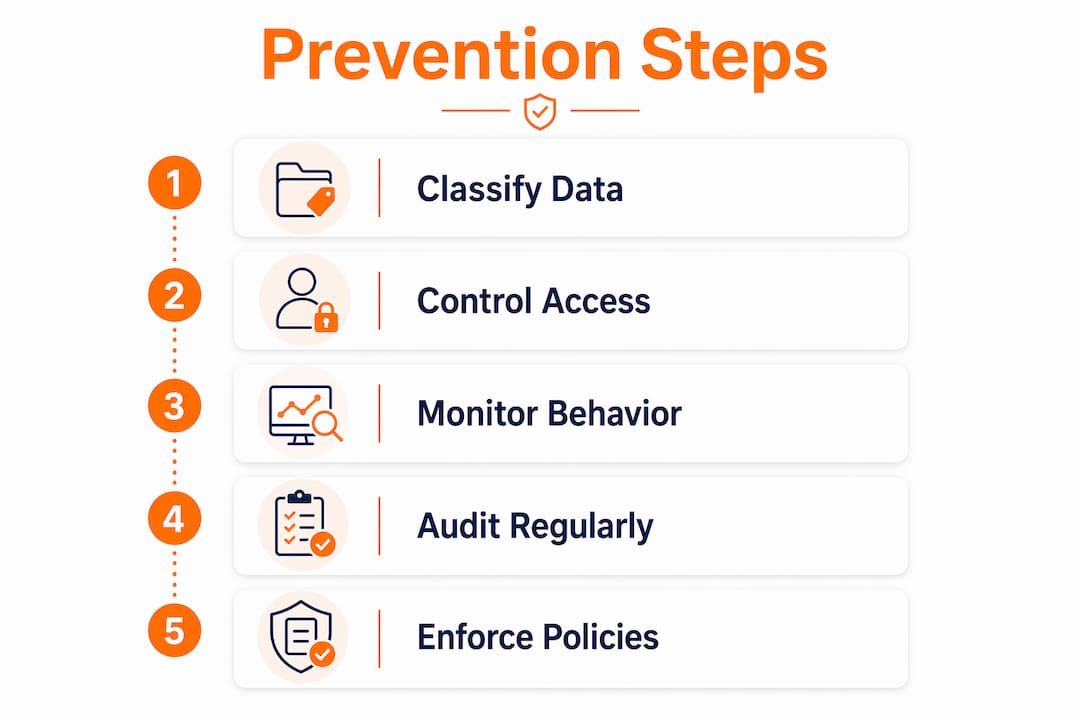
Classification also enables automated policy enforcement. When Microsoft Purview or a similar tool labels a document as Restricted, downstream DLP rules can automatically block email attachments, restrict printing, and require justification for downloads. This removes the human decision point that negligent or malicious insiders exploit.
What access control measures effectively limit insider threat risks
Access control is where insider threat mitigation moves from policy to enforcement. The principle of least privilege states that every user, service account, and application should hold only the permissions required to perform its specific function. In practice, most organizations accumulate permission creep over time: employees change roles, projects end, and access rights are never revoked. A quarterly access review cycle, enforced through an identity governance platform, directly addresses this drift.
The five access control measures that deliver the highest impact are:
- Least-privilege access assignments: Scope permissions to the minimum required for each role, reviewed and recertified every 90 days.
- Zero Trust architecture for internal users: Treat every access request as untrusted regardless of network location. LogMeOnce’s Zero Trust security model enforces continuous verification rather than relying on perimeter trust.
- Privileged Access Management (PAM) with just-in-time access: PAM with vaulting and just-in-time access prevents standing privileged sessions that insiders can exploit. Credentials are checked out for a defined window and automatically rotated afterward.
- Multi-factor authentication (MFA) on all critical systems: MFA blocks credential-based insider abuse and compromised-account scenarios. Passwordless MFA, which LogMeOnce supports natively, removes the shared-password risk entirely.
- Non-human identity governance: Non-human identities like service accounts and AI agents require the same least-privilege scoping, audit logging, and blast-radius isolation as human users. Ignoring machine identities is one of the fastest-growing gaps in insider risk programs.
| Control | Human insiders | Non-human identities |
|---|---|---|
| Least-privilege scoping | Role-based access reviews every 90 days | Scope service accounts to single-function permissions |
| MFA enforcement | Required on all privileged and sensitive-data access | API key rotation and certificate-based auth |
| Just-in-time access | PAM vaulting for admin credentials | Ephemeral tokens with automatic expiry |
| Audit logging | Full session recording for privileged users | Immutable logs for all API calls and agent actions |
Pro Tip: When auditing non-human identities, treat every service account with standing admin rights as a critical finding. Most were created for a one-time project and never decommissioned.
How behavioral analytics and continuous monitoring detect suspicious insider actions early
Behavioral analytics is the detection engine of any mature insider threat program. The approach works by establishing a baseline of normal behavior for each user and entity over a 30 to 90 day window, then flagging statistically significant deviations. A finance analyst who suddenly begins downloading bulk customer records at 11 PM on a Friday triggers an anomaly score even if their credentials are valid and their access is technically permitted.

Detection logic combining deterministic rules with heuristic signals balances early detection with manageable false positive rates. Deterministic rules fire on specific, unambiguous events: audit log clearing, mass file deletion, or disabling endpoint protection. Heuristic rules fire on patterns: a user accessing 10x their normal data volume, or logging in from a new geography immediately after a domestic session. Neither approach alone is sufficient. Deterministic rules miss novel behavior; heuristic rules generate noise without deterministic anchors.
| Detection type | Example trigger | Strength | Limitation |
|---|---|---|---|
| Deterministic | Audit log cleared | High precision | Misses novel tactics |
| Heuristic/behavioral | 10x normal download volume | Catches novel behavior | Higher false positive rate |
| Intent-aware | Negative sentiment in outbound email | Adds human context | Requires communication monitoring |
Modern UEBA platforms monitor exfiltration paths across email, web uploads, endpoint USB activity, and SaaS applications simultaneously. Correlating signals across multiple channels produces a risk score rather than a single alert, which dramatically reduces analyst fatigue. Behavioral analytics is shifting toward intent-aware detection that analyzes communication tone, sentiment, and entitlement context. A user who sends an angry resignation email and then begins downloading files to a personal cloud account presents a correlated risk profile that neither signal alone would surface.
Reducing unnecessary access to crown jewels shrinks the monitoring scope and improves program efficiency. When fewer users have access to your most sensitive data, behavioral anomalies in that population stand out more clearly and generate higher-confidence alerts. This is the shrink-the-blast-radius principle: limit access first, then monitor the smaller, higher-risk surface area with greater precision.
What governance structures and response strategies strengthen insider threat programs
Technology alone does not prevent insider threats. Cross-functional insider risk programs anchored in governance consistently outperform those relying solely on tools. An effective program requires a steering group that includes security operations, legal, HR, and business unit leaders operating under a clear RACI model. Security detects and investigates. HR manages the employment relationship. Legal advises on privacy compliance and evidence handling. Without this structure, investigations stall, evidence gets mishandled, and organizations face legal exposure from their own monitoring activities.
Key governance and response components include:
- Transparent monitoring policies: Employees should know that systems are monitored for security purposes. Covert monitoring without legal basis creates liability and destroys trust. Work with legal counsel to draft policies that are enforceable in your jurisdiction.
- CISA’s 4-step insider threat mitigation cycle: CISA’s framework covers identify, assess, manage, and respond. Using a recognized framework gives your program defensibility and a structured improvement path.
- Incident response plan with rehearsed playbooks: Incident response speed hinges on well-rehearsed plans that integrate legal and HR roles alongside security operations. Tabletop exercises that simulate a malicious insider exfiltrating data before resignation are far more effective than written plans that no one has practiced.
- Offboarding automation: Offboarding automation stops former employees’ access that frequently causes post-departure incidents. Access termination should trigger automatically on the HR system’s separation date, not when IT gets around to it.
- Staff training against threats: Regular training mitigates social engineering and negligent insider risk. Employees who understand phishing, credential sharing risks, and data handling expectations are both less likely to make costly mistakes and more likely to report suspicious colleague behavior.
Executive sponsorship is not optional. Programs without a C-suite champion struggle to get HR and legal cooperation, lack budget for proper tooling, and fail to enforce policies consistently across business units.
Key takeaways
Preventing insider threats requires a layered program combining data classification, least-privilege access, behavioral monitoring, and cross-functional governance, with no single control sufficient on its own.
| Point | Details |
|---|---|
| Start with data classification | Discover and label all sensitive data before configuring access or monitoring controls. |
| Shrink access before monitoring | Reduce who can reach crown jewels to make behavioral anomalies easier to detect. |
| Combine detection rule types | Use both deterministic and heuristic rules to balance precision and coverage. |
| Govern with cross-functional teams | Security, HR, and legal must operate under a shared RACI model for effective response. |
| Include non-human identities | Service accounts and AI agents need the same access controls and audit logging as human users. |
Why most insider threat programs fail before they start
The uncomfortable truth I have observed across many security program reviews is that organizations invest heavily in detection tools and almost nothing in the governance layer that makes those tools actionable. A UEBA platform generating 200 alerts per day is worthless if there is no process for triaging them, no HR partner to contextualize behavioral findings, and no legal counsel to advise on what evidence can be used in a termination or prosecution.
The second failure pattern I see consistently is treating insider risk as a purely technical problem. The behavioral warnings that precede sabotage are often visible to managers long before they appear in a SIEM dashboard. A manager who notices an employee becoming disengaged, expressing grievances, or suddenly working odd hours has information that no technical system captures. Bridging that human observation channel with your SOC is one of the highest-leverage improvements most programs can make.
The emerging challenge I am watching closely is shadow AI. Employees are connecting AI agents and automation tools to corporate systems without IT approval, creating non-human identities with broad data access and no monitoring coverage. This is the 2026 version of shadow IT, and most insider risk programs have not updated their threat models to account for it. If your program was designed before AI agents became mainstream workplace tools, your assumptions about what constitutes an insider need a serious review.
— Mike
Strengthen your insider threat defenses with LogMeOnce

LogMeOnce provides the identity and access control foundation that insider threat programs depend on. Its passwordless MFA, Zero Trust architecture, and single sign-on capabilities enforce least-privilege access and continuous verification across your entire user population, including contractors and remote employees. For organizations protecting sensitive information across cloud and on-premises environments, LogMeOnce’s cybersecurity solutions integrate directly with the access governance and monitoring workflows described in this guide. Explore the full platform to see how it supports your insider risk management strategy from credential control to encrypted cloud storage.
FAQ
What is the most effective first step to prevent insider threats?
Data discovery and classification is the most effective starting point. You cannot apply least-privilege access or targeted monitoring until you know where your sensitive data lives and how critical it is.
How does Zero Trust architecture reduce insider threat risk?
Zero Trust eliminates implicit trust for internal users by requiring continuous verification of identity and device posture for every access request. This means a compromised or malicious insider cannot move laterally using network location as a trust signal.
What behaviors indicate a potential insider threat?
Observable warning signs include bulk data downloads outside normal hours, accessing systems unrelated to job function, disabling security tools, and expressing significant workplace grievances. Correlating multiple signals produces higher-confidence risk scores than any single indicator.
How often should access reviews be conducted?
Access reviews should run on a 90-day cycle for standard users and monthly for privileged accounts. Quarterly reviews catch permission creep from role changes and project completions before it becomes a material risk.
Does staff training actually reduce insider threat incidents?
Yes. Regular training reduces negligent insider incidents by preparing employees to recognize social engineering, handle data correctly, and report suspicious behavior. Negligent insiders represent a significant share of total insider incidents, making training one of the highest-return controls available.
Recommended
- Professional IT Security Tips Everyone Can Benefit From
- 7 Business Cybersecurity Rules to Use in 2022 – LogMeOnce


