


 Password Manager
 Identity Theft Protection

 Team / Business
 Enterprise
 Government
 MSP
MSP


TL;DR:
- Authentication protocols verify user identities to secure digital resources, with selection impacting resistance to common attacks. Key protocols include Kerberos, OAuth 2.0 with OpenID Connect, SAML, and FIDO2/WebAuthn, each offering different trust models and security features. Implementing best practices like token validation, phishing-resistant MFA, and strict ticket policies ensures protocols deliver their intended security guarantees.
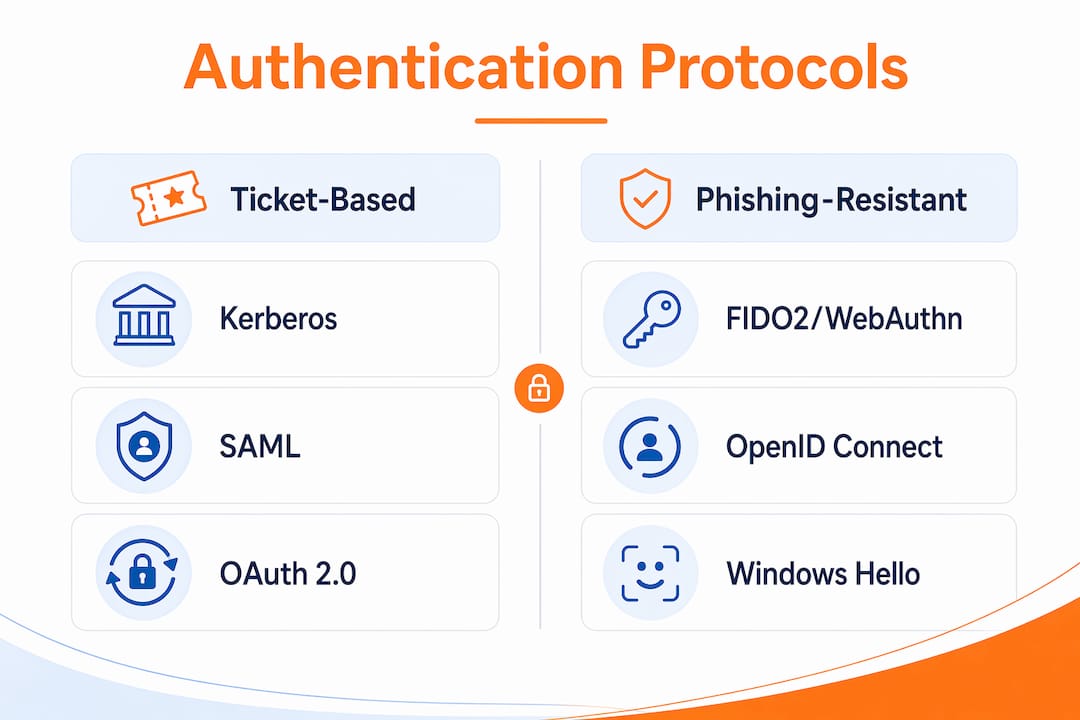
Authentication protocols are standardized frameworks that verify user or system identities to control access to digital resources. For IT professionals and security specialists, selecting the right protocol is not a preference exercise. It is a direct determinant of whether your systems resist credential theft, phishing, and session hijacking. The core types of authentication protocols in active enterprise use today include Kerberos, OAuth 2.0 with OpenID Connect (OIDC), SAML, and FIDO2/WebAuthn. Each operates on different trust models, token formats, and attack surfaces. Understanding those differences is what separates a secure implementation from a vulnerable one.
What are the main types of authentication protocols?
Authentication protocols are the mechanisms your infrastructure uses to confirm that a user, device, or service is who it claims to be before granting access. The four protocols below cover the majority of enterprise deployments.
Kerberos

Kerberos is a ticket-based protocol built around a Key Distribution Center (KDC). When a user authenticates, the KDC issues a Ticket Granting Ticket (TGT). That TGT is then exchanged for service tickets that grant access to specific resources, all without transmitting the user’s password across the network. Microsoft Active Directory relies on Kerberos as its default authentication mechanism, making it the backbone of most on-premises enterprise SSO environments. If you manage Windows domains, you are already running Kerberos whether you have explicitly configured it or not.
OAuth 2.0 and OpenID Connect
OAuth 2.0 is an authorization framework, not an authentication protocol. It enables limited access delegation, allowing a third-party application to act on a user’s behalf without exposing credentials. That distinction matters enormously in practice. When developers misuse OAuth access tokens as proof of identity, they introduce authentication bypass vulnerabilities that are notoriously difficult to detect during code review.
OpenID Connect solves this by adding an identity layer directly on top of OAuth 2.0. OIDC issues ID tokens specifically for login verification, separate from the access tokens used for API authorization. The ID token is a signed JWT containing claims about the authenticated user. The access token is for resource access. Treating them as interchangeable is one of the most common and consequential implementation errors in modern web applications.
SAML
Security Assertion Markup Language (SAML) is an XML-based protocol designed for federated authentication across organizational boundaries. An identity provider (IdP) such as Okta or Microsoft Entra ID issues signed XML assertions that a service provider (SP) trusts to grant access. SAML remains dominant in enterprise B2B SSO scenarios, particularly where legacy systems require it. Its verbosity and XML signature complexity introduce risks when assertion validation is implemented incorrectly, including signature wrapping attacks.
FIDO2/WebAuthn
FIDO2 combines WebAuthn and CTAP2 to deliver hardware-bound, phishing-resistant authentication. The private key never leaves the authenticator device, whether that is a YubiKey, a platform authenticator like Windows Hello for Business, or a passkey stored in a device’s secure enclave. Because authentication is bound to the origin domain, a FIDO2 credential registered at "login.example.comcannot be used on a phishing site atlogin-example.com`. That property alone makes FIDO2 categorically more resistant to credential phishing than any password or OTP-based method.
Pro Tip: When deploying FIDO2 for the first time, register at least two authenticators per user account. A single hardware key with no backup leaves users locked out if the device is lost, which drives helpdesk costs and tempts users to disable MFA entirely.
How do authentication protocols differ in security and attack resistance?
Choosing between protocols requires understanding not just what they do, but where each one breaks under adversarial conditions.
| Protocol | Phishing resistance | Token/ticket expiry | Primary attack surface |
|---|---|---|---|
| Kerberos | Moderate | Configurable TTL | Pass-the-ticket, Golden Ticket |
| OAuth 2.0 + OIDC | Low to moderate | Short-lived tokens recommended | Bearer token theft, code interception |
| SAML | Low to moderate | Assertion validity window | XML signature wrapping, replay |
| FIDO2/WebAuthn | High | Session-based | Physical device theft |
Kerberos tickets carry metadata including authTime, startTime, endTime, and renewal windows. Ticket lifetime and address binding directly affect how long a stolen ticket remains exploitable. A Golden Ticket attack, where an attacker forges TGTs using the KRBTGT account hash, can persist for years if ticket lifetimes are not enforced and the KRBTGT key is not rotated.
OAuth 2.0 bearer tokens grant access to any party holding them. There is no cryptographic binding between the token and the client that requested it. This means a token intercepted in transit or leaked from storage is immediately usable by an attacker. HTTPS is mandatory, but it is not sufficient on its own. Tokens must also be stored securely, scoped minimally, and expired aggressively.
Phishing-resistant authenticators like FIDO2 security keys and Windows Hello for Business represent the current ceiling of practical authentication security. Microsoft and NIST both endorse these methods for high-assurance scenarios. For organizations handling regulated data, the question is no longer whether to adopt phishing-resistant methods. It is how quickly you can deploy them at scale.
Pro Tip: SAML assertion replay attacks are preventable. Configure your service provider to reject assertions with duplicate assertion IDs within the validity window. Most IdPs generate unique IDs per assertion, but SP-side validation is your last line of defense.
What are best practices for implementing authentication protocols securely?
Protocol selection is only half the work. Implementation discipline determines whether your chosen protocol delivers its theoretical security guarantees.
-
Use Authorization Code with PKCE for all OAuth and OIDC flows. PKCE adds cryptographic binding that prevents authorization code interception attacks. It is mandatory in OAuth 2.1 and should be treated as mandatory in any new implementation today, regardless of whether the client is public or confidential.
-
Validate the correct token type. ID tokens prove identity. Access tokens prove authorization. Using an access token to verify a user’s identity is a documented path to authentication bypass. Your OIDC library should validate the ID token’s
iss,aud,exp, andnonceclaims on every login. -
Integrate phishing-resistant authenticators as a primary factor. NIST SP 800-63B defines AAL3 as requiring hardware-bound, phishing-resistant MFA. For systems handling sensitive data or privileged access, AAL3 is the target. Passkeys and FIDO2 security keys satisfy this requirement. TOTP apps and SMS codes do not.
-
Apply token rotation and revocation. Refresh tokens must rotate on each use. Revocation endpoints must be called on logout. A refresh token that persists indefinitely after a user logs out is an open session waiting to be exploited.
-
Map authentication methods to assurance levels explicitly. Define which methods satisfy primary authentication, which satisfy secondary factors, and which are acceptable for account recovery. Recovery flows are frequently the weakest link. An attacker who can reset your MFA via an email link has bypassed your entire authentication stack.
-
Audit Kerberos ticket policies in Active Directory. Default ticket lifetimes in many AD deployments are set to 10 hours with 7-day renewal windows. For privileged accounts, tighten these values and disable ticket renewal entirely. Combine this with monitoring for anomalous TGT requests from unusual source addresses.
How to evaluate and choose the right authentication protocol
No single protocol fits every environment. The right choice depends on your infrastructure, user population, and regulatory obligations.
Consider these factors before committing to a protocol or combination:
-
Existing infrastructure. Active Directory environments already run Kerberos. Extending that to cloud services via Azure AD or Microsoft Entra ID typically means adding OIDC or SAML rather than replacing Kerberos. Understand what your IdP natively supports before evaluating alternatives.
-
User population and device diversity. FIDO2 requires compatible authenticators. If your workforce includes contractors on unmanaged devices or users in regions where hardware keys are impractical, you need a fallback strategy. Single sign-on implementations that layer OIDC over existing directories often provide the best balance of security and usability at scale.
-
Required assurance level. Two-factor authentication requirements vary by system sensitivity. NIST SP 800-63B AAL2 requires two distinct factors. AAL3 requires hardware-bound phishing-resistant MFA. Map your systems to assurance levels before selecting protocols, not after.
-
Integration capability. SAML is the pragmatic choice when your SaaS vendors do not support OIDC. OAuth 2.0 with OIDC is the better long-term choice for new integrations given its JSON-based simplicity and wider developer tooling support.
-
Regulatory and audit requirements. HIPAA, FedRAMP, PCI-DSS, and SOC 2 each carry specific authentication control requirements. Some frameworks explicitly require phishing-resistant MFA for privileged access. Confirm your protocol choices satisfy the specific controls your auditors will test.
The separation of authentication from authorization is not just a conceptual nicety. Conflating the two in your architecture leads to access control gaps that are difficult to detect and expensive to remediate.
Key takeaways
Selecting and implementing the right authentication protocol requires matching protocol capabilities to your threat model, infrastructure, and assurance requirements rather than defaulting to the most familiar option.
| Point | Details |
|---|---|
| FIDO2 leads on phishing resistance | Hardware-bound credentials cannot be stolen via phishing, making FIDO2 the strongest available option for high-assurance access. |
| OAuth 2.0 is not an authentication protocol | Use OpenID Connect for identity verification; misusing OAuth access tokens as identity proof creates authentication bypass vulnerabilities. |
| Kerberos ticket policy matters | Tighten ticket lifetimes and disable renewal for privileged accounts to limit the window of exposure from stolen tickets. |
| PKCE is non-negotiable for OAuth/OIDC | Authorization Code with PKCE prevents code interception and is mandatory in OAuth 2.1 for all client types. |
| Assurance levels drive protocol selection | Map systems to NIST AAL1, AAL2, or AAL3 requirements before choosing protocols, not after deployment. |
Why implementation discipline beats protocol selection every time
After working through authentication architecture across dozens of enterprise environments, the pattern I keep seeing is this: organizations spend months debating which protocol to adopt and then deploy it with default settings, no token rotation, and recovery flows that bypass every control they just built.
The uncomfortable truth is that a well-implemented SAML deployment will outperform a poorly implemented FIDO2 rollout in practice. Protocol choice sets your ceiling. Implementation discipline determines where you actually land.
The shift toward passkeys is real and worth accelerating. But I have seen passkey rollouts fail because teams did not account for account recovery. When a user loses their device and the fallback is an SMS code, you have not deployed phishing-resistant authentication. You have deployed phishing-resistant authentication with a phishable escape hatch.
My strongest recommendation is to treat authentication as a continuous program, not a deployment project. Threat models change. New attack techniques emerge. The protocols that satisfied your compliance requirements in 2023 may not satisfy them in 2026. Build in quarterly reviews of your authentication stack, and make sure your team understands the difference between what a protocol promises and what your specific implementation actually delivers.
— Mike
Strengthen your authentication posture with Logmeonce
Logmeonce delivers the authentication controls that security teams actually need in production. The platform supports passwordless authentication using passkeys and FIDO2-compatible methods, alongside multi-factor authentication that maps to NIST assurance levels. For organizations managing identity across cloud services, SaaS applications, and on-premises systems, Logmeonce provides a unified layer that enforces consistent authentication policy without requiring protocol expertise from every end user. Explore the full range of cybersecurity solutions Logmeonce offers to see how the platform fits your existing infrastructure and compliance requirements.
FAQ
What is the difference between authentication and authorization protocols?
Authentication protocols verify identity. Authorization protocols determine what an authenticated identity is permitted to do. OAuth 2.0 is an authorization framework; OpenID Connect is the authentication layer built on top of it.
Which authentication protocol is most resistant to phishing?
FIDO2/WebAuthn is the most phishing-resistant protocol in common use. Credentials are cryptographically bound to the registered origin domain, so they cannot be used on spoofed sites.
When should you use SAML vs. OpenID Connect?
Use SAML when integrating with enterprise SaaS vendors that require it or with legacy identity providers. Use OpenID Connect for new integrations, mobile applications, and any scenario where JSON-based token handling is preferable to XML assertions.
What does PKCE add to OAuth 2.0 security?
PKCE adds a cryptographic code challenge that binds the authorization request to the token exchange, preventing authorization code interception attacks. It is required in OAuth 2.1 for all client types.
How does NIST SP 800-63B affect protocol selection?
NIST SP 800-63B defines three Authentication Assurance Levels. AAL2 requires two distinct factors; AAL3 requires hardware-bound phishing-resistant MFA such as FIDO2 security keys. Your protocol choices must satisfy the AAL required for each system you protect.


