


 Password Manager
 Identity Theft Protection

 Team / Business
 Enterprise
 Government
 MSP
MSP


Most American organizations face a growing challenge as sophisticated cyber threats evolve faster than ever. With over 60 percent of data breaches exploiting weak or stolen credentials, traditional security methods struggle to keep up. Adaptive authentication offers a smarter solution by adjusting protections in real time without disrupting legitimate user access. Discover how this advanced approach is reshaping the security landscape and why it is increasingly vital for protecting sensitive information.
Key Takeaways
| Point | Details |
|---|---|
| Adaptive Authentication Enhances Security | This approach adapts access protocols based on real-time risk assessments, reducing unauthorized access. |
| Behavioral Biometrics Improve Identity Verification | This method continuously analyzes user interaction patterns, making it difficult for imposters to replicate genuine behavior. |
| Machine Learning Optimizes Threat Detection | By analyzing historical data, it enhances recognition of anomalies, ensuring sophisticated responses to potential threats. |
| Implementation Requires Privacy Considerations | Organizations must balance security mechanisms with data privacy, ensuring compliance with global regulations. |
Adaptive Authentication Defined and How It Works
Adaptive authentication represents a sophisticated security approach that dynamically adjusts access protocols based on real-time risk assessments. Unlike traditional authentication methods that rely on static credentials, this intelligent system continuously evaluates multiple contextual factors during login attempts.
At its core, adaptive authentication operates by analyzing risk indicators across several critical dimensions. These indicators might include:
- Geographic location of login attempt
- Device type and hardware characteristics
- Network connection environment
- Time of access request
- User behavior patterns
- Historical login metadata
The system creates a comprehensive risk profile by cross-referencing these factors against established baseline behaviors. When unusual patterns emerge—such as accessing an account from a foreign country or using an unrecognized device—the authentication mechanism automatically escalates security requirements. This might involve requesting additional verification steps like multi-factor authentication, temporary account lockdown, or generating security alerts.
What makes adaptive authentication revolutionary is its ability to balance security with user experience. Instead of implementing blanket restrictions, the system intelligently calibrates access protocols. A trusted user logging from a familiar device receives minimal friction, while suspicious access attempts trigger more rigorous verification processes. This dynamic approach reduces unauthorized access risks while maintaining a seamless authentication experience for legitimate users.
Pro Tip: Implement Gradual Security Escalation: Configure your adaptive authentication system to use incremental verification steps, starting with low-friction challenges and progressively increasing complexity based on detected risk levels.
Types of Adaptive Authentication Methods
Adaptive authentication encompasses several sophisticated methods designed to dynamically enhance security protocols. Systematic research in mobile environments reveals multiple approaches that intelligently assess and respond to potential access risks.
Key adaptive authentication methods include:
- Behavioral Biometrics: Analyzes unique user interaction patterns such as typing speed, mouse movement, and device handling
- Contextual Risk Assessment: Evaluates login context including geographic location, device characteristics, and network environment
- Machine Learning-Based Authentication: Uses advanced algorithms to predict and detect anomalous access attempts
- Zero-Knowledge Proof Protocols: Enables secure verification without exposing sensitive user information, providing an innovative security mechanism
Behavioral biometrics represents a particularly advanced method. This approach creates a unique user profile by tracking subtle interaction characteristics that are nearly impossible to replicate. Unlike traditional authentication that relies solely on passwords or tokens, behavioral biometrics continuously validates user identity through ongoing interaction analysis.
Machine learning dramatically enhances these authentication methods by creating dynamic risk models. These intelligent systems can learn and adapt to evolving user behaviors, detecting potential security threats with unprecedented accuracy. By continuously analyzing historical data and real-time interactions, machine learning algorithms can identify subtle anomalies that might indicate unauthorized access attempts.
Pro Tip: Authentication Layer Strategy: Implement a multi-layered adaptive authentication approach that combines different methods, ensuring robust security while maintaining a smooth user experience.
Here’s how core adaptive authentication methods compare in deployment focus and benefits:
| Method | Primary Focus | Typical Use Case | Key Benefit |
|---|---|---|---|
| Behavioral Biometrics | User interaction analysis | Detecting impersonation attacks | Continuous identity validation |
| Contextual Risk Assessment | Environmental awareness | Flagging high-risk locations | Rapid anomaly response |
| Machine Learning-Based | Dynamic pattern recognition | High-volume access monitoring | Adaptive threat detection |
| Zero-Knowledge Proof Protocols | Privacy-centric validation | Identity verification without exposure | Enhanced data confidentiality |
Key Benefits for Organizations and Users
Adaptive authentication delivers transformative advantages for both organizational security infrastructure and individual user experiences. By continuously evaluating risk factors and dynamically adjusting authentication processes, these intelligent systems create a robust yet flexible security framework that addresses complex digital access challenges.
For organizations, the key benefits include:
- Reduced Security Breaches: Intelligent risk assessment minimizes unauthorized access attempts
- Compliance Optimization: Meets stringent regulatory requirements across multiple industry standards
- Operational Cost Reduction: Decreases expenses related to manual security monitoring and incident response
- Enhanced Threat Detection: Proactively identifies and mitigates potential security vulnerabilities
From an individual user perspective, adaptive authentication dramatically improves the access experience. Traditional security models often create friction through rigid, uniform authentication requirements. In contrast, adaptive systems recognize individual user patterns, allowing seamless access for trusted users while implementing additional verification for suspicious activities.
Two-factor authentication strategies complement adaptive authentication by providing an additional layer of security. These methods work synergistically to create a comprehensive security ecosystem that balances robust protection with user convenience. Machine learning algorithms continuously refine risk assessment models, ensuring that authentication processes become increasingly sophisticated and accurate over time.
Pro Tip: Adaptive Authentication Calibration: Regularly review and fine-tune your adaptive authentication parameters to maintain an optimal balance between security strictness and user accessibility.
Comparing Adaptive and Traditional Authentication
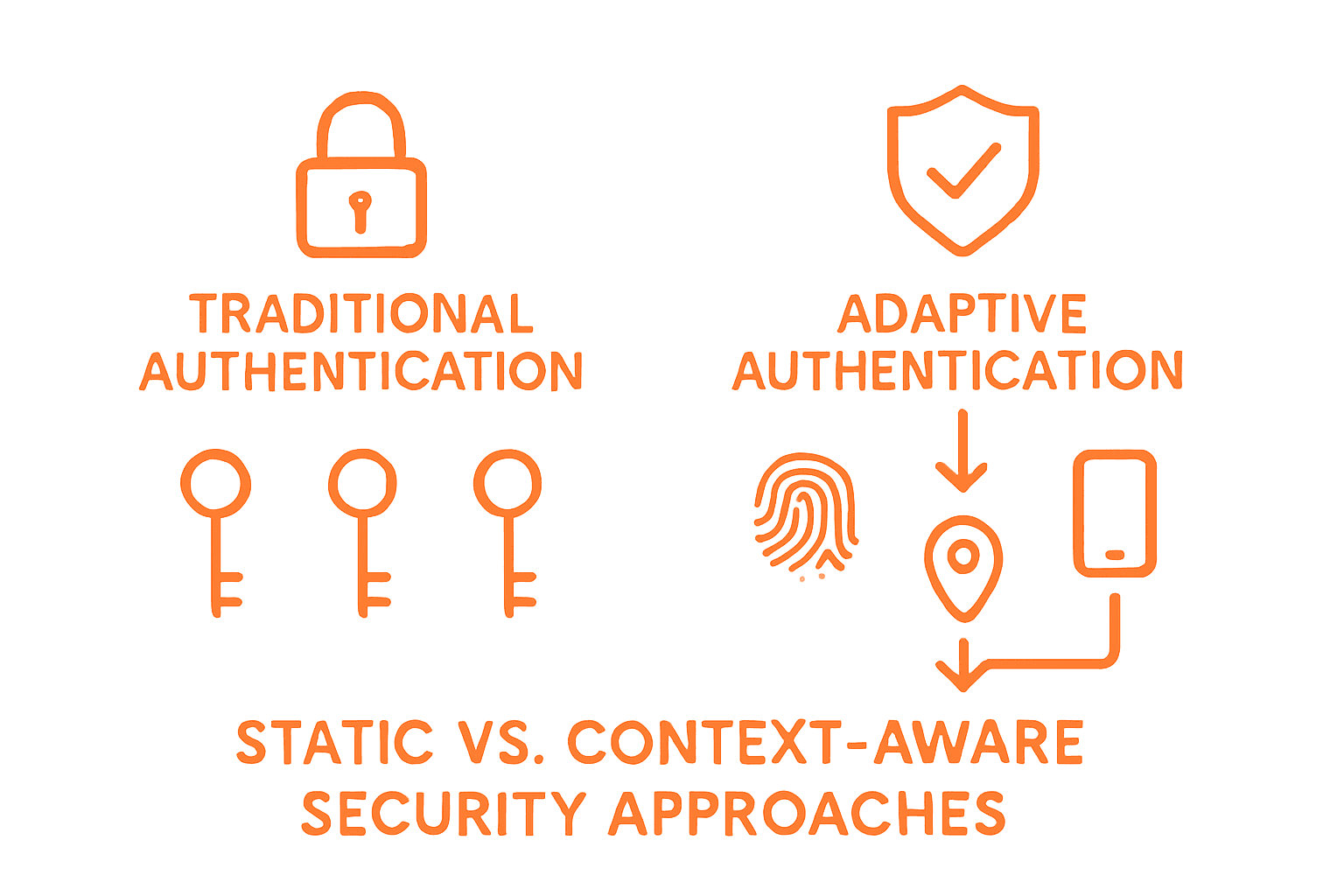
Traditional authentication relies on static, unchanging security protocols that demand uniform verification across all access attempts. By continuously analyzing user behavior and contextual factors, adaptive authentication represents a revolutionary approach to digital security that dynamically responds to potential risks.
Key differences between traditional and adaptive authentication include:
-
Authentication Flexibility
- Traditional: Fixed verification process
- Adaptive: Dynamic, context-aware verification
-
Risk Assessment
- Traditional: Binary accept/reject mechanism
- Adaptive: Nuanced risk scoring and graduated responses
-
User Experience
- Traditional: Uniform, often friction-filled access
- Adaptive: Personalized, low-friction authentication
-
Security Approach
- Traditional: One-size-fits-all security model
- Adaptive: Intelligent, behavior-based protection
Traditional authentication methods typically require identical verification steps for every login attempt, regardless of user context or historical behavior. This rigid approach creates unnecessary friction for trusted users while providing minimal additional security. Adaptive authentication, in contrast, intelligently evaluates multiple contextual signals such as device characteristics, geographic location, time of access, and historical usage patterns.

Cybersecurity awareness strategies complement adaptive authentication by helping organizations understand the evolving threat landscape. Machine learning algorithms continuously refine risk assessment models, enabling the system to distinguish between legitimate access attempts and potential security threats with unprecedented accuracy. This intelligent approach allows for seamless authentication for trusted users while implementing additional verification layers for suspicious activities.
Pro Tip: Authentication Transition Strategy: Gradually implement adaptive authentication alongside existing systems, using parallel tracking to validate and optimize the new security approach before full deployment.
Risks, Limitations, and Implementation Challenges
Adaptive authentication introduces sophisticated security mechanisms that also present unique implementation challenges. Privacy concerns emerge during the collection of sensitive user data, requiring organizations to develop comprehensive strategies that balance security with individual privacy protections.
Primary risks and limitations include:
-
Data Privacy Risks
- Extensive behavioral tracking
- Potential misuse of personal interaction data
- Compliance challenges with global privacy regulations
-
Technical Implementation Challenges
- Complex machine learning model development
- High computational resource requirements
- Accuracy and false positive management
-
User Experience Limitations
- Potential authentication friction
- Learning curve for new verification methods
- Perception of intrusive security measures
Implementation complexities in adaptive authentication systems demand a nuanced approach that considers multiple technological and human factors. Organizations must carefully design algorithms that can accurately distinguish between legitimate user behaviors and potential security threats without creating unnecessary access barriers.
Machine learning models require continuous training and refinement to maintain effectiveness. This involves developing sophisticated algorithms capable of understanding complex user interaction patterns while simultaneously protecting against emerging cyber threats. The most successful implementations incorporate privacy-enhancing technologies like differential privacy, which allows for robust risk assessment without compromising individual user data integrity.
This table summarizes major organizational and user challenges in adaptive authentication, with suggested strategies:
| Challenge Category | Example Issue | Suggested Strategy |
|---|---|---|
| Data Privacy | Sensitive user data exposure | Apply privacy-preserving technologies |
| Technical | Model training requirements | Use modular, scalable machine learning |
| User Experience | Perceived verification friction | Introduce context-based challenge levels |
| Compliance | Regulatory alignment | Regular compliance reviews |
Pro Tip: Risk Mitigation Strategy: Develop a phased implementation plan that includes pilot testing, continuous monitoring, and iterative algorithm refinement to address potential adaptive authentication challenges.
Enhance Your Security with Adaptive Authentication from LogMeOnce
Facing the challenge of balancing strong security with smooth user access is a common concern. This article highlights the power of adaptive authentication in dynamically verifying identity based on risk factors like location, device, and behavior. If you want to reduce unauthorized access without frustrating your users with constant hurdles, it is time to explore smarter, context-aware security solutions.
At LogMeOnce, we understand these pain points and offer a comprehensive suite to safeguard your digital identity. Our advanced multi-factor authentication combined with passwordless options and encrypted cloud storage empowers you to protect your organization proactively while keeping user experience seamless. Discover how our machine learning-enabled security adapts to threats in real time, giving you peace of mind and operational efficiency.

Take control of your secure access now with LogMeOnce. Visit LogMeOnce today to start your free trial and experience adaptive authentication that evolves with your needs. Learn more about how our identity management solutions can transform your cybersecurity posture and deliver flexible plans tailored for individuals, businesses, and government agencies.
Frequently Asked Questions
What is adaptive authentication?
Adaptive authentication is a security method that adjusts access protocols based on real-time risk assessments, analyzing various contextual factors during login attempts.
How does adaptive authentication improve user experience?
Adaptive authentication minimizes friction for trusted users by providing seamless access while requiring additional verification for suspicious activities, enhancing overall user experience.
What are some key benefits of implementing adaptive authentication?
Key benefits include reduced security breaches, compliance optimization, operational cost reduction, and enhanced threat detection, creating a robust security framework for organizations.
How does adaptive authentication differ from traditional authentication methods?
Unlike traditional authentication, which uses fixed verification processes, adaptive authentication employs dynamic, context-aware verification that adjusts based on the risk level of each access attempt.
Recommended
- Enterprise Password Management | Identity Management| LogMeOnce
- Consumer Top Features – LogMeOnce
- Enterprise Password Management – LogMeOnce


