


 Password Manager
 Identity Theft Protection

 Team / Business
 Enterprise
 Government
 MSP
MSP


Most American businesses are adopting cloud services at a rapid pace, yet over 60 percent underestimate the risks of unsecured data. As digital operations expand, organizations of every size face growing threats from hackers and costly data breaches. Understanding cloud encryption is not just a technical detail. It is a crucial defense that helps safeguard sensitive information against evolving cyber risks and protects your business’s reputation from potential damage.
Key Takeaways
| Point | Details |
|---|---|
| Importance of Cloud Encryption | Cloud encryption is essential for protecting sensitive data against unauthorized access and potential breaches. Organizations face significant financial and reputational risks from data breaches, making robust encryption strategies critical. |
| Types of Encryption | Understanding the differences between symmetric and asymmetric encryption is key for selecting appropriate security measures. Advanced techniques like homomorphic encryption can enhance confidentiality while allowing data processing. |
| Key Management Practices | Effective management of encryption keys is crucial for maintaining robust security. Regular audits, access controls, and key rotation help minimize vulnerabilities. |
| Compliance with Regulations | Organizations must develop encryption strategies that meet various regulatory standards like HIPAA and GDPR to ensure data privacy and protect sensitive information from unauthorized access. |
What Is Cloud Encryption and Why It Matters
Cloud encryption transforms sensitive digital information into an unreadable format, creating a critical shield against unauthorized access and potential data breaches. When organizations store data across remote servers, they expose themselves to significant cybersecurity risks. By implementing robust encryption strategies, businesses can protect their most valuable digital assets from malicious actors and potential vulnerabilities.
At its core, cloud encryption works by converting readable data into encoded text using complex mathematical algorithms. Cloud cryptography provides a sophisticated mechanism for securing information transmitted over internet networks, ensuring that even if intercepted, the data remains incomprehensible to unauthorized parties. The encryption process involves sophisticated key management systems that control who can decrypt and access the original information, adding multiple layers of security protection.
The importance of cloud encryption extends far beyond simple data protection. Modern enterprises face increasingly complex cybersecurity challenges, with data breaches potentially costing millions in financial losses and reputational damage. Research exploring cryptography’s role in cloud computing emphasizes its critical function in maintaining data confidentiality, integrity, and regulatory compliance. Organizations across industries increasingly rely on encryption as a fundamental strategy to safeguard sensitive information, whether it involves financial records, personal data, or proprietary business intelligence.
Pro Tip: Implement a comprehensive encryption strategy that includes both data-at-rest and data-in-transit protection, ensuring your cloud storage remains secure across all potential vulnerability points.
Types of Cloud Encryption Methods Explained
Cloud encryption methods provide sophisticated strategies for protecting digital information across various computing environments. These techniques serve as critical defenses against potential cybersecurity threats, ensuring data remains secure during storage and transmission. Researchers have identified multiple encryption approaches that address different security requirements in cloud computing systems.
Two primary categories of cloud encryption emerge as foundational protection mechanisms: symmetric key encryption and asymmetric key encryption. Symmetric key encryption utilizes a single shared secret key for both encryption and decryption processes, making it faster and more computationally efficient. Asymmetric key encryption, alternatively, uses separate public and private keys, providing enhanced security by allowing different keys for encoding and accessing information. This method introduces additional complexity that makes unauthorized access significantly more challenging.
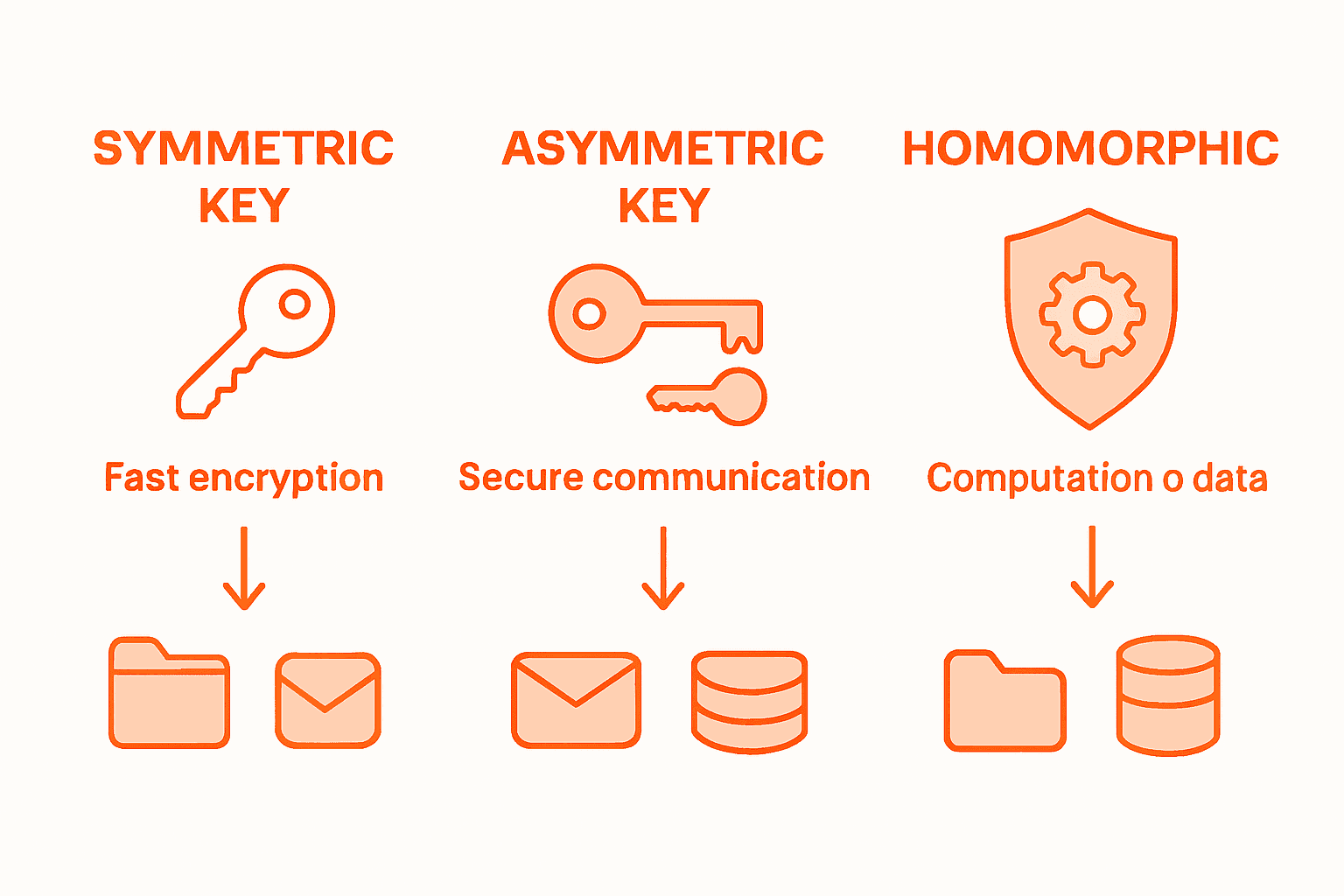
Beyond traditional encryption methods, advanced techniques like homomorphic encryption are gaining prominence in cloud security strategies. Homomorphic encryption enables computational processing on encrypted data without decrypting it, allowing organizations to perform complex analyses while maintaining complete data confidentiality. Organizations across industries increasingly rely on these sophisticated encryption methods to protect sensitive information from potential breaches and unauthorized access.
Pro Tip: Select encryption methods that align with your specific security requirements, considering factors like computational overhead, key management complexity, and the sensitivity of your stored data.
Here’s a concise comparison of common cloud encryption methods and their typical business applications:
| Encryption Method | Key Security Benefit | Typical Use Case |
|---|---|---|
| Symmetric Key | Fast, efficient processing | Large-scale data storage |
| Asymmetric Key | Enhanced access control | Secure external sharing |
| Homomorphic | Enables encrypted computation | Confidential analytics & reporting |
How Cloud Encryption Works in Practice
Cloud encryption transforms raw data into an unreadable format through sophisticated mathematical algorithms, creating a robust defense mechanism for digital information. Cryptosystems designed for cloud database security employ multiple layers of protection to ensure comprehensive data confidentiality, making it extremely challenging for unauthorized individuals to access sensitive information.

The practical implementation of cloud encryption involves several critical steps. First, data undergoes initial transformation using complex encryption keys that convert readable information into scrambled code. These encryption processes can occur at multiple stages: during data transmission, while information is stored, and when it is being accessed. Secure data sharing techniques enable organizations to collaborate effectively while maintaining strict security protocols, utilizing advanced cryptographic methods like Key-Aggregate Cryptosystem that allow controlled and secure information exchange.
Key management represents a crucial component of cloud encryption practices. Organizations must carefully generate, distribute, store, and rotate encryption keys to maintain optimal security levels. This involves creating robust key hierarchies, implementing strict access controls, and establishing comprehensive key lifecycle management protocols. Advanced encryption frameworks now incorporate artificial intelligence and machine learning algorithms to detect potential vulnerabilities and automatically adjust encryption strategies in real time.
Pro Tip: Regularly audit and rotate encryption keys, implementing multi-factor authentication for key access to minimize potential security breaches and maintain robust protection mechanisms.
Compliance, Data Privacy, and Regulations
Cloud encryption has become a critical component of modern data privacy strategies, with organizations facing increasingly complex regulatory landscapes. Systematic reviews of cryptography techniques highlight the intricate challenges surrounding information security in cloud computing environments, demonstrating the critical need for robust protection mechanisms that satisfy diverse regulatory requirements.
Different industries and regions enforce unique data protection standards that demand sophisticated encryption approaches. Healthcare organizations must comply with HIPAA regulations, financial institutions navigate stringent PCI-DSS requirements, and global companies must adhere to comprehensive frameworks like GDPR. Advanced security management schemes now incorporate emerging technologies such as blockchain and digital twins to enhance key management reliability and resist potential security breaches, providing multilayered protection that goes beyond traditional encryption methods.
Effective compliance strategies require organizations to implement comprehensive data governance frameworks that address multiple dimensions of security. This involves developing clear policies for data classification, establishing strict access controls, maintaining detailed audit trails, and creating transparent mechanisms for data handling and protection. Modern encryption solutions must not only protect information but also provide verifiable evidence of compliance, enabling organizations to demonstrate their commitment to regulatory standards and protecting sensitive information from unauthorized access.
Pro Tip: Conduct regular compliance audits, mapping your encryption strategies against specific regulatory requirements to ensure comprehensive protection and minimize potential legal vulnerabilities.
This table summarizes key regulatory frameworks influencing cloud encryption strategies:
| Regulation | Industry Focus | Primary Encryption Requirement |
|---|---|---|
| HIPAA | Healthcare | Protect patient records confidentiality |
| PCI DSS | Finance | Encrypt cardholder data at all stages |
| GDPR | All sectors | Ensure data privacy and explicit consent |
Risks, Limitations, and Security Best Practices
Cloud encryption, while powerful, presents complex challenges that organizations must carefully navigate. Comparative studies evaluating encryption methods reveal significant trade-offs between security performance and computational efficiency, highlighting the nuanced landscape of cloud data protection strategies.
Key risks in cloud encryption include potential performance bottlenecks, key management complexity, and vulnerability to sophisticated cyber attacks. Advanced security frameworks now emphasize fine-grained access control mechanisms that empower users with robust encryption capabilities, addressing critical vulnerabilities in traditional security approaches. Organizations must implement multi-layered defense strategies that go beyond simple encryption, incorporating continuous monitoring, threat detection, and adaptive security protocols.
Best practices for cloud encryption demand a holistic approach that balances technical sophistication with practical implementation. This includes developing comprehensive key management strategies, implementing strong authentication protocols, regularly updating encryption algorithms, and maintaining detailed audit trails. Critical security measures involve creating redundant encryption layers, using advanced cryptographic techniques like homomorphic encryption, and establishing clear incident response protocols that minimize potential data exposure risks.
Pro Tip: Conduct regular security assessments, performing comprehensive penetration testing and encryption vulnerability scans to identify and address potential weaknesses before they can be exploited by malicious actors.
Comparing Cloud Encryption to Other Approaches
Cloud encryption represents a sophisticated evolution beyond traditional data protection methods, offering advanced capabilities that address modern cybersecurity challenges. Comparative studies of homomorphic and searchable encryption schemes reveal significant innovations in cloud computing security approaches, demonstrating the increasingly nuanced landscape of data protection technologies.
Traditional encryption methods typically rely on static key systems that require complete data decryption for processing, creating inherent security vulnerabilities. In contrast, cloud encryption introduces dynamic, intelligent protection mechanisms. Advanced homomorphic encryption techniques enable secure data processing without compromising privacy, allowing computational operations directly on encrypted information, a breakthrough that fundamentally transforms how organizations manage sensitive digital assets.
Key differences between cloud encryption and traditional approaches include computational efficiency, scalability, and granular access control. While legacy encryption systems often create significant performance bottlenecks, modern cloud encryption methods incorporate intelligent algorithms that minimize processing overhead. These advanced approaches integrate machine learning, adaptive security protocols, and sophisticated key management systems that provide comprehensive protection across diverse computing environments.
Pro Tip: Evaluate encryption solutions based on their ability to balance security complexity with performance efficiency, prioritizing methods that offer robust protection without introducing substantial computational constraints.
Strengthen Your Cloud Encryption Strategy with LogMeOnce
In an era where data breaches and unauthorized access threaten your organization’s integrity, implementing robust cloud encryption is no longer optional. As the article highlights, the complexities of managing encryption keys and securing data both at rest and in transit demand innovative solutions that go beyond traditional approaches. If protecting sensitive information such as financial records, personal data, and proprietary business intelligence feels overwhelming, LogMeOnce offers advanced security tools designed specifically to make cloud encryption seamless and effective.
Whether you need to simplify multi-factor authentication, enforce strong passwordless identity management, or secure your cloud storage with encrypted solutions, our suite delivers. Take control with features tailored for businesses, government agencies, and individual users who cannot afford to compromise on security. Discover how integrating intelligent encryption methods and streamlined access controls can help you mitigate risks while maintaining operational efficiency.

Ready to elevate your cloud security and protect your data from evolving cyber threats? Explore our comprehensive cybersecurity offerings today at LogMeOnce. Dive deeper into the latest in secure identity management and cloud encryption, and experience the difference with our free trials and flexible plans. Your data’s safety is just a click away—visit LogMeOnce Solutions and start securing your cloud environment now.
Frequently Asked Questions
What is cloud encryption and why is it important?
Cloud encryption is the process of converting sensitive data into an unreadable format to protect it from unauthorized access and cyber threats. It safeguards valuable digital assets when stored on remote servers, reducing the risks of data breaches and ensuring compliance with regulations.
What are the main types of cloud encryption methods?
The primary types of cloud encryption methods are symmetric key encryption and asymmetric key encryption. Symmetric key encryption uses a single shared key for both encryption and decryption, while asymmetric key encryption employs a public and private key pair, enhancing security with separate keys for encoding and access.
How does cloud encryption work in practice?
Cloud encryption works by using complex mathematical algorithms to transform readable data into scrambled code during data transmission, storage, and access. Key management plays a crucial role, involving the generation, distribution, and rotation of encryption keys to ensure robust data protection.
What best practices should organizations follow for cloud encryption?
Organizations should implement a comprehensive approach to cloud encryption that includes robust key management strategies, strong authentication protocols, regular updates of encryption algorithms, and continuous security assessments. Establishing incident response protocols and maintaining detailed audit trails are also critical for minimizing data exposure risks.
Recommended
- 5 Reasons Cloud Encryption is Important for Every Business
- Cloud Data Storage FAQs: Can the Cloud Be Hacked? – LogMeOnce
- How to Protect Your Information While Using the Cloud – LogMeOnce
- Encryption for Cloud Storage – LogMeOnce


