


 Password Manager
 Identity Theft Protection

 Team / Business
 Enterprise
 Government
 MSP
MSP


More than 80 percent of American companies report gaps in cloud application security that leave sensitive data vulnerable. IT managers in mid-sized enterprises face rising pressure to protect information and control user access in complex environments. This guide uncovers how Cloud Access Security Brokers empower organizations to resolve data protection challenges with clear visibility, adaptive controls, and risk reduction strategies tailored for modern business demands.
Key Takeaways
| Point | Details |
|---|---|
| CASB Role | Cloud Access Security Brokers (CASBs) provide essential visibility and control over cloud applications, safeguarding organizations against unauthorized access and data breaches. |
| Deployment Models | There are three primary CASB deployment models: API-Based, Forward Proxy, and Reverse Proxy, each tailored to specific cloud security challenges. |
| Key Features | CASBs enhance security by offering comprehensive threat mitigation, data protection, and real-time monitoring capabilities. |
| Challenges | While effective, CASBs may face limitations such as deployment constraints and visibility gaps, necessitating a multi-layered security approach. |
Defining Cloud Access Security Broker Solutions
A Cloud Access Security Broker (CASB) represents a sophisticated security solution strategically positioned between enterprise users and cloud service providers. Cloud security brokers serve as comprehensive policy enforcement points designed to protect organizations navigating complex cloud environments.
CASB solutions provide enterprises with critical security capabilities across multiple dimensions. These include advanced features like:
- Authentication management
- Credential mapping
- Data encryption
- Comprehensive malware detection
- Granular cloud usage controls
- Risk visibility tracking
The primary objective of a CASB is to deliver robust visibility and control over cloud application usage. By establishing a centralized security checkpoint, these solutions enable organizations to monitor, manage, and secure cloud interactions effectively. They support flexible security enforcement across diverse cloud platforms, helping IT managers mitigate potential risks associated with unauthorized applications and devices.

Pro tip: Prioritize CASB solutions that offer real-time monitoring and adaptive policy enforcement to maximize your cloud security posture.
Types of CASB Deployment Models Explained
Cloud Access Security Brokers (CASBs) offer multiple deployment models that cater to diverse organizational security needs. Deployment models range from API-based approaches to sophisticated proxy configurations, each designed to address specific cloud security challenges.
Three primary CASB deployment models exist:
- API-Based CASB
- Connects directly to cloud service APIs
- Scans and assesses data retrospectively
- Provides compliance monitoring
- Ideal for sanctioned application security
- Forward Proxy CASB
- Intercepts and routes user traffic in real-time
- Enforces immediate security policies
- Protects data during cloud interactions
- Offers direct traffic inspection
- Reverse Proxy CASB
- Acts as an intermediary between users and cloud services
- Enforces contextual access controls
- Implements policy enforcement invisibly
- Provides seamless security integration
Organizations must carefully evaluate their infrastructure and security requirements when selecting a CASB deployment model. Cloud security strategies often involve hybrid approaches that combine multiple deployment techniques to maximize protection and visibility.
Here’s a side-by-side comparison of CASB deployment models and their ideal use cases:
| Deployment Model | Security Focus | Typical Use Case |
|---|---|---|
| API-Based | Retrospective data scan | Protecting sanctioned cloud services |
| Forward Proxy | Real-time traffic control | Safeguarding managed devices |
| Reverse Proxy | Contextual access control | Integrating seamless user access |
Pro tip: Conduct a comprehensive assessment of your cloud environment before selecting a CASB deployment model to ensure optimal security coverage and minimal operational disruption.
Key Features and How CASBs Work
Cloud Access Security Brokers (CASBs) represent sophisticated security solutions designed to protect organizational cloud environments. CASB functionality encompasses a comprehensive range of security mechanisms that monitor, control, and protect cloud service interactions.
The core operational features of CASBs include several critical security capabilities:
-
Visibility and Monitoring
- Track sanctioned and unsanctioned cloud application usage
- Detect potential shadow IT risks
- Provide granular insights into cloud service interactions
-
Data Protection
- Implement advanced encryption techniques
- Utilize data tokenization strategies
- Prevent unauthorized data transfers
- Enforce sensitive information protection
-
Threat Prevention
- Leverage sophisticated anomaly detection algorithms
- Identify potential security vulnerabilities
- Generate real-time threat alerts
- Prevent unauthorized access attempts
CASBs integrate seamlessly with existing identity management solutions like Identity and Access Management (IAM) and Single Sign-On (SSO) platforms. This integration enables organizations to establish robust, context-aware security policies that adapt to evolving cloud computing landscapes. By combining multiple deployment strategies and advanced security mechanisms, CASBs provide comprehensive protection against increasingly complex cloud-based security challenges.
This summary highlights core CASB features and their business value:
| CASB Feature | Business Impact | Integration Consideration |
|---|---|---|
| Usage Visibility | Reduces shadow IT risks | Requires detailed cloud mapping |
| Data Protection | Safeguards sensitive information | Encryption standards compatibility |
| Threat Prevention | Minimizes breach likelihood | Advanced analytics necessary |
Pro tip: Regularly update and fine-tune your CASB policies to maintain optimal security coverage and adapt to emerging cloud technology trends.
Essential Security Benefits and Use Cases
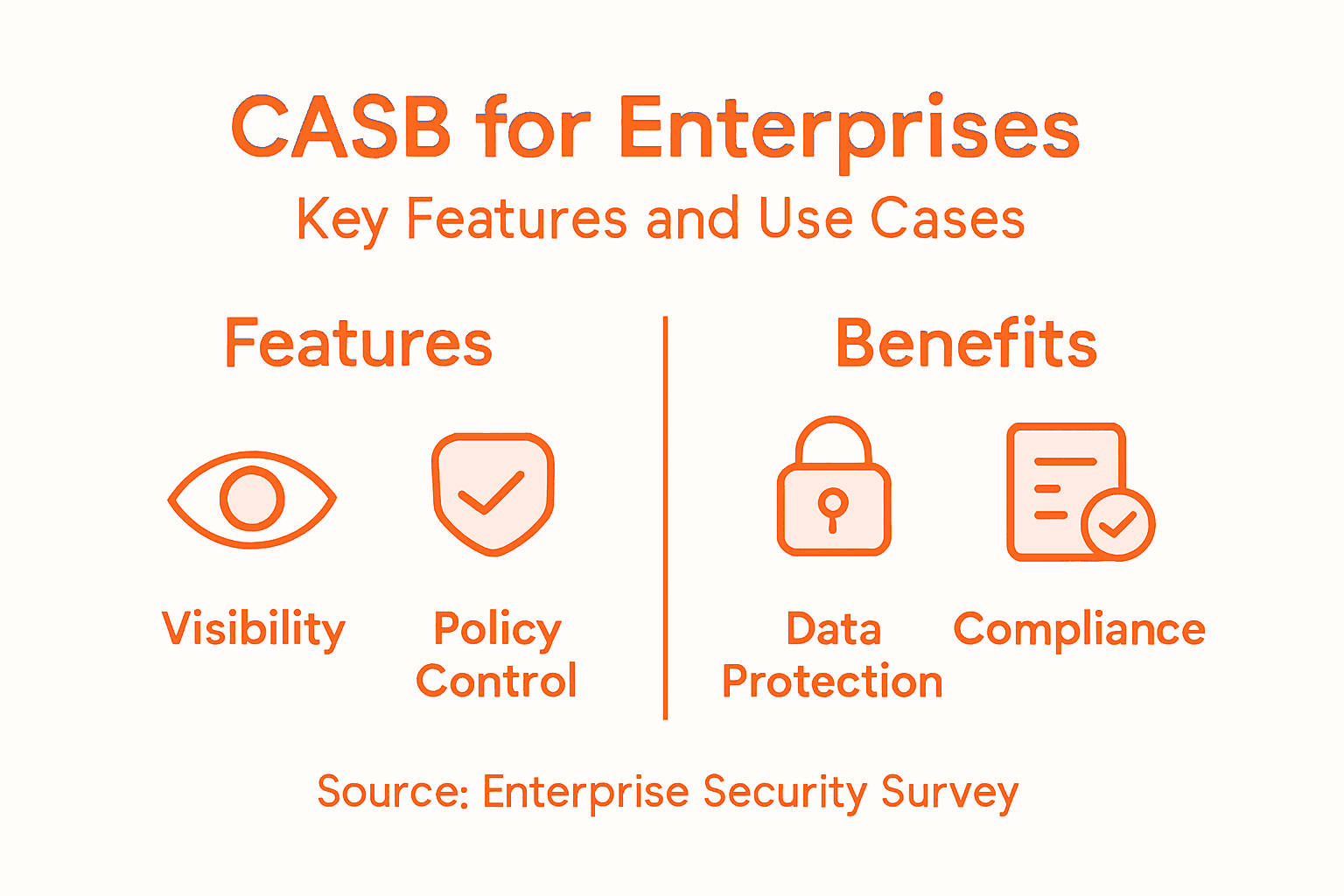
Cloud Access Security Brokers (CASBs) deliver critical security advantages for enterprises navigating complex cloud environments. Cloud security strategies enable organizations to enforce comprehensive protection across diverse technological landscapes.
The primary security benefits of CASBs include:
-
Comprehensive Threat Mitigation
- Protection against cyberattacks
- Defense against insider threats
- Prevention of operational security errors
- Real-time threat detection and response
-
Compliance and Governance
- Support for ISO 27001 standards
- Validation of user permissions
- Encryption of sensitive data transmissions
- Comprehensive audit trail generation
-
Operational Resilience
- Continuous monitoring of cloud interactions
- Adaptive security policy enforcement
- Cross-platform security integration
- Reduced vulnerability exposure
Enterprises can leverage CASBs to address critical security challenges across various use cases, including remote workforce management, multi-cloud environments, and complex regulatory compliance requirements. By providing granular visibility and control, CASBs transform cloud security from a reactive approach to a proactive, intelligence-driven strategy.
Pro tip: Conduct regular comprehensive security assessments to ensure your CASB implementation aligns with evolving organizational needs and emerging threat landscapes.
Risks, Limitations, and Integration Pitfalls
Cloud Access Security Brokers (CASBs) are powerful security solutions, but they come with inherent challenges that organizations must carefully navigate. CASB solution limitations expose critical vulnerabilities that demand strategic mitigation approaches.
Key risks and limitations include:
-
Deployment Model Constraints
- Forward proxy CASBs cannot govern unmanaged devices
- Reverse proxy solutions fail to prevent data exposure on unsanctioned apps
- API scanners lack comprehensive malicious activity prevention
-
Visibility and Coverage Gaps
- Incomplete management of shadow SaaS applications
- Limited tracking across managed and unmanaged devices
- Inconsistent real-time monitoring capabilities
- Potential blind spots in complex cloud environments
-
Integration Challenges
- Complex configuration requirements
- Potential performance overhead
- Compatibility issues with existing security infrastructure
- Difficulty maintaining consistent policy enforcement
Enterprise security teams must adopt a multi-layered approach to overcome these limitations. This involves supplementing CASB solutions with additional security controls, conducting regular comprehensive assessments, and maintaining flexible, adaptive security strategies that can evolve with changing technological landscapes.
Pro tip: Implement a hybrid security approach that combines CASB technologies with complementary security tools to address potential coverage gaps and minimize vulnerability exposures.
Strengthen Your Enterprise Cloud Security with LogMeOnce Solutions
Understanding the complexities of Cloud Access Security Broker (CASB) solutions is key to overcoming challenges like shadow IT, risky cloud access, and compliance demands. This article highlights the need for real-time visibility, adaptive policy enforcement, and seamless integration with identity management systems—all critical pain points for enterprises striving to protect sensitive data and prevent unauthorized cloud usage.
At LogMeOnce, we offer a comprehensive cybersecurity suite designed to address these exact challenges. Our solutions combine passwordless multi-factor authentication, secure single sign-on, and cloud encryption to empower organizations with the granular control and threat prevention capabilities described in the CASB framework. By bridging identity security and cloud protection, LogMeOnce helps eliminate risks from unmanaged devices and shadow SaaS applications.
Ready to transform your cloud security posture and gain full control over your enterprise environment?

Explore powerful, easy-to-implement cybersecurity tools tailored for your needs at LogMeOnce. Discover how our platform complements CASB strategies by enhancing access management and data protection. Start your free trial today to secure your cloud access and prevent costly breaches before they happen.
Learn more about achieving robust cloud security with Cloud Access Security Broker insights and take the first step toward proactive defense.
Frequently Asked Questions
What is a Cloud Access Security Broker (CASB)?
A Cloud Access Security Broker (CASB) is a security solution that acts as a mediator between enterprise users and cloud service providers, enforcing security policies and protecting organizational data in cloud environments.
What are the main types of CASB deployment models?
The three primary CASB deployment models are API-Based CASB, Forward Proxy CASB, and Reverse Proxy CASB. Each model offers different strengths, such as retrospective data scanning, real-time traffic control, and contextual access control.
How do CASBs enhance data protection in the cloud?
CASBs enhance data protection through advanced encryption techniques, data tokenization strategies, and policies that prevent unauthorized data transfers, thereby safeguarding sensitive information from breaches and unauthorized access.
What are some common risks and limitations of CASB solutions?
Common risks and limitations of CASB solutions include deployment model constraints, visibility and coverage gaps, and integration challenges with existing security infrastructure, which can sometimes lead to incomplete security coverage.
Recommended
- 5 Reasons Cloud Encryption is Important for Every Business
- How an Enterprise Password Manager Augments Efficiency and Security
- The Finesses of Enterprise Password Management


