


 Password Manager
 Identity Theft Protection

 Team / Business
 Enterprise
 Government
 MSP
MSP


Nearly one in three American organizations reported a phishing incident last year, proving that no business, no matter how prepared, is immune to clever attacks. For IT managers juggling multiple responsibilities across continents, recognizing the true scope of phishing is more critical than ever. This guide clears up common myths and exposes how modern social engineering puts even technically skilled teams at risk, providing fresh insights to strengthen your business’s defense.
Key Takeaways
| Point | Details |
|---|---|
| Understanding Phishing | Phishing is a sophisticated cyber attack exploiting human psychology to steal sensitive information through deceptive communication techniques. |
| Common Misconceptions | Many individuals mistakenly believe they can easily identify phishing attempts, underestimating the psychological manipulation involved. |
| Types of Phishing | Major phishing attack types include Business Email Compromise, Credential Theft, Spear Phishing, Vishing, and Smishing, each targeting different vulnerabilities. |
| Prevention Strategies | Organizations should implement multi-factor authentication, conduct regular phishing simulations, and establish clear incident reporting protocols to enhance security. |
Phishing Defined and Common Misconceptions
Phishing represents a sophisticated cyber attack strategy designed to deceive individuals into revealing sensitive personal or organizational information through manipulative communication techniques. Unlike traditional hacking methods that rely on technical vulnerabilities, phishing exploits human psychology and social engineering principles.

Phishing attacks have become increasingly complex, with cybercriminals developing nuanced psychological manipulation tactics. The National Institute of Standards and Technology (NIST) describes these attacks as escalating threats that depend critically on tricking users through seemingly legitimate communication channels. Most phishing attempts occur via email, but modern strategies now include text messages, social media platforms, and even phone calls.
Common misconceptions about phishing frequently undermine organizational security. Many professionals mistakenly believe they can easily identify fraudulent communications, but research demonstrates that even technologically savvy individuals can be susceptible. Key misconceptions include:
- Believing only unsophisticated users fall for phishing attempts
- Assuming all suspicious emails are obvious or easily recognizable
- Thinking personal or business email accounts are inherently secure
- Underestimating the psychological sophistication of modern phishing techniques
By understanding these misconceptions and implementing comprehensive security awareness training, organizations can significantly reduce their vulnerability to these deceptive attacks. Continuous education and practical simulation exercises help employees develop critical threat detection skills.
Pro tip: Implement regular phishing simulation training that exposes employees to realistic but controlled mock phishing scenarios to enhance their real-world threat recognition capabilities.
Major Types of Phishing Attacks Today
Phishing attacks have evolved into sophisticated strategies targeting businesses and individuals through multiple complex channels. Cybercriminals continuously adapt their techniques to exploit technological vulnerabilities and human psychology, making these attacks increasingly challenging to detect and prevent.
The most prevalent phishing attack types include:
- Business Email Compromise (BEC)
- Attackers impersonate trusted executives or business partners
- Target financial departments and payment authorization processes
- Often involve sophisticated social engineering techniques
- Credential Theft Attacks
- Focus on stealing login information for critical systems
- Utilize fake login pages that mirror legitimate websites
- Frequently target email, banking, and cloud storage platforms
- Spear Phishing
- Highly personalized attacks targeting specific individuals
- Leverage detailed personal information to appear credible
- Often discovered through meticulously crafted communications
- Voice Phishing (Vishing)
- Utilize phone calls to manipulate victims
- Impersonate technical support, government agencies, or financial institutions
- Exploit emotional manipulation and perceived authority
- Smishing
- Text message based phishing attempts
- Use urgent or alarming language to prompt immediate action
- Frequently include malicious links or request sensitive information
Understanding these attack vectors allows organizations to develop robust defense strategies that anticipate and neutralize potential threats before they cause significant damage.
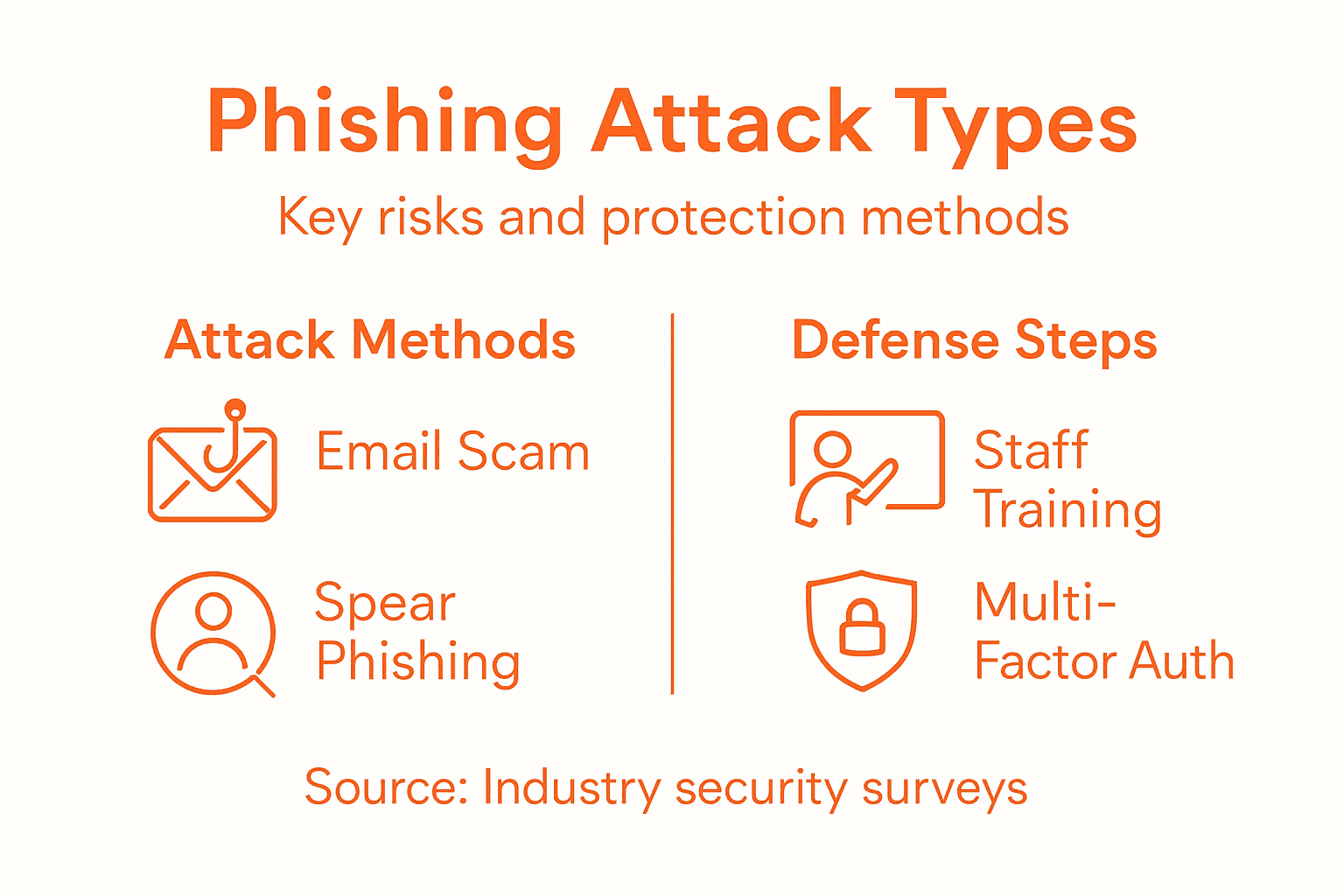
Here is a summary comparing the major phishing attack types and their primary business impacts:
| Attack Type | Primary Target | Main Tactic | Business Impact |
|---|---|---|---|
| BEC | Finance teams | Executive impersonation | Financial fraud, lost funds |
| Credential Theft | Employees & users | Fake login sites | Data breaches, account compromise |
| Spear Phishing | Decision makers | Personalized messages | Sensitive info exposure, reputational harm |
| Vishing | Employees | Phone manipulation | Unauthorized access, disrupted operations |
| Smishing | Mobile users | Malicious texts | Mobile compromise, privacy loss |
Pro tip: Implement multi-layered security awareness training that includes real-world simulation scenarios covering each type of phishing attack to enhance employee threat recognition skills.
How Phishing Works in Real-World Scenarios
Phishing attacks exploit human psychology through carefully orchestrated scenarios designed to manipulate victims into taking immediate, often irrational actions. User interaction patterns reveal critical vulnerabilities that cybercriminals systematically target across various communication channels.
A typical phishing scenario might unfold like this:
Initial Contact Strategies
- An email appears to be from a trusted organization (bank, employer, tech support)
- The message creates a sense of urgency or fear
- Includes a seemingly legitimate link or attachment
Psychological Manipulation Techniques
- Impersonates authority figures or trusted institutions
- Triggers emotional responses like panic or curiosity
- Presents seemingly urgent action requirements
Typical Attack Progression
- Deception Phase
- Craft a convincing message mimicking official communication
- Use logos, language, and formatting that appear authentic
- Exploit current events or institutional contexts
- Interaction Phase
- Prompt user to click a link or download an attachment
- Redirect to fake login pages or malware download sites
- Collect credentials or install malicious software
- Exploitation Phase
- Steal login credentials
- Access sensitive financial or personal information
- Potentially launch broader network infiltration
Real-world attacks often target specific sectors with tailored approaches. Educational institutions, financial services, and healthcare organizations face particularly sophisticated phishing campaigns that exploit institutional trust and complex communication networks.
Pro tip: Develop a personal protocol of independently verifying urgent communications through alternative contact methods before taking any requested actions.
Warning Signs and Attack Techniques to Watch For
Phishing attacks continuously evolve, leveraging sophisticated psychological manipulation techniques that make detection increasingly challenging. Complex phishing indicators emerge across communication channels that require constant vigilance and strategic awareness from cybersecurity professionals.
Critical Warning Signs of Potential Phishing Attempts
-
Urgent or Threatening Language
- Demands immediate action
- Creates artificial time pressure
- Suggests negative consequences for inaction
-
Suspicious Sender Information
- Email addresses with slight misspellings
- Domains that appear similar to legitimate organizations
- Generic sender names without specific identifiers
-
Unexpected Communication Patterns
- Unsolicited requests for sensitive information
- Messages from unknown or unverified sources
- Communications outside normal business protocols
Technical Red Flags in Digital Communications
- URL Anomalies
- Shortened or masked web links
- Misspelled domain names
- Unusual top-level domain extensions
- Attachment Risks
- Unexpected file attachments
- Executable files with unusual extensions
- Compressed files from unknown sources
- Email Header Inconsistencies
- Mismatched sender information
- Routing addresses that seem irregular
- Inconsistent metadata
Cybercriminals increasingly utilize multiple communication platforms, including email, SMS, social media, and messaging apps, to maximize their potential attack surface. Understanding these intricate techniques allows organizations to develop robust defense mechanisms that anticipate and neutralize potential threats.
Pro tip: Implement a zero-trust verification protocol where employees independently confirm unexpected communications through alternate verified communication channels before taking any requested actions.
Risks, Legal Liabilities, and Prevention Strategies
Phishing attacks represent more than technical security breaches they pose significant financial, legal, and reputational risks for organizations. Systematic mitigation strategies are critical for comprehensive protection that address both technological vulnerabilities and human factors.
Financial and Legal Consequences
- Potential direct monetary losses from fraudulent transactions
- Costs associated with incident response and system recovery
- Potential regulatory fines for inadequate cybersecurity practices
- Potential legal liability for compromised customer or employee data
- Significant reputational damage impacting future business relationships
Comprehensive Prevention Strategies
- Technical Defensive Measures
- Implement multi-factor authentication
- Deploy advanced email filtering systems
- Use protective DNS configurations
- Enforce strict application allow-listing
- Maintain updated security software
- Organizational Policy Development
- Create clear incident reporting protocols
- Establish mandatory cybersecurity training programs
- Develop comprehensive breach response plans
- Implement zero-trust security frameworks
- Regular security audits and vulnerability assessments
- Human-Centered Risk Mitigation
- Continuous employee cybersecurity awareness training
- Simulated phishing exercise programs
- Reward and recognition for security-conscious behavior
- Develop a culture of skeptical communication verification
- Encourage transparent reporting of potential security incidents
Successful phishing prevention requires a holistic approach that integrates technological solutions, strategic organizational policies, and continuous human education. No single defensive strategy can provide complete protection against evolving cyber threats.
The following table outlines key prevention strategies and how each strengthens organizational security:
| Prevention Measure | Focus Area | Security Benefit |
|---|---|---|
| Multi-factor Authentication | Technical | Blocks unauthorized access |
| Phishing Simulations | Human | Improves threat recognition |
| Zero-Trust Framework | Policy | Minimizes risk of trust abuse |
| Incident Reporting Protocols | Organizational | Enables rapid response to breaches |
Pro tip: Implement quarterly phishing simulation exercises that test and improve employee threat detection skills while maintaining a supportive, learning-focused environment.
Strengthen Your Defense Against Phishing Threats Today
Phishing attacks are evolving and exploiting human psychology to breach your business data. As this article highlights, sophisticated techniques like Business Email Compromise and credential theft can cause financial losses and reputational damage. Protecting your organization means addressing technical vulnerabilities and enhancing employee awareness through multi-factor authentication, encrypted cloud storage, and continuous security education.

Discover how LogMeOnce’s comprehensive cybersecurity solutions help you prevent phishing threats before they impact your business. With features like passwordless MFA, dark web monitoring, and single sign-on, you can secure your digital identity and reduce the risk of unauthorized access. Don’t wait for an attack to happen take control now by exploring LogMeOnce’s powerful security suite and start your journey toward stronger data protection today.
Frequently Asked Questions
What is phishing, and how does it impact businesses?
Phishing is a cyber attack strategy that deceives individuals into revealing sensitive information through manipulative communication, primarily exploiting human psychology. It can lead to financial loss, data breaches, and significant reputational damage for businesses.
How can I identify phishing attempts in emails?
Look for urgent or threatening language, suspicious sender information, unexpected requests for sensitive data, and technical red flags like URL anomalies and mismatched email headers. Always verify unexpected communications through alternate methods.
What types of phishing attacks should businesses be aware of?
Common types include Business Email Compromise (BEC), credential theft attacks, spear phishing, voice phishing (vishing), and smishing (text message phishing). Each of these exploits different vulnerabilities and targets within an organization.
What measures can organizations implement to prevent phishing attacks?
Organizations should adopt comprehensive prevention strategies like multi-factor authentication, regular employee cybersecurity training, phishing simulation exercises, advanced email filtering, and a zero-trust security framework.
Recommended
- blogs – LogMeOnce
- 7 Cyber Threats That Target Small Business – LogMeOnce
- 8 Data Security Tips Every Business Owner Should Know
- SOS: What to Do After a Data Breach – LogMeOnce


