


 Password Manager
 Identity Theft Protection

 Team / Business
 Enterprise
 Government
 MSP
MSP


More than 60 percent of successful data breaches involve credentials first leaked on the dark web. For American IT security managers, this stark reality highlights how critical it is to monitor underground networks that fuel cybercrime across continents. This guide shows how to uncover risk exposure, choose dark web monitoring tools, and build rapid response frameworks that help protect your enterprise before digital threats escalate.
Quick Summary
| Key Insight | Explanation |
|---|---|
| 1. Conduct Regular Risk Assessments | Quarterly evaluations of dark web exposure help identify vulnerabilities before they can be exploited by attackers. |
| 2. Choose Effective Monitoring Tools | Select tools that integrate well with existing systems and offer real-time alerts for potential threats on the dark web. |
| 3. Integrate Alerts into Security Operations | Use SOAR platforms to correlate alerts, streamline incident response, and improve overall threat management. |
| 4. Analyze Alerts Thoroughly | Systematic verification of alerts ensures focused resources are applied only to genuine threats, enhancing security effectiveness. |
| 5. Maintain Proactive Incident Response | Implementing AI-driven protocols for immediate action minimizes damage and strengthens defenses against future incidents. |
Step 1: Assess organizational risk exposure
Assessing your organization’s dark web risk exposure is about uncovering potential vulnerabilities before attackers exploit them. This systematic evaluation helps you understand which sensitive information might already be circulating in underground digital marketplaces.
Start by conducting a comprehensive risk identification process that involves multiple strategic layers. Your goal is to map out potential entry points where corporate credentials, intellectual property, or sensitive data could be compromised. This means scanning dark web forums, marketplaces, and encrypted communication channels where cybercriminals trade stolen information. Modern tools can automate this process by monitoring these platforms for specific company identifiers like email domains, IP ranges, or brand mentions.
Your risk assessment should focus on quantifying potential damage and prioritizing response strategies. Emerging threats like AI-powered attacks have made this process more complex, requiring advanced threat intelligence techniques. Look for indicators such as leaked employee credentials, mentions of your organization, or discussions about potential exploitation strategies. Cross reference these findings with your current security infrastructure to identify potential weaknesses.
Pro tip: Schedule quarterly dark web risk assessments to stay ahead of evolving cybersecurity threats and maintain a proactive security posture.
Step 2: Select and configure dark web monitoring tools
Selecting the right dark web monitoring tools is critical for protecting your organization’s digital assets and detecting potential security breaches before they escalate. Your goal is to choose solutions that provide comprehensive threat intelligence and seamless integration with your existing security infrastructure.

Begin by evaluating enterprise dark web monitoring solutions that offer robust data collection capabilities. Look for tools that can automatically scan multiple dark web channels like forums, marketplaces, and encrypted communication platforms. These tools should provide real time alerts for specific indicators such as company email domains, leaked credentials, and mentions of your organization. Key selection criteria include automation features, integration with Security Information and Event Management (SIEM) systems, and the ability to generate actionable intelligence quickly.
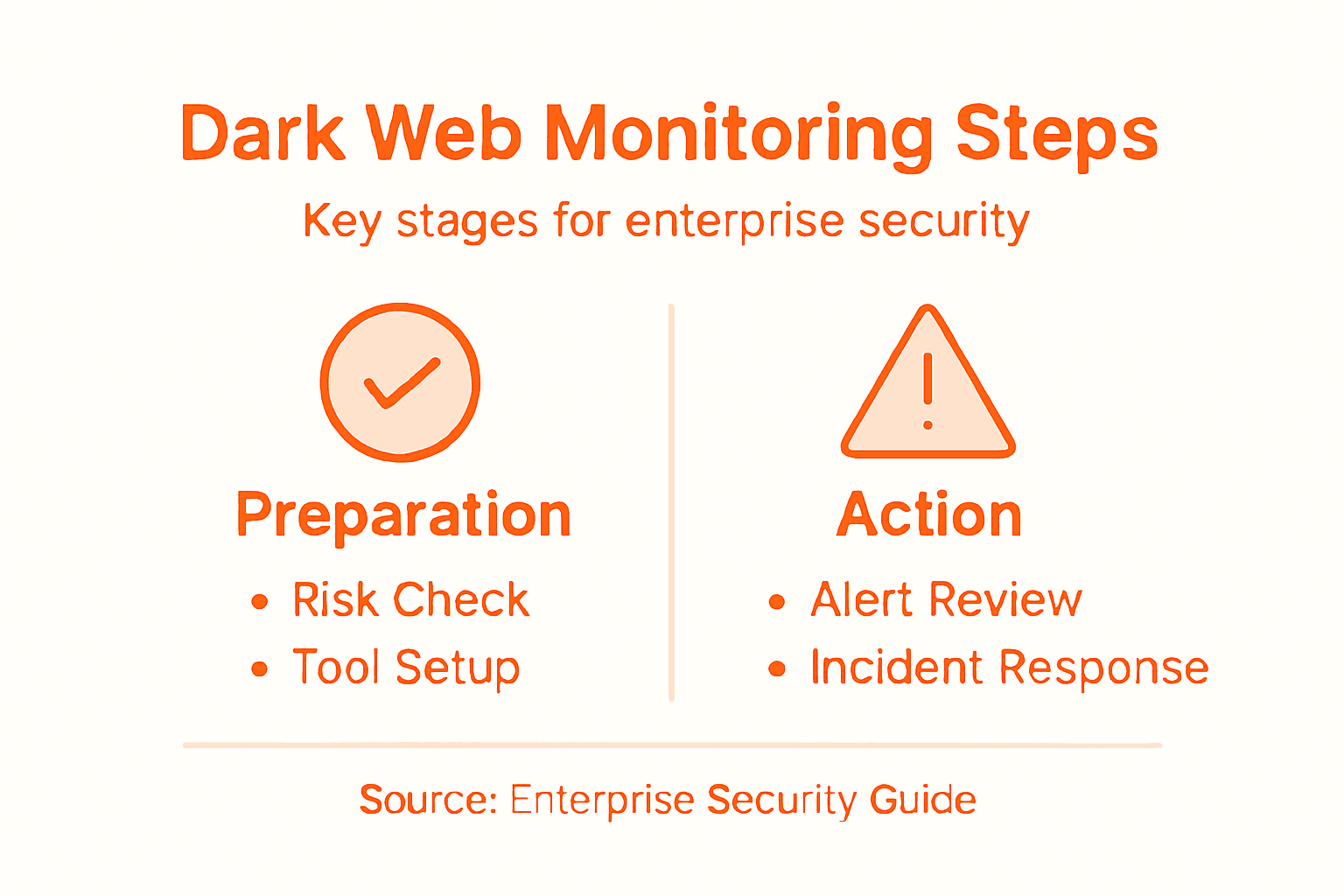
Configuration is equally important as tool selection. Start by mapping out your organization’s critical digital footprint identifying which email domains, IP ranges, and personnel with privileged access need monitoring. Set up custom alert thresholds that align with your risk tolerance and ensure the monitoring tool can send notifications through your preferred communication channels. Configure the tool to cross reference discovered threats with your current security infrastructure allowing for rapid verification and response.
Pro tip: Request free trials of multiple dark web monitoring tools and conduct side by side evaluations to find the most effective solution for your specific organizational needs.
Step 3: Integrate alert systems with security operations
Integrating dark web alert systems with your security operations is crucial for transforming raw threat intelligence into actionable defense strategies. Your objective is to create a seamless workflow that enables rapid threat detection, validation, and response across your organization’s security infrastructure.
Start by implementing Security Orchestration Automation and Response platforms that can consolidate alerts from multiple monitoring tools. These systems help reduce analyst workload by automatically correlating and prioritizing threats. Configure your SOAR platform to ingest data from dark web monitoring tools, security information and event management (SIEM) systems, and endpoint detection solutions. Establish custom workflows that automatically classify incoming alerts based on severity, potential impact, and relevance to your organization.
To maximize effectiveness, integrate AI powered threat intelligence that can provide contextual insights and accelerate incident response. Modern security platforms now offer advanced correlation capabilities that can connect seemingly unrelated alerts, helping your security team identify complex attack patterns. Develop detailed playbooks for different threat scenarios, ensuring your team can respond quickly and consistently to dark web related security incidents.
Pro tip: Conduct quarterly integration and workflow testing to ensure your alert systems remain synchronized and your response mechanisms stay sharp and adaptable.
Step 4: Analyze alerts and investigate findings
Analyzing dark web alerts requires a systematic and strategic approach to transform raw intelligence into meaningful security insights. Your primary goal is to validate threats, assess potential risks, and determine appropriate response strategies that protect your organization’s digital assets.
Begin by systematically scanning and verifying each alert for authenticity and potential impact. Cross reference discovered credentials, leaked information, and threat actor discussions against your organization’s digital footprint. Look for specific indicators such as exposed email domains, mention of internal infrastructure, or discussions about potential vulnerability exploits. Utilize threat intelligence platforms that can provide additional context and help you understand the credibility and potential severity of each alert.
Advanced investigation requires a multifaceted approach. Dark web investigation methodologies emphasize converting raw data into actionable intelligence by connecting seemingly unrelated pieces of information. Develop a structured investigation workflow that includes verifying the source of the alert, assessing the potential damage, and categorizing threats based on their immediacy and potential organizational impact. Collaborate with your security team to create comprehensive response protocols that can be quickly activated when high risk threats are identified.
Pro tip: Maintain a detailed incident log for each investigated alert to track patterns, improve future response strategies, and build institutional knowledge about emerging threat techniques.
Step 5: Respond to incidents and strengthen defenses
Responding to dark web security incidents demands a swift and strategic approach that minimizes potential organizational damage and prevents future vulnerabilities. Your primary objective is to create a robust incident response framework that enables rapid containment, mitigation, and long term defense enhancement.
Begin by implementing AI-driven response protocols that automate critical actions such as credential resets, access revocation, and multi factor authentication reinforcement. When a verified threat is identified, immediately activate your predefined incident response workflow. This should include steps like isolating affected systems, conducting forensic analysis, and documenting the entire incident lifecycle. Focus on understanding the attack vector, potential data exposure, and immediate containment strategies.
Post incident recovery requires a comprehensive approach to organizational defense strengthening. Continuous threat monitoring and incident tracking helps you develop adaptive security strategies. Conduct thorough post mortem analyses to identify systemic vulnerabilities, update your security policies, and retrain personnel on emerging threat detection techniques. Develop scenario based training programs that simulate dark web attack scenarios, ensuring your team remains prepared and resilient against sophisticated cybersecurity challenges.
Pro tip: Create a centralized incident response playbook that standardizes actions across different threat scenarios and enables quick knowledge transfer between security team members.
The following table compares traditional security monitoring with dark web monitoring:
| Feature | Traditional Monitoring | Dark Web Monitoring |
|---|---|---|
| Data Sources | Internal systems only | External criminal forums |
| Threat Detection | Known attack patterns | Emerging underground threats |
| Alert Context | Limited to organization | Includes external risk signals |
| Response Speed | Usually slower | Faster with automation |
Here’s a summary of key benefits for each main step of managing dark web risks:
| Step | Key Benefit | Primary Business Impact |
|---|---|---|
| Risk Assessment | Identifies vulnerabilities early | Reduces chances of costly breaches |
| Tool Selection | Enables automated threat alerts | Increases detection speed |
| Alert Integration | Streamlines security operations | Shortens incident response time |
| Alert Analysis | Filters out false positives | Focuses resources on real threats |
| Incident Response | Ensures rapid containment | Minimizes reputational and financial loss |
Strengthen Your Defense Against Dark Web Threats with LogMeOnce
The challenge of monitoring the dark web requires a proactive and integrated approach to enterprise security. This article highlighted the complexity of detecting leaked credentials and emerging underground threats before they turn into costly breaches. When every second counts, organizations need solutions that unify dark web monitoring with automated alerts, real-time analysis, and AI-powered response workflows. LogMeOnce offers a comprehensive cybersecurity platform designed to tackle these very pain points including secure identity management and passwordless multi-factor authentication. Our tools help you stay ahead by scanning for compromised credentials, integrating alert systems, and streamlining your incident response efforts.

Take control of your digital security today. Discover how LogMeOnce’s innovative features like single sign-on, encrypted cloud storage, and dark web monitoring can safeguard your organization from evolving cyber risks. Visit LogMeOnce now to start your free trial and transform your security operations with cutting-edge technology that’s easy to deploy and tailored to your needs. Learn more and empower your defense by exploring comprehensive cybersecurity solutions.
Frequently Asked Questions
How can I assess my organization’s dark web risk exposure?
To assess your organization’s dark web risk exposure, begin by conducting a comprehensive risk identification process that scans dark web forums and marketplaces for sensitive information. Utilize modern tools that automate this process to track corporate credentials and intellectual property, and schedule quarterly assessments to stay informed of potential vulnerabilities.
What features should I look for in dark web monitoring tools?
When selecting dark web monitoring tools, focus on features such as automated scanning of multiple dark web channels, real-time alerts for specific indicators, and seamless integration with your existing security infrastructure. Begin by evaluating enterprise-level solutions that provide robust data collection capabilities tailored to your organization’s needs.
How do I integrate dark web alerts into my existing security operations?
Integrate dark web alerts into your existing security operations by implementing Security Orchestration Automation and Response (SOAR) platforms that consolidate alerts from various monitoring tools. Establish custom workflows that classify incoming alerts based on severity and relevance, enabling your security team to respond quickly to potential threats.
What steps should I follow to analyze alerts and investigate findings?
To analyze alerts, systematically verify each one for authenticity and potential impact by cross-referencing with your organization’s digital footprint. Develop a structured investigation workflow to categorize threats and collaborate with your security team on comprehensive response protocols when high-risk alerts are identified.
How can I effectively respond to dark web security incidents?
Effectively respond to dark web security incidents by activating predefined incident response workflows that include steps like credential resets and forensic analysis. Implement AI-driven response protocols to automate critical actions, focusing on rapid containment to minimize potential harm to your organization.
Recommended
- The Benefits of Dark Web Monitoring for Businesses – LogMeOnce
- Identity Theft Protection – LogMeOnce
- Identity Theft Protection & Dark Web Scan – LogMeOnce
- 7 Ways to Boost Mobile Device Security for an Enterprise


