


 Password Manager
 Identity Theft Protection

 Team / Business
 Enterprise
 Government
 MSP
MSP


More than 80 percent of data breaches involve weak or mismanaged access controls, putting even the most diligent American and international IT teams at risk. As cyber threats grow in complexity, access management becomes the backbone of any robust security strategy. This overview brings clarity to common misconceptions and highlights the essential features modern enterprises need to protect sensitive assets and comply with strict global regulations.
Key Takeaways
| Point | Details |
|---|---|
| Access Management Importance | Access management is crucial for protecting sensitive information, requiring comprehensive strategies beyond simple password policies. |
| Role-Based Access Control (RBAC) | RBAC simplifies permission assignment by linking access rights to job roles, aiding security through principles like least privilege. |
| Multi-Factor Authentication (MFA) | Implementing MFA enhances security by requiring multiple forms of verification, significantly reducing unauthorized access risks. |
| Continuous Monitoring | Regular audits and dynamic adjustments of access permissions are essential to align with organizational needs and maintain compliance. |
Access management defined and misconceptions
Access management represents a critical cybersecurity framework designed to control and monitor user permissions within digital environments. At its core, access management involves systematically determining who can access specific technology resources, when they can access them, and under what conditions. Unlike simplistic authentication processes, comprehensive identity management encompasses a sophisticated approach to digital security.

The fundamental goal of access management extends beyond mere password protection. It involves creating a robust system that validates user identities, assigns appropriate roles and permissions, and continuously monitors access patterns. Organizations implement access management strategies to prevent unauthorized data breaches, protect sensitive information, and ensure that employees only interact with resources directly relevant to their job functions. Modern access management solutions leverage advanced technologies like multi-factor authentication, biometric verification, and real-time risk assessment to create adaptive security frameworks.
Common misconceptions about access management often stem from oversimplifying its complexity. Many professionals mistakenly believe that access management is solely about creating login credentials or implementing basic password policies. However, NIST guidelines highlight that effective access management involves intricate processes of identification, authentication, authorization, and ongoing monitoring. This includes managing digital identities for both human users and IoT devices, tracking access logs, and dynamically adjusting permissions based on contextual risks.
Pro tip: Implement a comprehensive access management strategy that includes regular permission audits, role-based access controls, and continuous user activity monitoring to minimize potential security vulnerabilities.
Major types and key access models
Access management encompasses several critical models that organizations use to control and secure digital resources. The most prominent approaches include Role-Based Access Control (RBAC), Discretionary Access Control (DAC), and Mandatory Access Control (MAC), each offering unique strategies for managing user permissions and protecting sensitive information.
Role-Based Access Control represents the most widely adopted model in enterprise environments. This approach assigns permissions based on organizational roles rather than individual user identities, dramatically simplifying access management complexity. Under RBAC, employees are granted access rights corresponding to their specific job functions, ensuring that individuals can only interact with resources directly relevant to their work responsibilities. This model supports critical security principles like least privilege and separation of duties, allowing organizations to create granular, predictable access frameworks that minimize potential security risks.
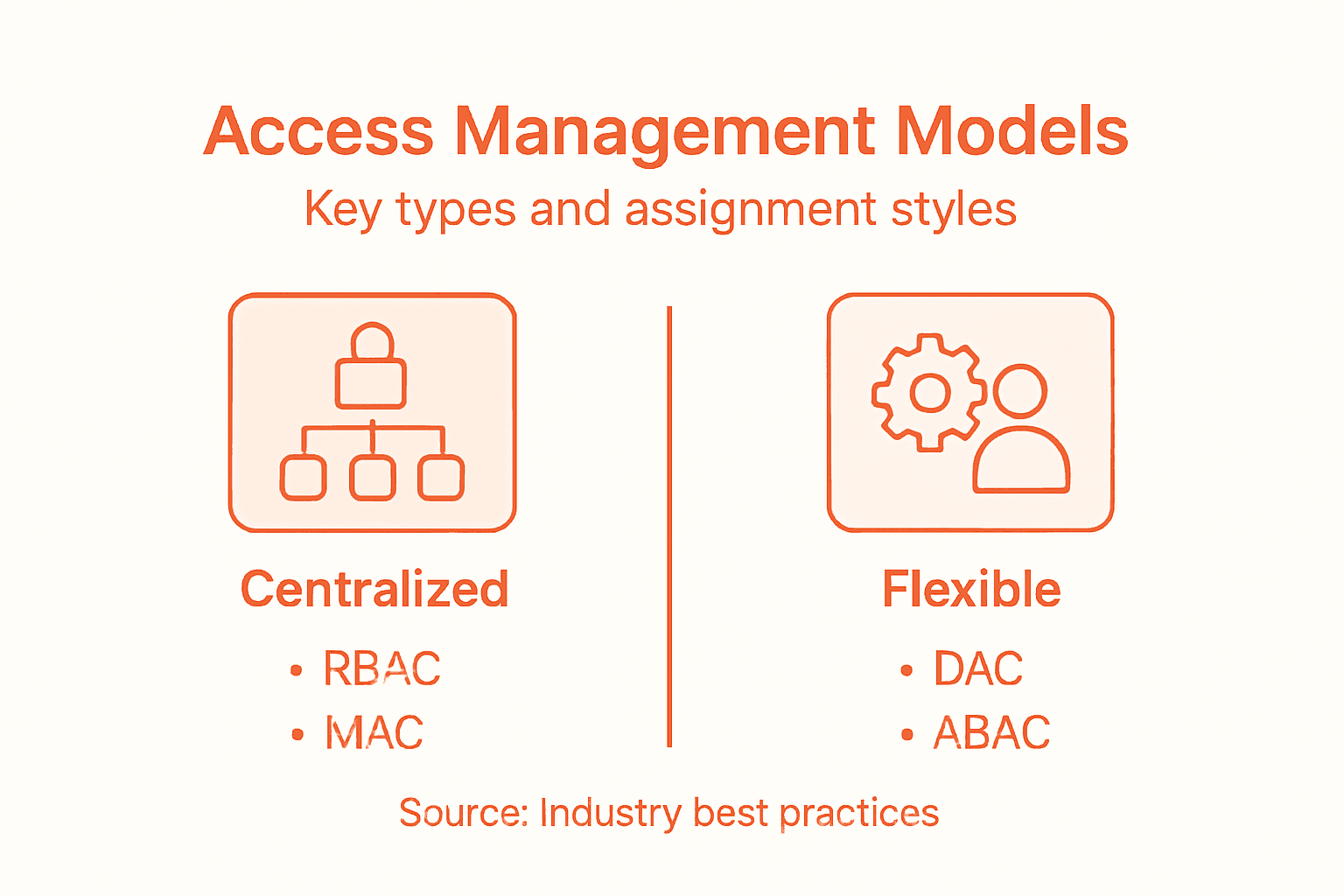
Discretionary access control provides a more flexible alternative, enabling resource owners to directly manage and configure access permissions. Unlike RBAC’s centralized approach, DAC models allow individual users or system administrators to dynamically control who can view, modify, or interact with specific digital assets. While this approach offers greater individual control, it can potentially create security vulnerabilities if not carefully managed. Organizations often implement DAC through access control lists and permission management systems that track and document every access modification.
Here’s how the main access control models differ in approach and risk:
| Model | How Permissions Are Assigned | Central Control Level | Risk Profile |
|---|---|---|---|
| RBAC | By user job role | Highly centralized | Lower risk if maintained |
| DAC | By asset owner discretion | Decentralized | Higher risk if mismanaged |
| MAC | By strict organizational policy | Extremely centralized | Lowest, but less flexible |
Pro tip: Regularly audit and review your access control model to ensure it aligns with current organizational needs, performing comprehensive permission assessments at least quarterly to maintain robust security standards.
How access management systems work
Access management systems operate through a complex, multi-layered process designed to protect digital resources and verify user identities. At their core, these systems function by implementing sophisticated mechanisms that authenticate users, authorize their specific access levels, and continuously monitor interactions with sensitive information. Access control systems employ multiple verification techniques to ensure that only authorized individuals can interact with specific digital or physical assets.
The authentication phase represents the first critical checkpoint in access management. During this stage, users must prove their identity through various methods, including passwords, biometric scans, security tokens, or multi-factor authentication protocols. These verification techniques create multiple layers of security, making it significantly more challenging for unauthorized users to gain entry. Advanced systems integrate contextual information such as user location, device characteristics, and historical access patterns to create dynamic risk assessments that can adjust access permissions in real-time.
Once authenticated, users enter the authorization stage, where the system determines precise access rights based on predefined roles and organizational policies. Physical access control systems demonstrate this principle through electronic credential readers that grant or deny entry at specific points like doors or digital gateways. These systems maintain comprehensive logs of all access attempts, successful or unsuccessful, creating an audit trail that enables security teams to investigate potential breaches, track user activities, and ensure compliance with organizational security standards. Modern access management solutions leverage artificial intelligence and machine learning algorithms to continuously refine and adapt access control mechanisms, anticipating potential security vulnerabilities before they can be exploited.
Pro tip: Implement a comprehensive logging and monitoring strategy that captures detailed access attempt metadata, enabling rapid forensic analysis and proactive security risk identification.
Essential features: MFA, SSO, and controls
Modern access management systems rely on three critical features that dramatically enhance security and user experience: Multi-Factor Authentication (MFA), Single Sign-On (SSO), and granular access controls. These technologies work in concert to create a robust security framework that protects sensitive organizational resources while maintaining user convenience and operational efficiency.
Multi-Factor Authentication represents a sophisticated defense mechanism that requires users to provide multiple verification credentials before gaining system access. This approach goes far beyond traditional password-based authentication by incorporating diverse verification methods such as biometric scans, hardware tokens, mobile device confirmations, and behavioral pattern recognition. By requiring multiple independent authentication factors, MFA significantly reduces the risk of unauthorized access, even if one credential is compromised. Advanced MFA systems dynamically assess risk levels, adjusting authentication requirements based on contextual factors like user location, device characteristics, and historical access patterns.
Single Sign-On systems streamline user authentication by enabling individuals to access multiple applications and platforms using a single set of credentials. This approach addresses the growing complexity of enterprise technology ecosystems, where employees frequently interact with numerous digital systems. SSO eliminates password fatigue, reduces the likelihood of weak password creation, and simplifies user management for IT departments. Complementing MFA and SSO, sophisticated access control mechanisms enforce granular permission policies, ensuring that users can only interact with resources directly relevant to their organizational roles. These policy-based controls create a dynamic security environment that adapts to changing organizational structures and compliance requirements.
Key features of modern access management and their business impacts:
| Feature | Description | Business Impact |
|---|---|---|
| MFA | Requires multiple authentication factors | Reduces unauthorized access risk |
| SSO | Single login for many systems | Increases user productivity |
| Granular Controls | Precise, role-based permissions | Minimizes over-privileged access |
Pro tip: Implement a comprehensive identity governance strategy that regularly audits and updates user access permissions, ensuring least privilege principles are consistently maintained across all systems and applications.
Risks, compliance challenges, and best practices
Access management introduces complex security challenges that demand sophisticated and proactive strategies. Organizations must navigate a minefield of potential risks, including unauthorized access, data breaches, and regulatory non-compliance, while simultaneously maintaining operational efficiency and user experience. Access control systems represent critical defense mechanisms that require continuous monitoring, refinement, and strategic implementation.
The landscape of compliance presents significant hurdles for modern enterprises. Global regulations like GDPR, HIPAA, and industry-specific standards impose stringent requirements for data protection and user access management. Insider threats pose particularly nuanced risks, with employees potentially exploiting legitimate access credentials to compromise sensitive systems. Advanced organizations are increasingly adopting zero trust frameworks that assume no inherent trust, requiring continuous authentication and verification regardless of user position or historical access patterns. These approaches demand granular access controls that dynamically adjust permissions based on contextual risk assessments, user behavior patterns, and real-time threat intelligence.
ISO standards recommend comprehensive strategies that transcend traditional perimeter-based security models. Best practices increasingly emphasize holistic approaches that integrate access management into broader security governance frameworks. Key recommendations include implementing multifactor authentication, conducting regular access reviews, maintaining detailed audit trails, and developing robust processes for timely privilege revocation. Organizations must also prioritize ongoing employee training, ensuring that human factors do not become the weakest link in their security infrastructure. Effective access management requires a delicate balance between security rigor and user convenience, preventing unauthorized access while avoiding overly restrictive policies that can impede productivity.
Pro tip: Develop a comprehensive access governance policy that includes quarterly access reviews, automated privilege tracking, and clear offboarding procedures to minimize security vulnerabilities during personnel transitions.
Strengthen Your Access Management with LogMeOnce Solutions
Understanding the complexities of access management is the first step toward protecting your organization from unauthorized access and data breaches. The challenges highlighted in the article such as multi-factor authentication, single sign-on, and granular access controls are essential for any modern security framework. If you are looking to implement a robust system that balances ease of use with powerful security features like adaptive authentication and continuous monitoring LogMeOnce offers comprehensive cybersecurity solutions designed to meet these exact needs.

Take control of who accesses your critical data and when with LogMeOnce. Explore how our passwordless MFA, encrypted cloud storage, and identity management capabilities can reduce security risks while enhancing productivity. Act now to protect your digital environment and experience firsthand why industry leaders trust LogMeOnce for advanced access management. Visit LogMeOnce to start your journey toward smarter cybersecurity today.
Frequently Asked Questions
What is access management?
Access management is a cybersecurity framework that controls and monitors user permissions within digital environments, determining who can access specific resources, when they can access them, and under what conditions.
Why is access management important for organizations?
Access management is crucial for preventing unauthorized data breaches, protecting sensitive information, and ensuring employees only interact with resources relevant to their job functions. It creates a structured security approach that minimizes risks.
What are the main types of access management models?
The main types of access management models include Role-Based Access Control (RBAC), Discretionary Access Control (DAC), and Mandatory Access Control (MAC), each with distinct methods of assigning permissions and varying levels of central control.
How do multi-factor authentication (MFA) and single sign-on (SSO) enhance security?
MFA enhances security by requiring users to provide multiple verification factors before gaining access, significantly reducing unauthorized access risks. SSO streamlines user access by allowing a single login for multiple systems, improving productivity while maintaining security.
Recommended
- Why Is the Advanced Password Manager One of the Best Security Tools – LogMeOnce
- Password Manager – LogMeOnce
- Consumer Top Features – LogMeOnce
- The Finesses of Enterprise Password Management


