


 Password Manager
 Identity Theft Protection

 Team / Business
 Enterprise
 Government
 MSP
MSP


Single Sign-On Explained: Benefits and Best Use Cases

Did you know that over 80 percent of data breaches involve weak or stolen passwords? Managing countless logins can be a daily struggle and a big security risk for many people. Single Sign-On technology changes the game by letting users access all their apps and tools with one secure login. This simple shift can make daily workflows easier while protecting sensitive digital information from common threats.
Key Takeaways
| Point | Details |
|---|---|
| Simplified Access | Single Sign-On (SSO) allows users to authenticate once and gain seamless access to multiple digital platforms, enhancing usability. |
| Enhanced Security | SSO minimizes password complexity, thereby reducing the risk of credential-based attacks and enhancing overall security protocols. |
| Cost Efficiency | By decreasing password-related IT support requests, SSO can lead to significant cost savings for organizations. |
| Diverse Solutions | Organizations can choose from various SSO types—such as Enterprise, Web, and Federated—to suit their specific security and operational needs. |
What Is Single Sign-On Technology?
Single Sign-On (SSO) is a sophisticated authentication approach that simplifies how users access multiple digital services and applications with just one set of login credentials. According to Wikipedia, SSO allows users to log in once and gain seamless access across several independent software systems without repeatedly entering authentication details.
At its core, SSO eliminates the complex web of multiple passwords that users traditionally manage. Instead of remembering numerous credentials for different platforms, individuals can authenticate themselves just once and then automatically access a range of interconnected systems. Research from healthcare technology studies suggests this approach significantly streamlines workflow processes, particularly in complex organizational environments where accessing multiple applications is routine.
Key benefits of SSO technology include:
- Reduced password fatigue
- Enhanced security by minimizing password complexity
- Faster login processes
- Simplified user experience
- Decreased IT support requests related to password resets
The technology works by establishing a trusted connection between the initial authentication point and subsequent applications, creating a secure yet convenient digital access framework. When a user logs in initially, the SSO system generates a time-limited token that grants access across integrated platforms without requiring repeated credential verification.
Types of Single Sign-On Solutions
Single Sign-On (SSO) technologies have evolved to meet diverse organizational needs, with several distinct approaches designed to streamline authentication across digital platforms. According to Wikipedia, the primary types of SSO solutions include Enterprise SSO (E-SSO) and Web SSO, each serving unique authentication requirements in different technological environments.
Enterprise SSO focuses on internal organizational systems, intercepting login requirements of applications and completing them with stored credentials. This approach is particularly valuable for large corporations with complex internal software ecosystems. Alternatively, Web SSO specializes in managing access to web-based applications and online resources, providing a seamless authentication experience across internet platforms.
Additional SSO solution types include:
- Federated SSO: Enables authentication across different organizational domains
- Social Media SSO: Allows login using credentials from platforms like Google or Facebook
- Cloud-based SSO: Manages access for distributed cloud services and applications
- Open Source SSO: Like CoSign, which is part of the National Science Foundation Middleware Initiative
Each SSO type addresses specific security and accessibility challenges, offering organizations flexible authentication strategies that balance convenience with robust digital protection. By understanding these different approaches, businesses can select the most appropriate SSO solution for their unique technological infrastructure and security requirements.
Here’s a summary comparing common types of SSO solutions:
| SSO Type | Primary Use | Typical Environment | Example Technologies |
|---|---|---|---|
| Enterprise SSO | Internal app authentication | Large corporations | Windows Integrated Oracle ESSO |
| Web SSO | Web application access | Internet/cloud platforms | SAML OAuth OpenID Connect |
| Federated SSO | Cross-organization authentication | Partnered enterprises | Shibboleth ADFS |
| Social Media SSO | Consumer login via social sites | Websites/online services | Google Login Facebook Login |
| Cloud-based SSO | Manage cloud app access | Distributed cloud services | Okta Azure AD |
| Open Source SSO | Custom SSO deployments | Academic/open-source orgs | CoSign SimpleSAMLphp |
How Single Sign-On Works in Practice
Single Sign-On (SSO) transforms the authentication process by creating a streamlined, secure method for accessing multiple digital platforms with minimal friction. According to Wikipedia, the core mechanism involves authenticating a user on a web server and then providing an environment variable that grants access to various applications without repeated credential entry.
The Central Authentication Service (CAS) protocol demonstrates a sophisticated approach to SSO implementation. As described in Wikipedia, this system permits users to access multiple applications by providing credentials only once, without exposing their security details to each individual application. This method ensures that sensitive authentication information remains protected while enabling seamless access across different systems.
Key steps in the SSO authentication process typically include:
- Initial user login with primary credentials
- Generation of a secure, time-limited authentication token
- Token verification across integrated applications
- Automatic access granted without additional login prompts
- Continuous security monitoring and token validation
Practical SSO implementation involves complex backend negotiations between authentication servers and target applications. The system creates a trusted environment where a single verified identity can traverse multiple digital resources, dramatically reducing password fatigue and enhancing overall security infrastructure.
 Learn more about setting up secure access with our SSO guide.
Top Security and Productivity Benefits
Single Sign-On (SSO) delivers transformative advantages that extend far beyond simple login convenience. According to Wikipedia, the technology offers comprehensive benefits that address both security vulnerabilities and operational inefficiencies across organizational ecosystems.
From a security perspective, SSO dramatically reduces the risks associated with multiple password management. By minimizing password complexity and eliminating the need for numerous credentials, organizations can significantly decrease their vulnerability to credential-based attacks. The streamlined authentication process means fewer opportunities for potential security breaches, while simultaneously simplifying user access protocols.
Key security and productivity benefits include:
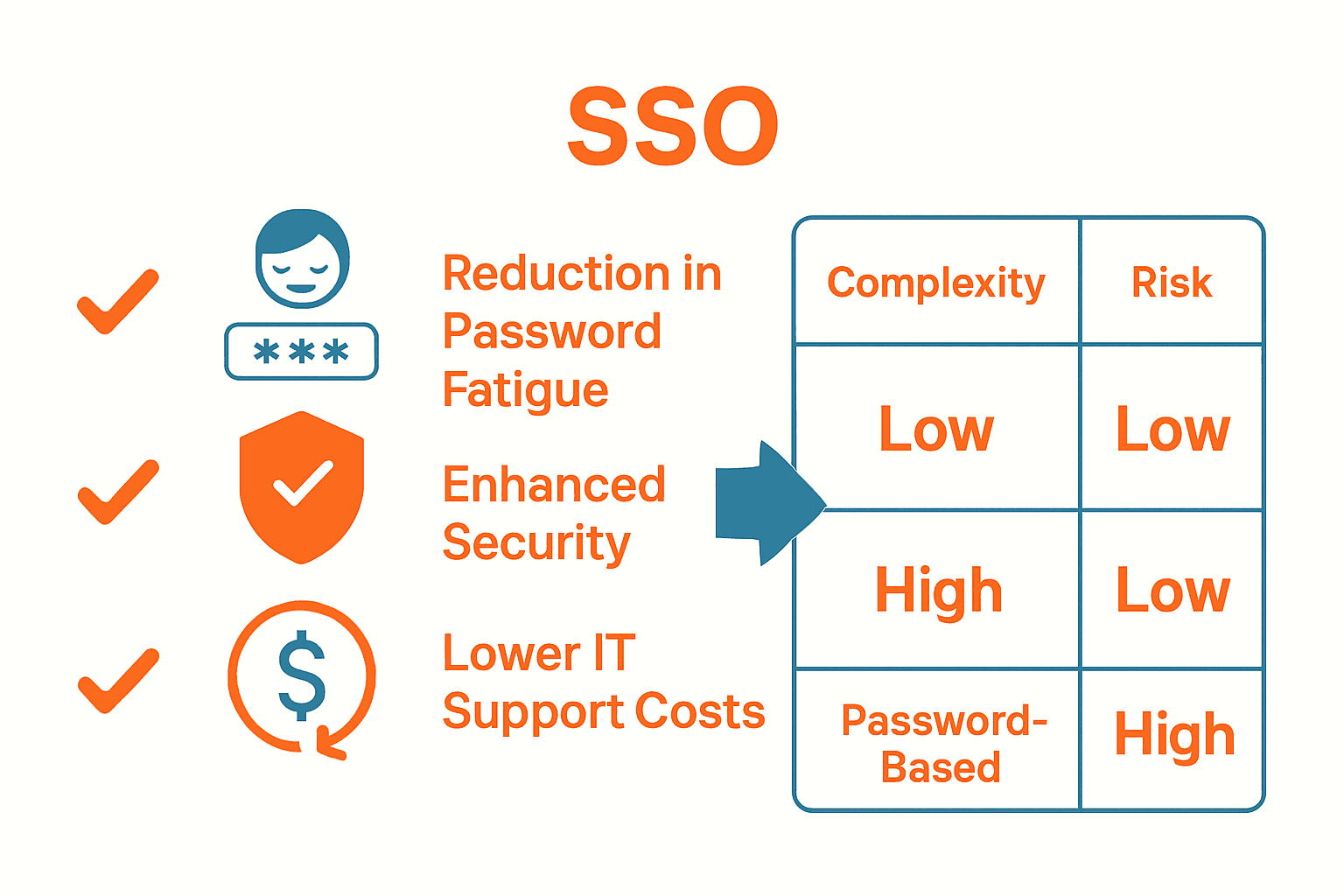
- Reduced Password Fatigue: Eliminates the mental burden of remembering multiple passwords
- Lower IT Support Costs: Decreases help desk calls related to password resets
- Enhanced Security: Minimizes risks associated with third-party site access
- Time Efficiency: Reduces time spent re-entering credentials across different platforms
- Simplified Administration: Centralizes user authentication management
For organizations seeking to enhance their multi-factor authentication strategies, SSO represents a critical component of a comprehensive digital security approach. By balancing convenience with robust protection, this technology empowers businesses to create more secure, efficient digital environments that protect both user experience and critical organizational assets.
Common SSO Challenges and How to Avoid Them
Single Sign-On (SSO) technologies, while powerful, are not without their complex security challenges. Recent research highlights critical vulnerabilities that organizations must proactively address to maintain robust authentication systems. According to research from ArXiv, key security risks include potential client secret leakages and weak Cross-Site Request Forgery (CSRF) protection mechanisms.
Privacy emerges as another significant concern in SSO implementations. Innovative solutions are emerging to combat user tracking and protect individual digital identities. Researchers have developed privacy-preserving technologies like MISO (Minimal Information Single Sign-On), which are designed to be compatible with existing identity providers while minimizing potential privacy intrusions.
Common SSO challenges and their mitigation strategies include:
- Client Secret Protection: Implement robust encryption and secure storage mechanisms
- CSRF Vulnerability: Deploy advanced token validation and request verification techniques
- User Tracking Prevention: Utilize privacy-preserving authentication frameworks
- Credential Management: Establish strict access control and regular credential rotation
- Identity Provider Risks: Conduct thorough vendor security assessments
To effectively navigate these challenges, organizations must adopt a proactive, multi-layered approach to SSO security. Exploring comprehensive multi-factor authentication strategies can provide additional insights into creating more resilient authentication ecosystems that balance security, privacy, and user experience.
Comparing SSO to Alternative Authentication Methods
Single Sign-On (SSO) represents a sophisticated approach to digital authentication, offering unique advantages over traditional and alternative access management strategies. According to comparative research, SSO provides a centralized authentication mechanism that fundamentally differs from decentralized methods like IP-based proxy solutions, each bringing distinct operational characteristics to digital security frameworks.
Authentication protocols like OpenID and OAuth demonstrate the nuanced landscape of access management technologies. Research comparing these authentication systems reveals significant performance variations and use-case specific benefits. While traditional methods rely on repeated credential verification, SSO streamlines access by establishing a single, trusted authentication point that serves multiple applications and platforms.
Key comparative authentication method characteristics include:
- Password-Based Authentication: Multiple credentials, higher user friction
- Multi-Factor Authentication (MFA): Enhanced security, more complex user experience
- IP Proxy Solutions: Decentralized access, location-specific limitations
- Token-Based Authentication: Stateless, scalable but potentially less secure
- Biometric Authentication: High security, device and infrastructure dependent
Exploring comprehensive multi-factor authentication strategies can provide deeper insights into selecting the most appropriate authentication approach for specific organizational needs. The key is understanding that no single method universally fits all security requirements, making adaptable, layered authentication frameworks increasingly critical in modern digital environments.
Simplify Your Security with LogMeOnce Single Sign-On Solutions
Managing multiple passwords and struggling with weak security can leave you vulnerable to cyber threats. This article highlights how Single Sign-On (SSO) technology reduces password fatigue, enhances security, and streamlines access across platforms — but implementing SSO correctly can be complicated and risky without the right tools. If managing secure, privacy-preserving authentication with robust protection sounds like your priority, LogMeOnce offers a powerful, user-friendly solution designed to safeguard your digital environment.

Take control of your identity management today and protect your workforce and customers from credential theft and login hassles. Explore how LogMeOnce’s comprehensive cybersecurity toolkit, including advanced single sign-on integration, multi-factor authentication, and passwordless options, can transform your security posture. Get started now at LogMeOnce or learn more through our multi-factor authentication resources to build a seamless, safe experience that your organization deserves.
Frequently Asked Questions
What is Single Sign-On (SSO) technology?
Single Sign-On (SSO) is an authentication method that allows users to access multiple applications and services with one set of login credentials, eliminating the need to enter separate credentials for each individual platform.
What are the key benefits of using Single Sign-On?
Key benefits of SSO include reduced password fatigue, enhanced security, faster login processes, simplified user experience, and decreased IT support requests related to password resets.
How does Single Sign-On work in practice?
SSO works by authenticating a user once and generating a secure, time-limited token that grants access to various applications without needing to repeatedly enter login details, ensuring a seamless experience across different platforms.
What are some common challenges associated with Single Sign-On systems?
Common challenges include client secret protection, vulnerabilities such as Cross-Site Request Forgery (CSRF), user tracking concerns, and risks related to identity providers. Implementing strong encryption, validation techniques, and privacy-preserving frameworks can help mitigate these challenges.

Sadia, with her Master of Computer Applications, stands at the intersection of technology and communication. Her academic background has endowed her with a deep understanding of complex technical concepts, which she skillfully simplifies for diverse audiences. Sadia’s extensive experience in both technical realms and writing enables her to translate intricate technical ideas into clear, engaging, and accessible content.


