


 Password Manager
 Identity Theft Protection

 Team / Business
 Enterprise
 Government
 MSP
MSP


Most American businesses face mounting pressure to keep user data safe across countless digital platforms. With over 80 percent of security breaches linked to weak authentication systems, finding reliable solutions becomes critical for organizations of every size. SAML offers a powerful answer by enabling secure single sign-on and streamlined access management, allowing American companies to reduce password fatigue and strengthen security without complicating the user experience.
Key Takeaways
| Point | Details |
|---|---|
| SAML Enhances Security and User Experience | SAML simplifies authentication through secure single sign-on, reducing the need for multiple credentials and lowering security risks. |
| Decentralized Authentication Mechanism | SAML allows systems to validate user identities without sharing credentials, supporting robust encryption and security standards. |
| Supports Various Federation Models | With both Identity Provider-Initiated and Service Provider-Initiated approaches, SAML offers flexibility in authentication based on organizational needs. |
| Implementation Requires Strategic Planning | Successful SAML deployment demands an assessment of technical infrastructure and the establishment of precise security policies and access controls. |
Why Use SAML Explained
Security Assertion Markup Language (SAML) represents a powerful authentication protocol transforming how organizations manage digital identities across complex technological environments. At its core, SAML enables secure single sign-on (SSO) experiences that streamline user access while maintaining robust security standards. Organizations leveraging SAML can dramatically simplify authentication processes across multiple applications and platforms.
The fundamental value of SAML lies in its ability to enable secure identity exchange between different systems. When a user attempts to access a protected resource, SAML allows a trusted identity provider to authenticate that user and communicate their credentials securely to the service provider. This process eliminates the need for multiple login credentials, reducing password fatigue and minimizing security risks associated with managing numerous authentication mechanisms. Identity management experts recognize SAML as a critical standard for enterprise-level authentication.
SAML offers several significant advantages for organizations seeking enhanced security and user experience. Key benefits include:
- Simplified Authentication: Single sign-on capabilities across multiple platforms
- Enhanced Security: Standardized authentication protocols that reduce unauthorized access risks
- Reduced Administrative Overhead: Centralized identity management eliminates redundant credential management
- Interoperability: Works seamlessly across different systems and technology ecosystems
Modern enterprises face increasing complexity in managing digital identities, and SAML provides a sophisticated solution that bridges authentication challenges. By creating a standardized framework for identity verification, SAML helps organizations maintain strict security protocols while delivering a smooth user experience.
Pro Tip – Authentication Strategy: Implement SAML with comprehensive user access policies and regularly audit authentication logs to maintain robust security and identify potential vulnerabilities in your identity management infrastructure.
SAML’s Core Definition And Misconceptions
SAML (Security Assertion Markup Language) is fundamentally an XML-based open standard for exchanging authentication and authorization data between security domains. Security protocols like SAML enable trusted digital interactions by allowing secure transmission of user credentials across different systems without repeatedly sharing sensitive login information. Authentication standards experts recognize SAML as a critical framework for modern identity management.

Despite its technical sophistication, several common misconceptions surround SAML’s functionality and implementation. Many organizations mistakenly believe SAML is exclusively complex or suitable only for large enterprises. In reality, SAML provides flexible authentication mechanisms adaptable to organizations of varying sizes and technological infrastructures. The protocol creates a standardized method for exchanging user identity information, essentially acting as a digital passport that verifies user credentials across multiple platforms.
Key characteristics that distinguish SAML from traditional authentication methods include:
- Decentralized Authentication: Allows separate systems to validate user identities without direct credential exchange
- Comprehensive Security: Implements robust encryption and validation protocols
- Cross-Platform Compatibility: Functions across diverse technological ecosystems
- Reduced Password Management: Minimizes the need for multiple login credentials
Understanding SAML requires recognizing its role as an identity federation standard that enables seamless, secure authentication experiences. By establishing a trusted communication framework between identity providers and service providers, SAML eliminates numerous security vulnerabilities associated with traditional login mechanisms.
Pro Tip – Authentication Complexity: Start with a pilot implementation of SAML in a controlled environment to understand its nuances before full-scale organizational deployment.
SAML Types And Federation Approaches
SAML encompasses multiple authentication federation models that enable organizations to securely manage digital identities across complex technological ecosystems. SAML 2.0 standards define two primary federation approaches: Identity Provider-Initiated and Service Provider-Initiated single sign-on (SSO) mechanisms, each serving distinct organizational authentication requirements.
In the Identity Provider-Initiated approach, authentication originates from the identity provider’s platform, where users first log in and are then automatically redirected to desired service providers. Conversely, the Service Provider-Initiated model begins when a user attempts to access a specific service, triggering a authentication request that redirects them to the identity provider for credential verification. Enterprise identity federation experts recognize these approaches as fundamental strategies for managing secure, streamlined access across diverse technological environments.
Key variations in SAML federation approaches include:
- Web Browser SSO Profile: Enables authentication through standard web browser interactions
- Artifact Resolution Profile: Facilitates secure transmission of authentication assertions
- Enhanced Client and Proxy Profile: Supports more complex authentication scenarios
- Identity Provider Discovery Profile: Helps users identify appropriate authentication sources
Understanding these federation models allows organizations to implement robust authentication frameworks tailored to their specific security and usability requirements. By selecting appropriate SAML approaches, enterprises can create sophisticated identity management systems that balance stringent security protocols with seamless user experiences.
Here’s a comparison of SAML federation approaches and their best use cases:
| Approach | Typical Scenario | Best For |
|---|---|---|
| Identity Provider-Initiated SSO | Centralized enterprise user portal | Environments with pre-authenticated users |
| Service Provider-Initiated SSO | Third-party apps or external platforms | Apps needing just-in-time user authentication |
| Web Browser SSO Profile | Standard web-based access | Broad end-user applications |
| Artifact Resolution Profile | High-assurance authentication required | Environments demanding assertion confidentiality |
Pro Tip – Federation Strategy: Conduct a comprehensive assessment of your organization’s authentication needs before selecting a specific SAML federation approach, considering factors like user volume, system complexity, and security requirements.
How SAML Works Behind The Scenes
SAML authentication operates through a sophisticated XML-based communication framework that enables secure identity verification across disparate technological systems. The authentication process involves a complex dance between three primary components: the user, the identity provider (IdP), and the service provider (SP), each playing a critical role in establishing trusted digital interactions.
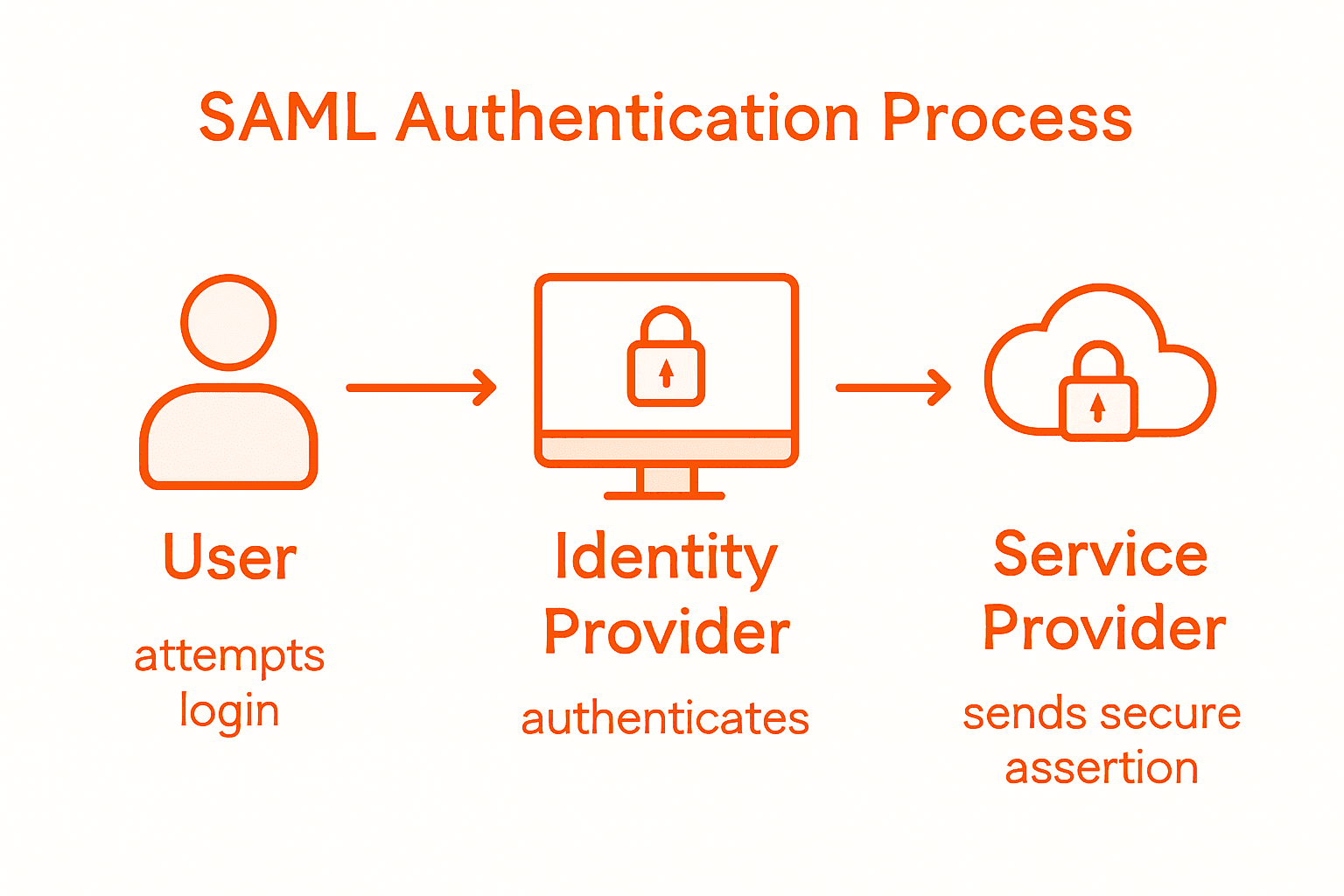
Enterprise identity management experts describe the SAML workflow as a sequence of carefully orchestrated authentication steps. When a user attempts to access a protected resource, the service provider generates an authentication request that is redirected to the identity provider. The identity provider then validates the user’s credentials, creating a secure XML-based assertion that confirms the user’s identity and associated access permissions.
The core mechanics of SAML authentication include several key stages:
- Request Initiation: Service provider generates authentication request
- User Redirection: User is redirected to identity provider’s authentication portal
- Credential Verification: Identity provider authenticates user credentials
- Assertion Generation: Secure XML token created with user authentication details
- Access Granted: Service provider receives and validates authentication assertion
This intricate process ensures a robust security model where sensitive authentication data is never directly exchanged between the service provider and user. Instead, the identity provider acts as a trusted intermediary, generating encrypted assertions that validate user identity without exposing critical credential information. By implementing this sophisticated framework, organizations can create seamless yet highly secure authentication experiences across complex digital environments.
Pro Tip – Security Configuration: Implement strict time-based validity constraints on authentication assertions to minimize potential security vulnerabilities and reduce the window of potential unauthorized access.
Security And Compliance Advantages
SAML provides comprehensive security frameworks that transform digital identity management across organizational ecosystems. Security protocols documented by industry experts demonstrate sophisticated mechanisms for protecting sensitive authentication data through advanced encryption and digital signature technologies. Organizations implementing SAML can dramatically reduce the risk of unauthorized access and credential compromise.
The compliance advantages of SAML extend far beyond basic authentication protection. By establishing a standardized approach to identity verification, SAML helps organizations meet stringent regulatory requirements across multiple industries. Cybersecurity awareness practices emphasize the critical nature of implementing robust identity management protocols that protect against evolving digital threats.
Key security and compliance advantages include:
- Enhanced Data Protection: Prevents unauthorized credential sharing
- Granular Access Control: Enables precise user permission management
- Comprehensive Audit Trails: Provides detailed authentication logging
- Regulatory Compliance: Supports adherence to industry security standards
- Reduced Security Complexity: Centralizes authentication management
The intricate architecture of SAML creates a robust security ecosystem where authentication assertions are securely transmitted and validated. By implementing XML-based digital signatures and encryption mechanisms, organizations can establish trust boundaries that protect sensitive identity information while maintaining seamless user experiences across diverse technological platforms.
Pro Tip – Security Implementation: Conduct regular security assessments and penetration testing of your SAML infrastructure to identify and address potential vulnerabilities before they can be exploited.
Implementation Requirements And Considerations
Successful SAML implementation requires a strategic approach that encompasses technical infrastructure, organizational readiness, and comprehensive security planning. Cloud encryption strategies highlight the critical importance of selecting robust technological frameworks that support seamless identity management across complex digital environments.
Data privacy considerations underscore the necessity of developing a comprehensive implementation strategy that addresses potential regulatory and technical challenges. Organizations must carefully evaluate their existing technological ecosystem, infrastructure compatibility, and specific authentication requirements before initiating a SAML deployment.
Key implementation requirements include:
- Technical Infrastructure Assessment: Evaluate current identity management systems
- Metadata Configuration: Establish precise identity provider and service provider configurations
- Certificate Management: Implement robust public key infrastructure for secure assertions
- Access Control Policies: Define granular user permission frameworks
- Integration Testing: Validate authentication workflows across different platforms
Navigating the implementation process demands a multifaceted approach that balances technical complexity with organizational security objectives. Successful SAML deployment requires cross-functional collaboration between IT security teams, network architects, and compliance professionals to ensure a comprehensive and seamless identity management strategy.
Pro Tip – Phased Rollout: Implement SAML authentication through a controlled, incremental approach, starting with non-critical systems and progressively expanding to mission-critical infrastructure to minimize potential disruption and validate performance.
Alternatives And When To Choose Others
While SAML remains a robust authentication protocol, organizations must carefully evaluate alternative identity management solutions based on their specific technological requirements. Enterprise identity federation approaches demonstrate that multiple authentication standards exist, each with unique strengths and potential implementation scenarios.
The primary alternatives to SAML include OpenID Connect, OAuth 2.0, and JSON Web Tokens (JWT), each offering distinct advantages depending on organizational infrastructure. OpenID Connect, for instance, provides a more lightweight authentication mechanism utilizing RESTful architectures and JSON-based token exchanges, making it particularly attractive for modern web and mobile applications that require rapid, stateless authentication processes.
Key considerations when selecting authentication protocols include:
- Technological Ecosystem: Compatibility with existing infrastructure
- Application Architecture: Web, mobile, or hybrid platform requirements
- Performance Needs: Latency and processing overhead
- Security Complexity: Granularity of access control mechanisms
- Scalability: Support for expanding user bases and diverse authentication scenarios
Deciding between SAML and alternative protocols requires a nuanced understanding of your organization’s specific authentication challenges. While SAML excels in enterprise environments with complex identity management needs, newer protocols like OpenID Connect might offer more streamlined implementations for organizations with simpler, more dynamic authentication requirements.
This table highlights how SAML compares to modern alternatives in key categories:
| Protocol | Token Format | Primary Use Case | Strengths |
|---|---|---|---|
| SAML | XML | Enterprise SSO | Granular access, strong compliance |
| OpenID Connect | JSON | Web/mobile authentication | Lightweight, user-centric flows |
| OAuth 2.0 | Varies (JWT) | API authorization | Delegated, flexible for microservices |
| JSON Web Token | JSON | Stateless auth/session | Compact, easy transport, fast processing |
Pro Tip – Protocol Selection: Conduct a comprehensive assessment of your authentication needs, including current infrastructure, future scalability requirements, and specific security constraints before committing to a particular identity management protocol.
Secure Your Enterprise Identity with LogMeOnce Solutions
The article “Why Use SAML: Secure, Seamless Identity Access” highlights the critical challenges organizations face in managing digital identities, including the need for simplified authentication, enhanced security, and centralized access control. If you are looking to overcome the complexity of multiple login credentials and reduce security risks associated with traditional authentication, then a robust identity management solution is essential. Concepts like SAML single sign-on and secure identity federation are fundamental to protecting your sensitive data while delivering a frictionless user experience.

Experience the power of seamless and secure authentication tailored for enterprises and government agencies with LogMeOnce. Our comprehensive cybersecurity platform integrates advanced single sign-on, multi-factor authentication, and encrypted cloud storage designed to eliminate password fatigue and safeguard your organization from unauthorized access. Take the next step to strengthen your identity security today and explore how our solutions can simplify your authentication framework. Visit LogMeOnce now to start your free trial and transform your digital identity management.
Frequently Asked Questions
What is SAML and how does it work?
SAML, or Security Assertion Markup Language, is an XML-based open standard that facilitates the exchange of authentication and authorization data between security domains, allowing a trusted identity provider to authenticate users and communicate their credentials securely to service providers.
What are the benefits of using SAML for authentication?
SAML provides several advantages, including simplified authentication through single sign-on (SSO), enhanced security by standardizing authentication protocols, reduced administrative overhead through centralized identity management, and interoperability across various systems and technology ecosystems.
How do the Identity Provider-Initiated and Service Provider-Initiated SSO approaches work in SAML?
In Identity Provider-Initiated SSO, users log in through the identity provider’s platform and are redirected to the service provider. In Service Provider-Initiated SSO, when users attempt to access a service, they are redirected to the identity provider for authentication before gaining access to the service provider.
What should organizations consider before implementing SAML?
Organizations should assess their technical infrastructure, configure metadata for identity and service providers, manage certificates for secure assertions, define access control policies, and carry out integration testing to ensure smooth authentication workflows across platforms.


