


 Password Manager
 Identity Theft Protection

 Team / Business
 Enterprise
 Government
 MSP
MSP


Why Enforce Password Policies: Complete Guide

Over 80 percent of data breaches involve weak or stolen passwords, highlighting how crucial strong password policies have become for every organization. With digital threats growing more sophisticated every year, protecting sensitive systems starts with consistent and clear password management rules. Understanding the definition, purpose, and impact of password policies gives organizations a real edge when building defenses that keep information truly secure.
Key Takeaways
| Point | Details |
|---|---|
| Importance of Password Policies | Comprehensive password policies are essential for protecting digital systems and sensitive information by establishing strong password management standards. |
| Types of Password Policies | Organizations should tailor password policies to different risk levels and account types to ensure robust security measures. |
| Risks of Weak Policies | Weak or absent password policies significantly increase vulnerability to cyber threats, data breaches, and reputational damage. |
| Best Practices for Enforcement | Effective enforcement of password policies requires clear documentation, regular training, and user-friendly processes to ensure compliance. |
Definition And Purpose Of Password Policies
A password policy is a comprehensive set of rules and guidelines designed to protect digital systems and sensitive information by establishing robust password management standards. According to Wikipedia, such policies are “a set of rules designed to enhance computer security by encouraging users to employ strong passwords and use them properly.”
The fundamental purpose of a password policy extends far beyond simply creating complex passwords. These strategic frameworks aim to mitigate potential security risks by setting clear expectations and protocols for password creation, management, and usage across an organization’s digital infrastructure. McNeese State University highlights this objective, noting that password policies establish “standards for password usage to ensure the security of computing resources” while applying to all users who access systems, data, or applications.
Effective password policies typically incorporate several critical components to enhance security:
- Minimum password complexity requirements
- Mandatory password change intervals
- Restrictions on password reuse
- Multi-factor authentication protocols
- User education and awareness training
By implementing comprehensive password policies, organizations can significantly reduce the risk of unauthorized access, data breaches, and potential cyber threats. These policies serve as a proactive defense mechanism, creating multiple layers of protection that make it substantially more challenging for malicious actors to compromise digital systems and sensitive information.
Types Of Password Policies And Standards
Password policies are not one-size-fits-all solutions but rather nuanced frameworks tailored to different organizational needs and risk environments. University of Idaho demonstrates this approach by categorizing password requirements based on distinct risk levels, specifying unique standards for various account types.
Organizations typically implement several distinct types of password policies:
- Individual Account Policies: Standard policies for personal user accounts
- Shared Account Policies: Guidelines for accounts accessed by multiple users
- Privileged Account Policies: Stringent requirements for administrative and high-access accounts
- Functional Account Policies: Specialized policies for service and system accounts
Dublin City University exemplifies comprehensive policy design by establishing base-level password requirements that include multi-factor authentication and clear guidelines on password sharing and reuse. These policies serve as critical safeguards across an organization’s entire digital ecosystem.

Effective password policies often incorporate sophisticated stratification, recognizing that different systems and user roles demand varying levels of security. High-risk environments like financial institutions or government agencies might implement multi-layered authentication protocols, while smaller organizations might focus on fundamental complexity requirements. The key is developing a flexible yet robust framework that balances security imperatives with user accessibility and operational efficiency.
To maximize policy effectiveness, organizations should regularly:
- Conduct comprehensive risk assessments
- Update password standards based on emerging threats
- Provide ongoing user training and awareness programs
- Implement adaptive authentication technologies
- Monitor and enforce policy compliance consistently
How Password Policies Protect Organizations
Password policies serve as critical defense mechanisms that protect organizations from a wide array of sophisticated cyber threats and potential security breaches. Colorado College demonstrates this protective approach by enforcing password standards that require minimum length and complexity, directly aimed at strengthening information security and reducing vulnerabilities associated with weak passwords.
The primary protective mechanisms of robust password policies include:
- Preventing unauthorized system access
- Mitigating risks of credential theft
- Creating multiple layers of authentication
- Establishing clear security accountability
- Reducing potential attack surfaces
Staffordshire University exemplifies comprehensive organizational protection by mandating regular password changes and establishing best practices specifically designed to prevent unauthorized access and safeguard critical systems and data. These strategic approaches transform password policies from simple access control mechanisms into comprehensive security frameworks.
Organizations face increasingly complex cyber threats that require sophisticated defensive strategies. Password policies act as the first line of defense, creating multiple barriers that potential attackers must overcome. By implementing multi-layered authentication protocols, enforcing regular password rotations, and establishing clear guidelines for password complexity, organizations can significantly reduce their risk profile and create a more resilient digital infrastructure.
To maximize organizational protection, security leaders should:
- Continuously update password policy frameworks
- Integrate advanced authentication technologies
- Conduct regular security awareness training
- Implement real-time threat monitoring systems
- Develop incident response protocols for potential breaches
Key Compliance And Regulatory Requirements
Compliance and regulatory requirements form the critical backbone of organizational password security, establishing mandatory standards that protect sensitive information across various industries and sectors. University of Iowa demonstrates this approach by establishing comprehensive enterprise password standards that apply uniformly across all university accounts, creating a systematic framework for digital security.
Key regulatory compliance requirements typically encompass several critical dimensions:
- Data protection standards
- Information security frameworks
- Privacy regulation adherence
- Cybersecurity risk management
- Audit and accountability protocols
Wesleyan University exemplifies precise compliance implementation by outlining explicit complexity rules for accounts on institutional IT resources. These standards ensure not just technical protection, but also legal and regulatory alignment that safeguards sensitive institutional information.
Different industries and sectors face unique compliance landscapes, each with nuanced password policy requirements. Financial institutions must adhere to strict regulations like GLBA, healthcare organizations must comply with HIPAA standards, while government agencies follow rigorous NIST guidelines. The fundamental goal remains consistent: creating robust, adaptive security frameworks that protect against evolving cyber threats while maintaining regulatory integrity.
To effectively navigate complex compliance requirements, organizations should:
- Conduct regular comprehensive security assessments
- Stay updated on emerging regulatory changes
- Develop flexible, adaptable password management strategies
- Implement continuous employee training programs
- Maintain detailed documentation of security protocols
Risks Of Weak Or Absent Policies
Password vulnerabilities can transform organizations into prime targets for sophisticated cybercriminals, creating catastrophic security risks that extend far beyond simple unauthorized access. Wikipedia highlights the critical nature of this challenge, emphasizing that weak passwords are fundamentally “susceptible to attacks, compromising system security” and underscoring the absolute necessity of robust password policies.
The most significant risks associated with weak or nonexistent password policies include:
- Increased vulnerability to brute-force attacks
- Higher likelihood of credential theft
- Potential for large-scale data breaches
- Compromised organizational reputation
- Financial losses from security incidents
Wikipedia reveals an additional complex dimension to password security: password fatigue. This phenomenon occurs when users become overwhelmed by managing numerous passwords, often leading to dangerous practices like password reuse across multiple systems. Such behavior exponentially increases an organization’s potential attack surface and vulnerability to comprehensive security breaches.
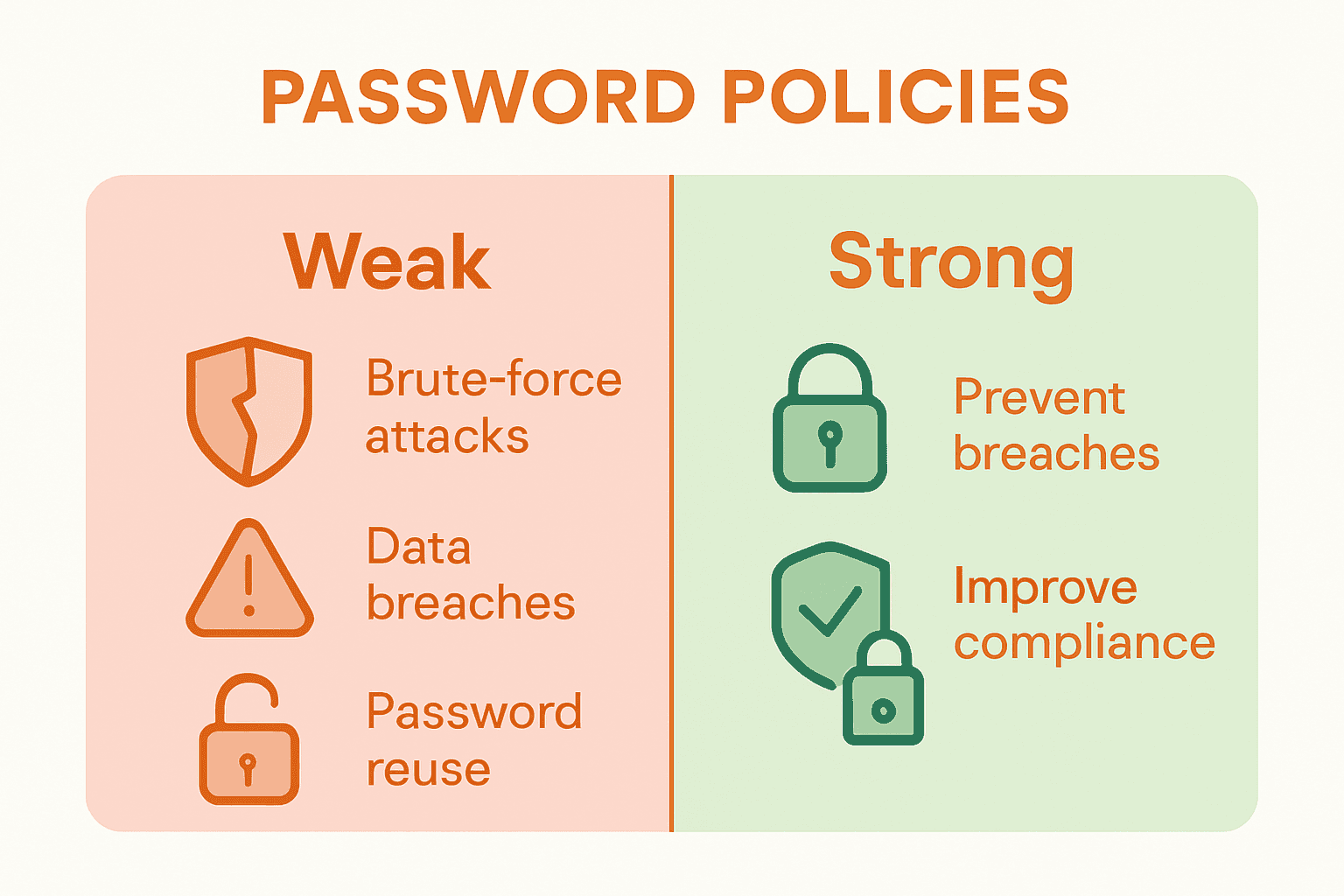
Cybercriminals exploit weak password policies through multiple sophisticated strategies. They leverage automated tools that can rapidly crack simple passwords, utilize sophisticated social engineering techniques, and target organizations with minimal authentication barriers. The financial and reputational consequences can be devastating, potentially resulting in millions of dollars in damages, legal liabilities, and long-term trust erosion among customers and stakeholders.
To mitigate these substantial risks, organizations must:
- Implement comprehensive password complexity requirements
- Enforce regular password rotation
- Deploy multi-factor authentication
- Conduct ongoing security awareness training
- Utilize advanced threat monitoring systems
Best Practices For Policy Enforcement
Policy enforcement represents the critical mechanism that transforms password guidelines from theoretical concepts into practical security measures. Earlham College provides innovative insights by recommending passphrases as a sophisticated approach to creating memorable yet secure authentication credentials, demonstrating how intelligent policy design can enhance both security and user experience.
Key strategies for effective password policy enforcement include:
- Implementing automated complexity checks
- Creating clear, accessible policy documentation
- Establishing consistent monitoring mechanisms
- Developing transparent accountability frameworks
- Designing user-friendly password reset processes
GeeksforGeeks reinforces the importance of passphrase strategies, highlighting that multi-word combinations offer significantly enhanced security while remaining easier for users to remember. This approach bridges the critical gap between stringent security requirements and user compliance.
Successful policy enforcement requires a holistic approach that balances technical requirements with human behavioral understanding. Organizations must design policies that are simultaneously robust and adaptable, recognizing that overly restrictive guidelines can inadvertently encourage dangerous workarounds. The most effective strategies integrate technological solutions with comprehensive user education, creating a collaborative security environment where employees understand and willingly participate in protecting organizational assets.
To maximize policy enforcement effectiveness, organizations should:
- Conduct regular security awareness training
- Provide clear, concise policy communication
- Use positive reinforcement techniques
- Implement gradual, understandable policy transitions
- Continuously evaluate and update enforcement mechanisms
Strengthen Your Security With Proven Password Management Solutions
The article highlights the critical challenges organizations face with weak or absent password policies. It underscores risks like credential theft, data breaches, and password fatigue that leave systems vulnerable to sophisticated cyber threats. If you are looking to enforce robust password policies that include multi-factor authentication, encrypted storage, and user-friendly management, these are exactly the challenges LogMeOnce addresses. Our platform transforms password management from a headache into a powerful defense layer.

Take control of your digital security today by exploring LogMeOnce and see how our innovative solutions simplify enforcing complex password policies across any organization. With features built for enterprises and government agencies to small businesses and individuals, it is time to protect your sensitive information with ease and confidence. Start your journey to stronger cybersecurity now and prevent security risks before they happen.
Frequently Asked Questions
What is a password policy and why is it important?
A password policy is a set of rules and guidelines designed to enhance computer security by ensuring users create and manage strong passwords. It is important because it helps protect sensitive information and digital systems from unauthorized access and cyber threats.
What are the key components of an effective password policy?
An effective password policy typically includes minimum password complexity requirements, mandatory password change intervals, restrictions on password reuse, multi-factor authentication protocols, and user education and awareness training.
How do weak password policies increase security risks?
Weak password policies can lead to vulnerabilities such as brute-force attacks, credential theft, data breaches, and compromised reputations. They also lead to practices like password reuse, which increases the likelihood of widespread security failures.
How can organizations enforce password policies effectively?
Organizations can enforce password policies by implementing automated complexity checks, creating clear policy documentation, establishing consistent monitoring mechanisms, developing accountability frameworks, and designing user-friendly password reset processes.
Recommended


