


 Password Manager
 Identity Theft Protection

 Team / Business
 Enterprise
 Government
 MSP
MSP


Security breaches cost American companies over $4 million per incident on average, raising urgent questions for IT managers everywhere. For medium-sized businesses, the pressure to strengthen access controls while making logins painless is growing. Biometric login technologies offer more than just password replacements, introducing advanced methods that combine unique human traits and seamless user experiences. This overview makes it clear what biometric authentication means, how it works, and why it matters for safeguarding your business operations.
Key Takeaways
| Point | Details |
|---|---|
| Biometric Authentication Enhances Security | Biometric login methods provide superior accuracy and convenience compared to traditional passwords, reducing unauthorized access risks. |
| Diverse Biometric Methods Available | Organizations can choose from various authentication methods like fingerprints, facial recognition, and voice patterns based on their specific needs and security requirements. |
| Regulatory Compliance is Essential | Businesses must navigate legal frameworks surrounding biometric data use, ensuring compliance with privacy regulations to protect user information. |
| Multi-Factor Authentication Recommended | Employing multi-factor authentication alongside biometric methods can further strengthen security and reduce the risk of breaches. |
Biometric Login Explained: Definition and Core Concepts
Biometric login represents a cutting-edge authentication method that utilizes unique physical or behavioral characteristics to verify an individual’s identity. Unlike traditional password systems, biometric authentication leverages distinctive human traits such as fingerprints, facial recognition, voice patterns, or retinal scans to grant secure access to digital systems and devices. This approach transforms how organizations and individuals protect sensitive information by replacing complex passwords with biological signatures that are inherently unique to each person.

At its core, biometric login works by capturing and analyzing specific physical or behavioral markers through specialized sensors and advanced algorithms. For instance, when you unlock a smartphone using facial recognition, the device’s camera captures multiple data points about your facial structure, creating a digital template that gets compared against stored reference data. Passwordless authentication technologies have dramatically improved this process, making identity verification faster, more accurate, and significantly more secure than traditional methods.
The primary mechanisms of biometric login involve three critical stages: data capture, data processing, and authentication matching. During capture, sophisticated sensors record precise measurements of a specific biometric trait. Processing transforms these raw measurements into a standardized digital format, creating a unique biometric profile. The final authentication stage compares the live sample against the stored profile, determining whether access should be granted. Modern biometric systems incorporate advanced techniques like liveness detection to prevent spoofing attempts, ensuring that only legitimate, present users can gain system access.
Pro tip: When implementing biometric login, always choose multi-factor authentication strategies that combine biological traits with additional verification methods for maximum security protection.
Types of Biometric Login Methods Compared
Biometric login technologies encompass a diverse range of authentication methods, each leveraging unique human characteristics to verify identity. These methods can be broadly categorized into two primary classifications: physiological biometrics and behavioral biometrics. Physiological biometrics focus on physical traits that are largely unchangeable, while behavioral biometrics analyze distinctive patterns of human activity that can evolve over time.
Physiological Biometric Methods include some of the most widely recognized authentication techniques. A comprehensive overview of biometric authentication systems highlights several key modalities:
- Fingerprint Recognition: Arguably the most common biometric method, analyzing unique ridge and valley patterns on fingertips
- Facial Recognition: Mapping facial features through advanced algorithms and geometric measurements
- Iris Scanning: Examining the intricate patterns in the colored ring around the pupil, considered extremely precise
- Retinal Scanning: Analyzing the unique blood vessel patterns at the back of the eye
Behavioral Biometric Methods offer a more dynamic approach to authentication, tracking how individuals interact with technology:
- Voice Recognition: Analyzing vocal characteristics like pitch, tone, and speech patterns
- Keystroke Dynamics: Examining typing rhythm, speed, and pressure
- Signature Verification: Assessing the unique way an individual signs their name
Each method presents distinct advantages and challenges. Fingerprint and facial recognition tend to be more user-friendly and widely implemented, while iris and retinal scanning offer higher accuracy but require more specialized equipment. Behavioral biometrics provide continuous authentication but can be less consistent due to variations in human performance.
Here’s a comparison of key biometric login methods and their ideal business applications:
| Biometric Method | Best Known For | Required Technology | Ideal Business Use |
|---|---|---|---|
| Fingerprint | Fast authentication | Optical or capacitive sensor | Employee access in offices |
| Facial Recognition | Touchless experience | High-resolution camera | Airport security, mobile devices |
| Iris Scan | Extreme accuracy | Infrared iris scanner | Healthcare, secure facilities |
| Voice Recognition | Remote verification | Microphone array | Call center authentication |
Pro tip: When selecting a biometric login method, consider your specific security requirements, user accessibility, and the potential for environmental variations that might impact authentication accuracy.
How Biometric Authentication Works Technically
Biometric authentication represents a sophisticated technological process that transforms unique human characteristics into secure digital signatures. The technical framework involves three fundamental stages: data acquisition, data processing, and pattern matching. These interconnected stages work seamlessly to convert complex biological information into a reliable authentication mechanism that can verify an individual’s identity with remarkable precision.
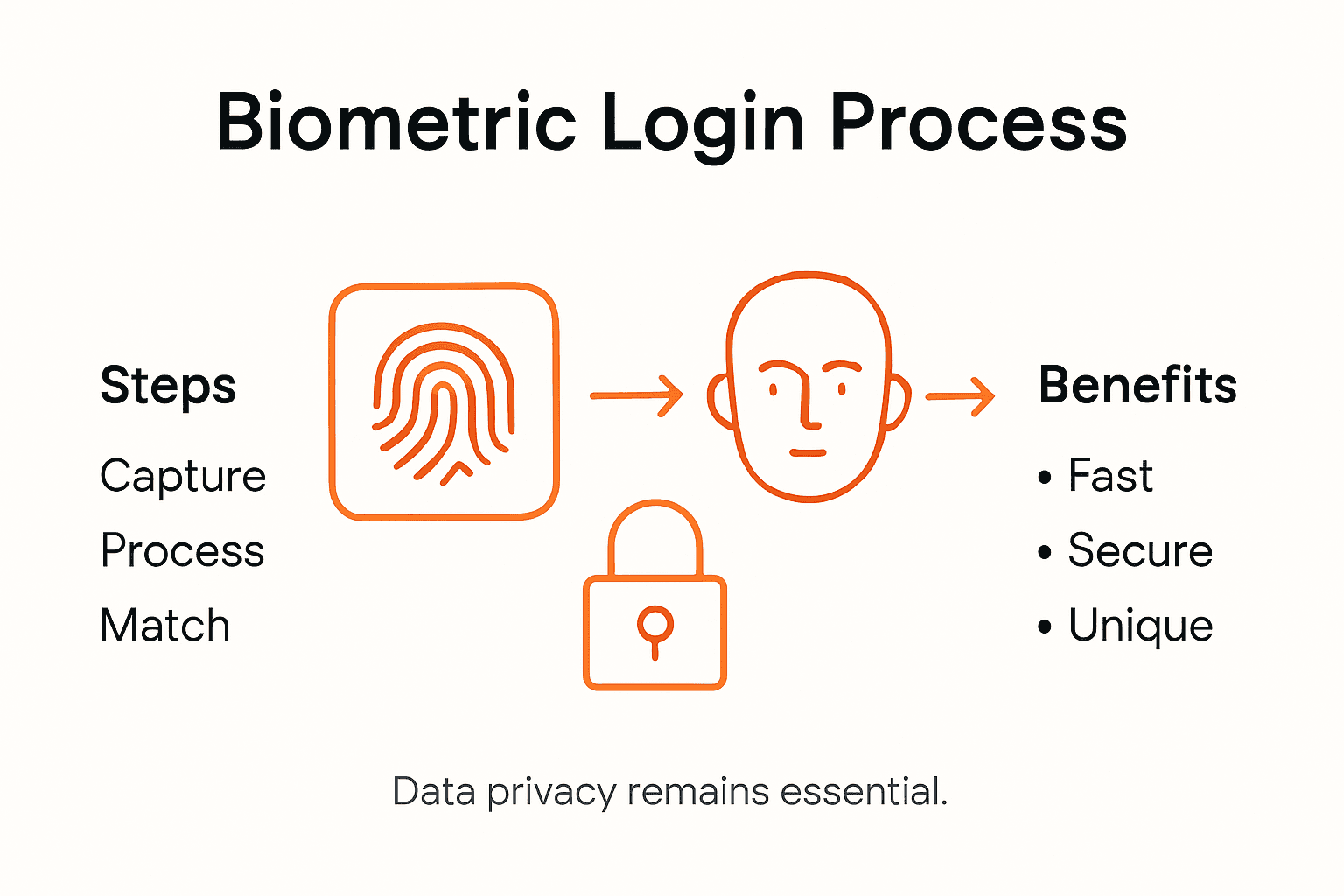
The initial data acquisition phase employs specialized sensors to capture intricate biological or behavioral details. Different biometric methods utilize distinct sensor technologies – fingerprint scanners use optical or capacitive sensors, facial recognition leverages high-resolution cameras, and voice recognition relies on sophisticated microphone arrays. Password management systems increasingly integrate these advanced sensor technologies to create multi-layered security protocols that go beyond traditional authentication methods.
During data processing, raw biometric data undergoes complex algorithmic transformation. Advanced mathematical models extract distinctive features and convert them into standardized digital templates. This process involves sophisticated signal processing techniques that normalize variations, remove background noise, and create a compact, unique representation of the original biometric trait. For instance, facial recognition algorithms might analyze over 80 distinct facial landmarks, converting them into a mathematical representation that can be quickly compared against stored profiles.
The final authentication stage involves intricate pattern matching, where the processed biometric template is compared against pre-registered reference templates. Sophisticated machine learning algorithms calculate similarity scores, applying complex statistical models to determine whether the live sample matches the stored profile. These algorithms incorporate advanced techniques like machine learning and artificial intelligence to improve accuracy, reduce false acceptance rates, and enhance overall security.
Pro tip: Implement multi-factor biometric authentication that combines different biometric methods to create a more robust and reliable identity verification system.
Business Applications and Real-World Use Cases
Biometric authentication has transformed security protocols across multiple industries, offering unprecedented levels of identity verification and access control. From financial institutions to government agencies, organizations are rapidly adopting these advanced technologies to mitigate security risks and streamline authentication processes. Enterprise security has fundamentally shifted from traditional password-based systems to more robust, reliable biometric solutions that provide granular control and real-time verification.
Common business uses of biometric technologies span several critical sectors with unique implementation strategies. Financial services represent a prime example, where banks and payment platforms leverage facial recognition and fingerprint scanning to prevent fraud and authenticate transactions. Corporate environments utilize biometric systems for:
- Employee Access Control: Restricting physical and digital entry points
- Time and Attendance Tracking: Eliminating buddy punching and manual timekeeping
- Secure Data Centers: Implementing multi-factor authentication for sensitive areas
- Mobile Device Management: Protecting corporate smartphones and tablets
Government and high-security industries have been particularly aggressive in biometric technology adoption. Airport security systems now routinely use facial recognition to verify traveler identities, dramatically reducing processing times and enhancing threat detection capabilities. Military and intelligence agencies employ advanced biometric screening to manage access to classified facilities, with some systems capable of identifying individuals from significant distances.
Healthcare and healthcare technology represent another frontier for biometric innovation. Patient identification systems use fingerprint and iris scanning to prevent medical errors, ensure accurate record-keeping, and protect patient privacy. Telemedicine platforms increasingly integrate biometric verification to securely authenticate patient and provider identities during remote consultations.
Pro tip: Conduct a comprehensive security audit to identify the most appropriate biometric authentication methods for your specific organizational infrastructure and risk profile.
Biometric Login Security: Benefits and Limitations
Biometric login technologies represent a complex security landscape with significant advantages and critical challenges. Advanced security analysis of biometric authentication reveals a nuanced approach to identity verification that fundamentally transforms traditional security paradigms. By leveraging unique human characteristics, these systems offer unprecedented protection against unauthorized access while simultaneously introducing complex security considerations.
The primary benefits of biometric login include:
- Unparalleled Authentication Accuracy: Biological traits are nearly impossible to replicate or steal
- Elimination of Password Vulnerabilities: No more weak passwords or credential sharing
- Seamless User Experience: Quick, frictionless access without memorizing complex credentials
- Enhanced Tracking and Accountability: Each access point generates verifiable, individual records
However, biometric systems are not without significant limitations. Potential security risks include sophisticated spoofing techniques where attackers might create artificial replicas of biometric traits. Facial recognition can be circumvented with high-resolution photographs, while fingerprint scanners might be tricked using advanced silicone molds. Moreover, unlike passwords, biometric data cannot be easily changed if compromised, creating a permanent vulnerability if initial security measures fail.
Organizations must carefully balance the convenience and security of biometric login against potential privacy and compliance challenges. Regulatory frameworks like GDPR in Europe and various state-level biometric privacy laws impose strict guidelines on collecting, storing, and managing biological identification data. This regulatory complexity requires robust data protection strategies, encrypted storage mechanisms, and transparent user consent protocols.
This summary table outlines key security pros and cons of biometric login:
| Security Aspect | Main Benefit | Major Limitation |
|---|---|---|
| Authentication Accuracy | Nearly impossible to forge | Biometrics can’t be changed if leaked |
| User Convenience | No need to remember passwords | May struggle in some environments |
| Data Privacy | Unique biometric records per user | Strict regulation and compliance |
| Attack Surface | Reduces credential theft | Vulnerable to advanced spoofing |
Pro tip: Implement multi-factor authentication that combines biometric verification with additional security layers to mitigate potential single-point-of-failure risks.
Risks, Privacy Concerns, and Common Pitfalls
Biometric authentication technologies, while innovative, introduce complex privacy and security challenges that organizations must carefully navigate. Comprehensive research on biometric authentication ethics reveals significant potential risks beyond technological vulnerabilities, highlighting critical concerns about individual rights, data protection, and potential systemic discrimination.
The primary privacy risks associated with biometric login systems include:
- Irreversible Personal Data Exposure: Unlike passwords, biological characteristics cannot be changed if compromised
- Potential Discriminatory Algorithmic Bias: Some facial recognition systems demonstrate lower accuracy for certain demographic groups
- Unauthorized Data Aggregation: Potential for cross-platform tracking and invasive personal profiling
- Consent and Transparency Challenges: Unclear mechanisms for user permission and data usage
Technical vulnerabilities present another significant concern. Sophisticated attackers can potentially exploit biometric systems through advanced spoofing techniques, including high-resolution image replication, 3D-printed facial masks, and synthetic voice recordings. These methods demonstrate that biometric authentication is not inherently foolproof, and organizations must implement robust multi-layered security protocols to mitigate potential breaches.
Regulatory landscapes add another layer of complexity to biometric authentication. Different jurisdictions maintain varying legal standards for biometric data collection, storage, and usage. Organizations must navigate intricate compliance requirements, ensuring they implement transparent data governance frameworks that protect individual privacy while maintaining effective security mechanisms.
Pro tip: Develop a comprehensive biometric data management policy that includes encrypted storage, limited retention periods, and clear user consent mechanisms to minimize privacy risks.
Strengthen Your Security with Advanced Biometric Login Solutions
The rise of biometric login presents a powerful solution to the challenges of traditional password vulnerabilities and complex identity management. If you are looking to enhance your organization’s authentication accuracy while providing a seamless user experience, leveraging biometric authentication combined with multi-factor authentication can protect against sophisticated spoofing and improve access control. Key pain points like irreversible biometric data exposure and regulatory compliance require a security partner that understands the nuances of biometric technology and data privacy.

Discover how LogMeOnce delivers comprehensive cybersecurity tools designed to secure your digital identities using cutting-edge biometric methods and passwordless MFA. Our platform integrates secure biometric login with encrypted cloud storage and dark web monitoring to create a resilient defense against evolving threats. Act now to safeguard your business with innovative security features and tailored plans that fit organizations of all sizes. Explore the powerful benefits for your team by visiting LogMeOnce and start your free trial today for a smarter, safer authentication experience. Learn more about passwordless authentication and strengthen your identity management with LogMeOnce’s password manager.
Frequently Asked Questions
What is biometric login?
Biometric login is an authentication method that uses unique physical or behavioral characteristics, such as fingerprints, facial recognition, and voice patterns, to verify a person’s identity and grant secure access to digital systems and devices.
How does biometric authentication enhance security compared to traditional passwords?
Biometric authentication enhances security by leveraging unique biological traits that are nearly impossible to replicate or steal, eliminating issues related to weak passwords, credential sharing, and forgotten login details.
What are the main types of biometric login methods?
The main types of biometric login methods include physiological biometrics like fingerprint recognition, facial recognition, iris and retinal scanning, and behavioral biometrics such as voice recognition, keystroke dynamics, and signature verification.
What are the potential privacy concerns with biometric login systems?
Potential privacy concerns with biometric login systems include irreversible personal data exposure, potential algorithmic biases, unauthorized data aggregation, and challenges related to user consent and transparency in data usage.
Recommended
- Consumer Top Features – LogMeOnce
- Passwordless Photon Login | Free Download
- Password Manager – LogMeOnce
- PasswordLess Photo Login – LogMeOnce


