


 Password Manager
 Identity Theft Protection

 Team / Business
 Enterprise
 Government
 MSP
MSP


More than half of all American businesses have experienced account takeover incidents in the past year, and the risk continues to climb worldwide. For IT security professionals, a single breach can expose sensitive assets and undermine hard-earned trust. Understanding how account takeover really works helps organizations see past common myths and implement smarter identity management—raising defenses not just in American companies but across international networks.
Key Takeaways
| Point | Details |
|---|---|
| Sophistication of Account Takeover | Account takeover is a strategic cybercrime, not a random occurrence, targeting specific vulnerabilities through various techniques. |
| Myths vs. Reality | Common misconceptions about account security can lead to poor protective measures; strong passwords alone are insufficient against modern threats. |
| Phases of Attack | Account takeover attacks typically occur in three stages: data gathering, account modification, and exploitation, increasing their stealth and impact. |
| Preventative Strategies | Organizations should implement multi-factor authentication, continuous monitoring, and comprehensive employee training to reduce susceptibility to attacks. |
Account Takeover Defined and Common Myths
Account takeover represents a sophisticated form of cybercrime where malicious actors gain unauthorized access to an individual’s digital accounts by stealing login credentials and personal information. Account takeover incidents can occur across multiple platforms, including banking, email, social media, and professional networks, with criminals exploiting vulnerabilities in digital security systems.
Contrary to popular misconceptions, account takeover is not just a random occurrence but a strategic attack targeting specific vulnerabilities. Cybercriminals employ multiple techniques to infiltrate accounts, including:
- Phishing emails designed to trick users into revealing login credentials
- Malware infections that capture keystrokes and login information
- Social engineering tactics that manipulate individuals into disclosing sensitive details
- Credential stuffing attacks using stolen passwords from previous data breaches
Many individuals mistakenly believe that strong passwords alone provide complete protection against account takeover. However, modern cybercriminals have sophisticated methods that can bypass traditional security measures. They often combine technical expertise with psychological manipulation, creating elaborate schemes that can compromise even well-protected accounts.
Here’s a comparison of common account takeover myths and the actual facts organizations should know:
| Myth | Reality | Consequence of Belief |
|---|---|---|
| Strong passwords are enough | Attackers use social engineering and malware | False confidence, poor security habits |
| Attacks are random | Attacks target specific vulnerabilities | Overlooked weak points |
| Only large companies targeted | Small businesses and individuals are also at risk | Inadequate safeguards for all sizes |
| Account takeover is easy to spot | Attacks often remain hidden for weeks | Delayed response, increased losses |
Pro tip: Enable two-factor authentication on all critical accounts and regularly monitor your digital footprint for suspicious activities.
Types of Account Takeover Attacks Today
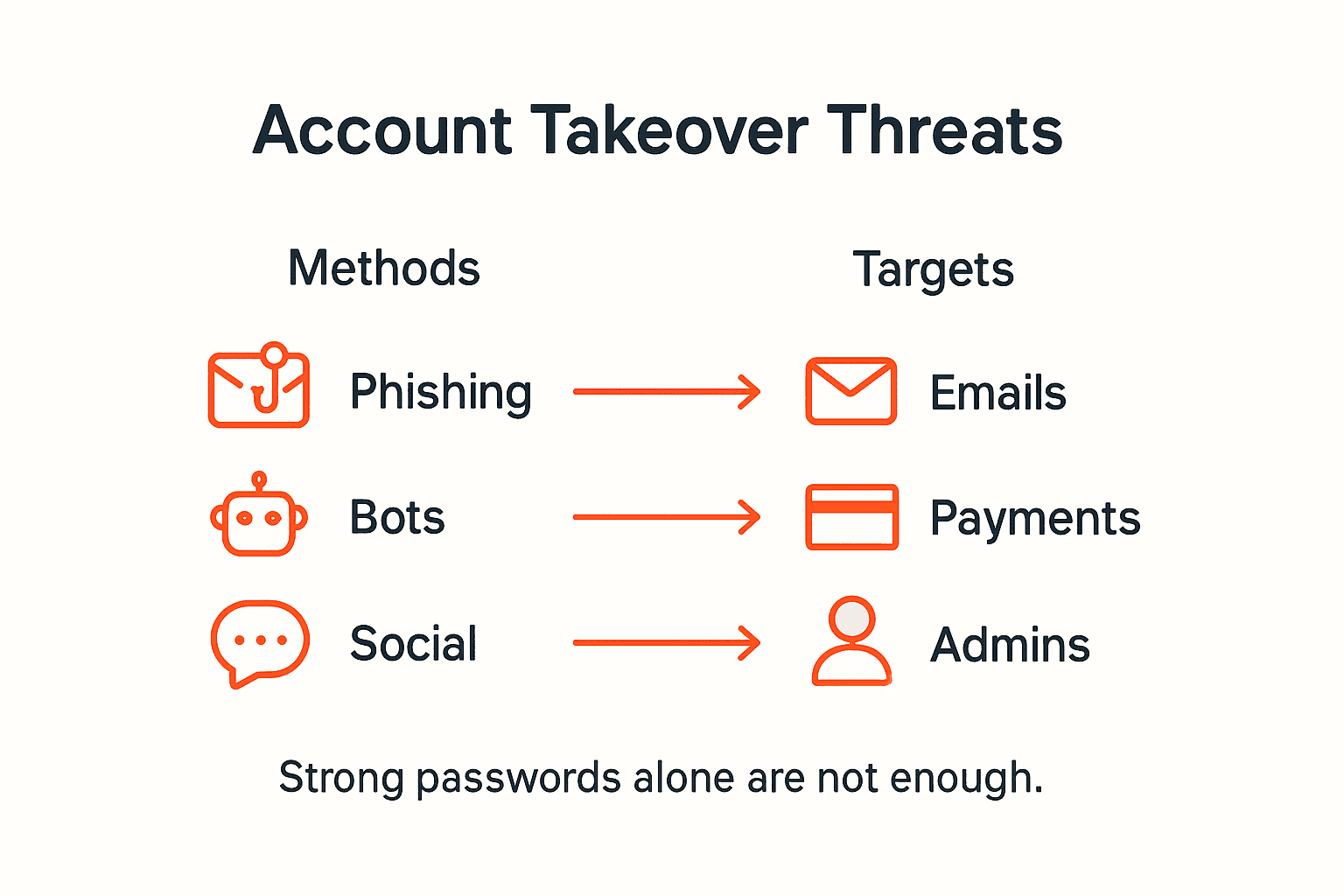
Account takeover attacks have evolved into sophisticated digital threats, with automated techniques targeting multiple platforms simultaneously. Modern cybercriminals leverage advanced technological strategies to breach digital security systems, exploiting vulnerabilities across personal and professional networks.
The primary types of account takeover attacks include:
- Credential Stuffing: Attackers use automated tools to test stolen username and password combinations across multiple platforms
- Brute Force Attacks: Systematic attempts to guess login credentials through repetitive password attempts
- Phishing Campaigns: Fraudulent communications designed to trick users into revealing sensitive login information
- Malware Injection: Deploying malicious software to capture keystrokes and authentication details
Automated account takeover techniques represent a significant threat, with bad bots performing large-scale credential breaches across eCommerce, financial, and social media platforms. These sophisticated attacks typically involve complex algorithmic approaches that can bypass traditional security measures, making detection increasingly challenging for organizations.
Cybercriminals frequently exploit weak password practices and low multi-factor authentication adoption, creating intricate strategies that compromise user accounts with minimal detection risk. The financial and reputational consequences of these attacks can be substantial, underscoring the critical importance of robust digital security practices.
Pro tip: Implement comprehensive password management strategies, including unique passwords for each account and regular credential rotation to minimize potential breach vulnerabilities.
How Account Takeover Attacks Unfold
Sophisticated account takeover attacks follow a meticulously designed multi-stage process that allows cybercriminals to systematically infiltrate and exploit digital accounts. These attacks are not random incidents but carefully orchestrated strategies targeting specific vulnerabilities in digital security systems.
The typical account takeover attack progresses through three critical phases:
- Data Gathering Stage
- Collecting login credentials through data breaches
- Harvesting information via phishing campaigns
- Purchasing stolen credentials from underground marketplaces
- Utilizing social engineering techniques
- Account Modification Stage
- Changing account settings to prevent detection
- Disabling security notifications
- Creating backup access points
- Manipulating account recovery mechanisms
- Impact and Exploitation Stage
- Executing unauthorized financial transactions
- Stealing sensitive personal information
- Launching further attacks using compromised accounts
- Monetizing stolen credentials
Complex account infiltration strategies often remain undetected for extended periods, allowing attackers to gradually expand their access and maximize potential damage. Cybercriminals continuously refine their techniques, developing increasingly sophisticated methods to bypass traditional security protocols and maintain prolonged unauthorized access.

The most dangerous aspect of these attacks lies in their ability to remain hidden, with attackers carefully managing their activities to avoid immediate detection. They strategically balance their malicious actions, ensuring they can exploit an account without triggering immediate security alerts or suspicion from the legitimate account owner.
This table summarizes the key phases of an account takeover attack and their business impact:
| Attack Phase | Description | Typical Business Impact |
|---|---|---|
| Data Gathering | Attackers collect credentials silently | No immediate signs, growing access risk |
| Account Modification | Criminals alter account settings | Security alerts disabled, control lost |
| Exploitation | Unauthorized activities occur | Financial loss, reputational harm |
Pro tip: Implement continuous account monitoring with real-time anomaly detection and set up immediate alert systems for any unexpected account changes or suspicious login activities.
Business Risks and Real-World Consequences
Corporate account takeover presents a devastating threat that can rapidly transform from a digital security incident into a comprehensive business catastrophe. The financial implications extend far beyond immediate monetary losses, potentially compromising an organization’s entire operational infrastructure and long-term sustainability.
The primary business risks associated with account takeover include:
-
Financial Losses
- Unauthorized wire and ACH transactions
- Direct theft from corporate bank accounts
- Potential multi-million dollar fraud damages
- Expensive forensic investigation costs
-
Operational Disruptions
- Critical system access interruptions
- Compromised internal communication channels
- Potential operational paralysis during recovery
- Extended downtime and productivity reduction
-
Reputational Damage
- Erosion of customer and partner trust
- Potential legal liability for data breaches
- Negative media exposure
- Long-term brand reputation impact
Real-world account takeover consequences extend beyond immediate financial harm, creating complex regulatory challenges that can fundamentally undermine an organization’s credibility. Businesses must not only address the immediate financial losses but also navigate intricate compliance requirements, potential legal actions, and the complex process of rebuilding stakeholder confidence.
The cascading effects of an account takeover can transform a single security breach into a systemic organizational crisis. Cybercriminals strategically target vulnerabilities that can trigger comprehensive operational failures, understanding that the true value of their attack lies not just in immediate financial gain but in the potential to destabilize entire corporate ecosystems.
Pro tip: Develop a comprehensive incident response plan with predefined protocols for immediate account lockdown, forensic investigation, and stakeholder communication to mitigate potential damage from account takeover incidents.
Proven Strategies to Prevent Account Takeover
Comprehensive risk management strategies are essential for organizations seeking to protect their digital infrastructure from account takeover threats. Modern cybersecurity requires a multifaceted approach that goes beyond traditional defensive mechanisms, integrating advanced technological solutions with human-centered security practices.
Key prevention strategies include:
- Authentication Enhancements
- Implement multi-factor authentication
- Use adaptive authentication technologies
- Create complex, unique passwords for each account
- Regularly rotate authentication credentials
- Monitoring and Detection
- Deploy real-time anomaly detection systems
- Implement behavioral analytics
- Establish continuous account activity monitoring
- Create automated threat alert mechanisms
- Employee Security Training
- Conduct regular phishing awareness programs
- Develop comprehensive cybersecurity education
- Simulate potential security breach scenarios
- Establish clear reporting protocols for suspicious activities
Advanced prevention technologies leverage machine learning and artificial intelligence to create dynamic, adaptive security frameworks. These intelligent systems can identify potential threats in real-time, distinguishing between legitimate user activities and potentially malicious access attempts with unprecedented accuracy.
Successful account takeover prevention requires a holistic approach that combines technological solutions, human expertise, and proactive risk management. Organizations must view cybersecurity as an ongoing process of adaptation, continuously updating their strategies to address emerging threats and technological innovations.
Pro tip: Conduct quarterly comprehensive security audits and maintain a flexible, adaptive cybersecurity framework that can rapidly respond to new account takeover techniques.
Strengthen Your Defenses Against Account Takeover Today
Account takeover attacks are increasingly sophisticated and can stay hidden for weeks while causing massive damage to your finances and reputation. If you are concerned about unauthorized access, compromised credentials, or the complex phases of account infiltration highlighted in the article, it is time to act now. Protecting your organization means combining advanced technologies like multi-factor authentication and continuous monitoring with smart password management.

Discover how LogMeOnce brings you a comprehensive security suite tailored to stop account takeover attacks before they start. Our solutions include passwordless MFA, encrypted cloud storage, and real-time anomaly detection designed for businesses of all sizes. Don’t wait for a breach to take control—explore LogMeOnce and empower your digital security infrastructure today to safeguard your critical accounts and sensitive data.
Frequently Asked Questions
What is account takeover?
Account takeover is a form of cybercrime where unauthorized individuals gain access to someone else’s digital accounts, such as email, banking, or social media, often using stolen credentials.
How do attackers typically gain access to accounts?
Attackers often gain access through methods like phishing emails, malware infections, social engineering, and credential stuffing attacks using previously leaked passwords.
What are the common signs of an account takeover?
Common signs include unusual account activity, unexpected password changes, and notifications of new devices or logins that you did not authorize.
Why is account takeover a significant concern for businesses?
Account takeover poses a major threat to businesses due to potential financial losses, operational disruptions, and reputational damage, which can lead to a total collapse of trust and stability in the organization.
Recommended
- Media Coverage – LogMeOnce
- Identity Theft Protection – LogMeOnce
- Identity Theft Protection & Dark Web Scan – LogMeOnce
- Biggest Hacker Attacks in History – LogMeOnce


