


 Password Manager
 Identity Theft Protection

 Team / Business
 Enterprise
 Government
 MSP
MSP


Nearly 90 percent of large organizations have reported identity-based cyberattacks in just the past year. For american IT managers facing growing threats, managing user access and data permissions across global operations has never been more complicated. Understanding the core concepts behind advanced identity management frameworks helps to reduce risk, strengthen compliance with American and European regulations, and equip enterprises to meet fast-changing cybersecurity demands.
Key Takeaways
| Point | Details |
|---|---|
| Identity Management Frameworks Enhance Security | Organizations must adopt robust identity management frameworks to protect sensitive information and streamline user access. |
| Framework Types Vary in Control and Scalability | Centralized, federated, and decentralized frameworks each offer distinct advantages in user control and scalability. |
| Regulatory Compliance is Critical | Compliance with standards such as GDPR and HIPAA is essential for protecting user privacy and maintaining trust. |
| Regular Assessment Mitigates Risks | Annual assessments of identity management frameworks are recommended to identify security gaps and ensure compliance with evolving regulations. |
Core Concepts of Identity Management Frameworks
Identity management frameworks represent strategic approaches organizations use to control digital identities, access permissions, and security protocols across complex technological ecosystems. These sophisticated systems enable enterprises to manage user authentication, authorization, and access management with precision and scalability. Modern identity management taxonomies demonstrate an evolutionary progression from traditional centralized models toward more flexible, user-centric architectures.
At their core, identity management frameworks encompass several critical components that work synergistically to protect organizational resources. These typically include user provisioning, access governance, authentication mechanisms, and authorization controls. Each component plays a unique role in establishing secure digital interactions. Comprehensive digital identity management systems analyze these elements across multiple domains, recognizing that effective frameworks must balance robust security with operational efficiency.
The primary objectives of robust identity management frameworks center on three fundamental goals: protecting sensitive information, ensuring regulatory compliance, and streamlining user experiences. Organizations implement these frameworks to achieve granular control over who accesses specific systems, when, and under what conditions. Key features often include:
- Centralized user identity repositories
- Role-based access controls
- Multi-factor authentication protocols
- Comprehensive audit and logging capabilities
- Automated user lifecycle management
Expert Recommendation: Conduct a comprehensive identity management framework assessment annually to identify potential security gaps and ensure alignment with evolving technological and regulatory landscapes.
Types of Frameworks and Key Technologies
Identity management technologies have evolved dramatically, presenting organizations with a spectrum of frameworks ranging from traditional centralized models to advanced decentralized architectures. Comparative studies of self-sovereign identity models reveal the complexity of modern identity management strategies, highlighting how different approaches address critical challenges like privacy, scalability, and governance.
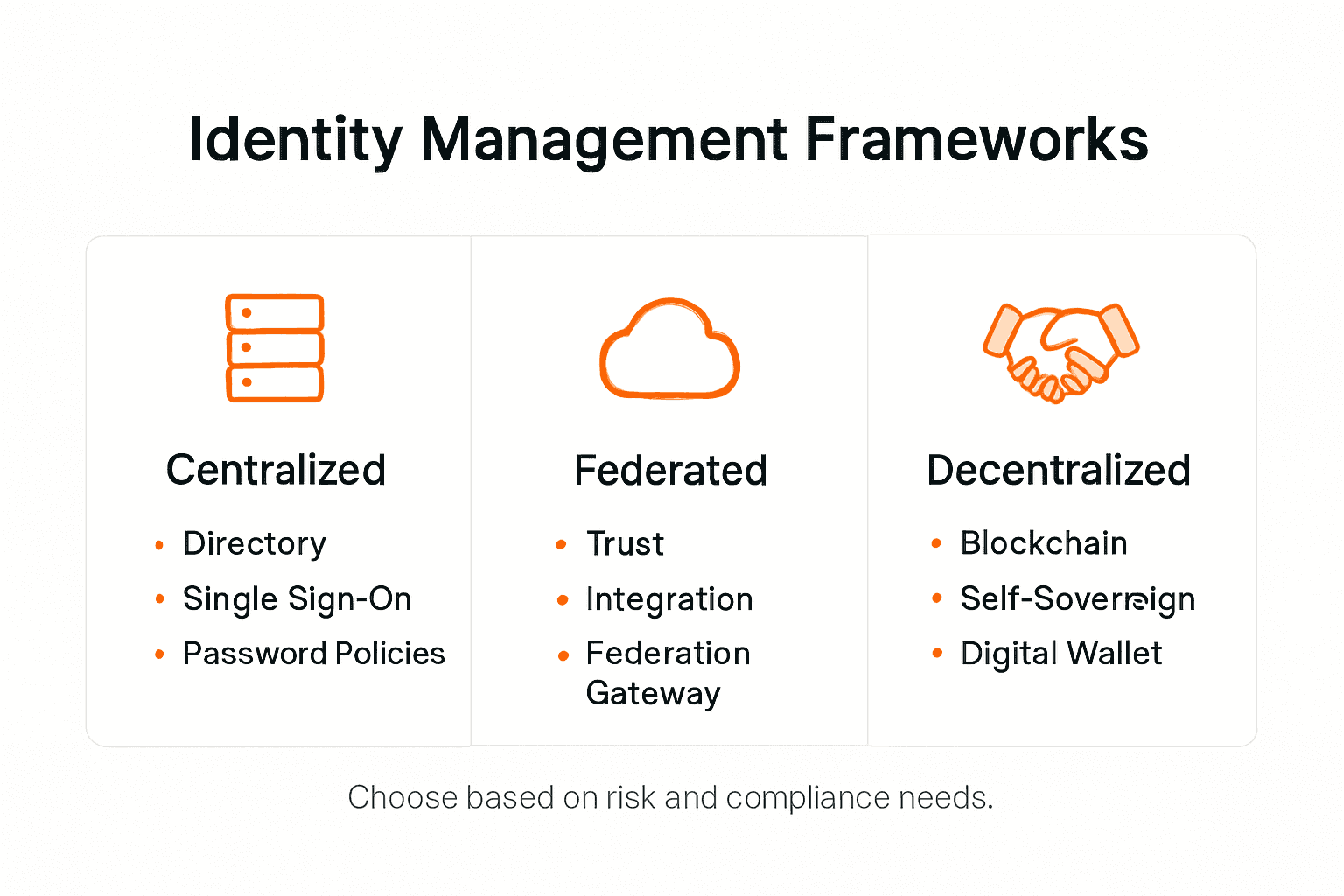
The primary identity management frameworks can be categorized into three fundamental types: centralized, federated, and decentralized systems. Centralized frameworks operate through a single, authoritative identity provider managing all authentication processes. Federated frameworks enable identity sharing across multiple organizations and domains, allowing seamless authentication through trusted intermediaries. Comprehensive identity management system surveys demonstrate that decentralized frameworks, particularly blockchain-based solutions like Sovrin and Hyperledger Indy, represent the most innovative approach by eliminating central authority and empowering individual user control.
This table highlights the differences between centralized, federated, and decentralized identity management frameworks:
| Framework Type | Core Advantage | Scalability | User Control |
|---|---|---|---|
| Centralized | Simple administration | Limited by provider | Low |
| Federated | Cross-organization access | Moderate to high | Medium |
| Decentralized | User autonomy, privacy | Highly scalable | High |
Key technologies driving these frameworks include:
- Authentication Protocols
- Security Assertion Markup Language (SAML)
- OpenID Connect
- OAuth 2.0
- Blockchain Technologies
- Public blockchain networks
- Permissioned blockchain systems
- Distributed ledger technologies
- Biometric Verification
- Facial recognition
- Fingerprint scanning
- Voice authentication
Pro Recommendation: Evaluate your organization’s specific security requirements and user experience needs before selecting an identity management framework to ensure optimal performance and protection.
How Identity Management Works in Enterprises
Enterprise identity management represents a sophisticated ecosystem of technologies and processes designed to secure, manage, and control digital identities across complex organizational environments. Systematic enterprise identity and access management requirements demonstrate a comprehensive approach that encompasses multiple critical stages of user lifecycle management, from initial onboarding to continuous access governance.

The operational framework of identity management in enterprises typically follows a structured progression that ensures robust security and operational efficiency. This process begins with employee onboarding, where comprehensive user profiles are created and integrated into the organization’s central identity repository. Subsequently, role-based access control mechanisms determine precise permission levels, ensuring employees can access only the systems and resources essential to their specific job functions. Enterprise password management strategies complement these efforts by establishing strong authentication protocols that protect sensitive organizational assets.
Key components of enterprise identity management include:
- User Provisioning
- Automated account creation
- Role assignment
- Access level determination
- Authentication Mechanisms
- Multi-factor authentication
- Biometric verification
- Single sign-on technologies
- Continuous Monitoring
- Regular access reviews
- Anomaly detection
- Compliance tracking
- Deprovisioning Processes
- Automatic account suspension
- Access revocation upon employee departure
- Comprehensive audit trails
Expert Recommendation: Implement a dynamic identity management strategy that balances stringent security protocols with user experience, ensuring both comprehensive protection and operational flexibility.
Regulatory Standards and Compliance Requirements
Navigating the complex landscape of regulatory standards requires organizations to implement rigorous identity management frameworks that meet diverse international compliance requirements. Global digital identity standards provide comprehensive guidelines for organizations seeking to establish robust identity and access management protocols that align with evolving cybersecurity policies.
The most prominent regulatory standards impacting identity management include General Data Protection Regulation (GDPR), Health Insurance Portability and Accountability Act (HIPAA), Payment Card Industry Data Security Standard (PCI DSS), and Sarbanes-Oxley Act. Each framework mandates specific requirements for protecting sensitive information, ensuring user privacy, and maintaining transparent access control mechanisms. These regulations demand organizations implement multi-layered security approaches that encompass user authentication, data protection, periodic access reviews, and comprehensive audit trails.
Here is a summary of regulatory standards and their unique focus areas:
| Standard | Main Focus | Applies To | Key Enforcement Mechanism |
|---|---|---|---|
| GDPR | Data privacy | EU organizations | Fines for breaches |
| HIPAA | Health data security | Healthcare providers | Mandatory audits |
| PCI DSS | Payment information | Payment processors | Annual assessments |
| SOX | Financial integrity | Public companies | Rigorous reporting |
Key compliance requirements across different regulatory frameworks typically include:
- Data Protection Principles
- User consent management
- Personal data minimization
- Purpose limitation
- Storage restriction
- Access Control Standards
- Role-based access restrictions
- Least privilege principle
- Mandatory access logging
- Regular permission audits
- Security Verification Processes
- Multi-factor authentication
- Continuous monitoring
- Incident response protocols
- Breach notification procedures
- Documentation Requirements
- Comprehensive access logs
- User consent records
- Security policy documentation
- Risk assessment reports
Expert Recommendation: Develop a proactive compliance strategy that anticipates regulatory changes, integrating flexible identity management frameworks capable of adapting to evolving cybersecurity landscapes.
Risks, Costs, and Key Implementation Challenges
Systematic reviews of identity and access management reveal a complex landscape of technological, economic, and operational challenges that organizations must navigate when implementing robust identity management frameworks. The multifaceted nature of these challenges demands a strategic approach that balances security requirements with operational efficiency and user experience.
The primary risks associated with identity management implementation encompass several critical domains. Cybersecurity vulnerabilities represent the most significant threat, with potential for data breaches, unauthorized access, and sophisticated social engineering attacks. Financial implications are equally substantial, with implementation costs ranging from significant infrastructure investments to ongoing maintenance expenses. User-centric identity management research highlights the complex balance between technical implementation and user experience that organizations must carefully manage.
Key implementation challenges include:
- Technological Barriers
- Legacy system integration
- Interoperability issues
- Complex authentication protocols
- Scalability limitations
- Economic Challenges
- High initial investment costs
- Ongoing maintenance expenses
- Training and personnel development
- ROI uncertainty
- Operational Risks
- User resistance to new systems
- Performance impact
- Productivity disruptions
- Compliance complexity
- Security Vulnerabilities
- Potential authentication failures
- Data breach risks
- Insider threat management
- Third-party access controls
Expert Recommendation: Conduct a comprehensive risk assessment and develop a phased implementation strategy that prioritizes security, user adoption, and scalable technology integration.
Comparing Frameworks and Avoiding Common Mistakes
Business selection criteria for comparing identity management frameworks reveal critical insights into how organizations can effectively evaluate and implement sophisticated digital identity solutions. The process of selecting an appropriate framework demands a nuanced approach that goes beyond surface-level feature comparisons, requiring deep understanding of organizational specific needs, technological compatibility, and long-term strategic alignment.
The most significant challenges emerge from common implementation mistakes that can compromise an organization’s security and operational efficiency. Fragmented identity management represents one of the most prevalent risks, where organizations fail to develop a holistic approach that integrates seamlessly across different systems and platforms. Comprehensive mapping of identity management models highlights critical gaps in implementation strategies, emphasizing the importance of developing frameworks that address cross-organizational interoperability and maintain robust trustworthiness.
Key comparison criteria and common mistakes to avoid include:
- Evaluation Dimensions
- Scalability potential
- Security architecture
- Integration complexity
- Total cost of ownership
- Common Implementation Mistakes
- Ignoring legacy system constraints
- Overlooking user experience
- Insufficient access governance
- Neglecting continuous monitoring
- Comparative Assessment Factors
- Authentication mechanisms
- Compliance capabilities
- Performance metrics
- Vendor support ecosystem
- Risk Mitigation Strategies
- Comprehensive security audits
- Phased implementation approach
- Regular framework reassessment
- Adaptive security protocols
Expert Recommendation: Develop a rigorous framework evaluation methodology that prioritizes comprehensive security, user adaptability, and long-term organizational strategic objectives.
Strengthen Your Enterprise Security With Advanced Identity Management Solutions
Organizations face growing challenges managing digital identities securely while balancing usability and compliance. This article highlights critical pain points such as protecting sensitive information, implementing multi-factor authentication, and ensuring seamless user provisioning and deprovisioning. It emphasizes the need for a scalable identity management framework that reduces enterprise risk and adapts to evolving regulatory standards.
LogMeOnce offers an innovative suite of cybersecurity tools designed to tackle these very challenges. With features like passwordless multi-factor authentication, single sign-on, and encrypted cloud storage, LogMeOnce empowers businesses to streamline access governance and protect against unauthorized data breaches. Don’t let complex identity frameworks slow your operations or expose vulnerabilities.

Explore how LogMeOnce can transform your identity management strategy today. Visit our comprehensive cybersecurity and password management solutions to experience flexible plans built for enterprises of all sizes. Secure your organization’s future by adopting a trusted platform that delivers both security and ease of use. Take action now—reduce your enterprise risk with LogMeOnce.
Frequently Asked Questions
What are the core components of an identity management framework?
The core components of an identity management framework include user provisioning, access governance, authentication mechanisms, and authorization controls. These elements work together to secure digital interactions and manage user access effectively.
How can an organization ensure compliance with regulatory standards in identity management?
To ensure compliance, organizations should implement multi-layered security approaches that include user authentication, data protection, periodic access reviews, and comprehensive audit trails, aligning with regulations like GDPR and HIPAA.
What are the primary risks associated with identity management frameworks?
The primary risks include cybersecurity vulnerabilities, financial implications from implementation costs, and operational risks such as user resistance and compliance complexities. Organizations should conduct risk assessments to mitigate these risks effectively.
What should organizations consider when comparing different identity management frameworks?
When comparing identity management frameworks, organizations should evaluate scalability potential, security architecture, integration complexity, and total cost of ownership while avoiding common mistakes like neglecting legacy system constraints and user experience.
Recommended
- The Finesses of Enterprise Password Management
- Identity and Access Management Software | LogMeOnce
- Government Ficam Identity and Access Management-2 – LogMeOnce
- How an Enterprise Password Manager Augments Efficiency and Security


