


 Password Manager
 Identity Theft Protection

 Team / Business
 Enterprise
 Government
 MSP
MSP


TL;DR:
- Authentication verifies user identity before resource access, with distinctions crucial between authentication and authorization. Modern security increasingly relies on phishing-resistant methods like passkeys and hardware keys, reinforced by strong session controls and centralized policies to prevent breaches. Implementing layered, well-managed authentication systems is essential for safeguarding personal and enterprise resources in 2026.
Authentication is the security process of verifying the identity of a user, device, or system before granting access to protected resources. Most people conflate authentication with authorization, but these are distinct concepts: authentication answers “who are you?” while authorization answers “what are you allowed to do?” Getting this distinction wrong leads directly to security misconfigurations. Understanding authentication methods is the foundation of any serious access management strategy, whether you are securing a personal account or an enterprise network. The FIDO Alliance, NIST, and modern passkey standards have reshaped what good authentication looks like in 2026.
What are the main types of authentication methods?
Authentication methods fall into three foundational categories based on what the user presents: something you know, something you have, or something you are. Each category carries different security tradeoffs, and most modern systems combine at least two.
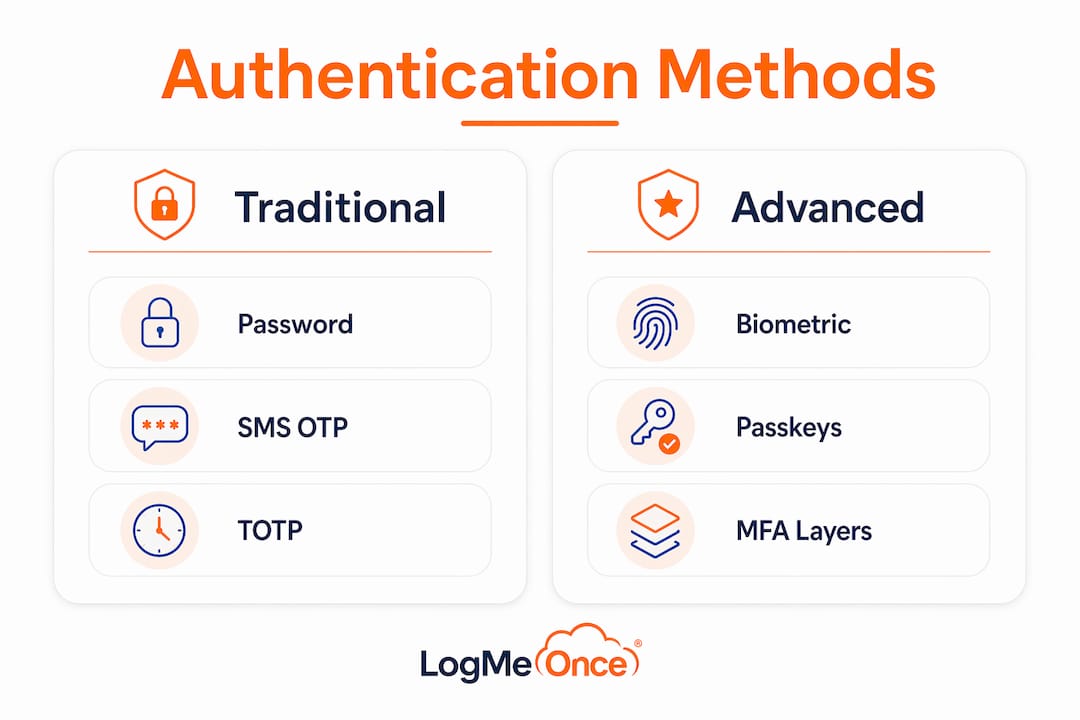
Password-based authentication is the oldest and most widely deployed method. A user supplies a secret string that the system compares against a stored hash. The weakness is well-documented: passwords get reused, stolen in breaches, and guessed through brute force. Creating strong passwords and pairing them with a password manager significantly reduces these risks, but passwords alone remain the most phishable credential in existence.
Multi-factor authentication (MFA) layers a second or third factor on top of a password. Common variants include TOTP (time-based one-time passwords) generated by apps like Google Authenticator or Authy, SMS OTP codes sent to a registered phone number, and hardware security keys such as YubiKey. SMS OTP is better than nothing, but it is vulnerable to SIM-swapping attacks. TOTP is stronger. Hardware keys are the most phishing-resistant option in the MFA category.
Biometric authentication uses physical characteristics: fingerprints, facial geometry, iris patterns, or voice. Apple Face ID, Windows Hello, and Android fingerprint sensors are the most familiar examples. Biometrics are fast and convenient, but they introduce a unique risk: you cannot change your fingerprint if it is compromised.

Passkeys represent the newest category. Built on the FIDO2/WebAuthn standard, passkeys replace passwords with cryptographic key pairs stored on the user’s device. They are phishing-resistant by design because the private key never leaves the device.
| Method | Security level | Ease of use | Phishing resistant |
|---|---|---|---|
| Password only | Low | High | No |
| Password + SMS OTP | Medium | Medium | No |
| Password + TOTP | Medium-high | Medium | No |
| Hardware security key | High | Medium | Yes |
| Passkeys (FIDO2) | Very high | High | Yes |
| Biometrics (device-bound) | High | Very high | Yes |
Pro Tip: If you are choosing between TOTP and SMS OTP for MFA, always prefer TOTP. SMS codes can be intercepted through SIM-swap attacks, while TOTP codes are generated locally and never transmitted over a phone network.
What are best practices for authentication security?
Strong authentication is not just about picking the right method. The controls surrounding your authentication system determine whether it holds up under real attack conditions.
NIST SP 800-63B guidance discourages arbitrary password rotation unless there is evidence of compromise, and recommends long passphrases managed with modern hashing. This overturns the old “change your password every 90 days” rule that security teams enforced for years. Forced rotation actually degrades security because users predictably append numbers or cycle through minor variations.
Password storage is a critical control. Argon2id is the current recommended hashing algorithm, followed by bcrypt as a widely trusted fallback. MD5 and SHA-1 are completely unacceptable for password storage in 2026. A breach that exposes Argon2id hashes gives attackers almost nothing to work with. A breach exposing MD5 hashes is effectively a plaintext leak.
Session management is where many otherwise solid authentication systems fall apart. Secure session tokens require at least 128 bits of entropy, and cookies must carry HttpOnly, Secure, and SameSite flags. This prevents JavaScript from reading session cookies and blocks cross-site request forgery. Session IDs must be regenerated after every authentication state change, including login, privilege escalation, and logout.
Here is a practical checklist of controls every authentication system should implement:
- Hash all passwords with Argon2id or bcrypt before storage.
- Enforce MFA for all privileged accounts and, ideally, all user accounts.
- Implement rate limiting and account lockout to block brute force attempts.
- Set HttpOnly, Secure, and SameSite=Strict flags on all session cookies.
- Regenerate session IDs after login and after any privilege change.
- Use short-lived access tokens paired with refresh token rotation for API authentication.
- Audit all authentication events and alert on anomalies like impossible travel or repeated failures.
- Test password reset flows separately. Recovery paths are a common attack vector.
Pro Tip: Check your NIST compliance posture before auditing your authentication stack. NIST assurance levels map directly to the authentication methods your organization should require for different risk tiers.
WorkOS recommends making passkeys the default, layering phishing-resistant MFA, and using short-lived tokens with refresh rotation. This combination addresses the three most common attack vectors: credential theft, phishing, and session hijacking.
How do advanced authentication methods improve security?
Passkeys and passwordless authentication have moved from theoretical to mainstream. The FIDO Alliance reported that organizations deploying passkeys see 47% improved security confidence, 45% faster logins, and 32% reduced phishing incidents. These are not marginal gains. Faster logins reduce friction enough that users actually prefer passkeys over passwords once they try them.
The technical reason passkeys resist phishing is cryptographic binding. FIDO2/WebAuthn binds credentials to the legitimate relying-party origin, meaning a credential created for "yourbank.comcannot be used onyourb4nk.com`. A phishing site that captures a passkey authentication attempt gets nothing reusable. This is fundamentally different from passwords or even TOTP codes, which can be relayed in real time by an attacker sitting between the user and the legitimate site.
Despite this progress, 57% of organizations still rely on phishable methods for employee sign-in in 2026. That gap between what is available and what is deployed represents the largest addressable risk in enterprise authentication today.
Steps organizations can take to move toward passwordless authentication:
- Audit current authentication methods and identify which user populations still rely on passwords alone.
- Deploy passkeys for consumer-facing applications first, where user experience gains are most visible.
- Require hardware security keys or platform authenticators for privileged and administrative accounts.
- Maintain a documented fallback authentication flow, but make sure fallback methods are not weaker than primary methods.
- Train users on passkey enrollment before deprecating passwords to avoid support surges.
“The shift to phishing-resistant authentication is not a future goal. It is a present necessity. Every day an organization runs password-only authentication for privileged accounts is a day it accepts a risk that modern tooling has already solved.”
What are common authentication pitfalls to avoid?
Even organizations with strong primary authentication methods get compromised through gaps in their implementation. The most common pitfalls are predictable and preventable.
Weak recovery flows are the most dangerous trap. Password recovery mechanisms that use long-lived or reusable tokens give attackers a persistent entry point. Best practice requires short-lived, single-use tokens delivered over a verified channel and invalidated immediately after use. If your primary authentication is a hardware key but your account recovery is a security question, attackers will always target the recovery path.
Inconsistent MFA enforcement is the second major failure mode. Scattered MFA policies across different applications create gaps that attackers exploit. An organization might enforce MFA on its main application but leave an internal admin panel or legacy API endpoint unprotected. Centralized policy enforcement and regular audits are the only reliable fix.
Session fixation and insecure cookies remain surprisingly common. Secure session cookies require strict HttpOnly, Secure, and SameSite flags, plus session ID regeneration after authentication state changes. Skipping any one of these controls opens the door to session hijacking or cross-site scripting attacks that steal active sessions.
Username enumeration is a subtle but serious exposure. Login and password reset endpoints that return different error messages for valid versus invalid usernames let attackers build a list of real accounts before attempting any credential attack. Generic error messages like “Invalid credentials” prevent this.
Pro Tip: Treat your fallback authentication path as a primary attack surface. If your two-factor authentication setup is strong but your account recovery sends a link to an unverified email address, you have not actually secured the account.
Session revocation strategy also shapes your security model. Server-side sessions allow immediate revocation when a compromise is detected. Token-only schemes require short token lifetimes and revocation lists to achieve the same result. Neither approach is universally better, but the choice must be deliberate and documented.
Key takeaways
Authentication security depends on combining phishing-resistant methods, strong session controls, and consistent policy enforcement across every access path in your organization.
| Point | Details |
|---|---|
| Passkeys lead in security | FIDO2 passkeys are phishing-resistant by design and reduce phishing incidents by 32% in deployed organizations. |
| NIST discourages forced rotation | Arbitrary password changes degrade security; use long passphrases and modern hashing like Argon2id instead. |
| Session controls are non-negotiable | HttpOnly, Secure, and SameSite cookie flags plus session ID regeneration prevent the most common session attacks. |
| Recovery flows are the weakest link | Fallback and recovery methods must match the security level of primary authentication or they become the attack vector. |
| MFA policy must be centralized | Scattered enforcement creates gaps; audit all applications and enforce MFA from a single policy source. |
Why authentication strategy is more than just picking a method
I have spent years watching organizations treat authentication as a checkbox. They deploy MFA, check the box, and move on. Then they get breached through a forgotten admin portal that still accepts a username and password, or through a password reset flow that emails a link valid for 48 hours.
The uncomfortable truth is that authentication is a system, not a feature. The method you choose matters, but the controls around it matter just as much. I have seen organizations running FIDO2 hardware keys for primary login while their helpdesk resets accounts by answering three security questions. That is not a secure authentication system. That is a secure front door with an unlocked window.
My honest recommendation for 2026: start with an audit of every authentication path, including recovery flows, API keys, service accounts, and legacy applications. Most organizations are surprised by what they find. Then prioritize phishing-resistant methods for privileged accounts first, because that is where a breach causes the most damage. Passkeys are ready for production. The FIDO Alliance data is clear. The friction argument against them has largely collapsed now that platform authenticators on iOS, Android, Windows, and macOS handle enrollment natively.
One more thing: do not underestimate the operational side. The best authentication technology fails if users do not understand how to use it or if IT cannot enforce it consistently. Policy consolidation and user training are not glamorous, but they determine whether your authentication investment actually holds.
— Mike
Strengthen your authentication with LogMeOnce

LogMeOnce gives individuals and organizations a single platform to manage authentication across every account and application. Its cybersecurity platform covers passwordless MFA, single sign-on, encrypted password storage, and dark web monitoring. Whether you are replacing weak passwords across a personal account portfolio or enforcing phishing-resistant MFA across an enterprise, LogMeOnce provides the tools to do it without juggling multiple vendors. The platform supports TOTP, hardware keys, biometrics, and passkeys, so you can match the authentication method to the risk level of each account. Start with a free trial and see how much of your current authentication exposure you can close in a single afternoon.
FAQ
What is the difference between authentication and authorization?
Authentication verifies who you are, while authorization determines what you are allowed to access. Conflating the two leads to security misconfigurations where users gain access to resources they should not see.
What is the most secure authentication method available in 2026?
Passkeys built on the FIDO2/WebAuthn standard are currently the most phishing-resistant option. They use cryptographic key pairs bound to specific origins, preventing credential replay even if a user visits a phishing site.
Why does NIST discourage regular password changes?
NIST SP 800-63B found that forced periodic rotation causes users to make predictable, minor changes rather than genuinely new passwords. Password changes are only recommended when there is evidence of compromise.
How does MFA protect against phishing attacks?
Standard MFA methods like SMS OTP and TOTP reduce risk but do not fully stop phishing because codes can be relayed in real time. Only phishing-resistant methods like FIDO2 hardware keys and passkeys block this attack by binding credentials cryptographically to the legitimate site origin.
What makes a session token secure?
A secure session token requires at least 128 bits of cryptographic randomness, must be transmitted only over HTTPS, and must be stored in cookies with HttpOnly, Secure, and SameSite flags set. The token must also be regenerated after every login or privilege change to prevent session fixation attacks.


