


 Password Manager
 Identity Theft Protection

 Team / Business
 Enterprise
 Government
 MSP
MSP


Role of MSPs in Data Security: Complete Guide

Cyber attacks strike businesses every 39 seconds, putting sensitive data at constant risk. Organisations of all sizes face mounting pressure to protect their networks while keeping up with evolving threats. For many, Managed Service Providers (MSPs) now offer a lifeline by delivering expert solutions that go far beyond traditional IT support. Discover how MSPs safeguard your digital assets and set new standards for data security in a challenging online world.
Key Takeaways
| Point | Details |
|---|---|
| Role of MSPs | Managed Service Providers (MSPs) optimize digital infrastructure and security for businesses by outsourcing essential technological responsibilities, enhancing efficiency and reducing costs. |
| Data Security Focus | MSPs provide comprehensive data security services including continuous monitoring, incident response, and compliance management to protect against evolving cyber threats. |
| Comparative Advantages | MSPs offer specialized expertise, 24/7 monitoring, and advanced technologies, often outperforming in-house IT teams in security effectiveness and cost management. |
| Risk Management Practices | Proactive risk assessment and incident response frameworks are vital for MSPs to effectively mitigate cybersecurity threats and align with client security outcomes. |
Defining MSPs and Data Security Fundamentals
Managed Service Providers (MSPs) are specialized organizations that offer comprehensive technology management solutions for businesses seeking to optimize their digital infrastructure and security. According to Wikipedia, MSPs involve outsourcing critical technological responsibilities to improve operational efficiency and reduce expenses, allowing organizations to concentrate on their core business activities.
At the heart of MSP services is data security – a multifaceted approach to protecting an organization’s digital assets. As defined by managed security service research, these providers deliver round-the-clock monitoring and management of complex security systems. Their services typically encompass:
- Continuous network monitoring
- Intrusion detection and prevention
- Firewall management
- Security patch and upgrade implementation
- Comprehensive security assessments
- Emergency response protocols
The strategic value of MSPs lies in their ability to provide expert, proactive security management that most organizations cannot develop internally. By leveraging specialized teams and advanced technological resources, MSPs help businesses defend against increasingly sophisticated cyber threats. For organizations looking to enhance their security posture, understanding remote work security principles can provide additional context about modern cybersecurity challenges.
Successful MSP partnerships are built on trust, expertise, and a deep understanding of an organization’s unique technological landscape. They transform complex security challenges into manageable, strategic solutions that protect critical digital infrastructure while enabling business growth and innovation.
Core Security Responsibilities of MSPs
Managed Service Providers (MSPs) carry a comprehensive set of critical security responsibilities that go far beyond basic IT support. According to cyber.gov.au, MSPs are fundamentally responsible for securely administering access to customer systems, implementing robust controls to prevent unauthorized entry, and strategically segmenting customer networks to limit potential security breaches.
The core security responsibilities of MSPs encompass several crucial domains:
- Network Protection: Implementing advanced firewall configurations
- Access Management: Controlling and monitoring user permissions
- Threat Detection: Continuous monitoring for potential security incidents
- Incident Response: Rapid identification and mitigation of security threats
- Compliance Management: Ensuring adherence to industry security standards
- Data Encryption: Protecting sensitive information across transmission and storage
Cyber security guidelines emphasize that MSPs have a critical duty to protect customer data. This includes proactively notifying clients about potential cybersecurity incidents, establishing mutually agreed security expectations, and incorporating clear incident notification protocols within service contracts.
To enhance your understanding of cybersecurity best practices, exploring cybersecurity awareness principles can provide valuable insights into the evolving landscape of digital protection. MSPs must continuously adapt their strategies, leveraging advanced technologies and staying ahead of emerging threats to provide comprehensive, dynamic security solutions that protect their clients’ critical digital infrastructure.
Types of Data Protection Solutions Offered
Data protection solutions represent the critical defensive mechanisms that Managed Service Providers (MSPs) deploy to safeguard organizational digital assets. According to arXiv research, effective data security frameworks incorporate multiple levels of protection, including comprehensive strategies at both Cloud Service Provider (CSP) and Cloud Service User (CSU) levels.
The primary types of data protection solutions offered by MSPs include:
- Encryption Solutions: Protecting data at rest and in transit
- Access Control Systems: Managing user permissions and authentication
- Network Segmentation: Isolating critical infrastructure
- Threat Detection Platforms: Real-time monitoring and incident response
- Backup and Recovery Services: Ensuring data resilience and business continuity
- Compliance Management Tools: Adhering to industry-specific regulatory requirements
Research from arXiv emphasizes the critical importance of solutions addressing three fundamental data security pillars: confidentiality, integrity, and availability. Modern MSPs must design holistic protection strategies that go beyond traditional perimeter defense, incorporating advanced technologies like artificial intelligence and machine learning to predict and mitigate potential security threats.
To gain deeper insights into comprehensive network defense strategies, exploring network security solutions can provide valuable context about how these protection mechanisms work together to create robust digital security ecosystems. The most effective data protection solutions are dynamic, adaptable, and tailored to an organization’s unique technological landscape and risk profile.
Compliance, Standards, and Legal Obligations
Managed Service Providers (MSPs) operate within a complex landscape of regulatory requirements and legal frameworks that demand rigorous data protection standards. According to the NIST Cybersecurity Framework, organizations must develop comprehensive guidelines to assess, prevent, detect, and respond to cybersecurity risks through a structured and integrated approach to risk management.
Key compliance and legal obligations for MSPs typically encompass:
- Data Privacy Regulations: Protecting personal and sensitive information
- Industry-Specific Compliance: Meeting sector-specific security requirements
- International Data Protection Standards: Adhering to global security frameworks
- Breach Notification Protocols: Mandatory reporting of security incidents
- Risk Assessment and Mitigation: Continuous evaluation of potential vulnerabilities
- Audit and Documentation Requirements: Maintaining comprehensive security records
Cybersecurity regulations research highlights the critical importance of frameworks like the EU General Data Protection Regulation (GDPR), which establish stringent standards for data protection and privacy. These regulations require organizations to implement robust safeguards that protect personal data and ensure transparency in how information is collected, processed, and secured.

To enhance your understanding of comprehensive password management strategies that support compliance efforts, exploring password policy guidelines can provide valuable insights into developing secure authentication practices. Successful MSPs must not only meet current legal requirements but also anticipate and adapt to the evolving regulatory landscape of cybersecurity and data protection.
Risk Management and Incident Response
Risk management represents the cornerstone of effective cybersecurity strategy for Managed Service Providers (MSPs). According to research from arXiv, a comprehensive Cloud Security Risk Management Framework (CSRMF) enables organizations to systematically identify, analyze, evaluate, and mitigate security risks, ensuring that management decisions align closely with broader business objectives.
The critical components of a robust risk management and incident response approach include:
- Proactive Threat Assessment: Identifying potential vulnerabilities
- Continuous Monitoring: Real-time tracking of network activities
- Rapid Incident Classification: Categorizing threats by severity and impact
- Predefined Response Protocols: Structured approaches to different threat scenarios
- Forensic Investigation: Detailed post-incident analysis
- Recovery and Restoration: Minimizing operational disruptions
Economic research on information security outsourcing suggests that effective risk management requires performance-based contracts that incentivize Managed Security Service Providers to maintain high standards of diligence and proactive threat mitigation. This approach addresses the critical moral hazard problem by aligning provider interests directly with client security outcomes.
To further enhance your understanding of comprehensive security strategies, exploring network security solutions can provide additional insights into building resilient digital defense mechanisms. Successful risk management is not about eliminating all potential threats, but creating adaptive, responsive systems that can quickly detect, contain, and neutralize potential security incidents.
Comparing MSPs to In-House IT Security
IT security management represents a critical strategic decision for organizations evaluating their technological defense mechanisms. According to managed services research, MSPs offer a proactive alternative to traditional break/fix models, providing comprehensive management and maintenance of IT infrastructure that can significantly improve operational efficiency and reduce overall costs compared to in-house solutions.
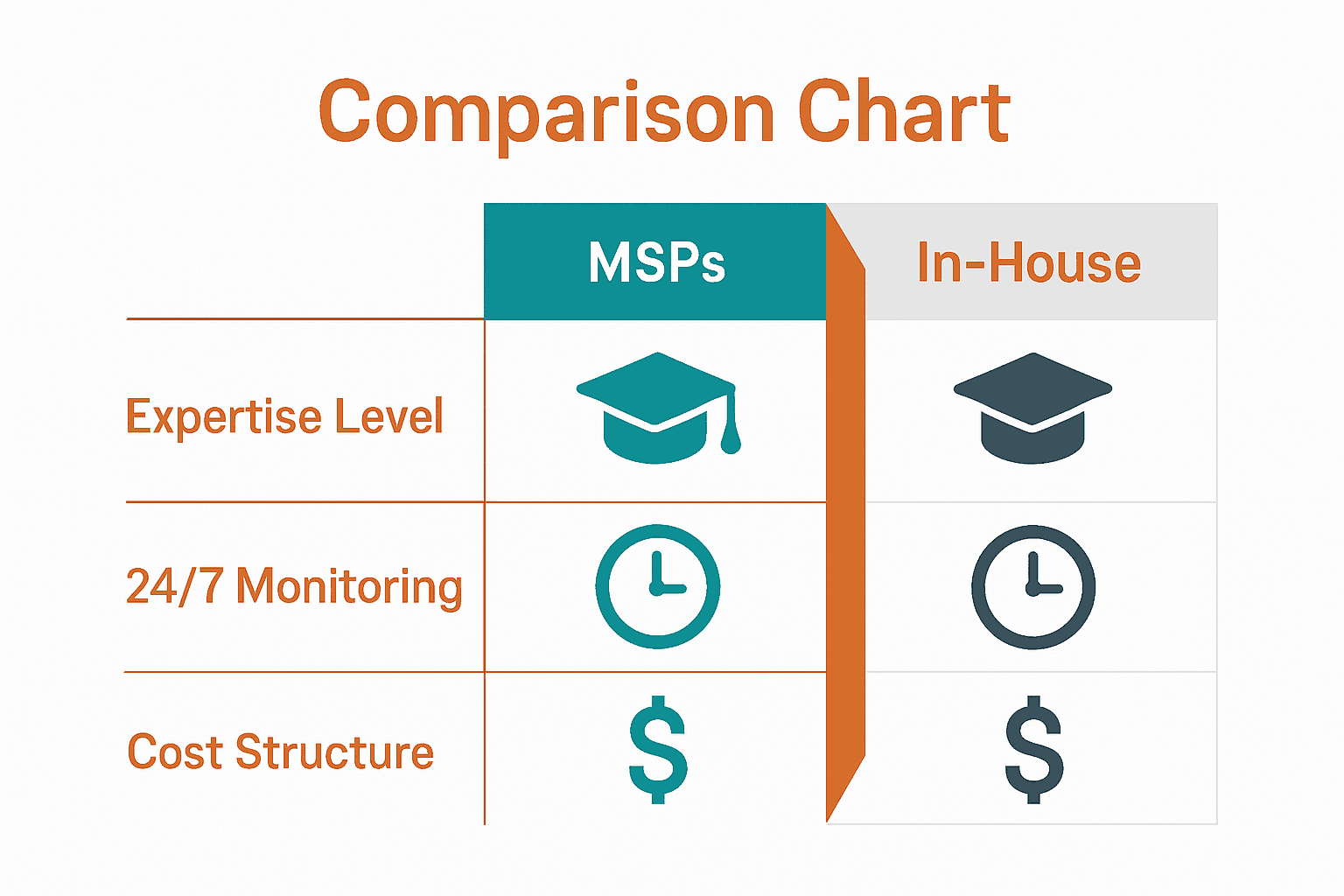
Key differences between MSPs and in-house IT security include:
- Expertise Level: Specialized knowledge vs. generalist internal teams
- Cost Structure: Predictable operational expenses vs. variable internal investments
- Technology Access: Cutting-edge tools vs. limited resource allocation
- Scalability: Flexible resource adjustment vs. rigid internal capabilities
- 24/7 Monitoring: Continuous global coverage vs. limited internal shifts
- Compliance Management: Comprehensive regulatory tracking vs. potential oversight
Economic research on information security outsourcing reveals critical challenges in transitioning from in-house to external security models, particularly the moral hazard problem. Performance-based contracts can mitigate risks by aligning provider incentives directly with client security outcomes, ensuring a more accountable and transparent relationship.
Understanding emerging cyber threats facing small businesses can provide additional context for why many organizations are choosing MSP partnerships. While in-house IT security offers direct control, MSPs bring specialized expertise, advanced technological resources, and a proactive approach to defending against increasingly sophisticated digital threats.
Strengthen Your Data Security With Trusted MSP Solutions
The challenges discussed in the article highlight the complexity of managing data security risks faced by organizations today. You may be struggling with maintaining continuous threat detection, enforcing strict access controls, or ensuring compliance with evolving regulations. These are critical pain points that demand expert management and innovative tools like encryption, multi-factor authentication, and comprehensive incident response protocols. Understanding the role of MSPs brings clarity but partnering with the right solution provider takes your cybersecurity to the next level.
At LogMeOnce, we specialize in empowering businesses with secure identity management and advanced password protection that complements MSP security responsibilities. Our powerful suite includes passwordless MFA, cloud encryption, and dark web monitoring designed to reduce risks and prevent unauthorized access while simplifying compliance with your internal policies and external regulations.
Looking to protect your critical infrastructure with a technology partner that understands your security needs?

Explore how our solutions align with the latest data protection and risk management frameworks. Visit LogMeOnce now and start your free trial to experience enterprise-grade security designed for seamless integration with MSPs’ managed services. Take control of your digital security today by adopting flexible, innovative protection that keeps cyber threats at bay while supporting your business growth.
Frequently Asked Questions
What are Managed Service Providers (MSPs) and their role in data security?
Managed Service Providers (MSPs) are specialized organizations that offer comprehensive technology management solutions, focusing on data security by providing services such as continuous network monitoring, intrusion detection, and incident response.
What core security responsibilities do MSPs have?
MSPs are responsible for various security measures, including network protection, access management, threat detection, incident response, compliance management, and data encryption to protect customer data from cyber threats.
What types of data protection solutions do MSPs offer?
MSPs offer various data protection solutions, such as encryption, access control systems, network segmentation, threat detection platforms, backup and recovery services, and compliance management tools to secure digital assets effectively.
How do MSPs compare to in-house IT security teams?
MSPs provide specialized expertise, predictable cost structures, advanced technology access, and 24/7 monitoring, while in-house IT teams may have limited resources, higher operational costs, and potentially less specialized knowledge in cybersecurity.
Recommended
- MSP password manager | – LogMeOnce
- What Business Leaders Must Know About Data Privacy Laws in 2021
- How to Increase Remote Work Security to Protect Sensitive Data
- 8 Data Security Tips Every Business Owner Should Know


