


 Password Manager
 Identity Theft Protection

 Team / Business
 Enterprise
 Government
 MSP
MSP


Modern cyber threats are evolving at a pace traditional solutions struggle to match. For IT security managers in Canadian, American, European, and global enterprises, integrating artificial intelligence into existing defenses is no longer a futuristic idea but a practical necessity. AI in cybersecurity empowers teams to automate threat detection and response, rapidly analyze incidents, and adapt to new risks, offering the speed and precision needed for real-world protection. This guide highlights how AI-driven strategies augment human expertise and strengthen your organization’s security posture.
Key Takeaways
| Point | Details |
|---|---|
| AI Enhances Cybersecurity | AI technologies transform cybersecurity by enabling real-time threat detection and proactive defenses against digital risks. |
| Integration of Human Expertise | AI systems augment human capabilities, allowing for strategic decision-making and oversight in an increasingly complex threat landscape. |
| Governance Challenges | Organizations must address ethical and governance challenges associated with AI deployment, ensuring transparency and accountability in AI systems. |
| Comparison to Traditional Methods | AI-driven security offers faster response times, adaptability, and more comprehensive threat detection compared to traditional approaches. |
AI in Cybersecurity: Definition and Key Concepts
Artificial Intelligence (AI) represents a transformative technology redefining cybersecurity strategies for organizations worldwide. At its core, AI in cybersecurity involves sophisticated algorithms and machine learning techniques designed to detect, predict, and respond to digital threats with unprecedented speed and accuracy.
The fundamental purpose of AI in cybersecurity is to enable real-time threat analysis through advanced computational methods. These intelligent systems leverage multiple technologies to enhance digital defense mechanisms:
- Machine Learning: Analyzes historical attack patterns to predict future threats
- Deep Learning: Creates neural networks capable of autonomous threat detection
- Predictive Analytics: Identifies potential vulnerabilities before they can be exploited
- Automated Response: Generates immediate countermeasures against detected risks
Cybersecurity AI operates by continuously learning from massive datasets, allowing security teams to move from reactive to proactive defense strategies. AI technologies help cybersecurity teams automate complex tasks, dramatically reducing response times and increasing overall system resilience.
Modern AI cybersecurity approaches integrate human expertise with machine intelligence, creating a synergistic defense ecosystem. This collaborative model ensures that while AI handles rapid data processing and pattern recognition, human professionals provide critical oversight and strategic decision-making.
AI in cybersecurity is not about replacing human experts, but augmenting their capabilities through intelligent, adaptive technologies.
Pro tip: Invest in continuous AI training and validate machine learning models regularly to maintain their effectiveness against evolving cyber threats.
Types of AI Systems Used in Security Operations
Cybersecurity professionals now leverage multiple AI system architectures to defend digital infrastructure against increasingly sophisticated threats. These intelligent technologies range from predictive analytics platforms to autonomous threat detection mechanisms that continuously evolve and adapt to emerging cyber risks.
Public sector security operations have embraced advanced AI systems with specific capabilities across different security domains:
- Threat Intelligence Platforms: Generate real-time risk assessments
- Predictive Detection Systems: Forecast potential security breaches
- Autonomous Response Mechanisms: Automatically mitigate detected threats
- Behavioral Analysis Tools: Monitor user and network behavior patterns
- Anomaly Detection Networks: Identify unusual system activities
These AI systems integrate multiple sophisticated technologies to create comprehensive security ecosystems. Security operations now span access control, fraud detection, and intelligent surveillance, enabling organizations to proactively manage digital risks with unprecedented precision.
Machine learning algorithms power these systems, enabling them to continuously learn from historical data and adapt to new threat landscapes. By analyzing massive datasets, AI can recognize subtle patterns that human analysts might miss, significantly reducing response times and improving overall security posture.
AI security systems are not replacements for human expertise, but powerful augmentation tools that dramatically enhance defensive capabilities.
Pro tip: Regularly validate and retrain your AI security models to ensure they remain effective against emerging cyber threats and technological advancements.
Major Applications and Real-World Use Cases
Artificial Intelligence has transformed cybersecurity from a reactive to a proactive discipline, enabling organizations to anticipate and neutralize digital threats with unprecedented precision. Cybersecurity applications now span multiple domains, offering sophisticated defense mechanisms across diverse technological environments.
AI cybersecurity use cases demonstrate remarkable capabilities across critical security domains:
- Threat Detection: Rapidly identify potential security breaches
- Malware Prevention: Predict and block emerging malicious software
- Identity Protection: Authenticate and secure user access
- Insider Threat Management: Monitor unusual organizational behavior patterns
- IoT Security: Protect interconnected device networks
- Phishing Prevention: Detect and neutralize sophisticated email-based attacks
In financial sectors, AI systems analyze millions of transactions in real-time, identifying fraudulent activities with accuracy far surpassing traditional rule-based systems. Healthcare organizations leverage similar technologies to protect sensitive patient data, implementing intelligent monitoring that can distinguish between legitimate access and potential security risks.
Machine learning algorithms continuously adapt, learning from each interaction to improve threat detection capabilities. These systems can process vast amounts of data exponentially faster than human analysts, creating a dynamic defense mechanism that evolves alongside emerging cyber threats.
Artificial Intelligence in cybersecurity represents not just a technological upgrade, but a fundamental reimagining of digital defense strategies.
Pro tip: Implement a continuous learning framework for your AI cybersecurity models, ensuring they remain updated with the latest threat intelligence and behavioral patterns.
Principal Risks and Governance Challenges in 2026
As artificial intelligence becomes increasingly integrated into cybersecurity infrastructure, organizations face unprecedented governance and ethical challenges that demand sophisticated management strategies. The rapid evolution of AI technologies has outpaced traditional regulatory frameworks, creating complex vulnerabilities that require immediate and strategic attention.
CISOs encounter significant AI integration risks across multiple critical dimensions:
- Privileged Access Control: Managing AI system permissions and boundaries
- Accountability Mechanisms: Establishing clear responsibility frameworks
- Traceability Requirements: Maintaining comprehensive audit trails
- Transparency Protocols: Ensuring algorithmic decision-making visibility
- Ethical Boundaries: Defining acceptable AI operational parameters
The emerging landscape reveals critical governance challenges requiring comprehensive oversight. AI governance demands balancing innovation with robust regulatory approaches, addressing complex issues like algorithmic bias, data privacy concerns, and potential autonomous system misuse.

Algorithmic transparency has become a paramount concern, with organizations needing sophisticated monitoring tools to understand and control AI system behaviors. These challenges extend beyond technical considerations, encompassing legal, ethical, and strategic dimensions that require holistic, proactive management approaches.
Below is a summary of governance challenges facing AI in cybersecurity in 2026:
| Governance Challenge | Why It Matters | Recommended Strategy |
|---|---|---|
| Privileged Access Control | Prevents internal misuse | Define strict permission sets |
| Algorithmic Transparency | Enables oversight and trust | Audit decision logs |
| Accountability Mechanisms | Clarifies responsibility | Assign clear roles |
| Ethical Boundaries | Avoids risky AI behavior | Implement operational limits |
Effective AI governance is not about restricting innovation, but creating intelligent frameworks that enable responsible technological advancement.
Pro tip: Develop a comprehensive AI governance framework that includes regular audits, clear accountability metrics, and transparent decision-making protocols.
Comparing AI-Driven Security to Traditional Methods
The landscape of cybersecurity is undergoing a profound transformation, with AI-driven technologies challenging long-established traditional defense mechanisms. Where conventional security systems relied on static, predefined rules, modern AI approaches introduce dynamic, adaptive intelligence that fundamentally reshapes threat detection and response strategies.
Cybersecurity methods now integrate AI capabilities with remarkable advancements across multiple critical domains:
- Automated Threat Analysis: Replacing manual intervention
- Real-Time Adaptive Detection: Responding faster than rule-based systems
- Complex Pattern Recognition: Understanding nuanced threat behaviors
- Predictive Risk Assessment: Anticipating potential security breaches
- Continuous Learning Mechanisms: Evolving defense strategies autonomously
The evolution from traditional to generative AI represents a quantum leap in cybersecurity capabilities. Traditional systems were constrained by predefined rules and supervised learning models, whereas modern AI approaches leverage unsupervised learning and neural networks to simulate and anticipate attacks dynamically.
Machine learning algorithms now enable security systems to understand context, recognize subtle anomalies, and generate predictive insights that human analysts might overlook. This shift transforms cybersecurity from a reactive discipline to a proactive, intelligence-driven practice that can anticipate and neutralize threats before they materialize.
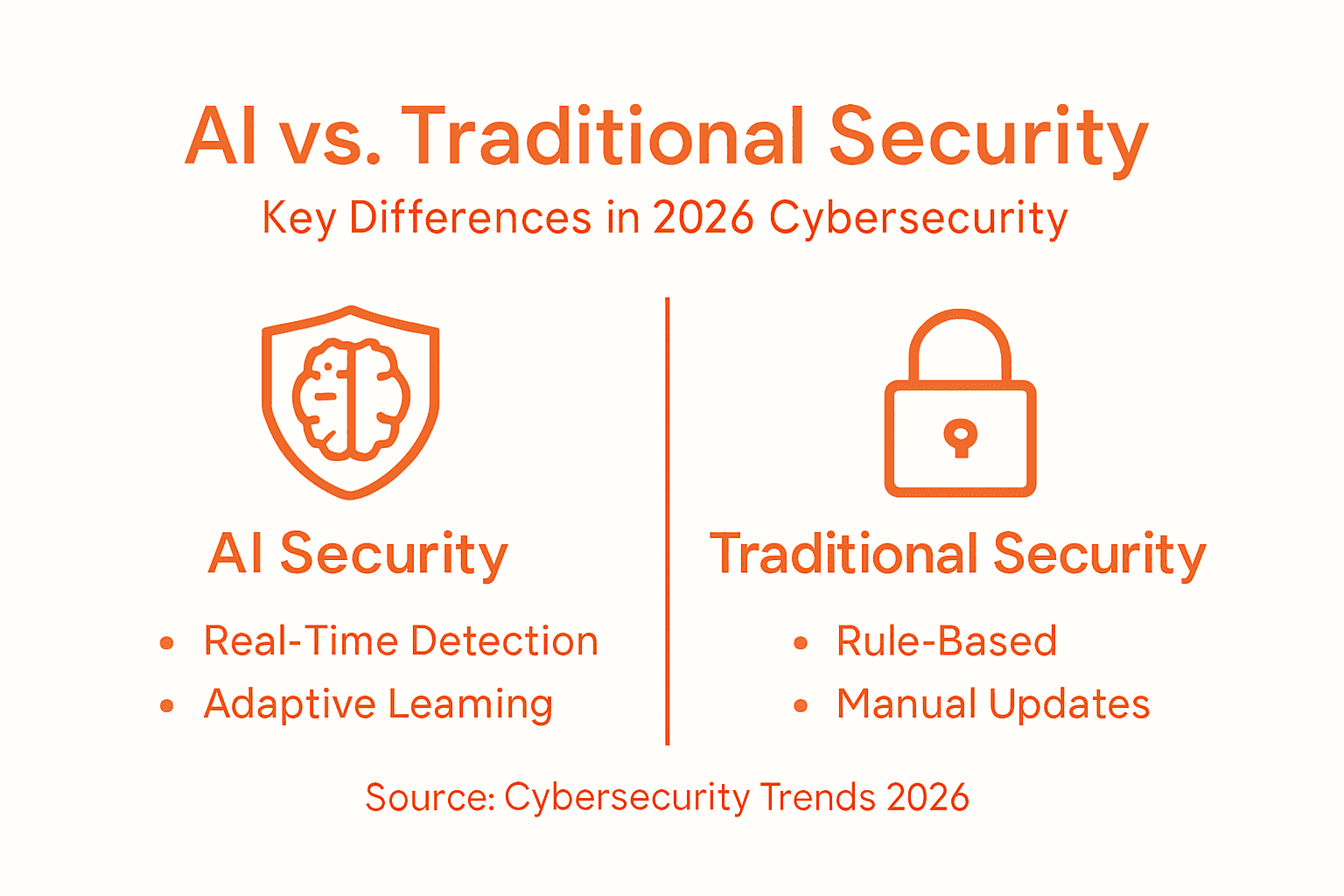
Here’s how leading AI-driven security systems differ from traditional cybersecurity approaches:
| Feature | AI-Driven Security | Traditional Methods |
|---|---|---|
| Threat Detection Speed | Instant, real-time | Manual, slower |
| Adaptability | Learns from new threats | Static rules only |
| Human Involvement | Augmented, analysts oversee AI | Manual decision-making |
| Pattern Recognition | Detects complex, subtle patterns | Limited to known patterns |
| Response Automation | Immediate countermeasures | Delayed manual actions |
The future of cybersecurity is not about replacing human expertise, but augmenting it with intelligent, adaptive technologies.
Pro tip: Implement a hybrid security approach that combines AI-driven insights with human expert oversight to maximize defense effectiveness.
Strengthen Your Cybersecurity with AI-Powered Solutions
The accelerated integration of Artificial Intelligence in cybersecurity brings remarkable benefits and complex risks as detailed in the article “Role of AI in Cybersecurity: Risks and Rewards 2026.” Organizations face critical challenges like algorithmic transparency, privileged access control, and accountability that require intelligent, adaptive defenses. Understanding these governance and operational risks is essential for protecting sensitive data and maintaining robust security postures in a rapidly evolving threat landscape.
LogMeOnce offers a comprehensive suite of cybersecurity solutions designed to help you navigate these AI-driven challenges effectively. With features such as passwordless multi-factor authentication, encrypted cloud storage, and dark web monitoring, our platform empowers businesses and government agencies to strengthen identity security while ensuring careful governance over AI-enabled tools. Discover how our innovative technologies can augment your security strategy and minimize risks associated with AI integration.
Elevate your cybersecurity today with trusted solutions tailored to the demands of 2026 and beyond.

Explore our full range of services at LogMeOnce and secure your digital future with confidence. Take advantage of our advanced security features now to stay ahead of emerging threats and maintain operational integrity.
Frequently Asked Questions
What is the role of AI in cybersecurity?
AI in cybersecurity enhances digital defense strategies through real-time threat analysis, predictive analytics, and automated responses to cyber threats, allowing organizations to proactively safeguard their infrastructures.
What are the main applications of AI in cybersecurity?
Key applications include threat detection, malware prevention, identity protection, insider threat management, IoT security, and phishing prevention, all of which leverage advanced algorithms to enhance security measures.
What are the risks associated with integrating AI in cybersecurity?
Risks include governance challenges such as privilege access control, algorithmic bias, and the need for accountability mechanisms and transparency in decision-making processes, which require robust management strategies.
How does AI-driven security differ from traditional cybersecurity methods?
AI-driven security utilizes dynamic, adaptive technologies for immediate threat detection and response, whereas traditional methods rely on static rules and manual analysis, making them slower and less effective against evolving threats.
Recommended
- blogs – LogMeOnce
- Best Cybersecurity Tools to Use In 2025 – LogMeOnce
- Why Passwords Are Cybersecurity’s Weakest Link – LogMeOnce
- Why Cybersecurity Awareness Is Vital to Your Business – LogMeOnce


