


 Password Manager
 Identity Theft Protection

 Team / Business
 Enterprise
 Government
 MSP
MSP


TL;DR:
- Shared passwords increase data breach risks by eliminating accountability and enabling credential reuse.
- Using individual accounts, password managers, and multi-factor authentication can significantly reduce these vulnerabilities.
Shared passwords are defined as login credentials used by more than one person, and they represent one of the most preventable causes of data breaches in both personal and organizational settings. The risks of shared passwords go far beyond simple convenience trade-offs. Stolen credentials were the initial entry point in 22% of all security breaches, and 88% of attacks against basic web applications involved stolen credentials. When multiple people share the same login, every one of those people becomes a potential breach point. NIST and the UK National Cyber Security Centre (NCSC) both treat credential sharing as a fundamental security failure, not a minor policy gap.
What specific security risks arise from sharing passwords?
Shared credentials eliminate individual accountability, and that single fact makes every other security control harder to enforce. When five people use the same login, no audit log can tell you which one clicked a phishing link or downloaded malware. Forensic investigation after a breach becomes nearly impossible, and shared passwords destroy accountability, forcing organizations into full system-wide credential resets that disrupt operations.
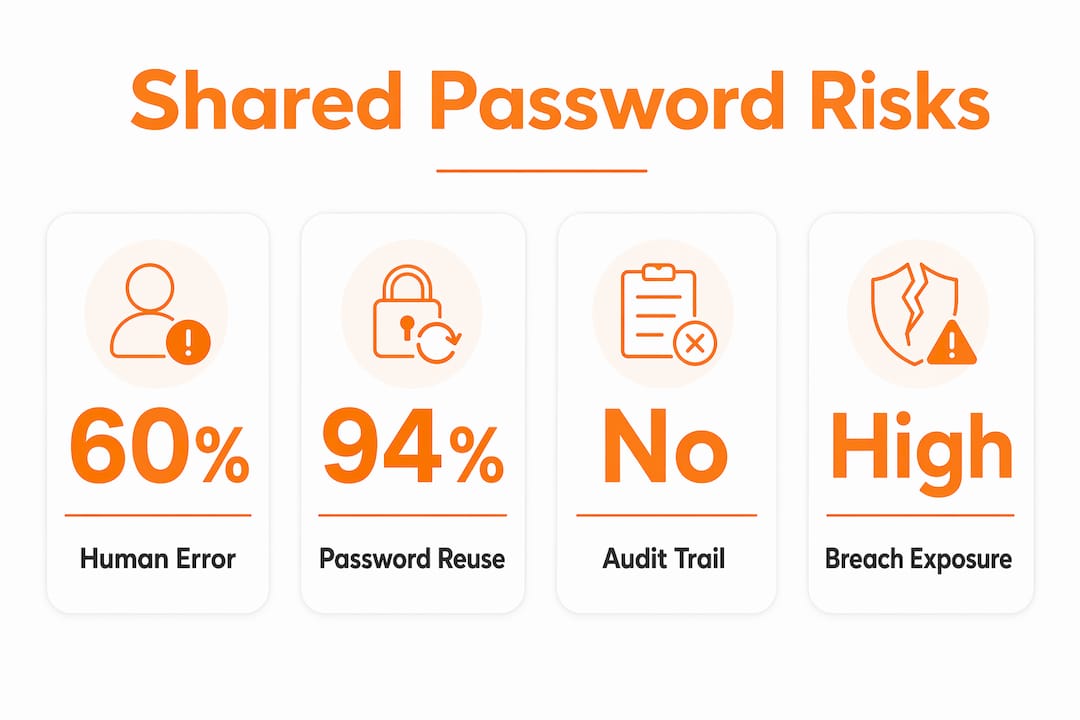
Human error is involved in roughly 60% of data breaches. That number climbs with every additional person who holds the same password. A single careless action, forwarding a password over email or entering it on a phishing site, exposes every account that credential protects.
Password reuse compounds the damage dramatically. Over 94% of leaked passwords are reused across accounts. That means one shared credential, once leaked, can open doors across multiple systems simultaneously. The security risks of shared accounts do not stay contained to the original breach.
Offboarding creates another critical gap. When an employee leaves a company, revoking access tied to a shared password requires changing it for every remaining user. That process is slow, often skipped, and leaves former employees with live access to sensitive systems.
Pro Tip: Treat every shared password as a single point of failure. If one person with access is compromised, every system that credential touches is compromised too.
- Zero audit trail: No way to attribute actions to specific individuals after an incident.
- Phishing multiplier: More users means more targets for credential theft.
- Credential reuse exposure: One leaked shared password can cascade across multiple platforms.
- Offboarding failure: Shared credentials are rarely revoked promptly when roles change.
- Incident response paralysis: Forensic teams cannot isolate the source of a breach without individual login records.
How do shared passwords affect compliance and organizational security controls?
Shared credentials directly violate the individual accountability requirements built into frameworks like ISO 27001 and SOC 2. Both standards require that access to sensitive systems be traceable to a specific person. Shared credentials break audit trails and prevent least-privilege enforcement, making compliance audits impossible to pass cleanly.
The least-privilege principle states that each user should access only what their role requires. Shared accounts collapse that principle entirely. One login used by a developer, a manager, and a contractor grants all three the same level of access, regardless of what each person actually needs.
Privileged accounts, those with administrative or root-level access, carry the highest risk when shared. Standard password managers are not built for this use case. Privileged Access Management (PAM) tools provide session recording, just-in-time access grants, automatic credential rotation, and full audit logging. Using a standard password manager for privileged accounts leaves the most sensitive credentials without proper controls.
Pro Tip: If your organization uses shared admin credentials, that is a PAM problem, not a password manager problem. The two tools solve different threat levels.
| Practice | Shared credentials | Individual credentials |
|---|---|---|
| Audit trail | None. Actions cannot be attributed. | Full. Every action is logged per user. |
| Least-privilege enforcement | Impossible. All users share one access level. | Enforced. Each user gets role-specific access. |
| Compliance (ISO 27001, SOC 2) | Fails individual accountability requirements. | Meets traceability standards. |
| Offboarding | Requires password change for all users. | Single account deactivation. |
| Incident response | System-wide reset required after breach. | Isolated to the compromised individual. |
What are the best practices to secure passwords and safely share access?
The most effective approach to password management combines long unique passphrases, a dedicated password manager, and multi-factor authentication. NIST SP 800-63-4 recommends passphrases of 15 or more characters and mandatory use of a password manager. That guidance replaced the older model of forced periodic resets, which consistently produced weaker, more predictable passwords.

Forced frequent password resets lead to predictable, weaker passwords. NIST now recommends changing passwords only when there is evidence of compromise, not on a fixed schedule. Screening passwords against known breach lists is more effective than requiring quarterly changes.
Enterprise password managers reduce exposure by creating encrypted, auditable sharing channels. They eliminate the need to send passwords through email or messaging apps, which are the most common vectors for accidental credential exposure. Tools like Logmeonce provide safe password sharing that keeps credentials encrypted end-to-end and logs every access event.
Traditional password complexity requirements encourage predictable patterns that attackers exploit. Truly random passwords generated by a password manager are far harder to crack than a human-chosen “complex” password like P@ssw0rd1!. The manager handles the complexity so users do not have to.
Here is a practical framework for businesses moving away from shared credential practices:
- Assign individual accounts: Every person gets their own login, even for shared tools and platforms.
- Use a password manager with encrypted sharing: Logmeonce and similar tools allow secure credential sharing without exposing the actual password.
- Enable MFA on every account: Multi-factor authentication adds a second barrier that shared passwords cannot provide alone.
- Adopt PAM for privileged accounts: Administrative credentials need session recording and just-in-time access, not just a vault.
- Screen passwords against breach databases: NIST recommends rejecting any password that appears in known leaked credential lists.
How does enabling two-factor authentication reduce risks tied to shared passwords?
Two-factor authentication (2FA) is the single most effective control for limiting damage when a shared password is compromised. The UK NCSC endorses universal use of two-step verification as the most effective defense against credential theft. Even if a shared password leaks, an attacker without the second factor cannot access the account.
Accounts with 2FA are vastly less likely to be breached despite leaked credentials. That protection holds even in shared-password environments where the credential itself is already compromised. The second factor acts as a firewall between the stolen password and actual account access.
The business benefits of two-factor authentication extend beyond breach prevention. 2FA creates an implicit log of authentication attempts, which partially restores the accountability that shared passwords destroy. If only one person holds the 2FA device, that person becomes identifiable even when the password is shared.
Implementing 2FA across an organization does not require complex infrastructure. Most modern platforms support authenticator apps like Google Authenticator or hardware keys like YubiKey. Logmeonce integrates MFA directly into its password management platform, making deployment straightforward for teams of any size.
- Phishing protection: A stolen password without the second factor is useless to an attacker.
- Partial accountability recovery: The 2FA device holder becomes identifiable even with shared credentials.
- Breach containment: Compromised credentials do not automatically translate into account access.
- Regulatory support: Many compliance frameworks now treat MFA as a baseline requirement, not an optional add-on.
Key Takeaways
Shared passwords multiply breach exposure, eliminate accountability, and break compliance controls. Replacing them with individual credentials, a password manager, and multi-factor authentication is the most direct path to reducing credential-based risk.
| Point | Details |
|---|---|
| Shared credentials destroy accountability | No audit trail means forensic investigation after a breach becomes impossible. |
| Human error scales with access | Every additional user sharing a password increases the chance of phishing or accidental exposure. |
| Compliance frameworks require individual access | ISO 27001 and SOC 2 both mandate traceable, individual credentials. |
| Password managers eliminate unsafe sharing | Encrypted sharing channels remove the need to send credentials through email or chat. |
| 2FA limits damage from leaked credentials | A second factor blocks attackers even when the shared password is already compromised. |
Why shared passwords persist despite the obvious risks
Organizations keep using shared passwords for one reason: convenience. Shared logins feel faster than provisioning individual accounts, especially for small teams or contractors who need temporary access. That logic made sense before password managers existed. It does not hold up anymore.
What I have seen repeatedly is that the real obstacle is not technology. It is the assumption that “we are too small to be a target” or “we trust everyone on the team.” Both of those assumptions collapse the moment one trusted team member clicks the wrong link. The breach does not care about team size or trust levels.
The other persistent problem is that organizations treat password policy as a one-time setup. They create rules, communicate them once, and assume the behavior follows. It rarely does without ongoing reinforcement and the right tools in place. Password hygiene is a habit, not a configuration.
The shift that actually works combines two things at once: making the secure behavior easier than the insecure one, and removing the option to share credentials informally. When a password manager is the default and individual accounts are the standard, the path of least resistance becomes the secure path. That is the goal.
— Mike
Logmeonce protects your accounts without the risks of credential sharing
Shared passwords create gaps that attackers exploit. Logmeonce closes those gaps with encrypted credential storage, auditable sharing controls, and built-in multi-factor authentication for individuals and businesses alike.
Logmeonce’s cybersecurity platform gives every user their own secure vault while allowing controlled, encrypted sharing when teams genuinely need it. MFA integrates directly into the platform, so adding a second factor requires no separate setup. Whether you manage five accounts or five thousand, Logmeonce provides the controls that shared passwords never can. Explore the password management benefits built for teams that take credential security seriously.
FAQ
What are the main risks of shared passwords?
Shared passwords eliminate individual accountability, increase phishing exposure, and make forensic investigation after a breach nearly impossible. They also complicate offboarding and can cascade a single leaked credential across multiple systems through password reuse.
Why do shared passwords violate compliance standards?
Frameworks like ISO 27001 and SOC 2 require that access to sensitive systems be traceable to a specific individual. Shared credentials break that traceability, making it impossible to pass a compliance audit that requires individual accountability.
Does 2FA fix the security risks of shared accounts?
Two-factor authentication significantly reduces the damage from a compromised shared password by blocking access without the second factor. The UK NCSC endorses 2FA as the most effective defense against credential theft, even when passwords are already exposed.
How should businesses safely share access without shared passwords?
Businesses should use a password manager with encrypted sharing channels, assign individual accounts to every user, and enable MFA on all systems. Tools like Logmeonce allow controlled credential sharing without exposing the actual password to the recipient.
What does NIST recommend instead of shared or frequently rotated passwords?
NIST SP 800-63-4 recommends passphrases of 15 or more characters, mandatory use of a password manager, and password changes only when there is evidence of compromise. Forced periodic resets are no longer recommended because they produce weaker, more predictable passwords.
Recommended
- Password Reuse: Convenient, But Dangerous – LogMeOnce
- How to Do Password Sharing the Safe Way – LogMeOnce


