


 Password Manager
 Identity Theft Protection

 Team / Business
 Enterprise
 Government
 MSP
MSP


Most security breaches originate from excessive user permissions that remain unnoticed in complex networks. An american financial firm discovered that strict least privilege access controls reduced insider risk by over 60 percent in just six months. For IT security professionals, managing the right access levels protects sensitive data and supports global compliance standards. This overview delivers practical insights to implement and maintain least privilege strategies that strengthen security for every enterprise.
Key Takeaways
| Point | Details |
|---|---|
| Implement Least Privilege Principles | Organizations should restrict user permissions to the minimum necessary to complete job functions, enhancing overall security. |
| Conduct Regular Access Reviews | Performing quarterly access reviews helps ensure that user permissions remain appropriate and reduce risks related to privilege creep. |
| Utilize Advanced Identity Management Technologies | Employing modern identity management solutions allows for real-time tracking and adjustments of user permissions, reducing unauthorized access. |
| Provide Security Training | Educating employees on the importance of access restrictions fosters compliance and minimizes resistance to necessary security measures. |
Least Privilege Access in Cybersecurity
Least Privilege Access represents a foundational security strategy where organizations systematically control user permissions to minimize potential cybersecurity vulnerabilities. By restricting user access rights, businesses dramatically reduce their risk of unauthorized system access and potential data breaches.
The core principle of least privilege is straightforward yet powerful: employees receive only the minimum access permissions necessary to complete their specific job responsibilities. This approach creates multiple protective layers by ensuring that if one user account becomes compromised, the potential damage remains significantly contained. For instance, a marketing specialist would not have administrative access to financial systems, and a junior accountant would not have permissions to modify high-level financial records.
Implementing least privilege requires a systematic approach involving several critical steps:
- Conduct comprehensive role-based access audits
- Map precise permission requirements for each organizational role
- Establish clear access control policies
- Utilize advanced identity management technologies
- Regularly review and update access permissions
Cybersecurity experts recognize least privilege as more than just a technical control but a strategic risk management framework. Minimizing insider threat potential, this approach creates accountability by ensuring that users can only interact with systems directly related to their job functions.
Pro tip: Implement automated access review processes quarterly to ensure least privilege policies remain current and effective.
Types of Privileges and Access Levels
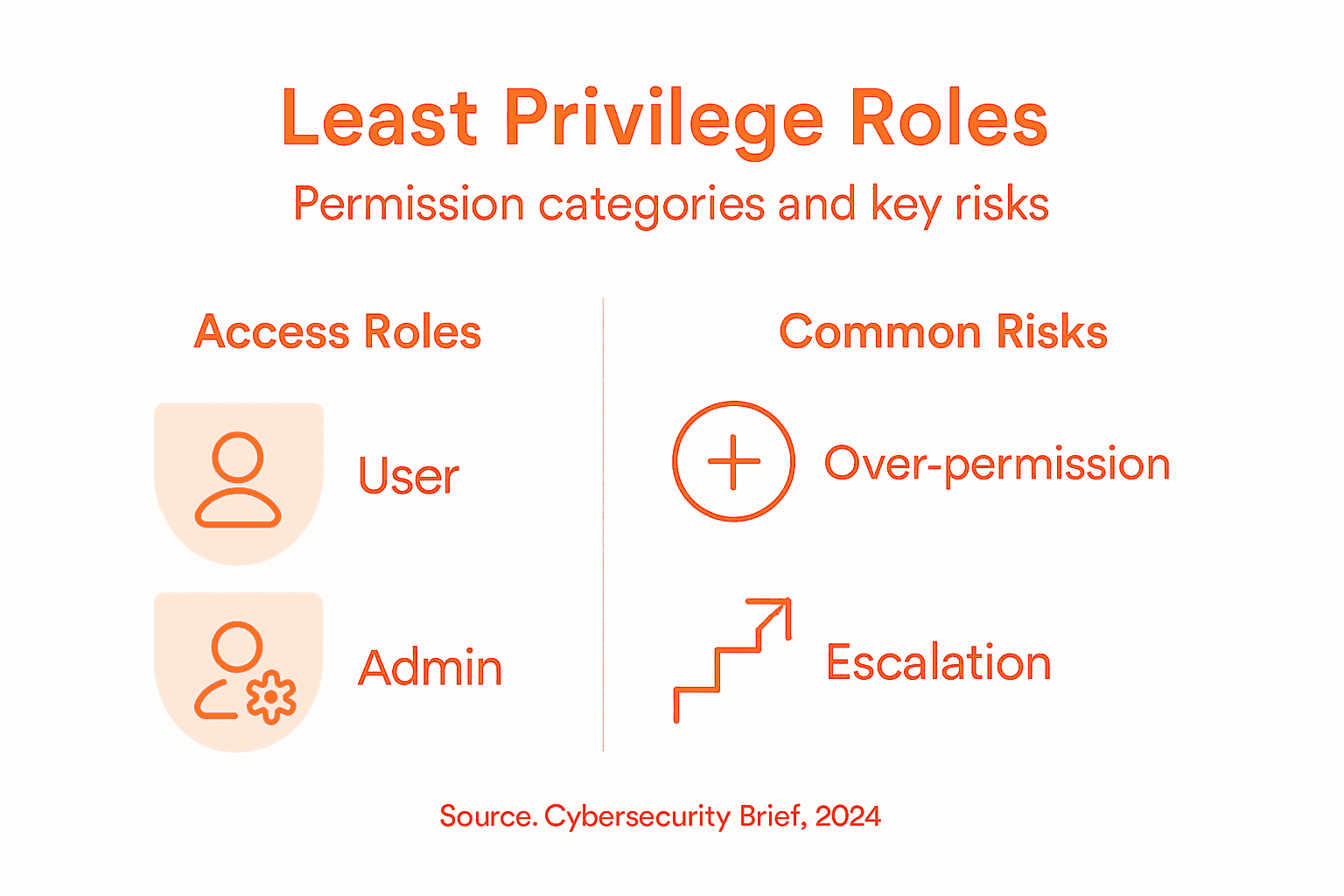
Privilege levels in cybersecurity represent a critical framework for managing organizational access, with different permission hierarchies designed to protect sensitive information and system resources. These access levels range from basic user permissions to high-level administrative rights, each carefully structured to minimize potential security vulnerabilities.
Typically, organizations implement several distinct privilege categories:
- Standard User: Limited access to basic systems and applications
- Power User: Extended permissions for specific departmental functions
- Administrator: Comprehensive system control and configuration rights
- Root/Superuser: Unrestricted, highest-level system access
- Service Account: Automated system process permissions
Granular Access Control breaks down these privilege levels into more nuanced permissions. For instance, a financial analyst might have read-only access to specific accounting systems, while a database administrator could have modification rights for certain data repositories. Global access control strategies emphasize creating precise, role-specific permission sets that align exactly with job responsibilities.
Here’s a quick reference comparing common user privilege levels and their typical functions:
| Privilege Level | Typical Functions | Example Roles |
|---|---|---|
| Standard User | Access basic applications, view data | Employee, Staff Member |
| Power User | Manage specific tools, modify some data | Department Lead, Analyst |
| Administrator | Configure systems, manage other accounts | IT Admin, Systems Manager |
| Root/Superuser | Full control over entire system | IT Director, SysAdmin |
| Service Account | Run automated processes and integrations | Application Bot, Scheduler |
Understanding and implementing these privilege levels requires continuous monitoring and regular access audits. Organizations must constantly evaluate user roles, ensuring that employees maintain only the minimum necessary permissions to perform their core job functions. This dynamic approach prevents potential security gaps and reduces the risk of unauthorized system access.
Pro tip: Conduct comprehensive access review workshops quarterly to validate and adjust user privilege levels across your organization.
How Least Privilege Works in Practice
Implementing least privilege is a systematic process that requires careful planning and continuous management. Role-based access control strategies serve as the foundation for effectively limiting user permissions to only those absolutely necessary for performing specific job functions. This approach dramatically reduces potential security vulnerabilities by minimizing the potential attack surface within an organization.
The practical implementation involves several critical steps:
- Identify User Roles: Precisely map each employee’s job responsibilities
- Define Specific Permissions: Create granular access rights aligned with role requirements
- Establish Access Baseline: Set minimum required permissions for each position
- Implement Strict Verification: Use multi-factor authentication and continuous monitoring
- Regular Access Reviews: Conduct periodic audits to validate and adjust permissions
Preventing privilege escalation requires organizations to develop dynamic access management protocols. This means constantly evaluating user permissions, removing unnecessary access rights, and ensuring that employees can only interact with systems directly relevant to their core responsibilities. For example, a marketing team member would have zero access to financial databases, while a payroll specialist would have limited, read-only access to specific financial systems.

Technological solutions play a crucial role in enforcing least privilege principles. Advanced identity management platforms can automatically track and adjust user permissions, creating real-time safeguards against unauthorized system access. These tools help organizations maintain a robust security posture by providing granular control over user interactions with critical systems and sensitive data.
Pro tip: Implement automated access monitoring tools that generate immediate alerts when users attempt to access systems outside their defined permission levels.
Implementing Least Privilege Access Policies
Developing comprehensive access policies requires a strategic and methodical approach that balances organizational security with operational efficiency. The process begins with a thorough analysis of existing user roles, permissions, and system interactions, creating a detailed map of current access landscapes that will inform future security protocols.
Key components of effective least privilege implementation include:
- Role Definition: Precisely document each job function’s specific system requirements
- Permission Mapping: Create detailed access matrices for different organizational roles
- Access Granularity: Design permission levels with maximum specificity
- Dynamic Adjustment: Build flexibility into access management frameworks
- Comprehensive Documentation: Maintain detailed records of all access assignments
Identity and access management strategies demand continuous monitoring and proactive management. Organizations must develop robust verification processes that include multi-factor authentication, real-time access tracking, and automatic permission revocation when job roles change. This dynamic approach ensures that users maintain only the precise access levels required for their current responsibilities, minimizing potential security vulnerabilities.
Technological implementation relies on advanced tools that enable granular control and automated management. Modern identity management platforms can integrate role-based access controls, providing intelligent systems that automatically adjust permissions based on predefined organizational rules. These solutions offer real-time visibility into user access patterns, enabling security teams to quickly identify and address potential risk areas before they become significant threats.
Pro tip: Create a formal access review process that requires quarterly validation and explicit reauthorization of all user permissions.
Risks, Challenges, and Common Pitfalls
Privilege management challenges represent significant obstacles for organizations implementing robust access control strategies. These challenges emerge from complex organizational dynamics, technological limitations, and human behavioral patterns that consistently undermine security best practices.
The most prevalent risks in least privilege implementation include:
- Privilege Creep: Gradual accumulation of unnecessary access rights over time
- Over-Provisioning: Granting excessive permissions beyond job requirements
- Resistance to Change: Employee pushback against strict access controls
- Complex Role Definitions: Difficulty mapping precise permission requirements
- Monitoring Gaps: Insufficient tracking of user system interactions
Organizational access management strategies must address the human elements that complicate security implementations. Employees often perceive strict access controls as impediments to productivity, creating cultural resistance that can undermine carefully designed security protocols. This psychological barrier requires comprehensive training programs that demonstrate the direct relationship between restricted access and organizational protection.
The following summary outlines common challenges and strategies for successful least privilege implementation:
| Challenge | Organizational Impact | Mitigation Strategy |
|---|---|---|
| Privilege Creep | Increased risk of data exposure | Schedule regular access reviews |
| Over-Provisioning | Greater attack surface | Map permissions to actual job needs |
| Resistance to Change | Employees bypass controls | Offer targeted security training |
| Monitoring Gaps | Unnoticed policy violations | Deploy automated tracking solutions |
| Complex Role Definitions | Slow, error-prone policy updates | Create detailed, documented role maps |
Technological complexity further compounds least privilege challenges. Modern enterprise environments feature intricate interconnected systems, making granular access management extraordinarily difficult. Security teams must balance precise access restrictions with operational flexibility, ensuring that employees can effectively perform their responsibilities while maintaining robust protective measures. Advanced identity management platforms with intelligent, context-aware authorization mechanisms become critical in navigating these complex technological landscapes.
Pro tip: Develop a continuous education program that transforms access restrictions from perceived obstacles into understood security necessities.
Strengthen Your Cybersecurity with Effective Least Privilege Access Solutions
Managing user permissions to enforce least privilege access is critical to reducing cybersecurity risks such as privilege creep and unauthorized system entry. If your organization struggles with over-provisioned accounts or complex access reviews, adopting robust identity management tools can create the granular controls necessary to limit user permissions precisely to their job needs. Using advanced security measures like multi-factor authentication and automated access monitoring helps prevent privilege escalation and insider threats.

Take charge of your organization’s cybersecurity today by exploring how LogMeOnce offers a comprehensive suite of solutions designed to implement least privilege access with ease. Our platform supports secure identity management, passwordless MFA, encrypted cloud storage, and continuous access audits to keep your data protected and compliance on track. Don’t wait for a breach to expose vulnerabilities. Visit LogMeOnce now to discover how streamlined access control can safeguard your digital assets and empower your security team.
Frequently Asked Questions
What is Least Privilege Access in cybersecurity?
Least Privilege Access is a security strategy that restricts user permissions to only those necessary for their specific job functions. This approach minimizes the risk of unauthorized access and potential data breaches.
How can implementing Least Privilege reduce cybersecurity risks?
By ensuring that users have only the minimum permissions required, organizations can contain potential damage if an account is compromised, thus reducing the attack surface and enhancing overall security.
What are the main steps to implement Least Privilege Access in an organization?
Key steps include conducting role-based access audits, defining specific permission requirements for each role, establishing clear access control policies, and regularly reviewing and updating access permissions.
What are common challenges when implementing Least Privilege Access?
Challenges include privilege creep, over-provisioning of access rights, employee resistance to changes, and insufficient monitoring of user interactions with systems.
Recommended
- blogs – LogMeOnce
- Best Cybersecurity Tools to Use In 2025 – LogMeOnce
- How to Increase Remote Work Security to Protect Sensitive Data
- Why Cybersecurity Awareness Is Vital to Your Business – LogMeOnce


