


 Password Manager
 Identity Theft Protection

 Team / Business
 Enterprise
 Government
 MSP
MSP


TL;DR:
- Identity verification combines document, biometric, and database checks to confirm a person’s identity. AI accelerates these processes, making verification instant while increasing accuracy and fraud detection. Balancing security with user experience is essential to reduce abandonment and improve overall trust.
Identity verification processes are defined as multi-layered methods used to confirm that a person is who they claim to be, combining document checks, biometric validation, and database cross-referencing. Regulatory frameworks like Know Your Customer (KYC), Anti-Money Laundering (AML), and NIST 800 standards set the compliance baseline for these checks across industries. AI and biometrics have transformed what once took days into a process that now completes in seconds. For individuals and businesses alike, getting verification right means preventing fraud, meeting legal requirements, and building user trust from the first interaction.
What are the main identity verification processes and how do they work?
Document verification is the starting point for most identity check procedures. A user submits a government-issued ID, such as a passport or driver’s license, and the system extracts data using optical character recognition (OCR). Modern documents contain security features including holograms, machine-readable zones (MRZs), and NFC chips. Combining document verification with NFC chip reading extracts tamper-proof data and provides the highest assurance level available today.
Biometric verification adds a second layer by confirming the person holding the document is its rightful owner. Facial recognition compares a live selfie against the ID photo, while liveness detection confirms the user is physically present, not a mask, video replay, or deepfake. This step is not optional for high-risk onboarding. Relying solely on document checks leaves a critical gap that fraudsters exploit.

Knowledge-based authentication (KBA) cross-references personal data against credit bureau records or public databases. A system might ask questions only the real person could answer, such as a previous address or a loan amount. KBA works well as a secondary check but fails as a standalone method because data breaches have made personal information widely available on the dark web.
Video verification uses a live agent or automated session to confirm identity in real time. This method suits regulated industries like financial services, where a human review adds a legal layer of accountability. The table below summarizes how each method compares.
| Method | Primary purpose | Key strength | Main limitation |
|---|---|---|---|
| Document verification | Validate ID authenticity | Checks physical security features | Susceptible to high-quality forgeries |
| Biometric verification | Confirm document ownership | Liveness detection blocks spoofing | Requires quality camera hardware |
| Knowledge-based authentication | Cross-reference personal data | No hardware needed | Vulnerable after data breaches |
| Video verification | Real-time human confirmation | High legal accountability | Slow and costly at scale |
| NFC chip reading | Extract tamper-proof chip data | Highest assurance level | Requires NFC-enabled devices |
How does AI improve identity verification accuracy and speed?
AI has changed the economics of authenticating user identity. AI-powered systems process documents in under 15 seconds with fraud detection rates above 99% for known fraud types. That speed matters because slow verification flows push users to abandon onboarding before completing it.
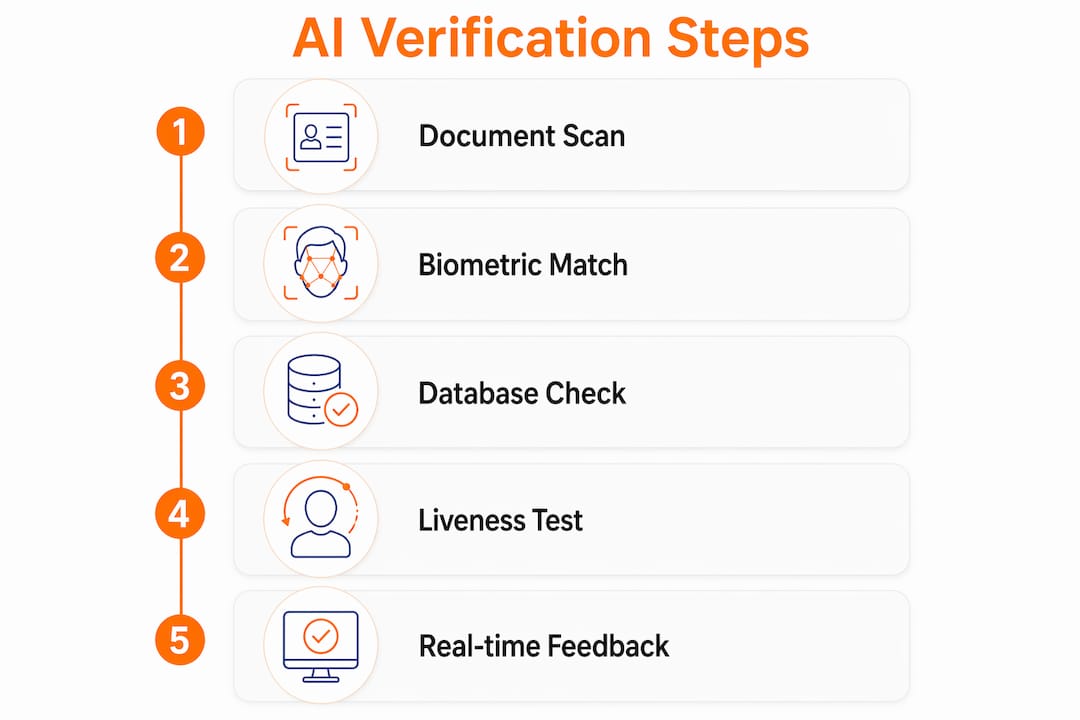
Legacy manual systems cannot match that performance. Modern AI verification solutions outperform manual-heavy systems by approximately 6x in accuracy. The gap comes from AI’s ability to detect subtle anomalies in fonts, microprinting, and metadata that a human reviewer would miss under time pressure.
Real-time feedback during document capture is one of AI’s most underrated contributions. Automated feedback on lighting, framing, and glare reduces verification failures caused by poor image quality. This matters because the quality of document image capture is the most common failure point in the entire verification flow.
AI does have limits. It struggles with novel document types or security features not present in its training data. Hybrid workflows that route low-confidence cases to human reviewers reduce false acceptance rates without blocking legitimate users. The AI handles the clear majority of cases instantly, while edge cases get the careful review they need.
- OCR extraction reads text fields and compares them against expected formats for each document type.
- Anomaly detection flags inconsistencies in fonts, layout, and security features.
- Biometric matching compares the live selfie against the ID photo with sub-second processing.
- Metadata analysis checks device signals, IP location, and session behavior for risk indicators.
- NFC validation reads the chip embedded in modern passports and ID cards for tamper-proof confirmation.
Pro Tip: Set your AI verification system to trigger a real-time image quality prompt before the user submits their document. Catching a blurry photo at capture is far cheaper than a failed verification and a support ticket.
What challenges arise when balancing security and user experience?
Security and user experience pull in opposite directions, and the tension is real. Add too many friction points and legitimate users abandon the process. Remove too many checks and fraud slips through. Businesses should treat verification flows as UX design challenges to reduce abandonment and increase completion rates.
The most effective approach is risk-based. The best verification strategy applies active friction checks like selfie submission only when passive risk signals indicate elevated threat. A user logging in from a recognized device on a familiar network needs less friction than one connecting from an anonymous proxy in a new country.
False positives create their own problem. When a legitimate user gets flagged and rejected, they often leave permanently. Minimizing manual review delays and giving users clear guidance on why a check failed both reduce churn without lowering security standards.
Best practices for businesses optimizing this balance include:
- Passive risk scoring at session start to segment users before any active check begins.
- Progressive verification that starts with document capture and adds biometrics only when risk scores warrant it.
- Clear error messaging that tells users exactly what went wrong and how to fix it, rather than a generic failure screen.
- Mobile-first design because most users complete verification on a smartphone, and desktop-centric flows create unnecessary friction.
- Audit trails that log every verification decision for compliance review without slowing the user-facing flow.
Pro Tip: Test your verification flow with users who have older devices and slower connections. If it breaks for them, it will break for a meaningful portion of your real user base.
How can you implement reliable identity verification today?
Implementation starts with mapping your risk profile. A fintech platform onboarding new account holders faces different regulatory requirements than a healthcare provider confirming patient identity. Your verification stack should match the risk level and the applicable compliance framework, whether that is KYC, AML, or GDPR.
Step-by-step implementation
- Document capture — Integrate a capture module with real-time quality feedback to reduce submission errors before they reach the validation engine.
- AI validation — Run OCR extraction and anomaly detection against the captured document to confirm authenticity and extract structured data.
- Biometric check — Require a live selfie and run facial matching plus liveness detection to confirm document ownership.
- Database screening — Cross-reference extracted data against watchlists, sanctions lists, and credit bureau records as required by your compliance obligations.
- Risk scoring and routing — Score the combined result and route high-confidence passes automatically, while flagging edge cases for human review.
- Continuous monitoring — Re-verify users when behavior changes significantly, such as a new device, a new country, or a high-value transaction.
Integration options depend on your technical resources. API-based solutions let engineering teams embed verification directly into existing onboarding flows. SDKs provide pre-built mobile components that handle camera access and image processing. Pre-built modules suit smaller teams that need compliance coverage without deep technical investment.
Multi-layered checks combining OCR, biometric matching, and NFC validation cover more attack vectors than any single-method approach. Fraud tactics evolve constantly, so your verification stack needs regular updates to stay ahead. Schedule quarterly reviews of your fraud detection rules and document type coverage to catch gaps before attackers do.
Two-factor authentication adds a critical layer on top of initial verification, confirming identity at every subsequent login rather than just at onboarding. Pairing strong initial verification with ongoing authentication closes the window that fraudsters use after account creation.
Key Takeaways
Effective identity verification requires layered methods, AI-driven speed, and risk-based friction to protect users without blocking them.
| Point | Details |
|---|---|
| Layer your methods | Combine document checks, biometrics, and database screening to cover more attack vectors. |
| Use AI for speed and accuracy | AI processes documents in under 15 seconds and outperforms manual review by approximately 6x. |
| Apply friction based on risk | Trigger active checks like selfies only when passive signals indicate elevated threat. |
| Treat UX as a security variable | Poor verification flows cause abandonment; clear guidance and real-time feedback improve completion. |
| Monitor continuously | Re-verify users when behavior changes, not just at initial onboarding. |
Why I think most businesses underestimate verification UX
After years of watching organizations deploy verification systems, the pattern is consistent. Security teams build the checks, and UX teams find out about them at launch. The result is a flow that satisfies the compliance checklist but loses a third of real users before they finish.
The uncomfortable truth is that a verification system with a 30% abandonment rate is not actually secure. It just means fraudsters who are motivated enough to complete the flow face less competition from legitimate users who gave up. Security and experience are not trade-offs. They are the same problem.
I have seen passwordless photo login approaches dramatically reduce friction while maintaining strong biometric confirmation. The technology exists to make verification feel effortless. The barrier is organizational, not technical. Security teams need to own the user experience of their verification flows, not just the pass/fail logic.
The future of online identity validation will be shaped by regulatory pressure and AI capability in equal measure. Regulations are getting stricter, document types are multiplying, and deepfake quality is improving faster than most detection models. The organizations that will handle this well are the ones building adaptive, layered systems now, not waiting for a compliance deadline to force the issue.
— Mike
Logmeonce and identity verification for your security stack
Logmeonce brings together the core elements of strong identity confirmation in one platform, including biometric login, single sign-on security, multi-factor authentication, and encrypted credential management.

For individuals and businesses that need to confirm identity at every access point, not just at onboarding, Logmeonce provides the authentication layer that sits on top of your verification stack. Explore the full range of security and identity benefits that Logmeonce delivers, from passwordless login to dark web monitoring, and see how the platform fits your compliance and security requirements.
FAQ
What is the difference between identity verification and authentication?
Identity verification confirms who a person is, typically at onboarding, using documents and biometrics. Authentication confirms that the same person is accessing an account at each subsequent login using passwords, tokens, or biometrics.
How do identity verification processes meet KYC and AML requirements?
KYC and AML compliance requires collecting and validating identity documents, screening against sanctions and watchlists, and maintaining audit records. A layered verification flow covering document checks, biometric matching, and database screening satisfies the core requirements of both frameworks.
Why is liveness detection necessary in biometric verification?
Liveness detection confirms that a real person is present during verification, blocking attacks that use photos, videos, or masks. Without it, facial recognition alone cannot prevent presentation attacks or deepfake fraud.
How long does an AI-powered identity check take?
AI-powered systems complete document processing in under 15 seconds with fraud detection rates above 99% for known fraud types. Manual review of edge cases adds time but applies only to a small fraction of total verifications.
What is the biggest failure point in most verification flows?
Poor document image quality is the most common failure point. Real-time AI feedback during capture, covering lighting, framing, and glare, substantially reduces errors before they reach the validation engine.


