


 Password Manager
 Identity Theft Protection

 Team / Business
 Enterprise
 Government
 MSP
MSP


Managing user identities across a complex mix of cloud and on-premises systems can quickly become a headache for IT leaders. As new applications and remote work options multiply, the old ways of securing access often cannot keep up. With Identity as a Service (IDaaS), organizations move from traditional on-premises identity management to modern cloud-hosted solutions that offer centralized control, flexible authentication, and improved compliance. Discover how adopting IDaaS strengthens data protection while simplifying everyday access challenges for medium and large enterprises.
Key Takeaways
| Point | Details |
|---|---|
| IDaaS Centralization | Identity as a Service (IDaaS) streamlines identity management through centralized control over authentication and user access, enhancing security and efficiency. |
| Deployment Models | Organizations can choose between public, private, and hybrid cloud models for IDaaS, balancing control and scalability to suit their unique needs. |
| Security Enhancements | IDaaS platforms offer advanced security features, including adaptive multi-factor authentication and real-time threat detection, outperforming traditional IAM systems. |
| Cost Considerations | The total cost of ownership for IDaaS includes initial setup, ongoing maintenance, and potential staff training, requiring thorough cost-benefit analysis before implementation. |
Identity as a Service fundamentals
Identity as a Service (IDaaS) represents a modern cloud-based approach to managing digital identities and access controls for organizations. By shifting identity management to cloud platforms, businesses can streamline authentication processes while maintaining robust security protocols.
At its core, IDaaS provides organizations with centralized identity management capabilities that transcend traditional on-premises systems. Key features typically include single sign-on (SSO), multi-factor authentication (MFA), and automated user provisioning. These services enable IT teams to manage user access across multiple applications and platforms without maintaining complex infrastructure internally. By leveraging cloud technologies, IDaaS solutions offer scalable, flexible approaches to identity management that adapt quickly to changing organizational needs.
The architecture of Identity as a Service solutions focuses on three primary components: authentication, authorization, and user management. Authentication verifies user identities through credentials and multi-factor methods. Authorization determines specific access rights and permissions for authenticated users. User management involves creating, updating, and removing digital identities across organizational systems. These interconnected processes work seamlessly to provide secure, efficient access control.
Pro tip: When selecting an IDaaS solution, prioritize platforms offering comprehensive integration capabilities with your existing technological ecosystem and robust compliance tracking mechanisms.
Types and deployment models of IDaaS
Identity as a Service (IDaaS) offers multiple deployment models designed to meet diverse organizational requirements. Cloud service models provide flexible identity management approaches that can be tailored to specific security, compliance, and operational needs.
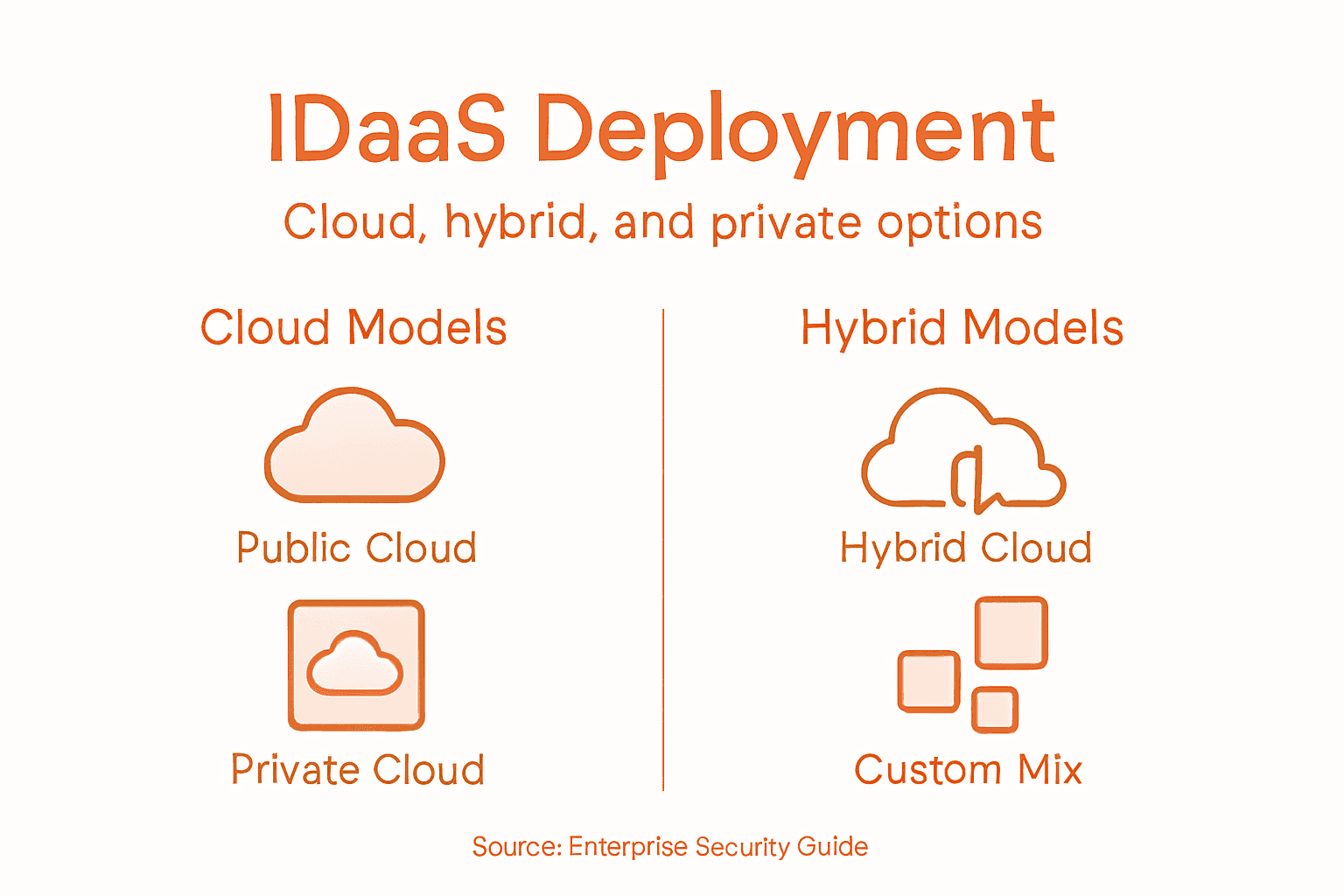
The primary deployment models for IDaaS include public cloud, private cloud, and hybrid cloud configurations. Public cloud deployments offer cost-effective, scalable solutions where identity management services are hosted on shared infrastructure managed by third-party providers. Private cloud models provide maximum control and customization, allowing organizations to maintain identity services within their own dedicated infrastructure. Hybrid cloud approaches combine elements of both public and private models, enabling businesses to balance security requirements with flexibility and cost-effectiveness.
These deployment models are further categorized according to service implementation strategies. Infrastructure as a Service (IaaS), Platform as a Service (PaaS), and Software as a Service (SaaS) represent different levels of cloud service integration. For identity management, SaaS models typically offer the most comprehensive and turnkey solutions, allowing organizations to leverage pre-configured identity management platforms without extensive internal development or maintenance.
Here is a summary of major IDaaS deployment models and their business relevance:
| Deployment Model | Control Level | Scalability | Typical Use Case |
|---|---|---|---|
| Public Cloud | Moderate | High | Startups, SMBs |
| Private Cloud | High | Moderate | Heavily regulated industries |
| Hybrid Cloud | Flexible | High | Large enterprises with mixed needs |
Pro tip: Conduct a comprehensive assessment of your organization’s security requirements, compliance needs, and existing technological infrastructure before selecting an IDaaS deployment model to ensure optimal alignment and performance.
Core features and how IDaaS works
Identity as a Service (IDaaS) platforms operate as sophisticated cloud-based authentication systems that manage digital identities across complex technological environments. Cloud-based authentication gateways verify user credentials through multiple sophisticated mechanisms, ensuring secure and streamlined access management for organizations.

The core features of IDaaS encompass several critical authentication and identity management capabilities. These include single sign-on (SSO), which allows users to access multiple applications using one set of credentials, multi-factor authentication (MFA) that adds additional verification layers, and adaptive authentication techniques that dynamically assess risk based on user behavior and context. Advanced IDaaS platforms also support comprehensive identity federation, enabling seamless authentication across different systems and platforms while maintaining robust security protocols.
The operational workflow of IDaaS involves multiple interconnected processes. When a user attempts to access a system, the IDaaS platform first validates their identity through configured authentication methods. This might involve password verification, biometric checks, one-time passwords (OTPs), or possession-based authentication factors. Once authenticated, the system generates secure access tokens that grant appropriate permissions based on predefined organizational policies. These tokens are time-limited and can be revoked instantly, providing granular control over user access and reducing potential security vulnerabilities.
Pro tip: Implement a comprehensive identity governance strategy that regularly audits and updates user access permissions to maintain optimal security and compliance across your IDaaS ecosystem.
Enterprise use cases and integrations
Enterprises leverage Identity as a Service (IDaaS) solutions to address complex identity management challenges across diverse technological ecosystems. Enterprise identity management supports workforce transformations by providing flexible, scalable authentication mechanisms that adapt to changing organizational needs.
The primary use cases for IDaaS span multiple critical business functions. In workforce management, IDaaS platforms enable seamless employee onboarding and offboarding processes, automatically provisioning and deprovisioning user accounts synchronized with human resources systems. These platforms support comprehensive identity lifecycle management, ensuring that access privileges are precisely aligned with employee roles and organizational requirements. Sectors like healthcare, government, education, and financial services particularly benefit from these capabilities, as they require stringent access control and regulatory compliance.
Technical integrations represent another crucial dimension of enterprise IDaaS implementation. Modern IDaaS solutions connect with existing directory services, cloud applications, on-premises systems, and third-party platforms through advanced federation protocols. These integrations facilitate unified identity governance, enabling organizations to maintain consistent security policies across hybrid infrastructure. Key integration features include single sign-on capabilities, multi-factor authentication, adaptive access controls, and real-time identity synchronization across different technological environments.
Pro tip: Conduct a comprehensive identity integration audit annually to ensure your IDaaS platform maintains optimal alignment with evolving organizational infrastructure and security requirements.
Risks, costs, and common pitfalls
Identity as a Service (IDaaS) platforms offer significant benefits, but organizations must carefully navigate potential risks and challenges. Digital identity systems present complex security challenges that require comprehensive risk management strategies and proactive governance approaches.
The primary risks associated with IDaaS implementations include data breaches, privacy vulnerabilities, and potential unauthorized access. Organizations face significant financial implications from potential security incidents, including direct costs of breach remediation, potential regulatory penalties, and long-term reputational damage. Common pitfalls involve inadequate stakeholder engagement, insufficient interoperability between systems, and weak legal frameworks that fail to establish clear accountability and protection mechanisms. Specific technical risks include weak authentication protocols, insufficient multi-factor authentication, and lack of adaptive security mechanisms that can dynamically respond to emerging threat landscapes.
Cost considerations extend beyond initial implementation expenses. Enterprises must factor in ongoing maintenance, continuous security updates, compliance monitoring, and potential infrastructure modifications required to integrate IDaaS platforms effectively. The total cost of ownership includes not just technical implementation but also staff training, potential productivity disruptions during transition, and long-term scalability requirements. Organizations must conduct thorough cost-benefit analyses that consider both direct financial investments and potential risk mitigation value provided by robust identity management solutions.
Pro tip: Develop a comprehensive risk assessment framework that regularly evaluates your IDaaS platform’s security posture, including periodic penetration testing and comprehensive vulnerability scanning.
Comparing IDaaS to traditional IAM
Traditional Identity and Access Management (IAM) and modern Identity as a Service (IDaaS) represent fundamentally different approaches to managing digital identities and access controls. Cloud-based identity solutions transform authentication strategies by offering more flexible, scalable, and secure mechanisms compared to legacy on-premises systems.
The primary distinctions between traditional IAM and IDaaS emerge across several critical dimensions. Traditional IAM requires organizations to maintain complex on-premises infrastructure, demanding significant hardware investments, continuous software updates, and dedicated IT personnel for system maintenance. In contrast, IDaaS shifts these operational burdens to cloud service providers, enabling organizations to focus on core business objectives instead of managing intricate identity infrastructure. Traditional systems often struggle with scalability and rapid deployment, whereas IDaaS platforms offer near-instantaneous provisioning, global accessibility, and seamless integration across diverse technological environments.
From a security perspective, IDaaS introduces substantial improvements over traditional IAM models. Modern cloud-based identity services incorporate advanced authentication mechanisms like adaptive multi-factor authentication, real-time threat detection, and zero trust architecture principles. These features enable more dynamic, intelligent security responses that can automatically adjust access privileges based on contextual risk factors. Traditional IAM systems typically rely on static, rules-based authentication models that lack the sophisticated, machine learning-powered threat detection capabilities inherent in contemporary IDaaS platforms.
The following table contrasts key areas between IDaaS and traditional IAM:
| Area | Traditional IAM | IDaaS Modern Approach |
|---|---|---|
| Infrastructure | On-premises servers | Managed in the cloud |
| Security Features | Static authentication | Adaptive MFA, real-time monitoring |
| Deployment Speed | Slow, manual | Rapid, automated |
| Maintenance | In-house IT needed | Vendor-managed updates |
Pro tip: Conduct a comprehensive gap analysis comparing your existing IAM infrastructure with potential IDaaS solutions to identify specific opportunities for security enhancement and operational efficiency.
Strengthen Your Enterprise Security with Advanced Identity as a Service Solutions
Managing digital identities with precision and confidence is crucial in today’s fast-evolving cybersecurity landscape. This article highlights common challenges such as ensuring adaptive multi-factor authentication, seamless single sign-on, and scalable cloud-based identity management—all essential to reducing risk and maintaining compliance in large organizations. If you are seeking to eliminate access vulnerabilities, simplify user lifecycle management, and enhance your security posture, these are exactly the pain points modern enterprises face.
LogMeOnce offers a powerful suite of solutions designed to directly address these challenges. With features like passwordless MFA, encrypted cloud storage, and comprehensive identity governance, our platform empowers your IT teams to take control of complex authentication workflows without added infrastructure headaches. Unlock easy integration with existing systems and enjoy rapid deployment so you can protect your organization immediately.
Explore how LogMeOnce can transform your identity management strategy and provide peace of mind with cutting-edge authentication technologies.

Ready to boost your security with a trusted Identity as a Service partner Put your enterprise on a path to resilience today by visiting LogMeOnce for a free trial and tailored cybersecurity plans that fit your business size and goals. Don’t wait until vulnerabilities show; secure your digital identity now and stay ahead of evolving threats.
Frequently Asked Questions
What is Identity as a Service (IDaaS)?
Identity as a Service (IDaaS) is a cloud-based solution for managing digital identities and access controls, providing features like single sign-on (SSO), multi-factor authentication (MFA), and automated user provisioning.
How does IDaaS enhance enterprise security?
IDaaS enhances security by utilizing advanced authentication methods, real-time threat detection, and adaptive security mechanisms to ensure secure access management across diverse technological environments.
What are the main deployment models of IDaaS?
The main deployment models of IDaaS include public cloud, private cloud, and hybrid cloud configurations, each offering varying levels of control, scalability, and customization to meet organizational needs.
How do IDaaS solutions compare to traditional Identity and Access Management (IAM)?
IDaaS provides more flexible and scalable solutions than traditional IAM systems by shifting operational burdens to cloud providers, incorporating advanced security features, and enabling faster deployment and integration.
Recommended


