


 Password Manager
 Identity Theft Protection

 Team / Business
 Enterprise
 Government
 MSP
MSP


TL;DR:
- Controlling personal data access across digital and physical environments is essential for identity security. Implementing layered protections like password managers, hardware security keys, and email aliases significantly reduces the risk of identity theft.
Identity security is defined as the layered practice of controlling who can access your personal data, accounts, and credentials across both digital and physical environments. Knowing how to secure identity is no longer optional for individuals or businesses. The Federal Trade Commission reports identity theft as one of the most frequently filed consumer complaints year after year. National Cybersecurity standards now recommend multi-factor authentication, credential management, and continuous monitoring as baseline protections. Logmeonce provides a full suite of tools that address each of these layers, from passwordless MFA to dark web monitoring. The threat is real, but the defenses are practical and within reach.
What are the essential tools to secure your identity?
The foundation of identity security starts with three tools: a password manager, a hardware security key, and an email aliasing service. Without these in place, every other protection you add sits on a cracked base.

Password reuse is the single largest preventable risk in credential security. When one site suffers a breach, attackers run those credentials against hundreds of other services in what is called credential stuffing. A password manager generates and stores unique, randomly generated passwords for every account, eliminating that risk entirely. Logmeonce’s password manager tools use encrypted vaults that protect credentials even if your device is compromised.
Hardware security keys using FIDO2/WebAuthn are currently the strongest form of multi-factor authentication available. They require physical presence and cryptographic verification, which makes remote account takeover virtually impossible. A software token or authenticator app can be intercepted. A hardware key cannot be phished remotely. For your highest-value accounts, a hardware key is the correct choice.
Not all MFA methods offer equal protection. The table below ranks common methods from strongest to weakest:
| MFA Method | Security Level | Phishing Resistant |
|---|---|---|
| Hardware key (FIDO2) | Highest | Yes |
| Passkey (device-bound) | Very high | Yes |
| Authenticator app (TOTP) | High | Partial |
| Push notification | Medium | No |
| SMS one-time code | Low | No |
Email aliasing services like SimpleLogin and AnonAddy let you create separate email addresses for each service you use. Your real inbox stays hidden. If a retailer suffers a breach, you disable that alias and the attacker gains nothing useful. This compartmentalization limits what security professionals call the “blast radius” of any single breach.
Pro Tip: Never use your primary email address to sign up for newsletters, loyalty programs, or any non-critical service. Create a dedicated alias for each category and treat your real email like a private key.
The behavioral mindset matters as much as the tools. Adopt a “verify before trusting” posture for every login request, email link, and phone call asking for credentials. User vigilance against social engineering is as critical as any technical defense.
How to implement a tiered identity protection strategy
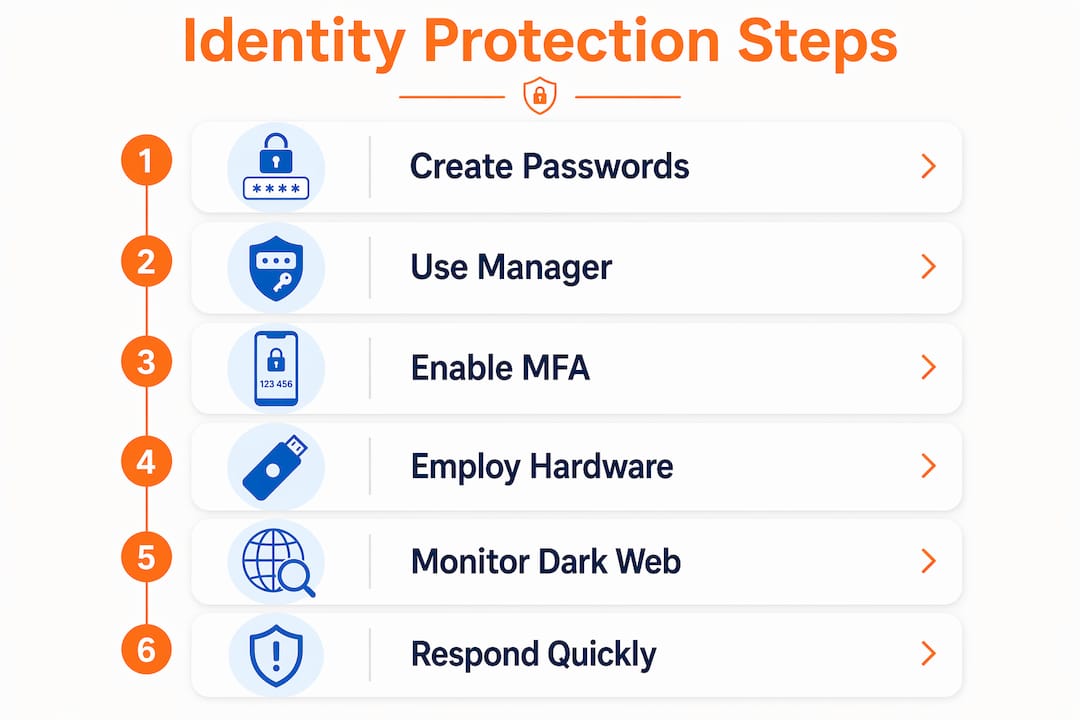
A tiered approach means securing your most critical accounts first, then expanding outward. Follow these steps in order.
- Secure your primary email account first. Your email is the master key to every other account. Add a hardware security key as the only MFA method. Remove SMS as a fallback option.
- Set up a password manager with a strong master password. Use a passphrase of at least four random words. Protect the manager itself with a hardware key.
- Create email aliases for every service category. Use one alias for financial accounts, one for shopping, one for social media. Never cross-contaminate them.
- Freeze your credit reports. Freezing credit at Equifax, Experian, and TransUnion blocks any new credit line from opening in your name, even if your Social Security number is stolen. This step costs nothing and takes minutes.
- Secure your domain registrar account. If you own a domain, registrar account compromise enables email redirection and certificate fraud. Add a hardware key and enable domain lock to prevent unauthorized transfers.
- Audit all active sessions and authorized devices. Log out of sessions you do not recognize. Revoke access for apps you no longer use.
- Subscribe to breach monitoring alerts. Services that scan the dark web notify you the moment your credentials appear in a known data dump.
Logmeonce supports layered identity protection across all of these steps, including hardware key integration, dark web monitoring, and encrypted credential storage.
Pro Tip: Never deploy MFA on only some accounts. Partial 2FA deployment creates a false sense of security. Attackers target the unprotected accounts first and use them as pivot points to reach the protected ones.
What are common identity security mistakes to avoid?
Most successful identity attacks exploit predictable mistakes. Fixing these gaps removes the majority of your attack surface.
- Password reuse across accounts. One breach becomes ten when you reuse credentials. A password manager eliminates this entirely.
- Relying on SMS 2FA for important accounts. SMS-based 2FA is vulnerable to SIM swap attacks, where an attacker convinces your carrier to transfer your number to their device. Use an authenticator app or hardware key instead.
- Single vendor dependency. Storing your password manager, email, and authentication app with one provider creates a single point of failure. If that account is compromised, everything falls at once.
- Ignoring recovery options. Backup codes, recovery emails, and trusted devices are often the weakest link. Store backup codes offline in a secure location and audit recovery settings annually.
- Skipping breach monitoring. Early detection of unauthorized activity reduces damage and allows faster credential rotation. Without monitoring, a breach can go undetected for months.
“Most attackers target the easy mark. Implementing basic security hygiene removes the majority of attack opportunities. You do not need to be impenetrable. You need to be harder to attack than the next target.”
Cloud-synced passkeys transfer security risk from individual devices to the cloud keychain account that holds them. That means the security of your passkeys depends entirely on the security of that cloud account. For the highest-value accounts, hardware-bound keys remain the stronger choice.
How to recognize and respond to identity compromise
Knowing the signs of a compromised account lets you act before the damage compounds.
Signs your identity may be compromised:
- Login alerts from locations or devices you do not recognize
- Password reset emails you did not request
- New devices added to your accounts without your knowledge
- Unexpected charges on financial accounts
- Emails or messages sent from your accounts that you did not write
- Credit inquiries or new accounts appearing on your credit report
When you spot any of these signs, act immediately. Change the password on the affected account first, then revoke all active sessions. Check account settings for unauthorized changes, such as a new recovery email or forwarding rule. Report the incident to the service provider and, if financial fraud is involved, to the FTC at IdentityTheft.gov.
AI-driven monitoring tools now analyze behavioral patterns and dark web data to flag suspicious activity before it reaches you. These tools detect phishing attempts and credential exposure in real time. Logmeonce includes dark web monitoring as part of its identity security suite.
Pro Tip: During a suspected compromise, do not communicate with anyone claiming to be from the affected company via the channel they initiated. Go directly to the official website or app to verify and respond. Social engineers often pose as support staff during the chaos of a breach.
Document every step you take during a response. Write down what happened, when you noticed it, what accounts were affected, and what actions you took. This record helps law enforcement, your bank, and credit bureaus process your case faster.
Key Takeaways
Securing your identity requires layered defenses: strong credentials, hardware-backed authentication, compartmentalized email, credit freezes, and active monitoring working together.
| Point | Details |
|---|---|
| Use a password manager | Generate unique passwords for every account and store them in an encrypted vault. |
| Prioritize hardware keys | FIDO2 hardware keys are phishing-resistant and the strongest MFA option for critical accounts. |
| Compartmentalize with aliases | Email aliases limit breach exposure and make compromised accounts easy to identify and disable. |
| Freeze your credit | Credit freezes at all three bureaus block new fraudulent accounts even after data theft. |
| Monitor and respond fast | Breach alerts and session audits catch compromise early, reducing damage significantly. |
What I’ve learned after years of watching identity attacks succeed
The attacks that succeed are rarely sophisticated. They succeed because someone reused a password, left SMS 2FA on a critical account, or clicked a link without verifying the sender. The technical solutions exist. The gap is almost always in execution.
The threat landscape is shifting in ways that demand more than good habits. AI-generated phishing emails now read like messages from people you know. Quantum computing poses a longer-term risk to current encryption standards. Zero-trust principles applied at the individual level, meaning you verify every request and trust no session by default, are the correct response to this environment.
What I find most underestimated is the compounding effect of small steps. Freezing your credit takes five minutes. Setting up an email alias takes two. Adding a hardware key to your email account takes ten. None of these actions feel dramatic. Together, they close the doors that most attackers rely on. The people who get hurt are almost always the ones who delayed these steps because they felt low-risk.
Decentralized identity, where you control your own credentials without relying on a central provider, is the direction the industry is moving. Until that infrastructure matures, the best defense is layered, hardware-backed, and actively monitored. Convenience is the enemy of security. Every time you choose the easier option, you are making a bet that you will not be targeted. That bet gets worse every year.
— Mike
Logmeonce: a practical next step for identity security
Logmeonce brings together the tools this guide describes into one platform built for individuals and businesses.
The Logmeonce cybersecurity suite includes encrypted password management, passwordless MFA, hardware key support, dark web monitoring, and cloud storage encryption. These are not separate products you need to stitch together. They work as a single system, which means fewer gaps and less room for the configuration errors that attackers exploit. Logmeonce also offers single sign-on and password management benefits tailored for teams and enterprises. Free trials are available for personal users and organizations that want to evaluate the platform before committing.
FAQ
What is the strongest form of multi-factor authentication?
Hardware security keys using the FIDO2/WebAuthn standard are the strongest MFA method available. They require physical presence and cannot be compromised remotely or through phishing.
How does a credit freeze protect your identity?
A credit freeze prevents any new credit account from being opened in your name at Equifax, Experian, and TransUnion. It remains effective even if your Social Security number has already been stolen.
Why is SMS 2FA considered weak?
SMS codes are vulnerable to SIM swap attacks, where an attacker transfers your phone number to their device. Authenticator apps and hardware keys are significantly more secure alternatives.
What should you do first if your identity is compromised?
Change the password on the affected account immediately, revoke all active sessions, and check account settings for unauthorized changes. Report financial fraud to the FTC at IdentityTheft.gov.
How does email aliasing protect personal information?
Email aliasing creates separate addresses for each service, keeping your real email private. If one alias is exposed in a breach, you disable it without affecting any other account.
Recommended


