


 Password Manager
 Identity Theft Protection

 Team / Business
 Enterprise
 Government
 MSP
MSP


TL;DR:
- Most client data breaches begin with stolen credentials rather than zero-day exploits.
- Organizations must conduct thorough data inventories, classify data sensitivity, and comply with key frameworks like FTC Safeguards, NIST SP 800-171, and CJIS.
- Implementing strong access controls, encryption, continuous monitoring, and vendor management creates an integrated security program that effectively protects client data over time.
Client data breaches don’t usually start with sophisticated zero-day exploits. They start with a stolen password. Credential theft and social engineering via email and phone remain among the most common and damaging attack vectors facing IT and security teams today. Knowing how to secure client data is no longer a compliance checkbox, it’s a core operational responsibility. This guide covers the specific frameworks, technical controls, and organizational practices you need to build a security program that actually holds up under real-world pressure.
Key Takeaways
| Point | Details |
|---|---|
| Know your data | Identify and classify all client data and understand applicable regulatory requirements. |
| Enforce strong access controls | Use multi-factor authentication and least privilege principles across all client-data access points. |
| Protect data with encryption | Encrypt client data both at rest and in transit while following secure data retention and disposal policies. |
| Train and monitor continuously | Provide security awareness training and regularly test safeguards with an incident response plan in place. |
| Manage vendor risks | Contractually require vendors to safeguard client data and perform regular security assessments. |
How to secure client data: start with knowing what you hold
Before you can protect anything, you need a precise inventory. That means identifying every type of client data your organization collects, stores, processes, or transmits. Think financial records, Social Security numbers, health data, criminal justice information, login credentials, and behavioral data. Not all of it carries equal risk, and your security investments should reflect that difference.
Classifying data by sensitivity lets you apply proportionate controls. Routine contact information doesn’t need the same treatment as tax records or protected health information. Build a data map that shows where client information lives, who accesses it, and how it flows between systems and vendors.
Regulatory requirements add another layer to this exercise. The FTC Safeguards Rule requires covered financial institutions to maintain a written Information Security Program that includes risk assessments, access controls, encryption, multi-factor authentication (MFA), and vendor oversight. For organizations handling Controlled Unclassified Information (CUI) in nonfederal systems, NIST SP 800-171 Revision 3 sets the baseline security requirements. Government agencies and their contractors working with criminal justice data must comply with the FBI CJIS Security Policy, which governs controls protecting Criminal Justice Information throughout its full lifecycle.
Here’s a quick reference for the major frameworks:
| Framework | Who it applies to | Core focus |
|---|---|---|
| FTC Safeguards Rule | Financial institutions, tax preparers | Written ISP, encryption, MFA, vendor oversight |
| NIST SP 800-171 | Federal contractors handling CUI | 110 security requirements across 17 families |
| FBI CJIS Security Policy | Law enforcement, criminal justice agencies | CJI protection at rest and in transit |
| IRS Publication 4557 | Tax professionals | Safeguarding taxpayer data from credential theft |
Your written risk assessment should account for your organization’s size, the volume and sensitivity of data you hold, and the complexity of your technical environment. Smaller organizations may qualify for exemptions under certain rules, but they still must apply core safeguards. Ignoring this step because you’re small is a common mistake with costly consequences. The NIST SP 800-171 security framework offers a practical starting point for structuring that assessment regardless of organizational scale.
Establishing strong access controls and authentication
Once you’ve mapped your data and identified your compliance obligations, access control is your next priority. Most client data breaches involve someone accessing data they shouldn’t have had access to, either through compromised credentials or misconfigured permissions.

Start by mapping every path that leads to client data. That includes cloud platforms, email systems, remote desktop connections, mobile devices, contractor portals, and any API integrations. If a path exists and isn’t protected, it’s a liability.
Key access control practices to implement:
- Enforce MFA universally. MFA reduces stolen credential effectiveness across every access point including endpoints, cloud apps, VPNs, and remote access tools. No exceptions without documented justification.
- Apply least privilege strictly. Every user, service account, and application should have access to only what it needs to perform its function. Nothing more.
- Review access rights regularly. Audit user permissions on a scheduled basis and revoke access immediately when roles change or employees depart.
- Separate administrative accounts. Admins should use elevated accounts only for administrative tasks, not for daily email or browsing.
- Log all access events. Every login, failed attempt, and privilege escalation should be recorded and reviewable.
The FTC Safeguards Rule explicitly requires MFA for any individual accessing a covered information system, with only narrowly defined exceptions permitted. This isn’t optional for covered entities. It’s a minimum baseline.
Pro Tip: Don’t just turn on MFA and call it done. Test it. Verify that bypass routes like password reset flows and legacy authentication protocols are also locked down. Attackers frequently exploit these overlooked gaps after MFA is deployed on primary login paths.
Combining strong authentication with detailed access logging gives you both a deterrent and a forensics trail. When something goes wrong, and it eventually does, you’ll need that trail to understand what happened and how far the exposure reached. Explore multi-factor authentication best practices to structure your MFA deployment correctly from the start.
Implementing encryption and secure data handling practices
Access controls stop unauthorized users from reaching client data. Encryption ensures that even if data is intercepted or a device is stolen, it remains unreadable. Both layers work together, and neither is sufficient alone.
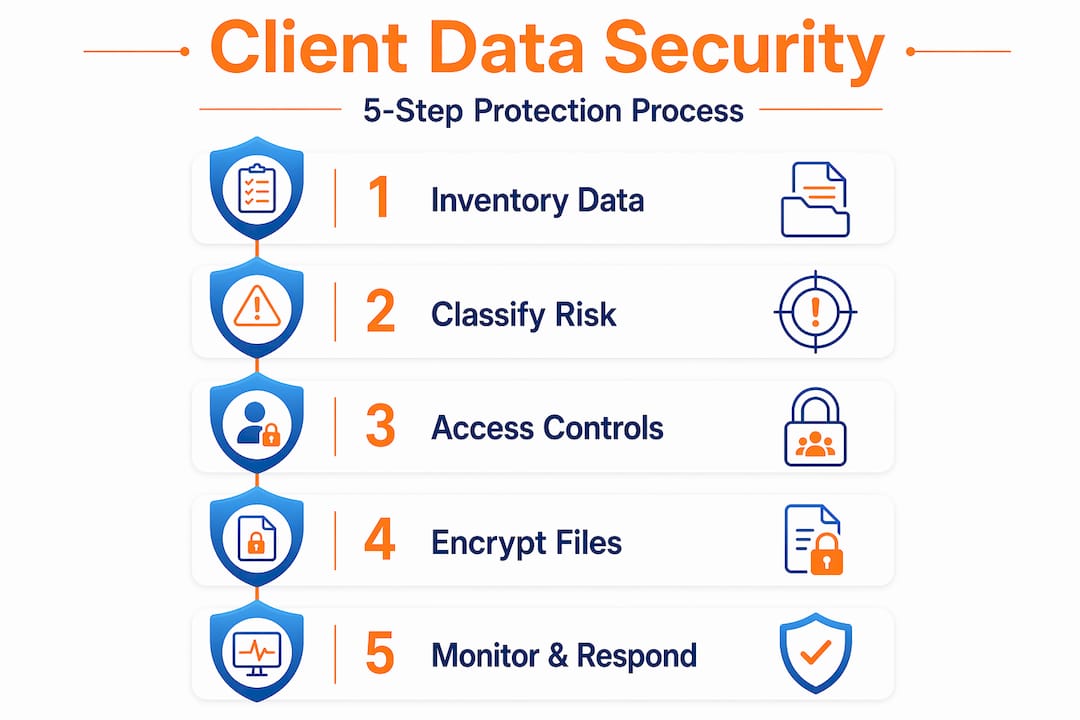
The FTC Safeguards Rule requires encryption of customer information both in transit and at rest, with compensating controls allowed only where encryption is technically infeasible. “We don’t have a budget for it” doesn’t qualify as infeasible. Build encryption into your baseline architecture, not as an afterthought.
Here’s how to structure your encryption and data handling practices:
- Encrypt all client data stored in databases, file systems, backup media, and portable devices using AES-256 or equivalent standards.
- Use TLS 1.2 or higher for all data transmitted between systems, including internal network traffic where client data is involved.
- Apply encryption to email attachments and file-sharing services used to exchange client information with third parties.
- Maintain audit logs of all data access, modification, transfer, and deletion events.
- Establish clear data retention schedules. Secure disposal is mandatory under the FTC rule no later than two years after the data’s last use, unless a legal or business obligation requires longer retention.
| Data state | Encryption standard | Common tools |
|---|---|---|
| At rest | AES-256 | Full disk encryption, database encryption |
| In transit | TLS 1.2 or 1.3 | HTTPS, secure email gateways |
| Backup media | AES-256 | Encrypted backup software |
| Email/file sharing | End-to-end encryption | Secure file transfer platforms |
Pro Tip: Don’t forget backup media. Unencrypted backup tapes and cloud snapshots are a favorite target because organizations often treat backups as outside the security perimeter. Treat every copy of client data with the same protection you apply to production systems.
Change management matters here too. Any application or system update that touches client data should go through a formal review process before deployment. A poorly tested update can silently disable encryption or open new access pathways. Review encrypting data at rest and in transit to understand the technical requirements for each data state.
Training, monitoring, and incident response to maintain security over time
The technical controls you build are only as strong as the people operating them. Social engineering attacks specifically target the human layer because it’s often easier to manipulate a person than to crack encryption.
Security awareness training should be ongoing, not annual. Focus specifically on:
- Recognizing phishing emails and fraudulent phone calls targeting client account access
- Proper handling of client data in email, file sharing, and remote work environments
- Password hygiene and the risks of credential reuse across personal and work accounts
- Reporting suspected incidents quickly without fear of blame
- Following documented procedures for data access, sharing, and disposal
“Credential theft, social engineering, and remote access attacks remain the most frequent methods used to compromise client data at financial institutions and professional service firms.”
The FTC Safeguards Rule requires both ongoing security testing and a written incident response plan. Testing can take the form of continuous monitoring, periodic penetration testing, or vulnerability assessments depending on your risk profile. The key word is periodic at minimum, meaning you can’t test once and assume you’re covered.
Your incident response plan should document:
- Roles and responsibilities for each phase of response
- Detection procedures and escalation thresholds
- Containment steps for different breach scenarios
- Client and regulatory notification timelines
- Recovery and remediation procedures
- Post-incident review requirements
Assign a Qualified Individual to own the security program. Under the FTC Safeguards Rule, this person is responsible for reporting to senior leadership on program effectiveness and compliance status. Without clear ownership, programs drift. Review employee security awareness training guidance to build a training curriculum that actually changes behavior rather than just checking a box.
Managing vendors and third-party relationships securely
Your security program is only as strong as its weakest third-party connection. Vendors with access to your client data must meet the same security standards you hold internally. Many high-profile breaches trace back not to the primary organization but to a vendor with privileged access and insufficient controls.
The FTC Safeguards Rule requires reasonable steps to ensure vendors safeguard client information and mandates periodic vendor assessments. “Reasonable steps” in practice means contractual requirements, documented assessments, and ongoing oversight. A vendor’s self-attestation isn’t enough.
Build your vendor management program around these practices:
- Contract language: Every vendor agreement that involves client data must include specific security requirements, breach notification timelines, audit rights, and remediation obligations.
- Risk-based assessments: Tier your vendors by the sensitivity of data they access and the criticality of their services. High-risk vendors warrant more frequent and deeper assessments.
- Evidence of compliance: Require vendors to provide documentation such as SOC 2 reports, penetration test results, or certifications showing their controls align with the frameworks governing your client data.
- Ongoing monitoring: Don’t assess a vendor once at onboarding and then forget them. Establish a recurring review cycle and monitor for vendor security incidents in the news and via threat intelligence feeds.
- Clear offboarding procedures: When a vendor relationship ends, ensure client data is returned or destroyed and that all access is revoked promptly.
Pro Tip: Build a vendor security questionnaire specific to the frameworks you operate under. A generic vendor assessment form misses critical framework-specific requirements. Map your questionnaire directly to the control families in FTC Safeguards, NIST 800-171, or CJIS, depending on your compliance obligations. Get more detail on building a sound program at vendor risk management best practices.
Why integrated client data protection programs outperform isolated security measures
Here’s what the compliance checklists don’t tell you: organizations that treat security as a collection of separate controls consistently underperform those that run it as a coordinated program. You can check every individual box, encrypt your data, deploy MFA, run phishing simulations, and still have a significant breach because the pieces don’t connect.
The example that comes up repeatedly in post-breach analyses is the gap between technical controls and vendor management. An organization deploys excellent internal encryption and access controls, then grants a vendor read access to a client database with only a password and no MFA requirement, no contractual security obligations, and no monitoring. The vendor gets compromised. The client data walks out the door. Every individual control was “in place.” The program wasn’t.
CUI protection achieved through integrated security requirements consistently outperforms isolated best practices. NIST’s guidance on this point is deliberate: the security requirements are designed as a system, not a menu of options.
What separates programs that hold from programs that fail is documented accountability. Someone senior must own the program, report on it regularly, and have authority to enforce it across departments and vendor relationships. When that accountability is absent, controls decay quietly over time.
Regular program reviews tied to actual threat intelligence, not just compliance calendars, also matter enormously. The threat landscape in 2026 looks different than it did three years ago. Your program should reflect that. Comprehensive security program benefits compound over time precisely because integrated programs adapt as threats evolve, while isolated controls stay static until they fail.
Enhance your client data security with LogMeOnce solutions
Putting these principles into practice requires tools that work together, not a patchwork of disconnected products.
LogMeOnce brings MFA, password management, cloud storage encryption, and dark web monitoring into a single platform built for organizations that take client data protection seriously. Whether you’re aligning with the FTC Safeguards Rule, NIST 800-171, or FBI CJIS requirements, LogMeOnce’s cybersecurity solutions provide the technical controls you need without requiring a separate tool for every requirement. The LogMeOnce MFA platform supports passwordless authentication, single sign-on, and granular access controls across your entire environment, covering every access path to client data in one place.
Frequently asked questions
What are the core safeguards required by the FTC Safeguards Rule to protect client data?
The FTC Safeguards Rule requires a written Information Security Program covering risk assessments, access controls, encryption, MFA, employee training, continuous monitoring, incident response planning, and vendor oversight. All covered financial institutions must implement these as a coordinated program, not as standalone measures.
Why is multi-factor authentication important for securing client data?
MFA blocks the majority of credential-based attacks by requiring a second verification factor that stolen passwords alone cannot satisfy. MFA effectiveness across access paths, including cloud apps, endpoints, and remote access, makes it one of the highest-return security investments available.
How does encryption help protect client data?
Encryption converts client data into unreadable ciphertext so that intercepted or stolen data is useless without the decryption key. The FTC Safeguards Rule mandates encryption for customer information in both transit and storage, with compensating controls allowed only when encryption is genuinely infeasible.
What should I include in an incident response plan for client data breaches?
An effective plan must define team roles, detection thresholds, containment procedures, regulatory and client notification timelines, and recovery steps. The FTC Safeguards Rule requires a written plan covering these elements, and it should be tested regularly through tabletop exercises or simulated incidents.
How can organizations ensure vendors protect client data properly?
Organizations must contractually bind vendors to specific security standards, conduct periodic risk-based assessments, and verify compliance through evidence like SOC 2 reports or penetration test results. The FTC rule mandates periodic vendor assessments and ongoing oversight to ensure that third-party access to client data remains appropriately controlled.
Recommended
- Professional IT Security Tips Everyone Can Benefit From
- How to Protect Your Information While Using the Cloud – LogMeOnce
- How to Increase Remote Work Security to Protect Sensitive Data


