


 Password Manager
 Identity Theft Protection

 Team / Business
 Enterprise
 Government
 MSP
MSP


TL;DR:
- Access management strategies that incorporate the AAA framework—authentication, authorization, and accounting—are essential for rapid breach containment and proactive security. Selecting appropriate authorization models like RBAC, ABAC, or ReBAC depends on policy complexity, resource relationships, and organizational scale, with zero trust architecture emphasizing continuous, session-based verification. Effective governance of non-human identities, including inventories, automated credential rotation, and exposure monitoring, is critical to prevent privilege debt and exploitation.
Access management strategies are what separate organizations that contain breaches quickly from those that spend months discovering them. Most security teams understand authentication well enough, but authentication is only one piece of a three-part framework that also includes authorization and accounting. If you are only asking “who is this person?” without equally enforcing “what are they allowed to do?” and “what did they actually do?”, your security posture has gaps you may not see until something goes wrong. This guide covers the models, frameworks, and operational practices that matter most in 2026, from dynamic authorization to the non-human identity problem that most teams are still underestimating.
Key takeaways
| Point | Details |
|---|---|
| AAA framework is foundational | Authentication, Authorization, and Accounting together form the operational backbone of any effective access strategy. |
| Authorization model matters | Choosing between RBAC, ABAC, and ReBAC depends on your policy complexity, resource relationships, and scale. |
| Non-human identities carry hidden risk | Service accounts and automation credentials require the same governance rigor as human identities to prevent privilege debt. |
| JIT access shrinks your attack surface | Replacing standing permissions with just-in-time access limits exposure to the exact task and time window required. |
| Zero Trust is an organizational shift | Implementing zero trust architecture requires process and cultural changes, not just technology deployment. |
Core access management strategies and frameworks
The foundation of any serious access management program is the AAA framework: Authentication verifies who you are, Authorization defines what you can do, and Accounting records what you actually did. Teams that treat access management as synonymous with login security are effectively skipping two thirds of the framework.
Understanding each component in depth is what turns a reactive security posture into a proactive one.
- Authentication is the identity verification layer. It answers the question “are you who you claim to be?” using passwords, biometrics, certificates, or passwordless MFA. Strong authentication is the entry requirement, not the finish line.
- Authorization is where access rights are actually defined and enforced. This is the layer most organizations under-invest in. It governs which resources a verified identity can reach and under what conditions.
- Accounting is your audit trail. Every access event, permission change, and denied request gets logged. Without it, you cannot reconstruct what happened after a compromise, which makes incident response guesswork.
On top of AAA, the frameworks you choose for authorization determine how granular and flexible your controls become. Role-Based Access Control (RBAC) assigns permissions based on job roles. It is easy to manage at small to medium scale and works well when user responsibilities map cleanly to defined roles. Attribute-Based Access Control (ABAC) goes further by evaluating dynamic conditions at access time, such as device health, time of day, and data sensitivity. This makes ABAC well suited for cloud environments where context changes constantly.
The Principle of Least Privilege cuts across all of these models. It means every user, service, or system gets only the access it needs to perform its function, nothing more. Applying least privilege at the data layer using RBAC for baseline entitlements and ABAC for dynamic conditions reduces exposure at the dataset, table, row, and column level, which is far more precise than platform-layer controls alone.
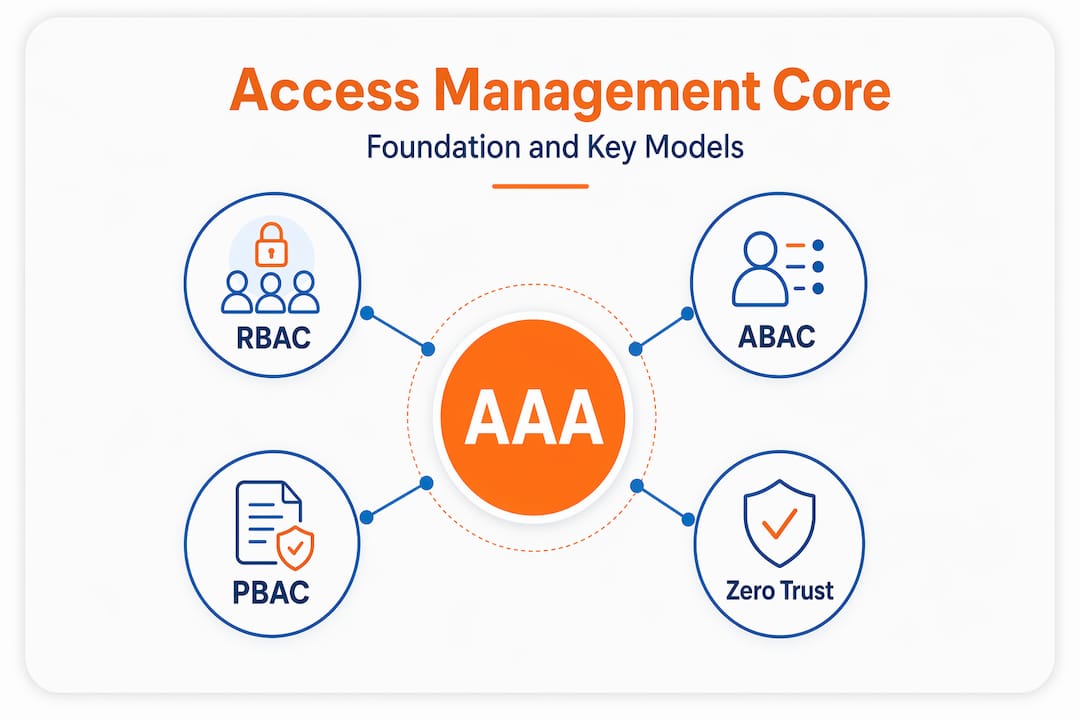
Zero Trust architecture operationalizes these principles continuously. Rather than trusting anyone inside the network perimeter, NIST SP 800-207 zero trust treats every access request as untrusted by default, evaluating identity, device posture, environment, and behavior analytics per session. Understanding the specifics of NIST 800 security policies gives your team a concrete implementation baseline to work from.
Pro Tip: Do not try to implement zero trust across your entire environment at once. Start with your highest-value data stores and work outward. This produces measurable risk reduction fast without overwhelming your team.
Choosing the right authorization model
Picking an authorization model is one of the most consequential architectural decisions in identity access management. The wrong choice either creates a management nightmare or leaves you unable to express the policies your business actually needs.
| Model | Best fit | Limitation |
|---|---|---|
| RBAC | Predictable, role-driven access in SaaS apps and enterprise setups | Struggles with complex resource relationships; risks role explosion at scale |
| ABAC | Context-dependent policies requiring dynamic attribute evaluation | Policy logic can become difficult to manage and debug at high complexity |
| ReBAC / FGA | Fine-grained, resource-level permissions based on relationships | Higher implementation overhead; best for mature teams with clear requirements |
Authorization models each have distinct tradeoffs: RBAC is widely adopted because it is simple and auditable. ABAC handles dynamic context. Relationship-Based Access Control (ReBAC) and Fine-Grained Authorization (FGA) solve the problem RBAC cannot: permissions that depend on who owns or shares a specific resource, not just what role a user holds.
Consider a document collaboration platform. RBAC can grant “editor” rights globally, but it cannot express “this user can edit only documents they created or that were explicitly shared with them.” That requires ReBAC. The same logic applies to non-human principals like automation services that need scoped delegation to specific resources without broad role assignments.
The practical decision framework looks like this. Start with RBAC if your policies are straightforward and role-aligned. Add ABAC when you need environmental conditions or data classification to influence decisions. Move to ReBAC or FGA only when resource-level relationships drive your permission model. Combining models while keeping authorization logic modular lets you evolve your approach without rewriting core business logic every time requirements change.
Pro Tip: Decouple your authorization logic from your application code from day one. Mixing the two creates expensive rewrites later and makes policy changes slower and riskier than they need to be.
Managing non-human identities
Non-human identities are the fastest-growing and least-governed category in most organizations’ access environments. Service accounts, CI/CD pipeline credentials, API keys, automation bots, and AI agents all authenticate to systems and accumulate permissions over time. Unlike human users, they rarely get reviewed in quarterly access certification cycles.

The result is privilege debt: a collection of over-permissioned credentials attached to systems that may have changed purpose or been decommissioned entirely. Treating non-human identities as second-class risks creates exactly the blind spots that attackers exploit to move laterally after an initial compromise.
Effective governance of non-human identities starts with inventory. You cannot revoke what you cannot find. The key steps are:
- Map every non-human identity to its associated credentials, the system or process that owns it, and the specific scopes it accesses. Identity-to-credential-to-owner mapping is the foundational requirement for automated lifecycle governance.
- Authenticate with modern methods wherever possible. Scoped delegation, managed identities provided by your cloud platform, and short-lived credentials replace long-lived secrets that accumulate and get forgotten.
- Automate credential rotation on a scheduled basis. Manual rotation processes get skipped under operational pressure. Automation removes the human failure point entirely.
- Monitor continuously for exposure. Secrets that appear in code repositories, logs, or configuration files represent an active risk even if the credentials have not been used maliciously yet. Automated scanning for exposed credentials followed by enforced revocation is the only reliable defense.
The lifecycle governance piece matters as much as the initial setup. When a service is decommissioned or a pipeline is rebuilt, its credentials need to be revoked promptly. Without that ownership mapping for revocation, you end up with orphaned credentials that remain valid indefinitely. That is a standing invitation for attackers.
Pro Tip: Require every non-human identity to have a named human owner in your inventory system. When that person changes roles or leaves, the review of their service accounts gets triggered automatically.
JIT access, automated reviews, and dynamic enforcement
Standing permissions are the security equivalent of leaving your office unlocked because you plan to come back. The access exists whether or not the work is actively happening, and that window of unnecessary exposure is where breaches grow.
Just-in-time (JIT) access solves this by granting permissions only at execution time and revoking them automatically after the task completes. A developer gets elevated database access for the 30 minutes required to run a maintenance script, then loses it. The attack surface shrinks to the actual work window. JIT also produces cleaner audit logs because every access event is tied to a specific request and approval.
Implementing JIT and dynamic policy enforcement effectively requires a structured approach:
- Define access request workflows with approval routing based on sensitivity level. Highly sensitive resources require a second approver or manager sign-off.
- Set time-bound grants for all elevated or sensitive permissions. Build expiration into the grant, not as an afterthought.
- Automate access reviews using data owner attestation. Automated certification cycles provide defensible audit trails for compliance without relying on manual spreadsheet reviews that get deprioritized.
- Integrate behavior analytics to detect anomalies. AI-driven adaptive access controls establish baselines for each user and trigger additional authentication or temporary restrictions when behavior deviates from normal patterns.
- Log everything at the enforcement point. Your policy decision point and policy enforcement point, the two pillars of zero trust dynamic enforcement, both need to emit detailed logs to your SIEM for correlation and incident response.
“Access reviews only work if someone is accountable for the outcome. Automation handles the process; humans still need to own the decisions.”
The practical challenge is getting data owners to complete attestation on time. Automating reminders and escalations, with clear documentation of what each access grant actually covers, reduces the cognitive load and improves completion rates substantially.
My honest take on where most teams go wrong
I have spent years watching organizations treat access management like a checkbox exercise. Get MFA deployed, tick the box. Finish the annual access review, tick the box. Move on. What that approach misses is that the real exposure usually lives in the spaces between the checkboxes.
In my experience, the single biggest gap is authorization. Teams invest heavily in authentication because it is visible and user-facing. But I have seen environments where authentication is genuinely strong and authorization is a mess of overly permissive roles that nobody has reviewed in two years. Getting past the login is hard. Once inside, the blast radius is enormous.
The non-human identity problem is where I have seen the most uncomfortable discoveries. When teams do their first real inventory of service accounts, they routinely find credentials attached to decommissioned systems, credentials with admin-level access for tasks that need only read permissions, and credentials with no documented owner at all. That is not negligence. It is what happens when governance does not keep pace with operational velocity.
My honest advice on zero trust implementation is this: do not buy a platform and call it done. Zero trust is a governance model that requires your engineering, security, and IT operations teams to change how they think about access by default. The technology supports the model. It does not replace the organizational alignment you need to make it stick.
Start simple. Get your authorization model right before you layer in AI-driven anomaly detection. Build your non-human identity inventory before you automate lifecycle governance. The sequence matters more than the speed.
— Mike
How LogMeOnce makes access management operational
Access management strategy only creates value when it runs in production without friction. LogMeOnce brings together the identity and access management capabilities your team needs in a single platform, covering MFA, password management, single sign-on, and automated user lifecycle workflows.

For security managers implementing least privilege and zero trust policies, LogMeOnce provides zero-touch onboarding and offboarding, two-factor authentication with passwordless options, and audit-ready access logs that support compliance certification. The platform handles the operational weight of access governance so your team can focus on architecture and policy, not manual provisioning. Explore the full cybersecurity solution suite to see how LogMeOnce fits into your access management framework.
FAQ
What are the three core components of access management?
Access management is built on Authentication (verifying identity), Authorization (enforcing what each identity can access), and Accounting (logging all access events for accountability and audit).
When should you use ABAC instead of RBAC?
Use ABAC when your access decisions depend on dynamic conditions such as device health, data classification, or time of access, rather than just a user’s role. RBAC works well for stable, role-aligned policies at manageable scale.
What is just-in-time access and why does it matter?
Just-in-time access grants permissions only for the duration of a specific task and revokes them automatically afterward. This shrinks the attack surface by eliminating the standing permissions that attackers exploit during lateral movement.
How do you manage non-human identities effectively?
Start by mapping every service account and automation credential to its owner, scopes, and associated systems. Then enforce short-lived credentials, automate rotation, and monitor continuously for credential exposure in code repositories and logs.
What makes zero trust different from traditional access control?
Zero trust evaluates every access request independently using identity, device posture, and behavior signals, rather than trusting any user or system based on network location. Per NIST SP 800-207, access decisions are made per session with continuous verification, not granted once at login.


