


 Password Manager
 Identity Theft Protection

 Team / Business
 Enterprise
 Government
 MSP
MSP


Zero Trust means no user, device, or connection gets trusted by default, no matter where it sits on the network. Every access request gets verified on its own terms. Two moves matter most right now: inventory your protect surface (the specific data, assets, and services you’re actually defending), and lock down identity with mandatory MFA and centralized authentication before touching anything else.
TL;DR:
- Inventory your protect surface thoroughly before implementing segmentation to prevent production traffic disruptions.
- Enforce MFA universally and adopt hardware-backed passwordless authentication to significantly reduce credential theft risks.
- Establish device posture checks with endpoint detection and management tools to differentiate access levels based on device health.
- Automate policy enforcement and implement quick session revocation to minimize exposure windows during a breach.
- Focus initially on identity fundamentals and phased deployment to build a scalable, manageable Zero Trust program without overwhelming resources.
What Are the Core Zero Trust Principles?
Zero Trust security best practices all trace back to one idea: never trust, always verify. That’s not a slogan, it’s an operational rule. Every request for access, whether it’s a laptop pinging a file server or a microservice calling another microservice, gets evaluated on its own merits. Nothing gets a free pass because it’s “inside the firewall,” because NIST SP 800-207 treats the network perimeter as functionally meaningless.
That verification happens per session and often per request. A user authenticated an hour ago doesn’t automatically stay authorized now. Sessions expire, risk signals shift, and the system re-checks before granting the next action. This is where least privilege earns its keep: access gets scoped to exactly what a task requires, for exactly as long as it’s needed, then it goes away. Just-in-time access elevation, rather than standing admin rights, is the mechanism that makes this practical instead of theoretical.
Underneath all of it sits a policy decision engine. NIST’s model splits this into a Policy Decision Point (PDP) that evaluates the request against attributes like identity, device health, location, and behavior, and a Policy Enforcement Point (PEP) that actually allows or blocks the connection. This split matters because it lets policy stay dynamic. A login from a managed laptop with an up to date patch level looks different to the PDP than the same credentials on an unpatched personal device.
Encryption in transit and in use isn’t optional inside this model, regardless of whether traffic stays on an internal segment. Translating these tenets into engineering work means mapping them across five domains: identity, device, network, workload, and data. Each domain needs its own controls, but they all feed the same policy engine, which is what keeps a Zero Trust architecture coherent instead of becoming five disconnected point solutions.
What Is the Best Zero Trust Implementation Checklist?
Here’s a prioritized sequence, ranked by what reduces risk fastest relative to effort.
- Inventory and classify the protect surface. List the specific data, applications, assets, and services worth defending, then map their dependent identities, service accounts, APIs, and data flows before writing a single policy. Skipping this step is the single most common reason segmentation projects break production traffic.
- Centralize identity and kill weak authentication. Stand up a single identity provider, enforce MFA everywhere, and move toward FIDO2-based passwordless authentication where possible. AWS’s prescriptive guidance lists hardware-backed authentication as a core control precisely because it removes phishable credentials from the equation.
- Establish device posture checks. EDR coverage, MDM enrollment, and a real patching cadence feed device health signals into your policy engine. An unmanaged laptop should never get the same access as a hardened, attested one.
- Tighten entitlements before you enforce anything. Run entitlement reviews, retire stale accounts, and route privileged access through a PAM solution with just-in-time elevation instead of standing admin rights.
- Deploy network and application controls. ZTNA and identity-aware proxies replace flat network trust with per-application, per-user decisions. CISA’s microsegmentation guidance is worth reading closely before you start carving up network zones.
- Build telemetry you can actually audit. SIEM and UEBA platforms need consistent logging across identity, device, and network layers, or your policy decisions become unverifiable after the fact.
- Automate policy enforcement and revocation. Policy-as-code and automated session termination on risk signals turn Zero Trust from a manual review process into something that scales past a few hundred endpoints.
- Write the runbooks before you need them. Incident playbooks, policy review cadences, and change control processes keep the program from decaying six months after launch.
Pro Tip: Design for fast revocation from day one. Short-lived tokens and just-in-time privilege elevation mean a detected compromise has a narrow exposure window instead of a standing credential that stays valid for days.
A few things worth calling out separately:
- Passwordless MFA and centralized SSO reduce the credential attack surface faster than almost any other single control.
- Microsegmentation without a dependency map tends to break legitimate traffic before it stops attackers.
- PAM with JIT access closes the gap that standing privileged accounts leave wide open.
How Should You Roll Out Zero Trust in Phases?
Trying to deploy Zero Trust security principles everywhere at once is how programs stall. A phased approach, consistent with the maturity model CISA publishes, gets you measurable wins without disrupting production.
- Phase 1: Identity fundamentals. Deploy SSO and mandatory MFA, finish the asset inventory, and centralize your identity provider. Success looks like widespread adoption of MFA across all accounts and a complete map of your protect surface.
- Phase 2: Device posture and adaptive access. Pilot ZTNA for a small set of high-value applications, tie access decisions to device health signals, and start scoring risk dynamically. Success means your pilot apps have no flat network access and posture checks run on every session.
- Phase 3: Microsegmentation and automation. Extend segmentation to workload identities, automate policy enforcement through code, and expand ZTNA coverage organization-wide. Success is measured by lateral movement paths closed and the extent of automated policy change deployment.
None of this works without organizational buy-in. A steering committee, named policy owners, and cross-team coordination between IAM, network, and application teams need to exist before Phase 1 starts, not after Phase 2 stalls. NIST’s implementation examples document 19 working builds worth reviewing before you design your own, since several of the integration headaches are already solved there.
Which Technologies Support a Zero Trust Architecture?
The right tools depend on where you are in the checklist above, but a few categories show up in nearly every serious deployment.
- Identity and access management: an IdP with SSO, passwordless authentication, and FIDO2 hardware key support forms the foundation almost everything else builds on.
- ZTNA and identity-aware proxies replace the implicit trust a VPN grants once you’re on the network. A VPN authenticates once at the tunnel; ZTNA re-evaluates per application, per session.
- Microsegmentation comes in host-based flavors (agents enforcing policy on the endpoint) and network-based flavors (enforcement at the switch or firewall layer). Host-based tends to scale better in cloud-native environments; network-based fits legacy data centers with fixed topology.
- Endpoint controls: EDR and MDM generate the posture signals your policy engine needs, and device attestation confirms those signals haven’t been spoofed.
- Policy enforcement infrastructure: PDP/PEP architecture, paired with telemetry pipelines feeding SIEM and UEBA platforms, is what turns static rules into adaptive decisions.
- Data protection: encryption at rest and in transit, DLP tooling, and scoped access based on data classification round out the model.
Industry guidance from AWS treats strong authentication, microsegmentation, PAM, and continuous monitoring as the non-negotiable baseline, not optional add-ons layered on top of a “real” security stack. Legacy VPN infrastructure doesn’t need to be ripped out overnight. Most teams run ZTNA and VPN in parallel during migration, moving application by application as identity-aware proxies get validated.
Who Should Own Zero Trust Governance and Metrics?

Zero Trust needs named owners, not a committee that meets quarterly and forgets what it decided. A steering committee sets direction, but day-to-day accountability sits with policy owners (who approve access rule changes) and IAM owners (who run the identity infrastructure everything else depends on). Every policy change needs a change control process, because an unreviewed policy edit is how overly permissive rules creep back in.
Metrics make the program auditable instead of aspirational:
- MFA adoption rate across all accounts, not just privileged ones
- Percentage of the protect surface actually covered by policy enforcement
- Mean time to detect and contain anomalous access
- Percentage of privileged access sessions using just-in-time elevation
| Metric | What it tells you | Reporting cadence |
|---|---|---|
| MFA adoption rate | Credential attack surface remaining | Monthly |
| Protect surface coverage | Program maturity and scope gaps | Quarterly |
| Mean time to detect/contain | Telemetry and response effectiveness | Monthly |
| JIT access percentage | Standing privilege exposure | Quarterly |
Report these to the steering committee on a fixed cadence. A KPI nobody reviews is a KPI that stops improving.
What Mistakes Undermine Zero Trust Adoption?
Scope creep kills momentum fast. Trying to segment the entire network before finishing identity fundamentals leaves teams juggling pilots that never graduate to production.
- Identity and entitlement sprawl left uncleaned before enforcement creates false denials that erode trust in the whole program.
- Telemetry gaps around unmanaged or shadow IT assets create blind spots no policy engine can see around.
- Overly strict adaptive auth without risk-based tuning frustrates users and drives shadow workarounds.
Pro Tip: Use risk-based adaptive authentication instead of blanket friction. Step up verification only when a signal actually looks off, like a new device or an impossible-travel login, rather than challenging every request equally.
How Does LogMeOnce Support These Zero Trust Controls?
Several of the checklist items above map directly to capabilities LogMeOnce provides for identity-first Zero Trust pilots.
- Passwordless MFA with FIDO2 support closes the credential gap covered in Phase 1 of the roadmap.
- Centralized SSO reduces the identity sprawl that undermines entitlement reviews.
- Cloud storage encryption addresses the data protection layer alongside classification and DLP.
- Dark web monitoring adds a telemetry signal that feeds risk-based policy decisions.
Reviewing LogMeOnce’s Zero Trust security resources is a reasonable next step if you’re scoping Phase 1 identity work and want to see how a purpose-built platform handles the MFA and SSO pieces without a custom build.
Where Can You Find Official Zero Trust Standards?
Start with NIST SP 800-207 for the foundational architecture and tenets. Pair it with NIST SP 1800-35 from the NCCoE for 19 working example builds. CISA’s Zero Trust maturity model and its microsegmentation guidance help with phased planning. The NSA’s Zero Trust Implementation Guidelines round out the set with pillar-based capability activities by phase.
An Editorial Take on Getting This Right
Most Zero Trust advice treats it as an architecture decision. It’s actually a governance decision wearing architecture clothes. The technical controls, ZTNA, microsegmentation, PDP/PEP, aren’t hard to understand on paper. What breaks programs is the absence of a named owner willing to say no to a policy exception at 4 p.m. on a Friday.
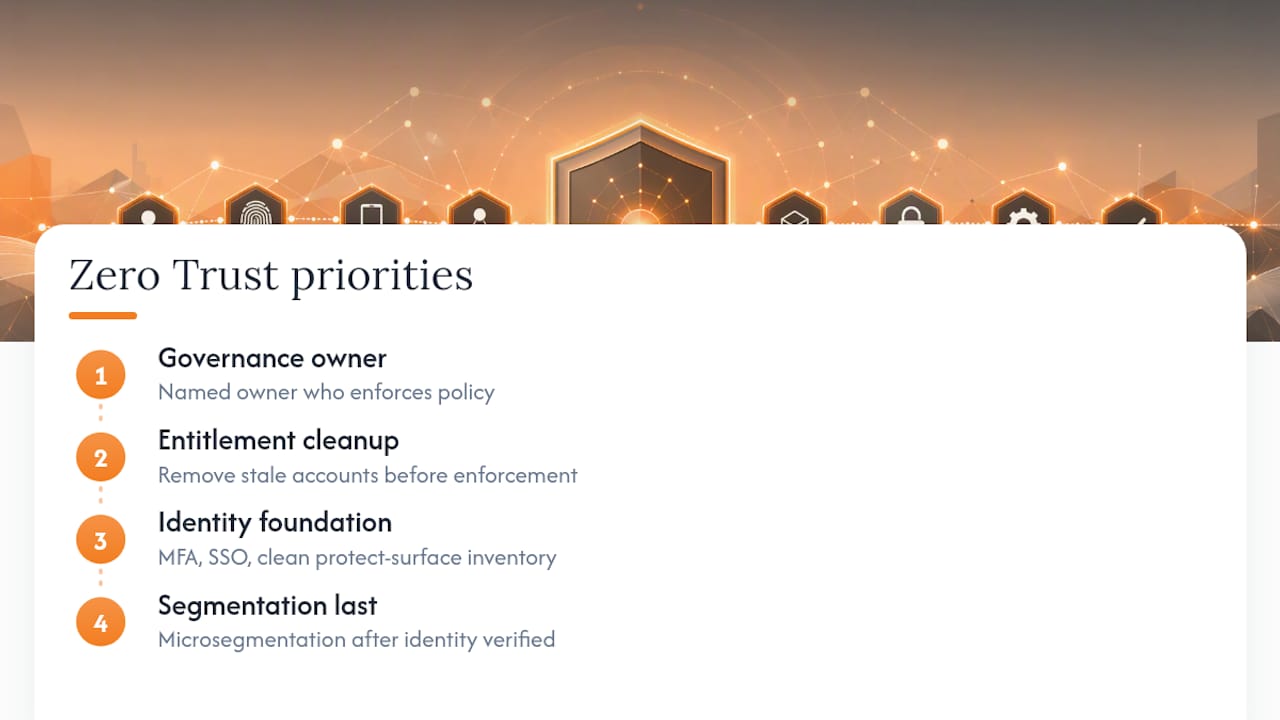
The conventional advice oversells microsegmentation as the starting point. It isn’t. Identity is. You can run a genuinely effective Zero Trust program for six months on MFA, SSO, and a clean protect surface inventory before you touch a single network segment. Segmentation, without that identity foundation, just adds complexity to a system nobody’s actually verifying yet.
If you take one thing from this: fix entitlement sprawl before you enforce anything. Every pilot I’d bet stalls because someone in the second phase discovers three thousand stale accounts nobody bothered to clean up during phase one. Do that work first. It’s unglamorous, and it’s the entire game.
— Mike
Sources
- Zero Trust Architecture (NIST SP 800-207)
- CISA: Zero Trust (topic page & maturity model)
- AWS Prescriptive Guidance: Best practices for Zero Trust
Recommended


