


 Password Manager
 Identity Theft Protection

 Team / Business
 Enterprise
 Government
 MSP
MSP


An effective security awareness program drives measurable behavior change through a lifecycle of role-based content, continuous simulation, and outcome-focused metrics — not a once-a-year compliance event.
The non-negotiable elements:
- Lifecycle management aligned to NIST SP 800-50 Rev.1 (plan, deploy, measure, improve)
- Role-based content matched to actual threat exposure by job function
- Continuous phishing simulations with quarterly theme rotation to prevent habituation
- Outcome-focused KPIs beyond completion rates: click rates, reporting rates, remediation times
- Executive sponsorship tied to breach economics and board-level risk language
- Integration with incident response and HR systems so the program feeds real operational decisions
“Building a cybersecurity and privacy learning program requires a structured, lifecycle-based approach that integrates awareness, training, and education to produce measurable behavior change and a culture of security.” — NIST SP 800-50 Rev.1
CISA’s Cybersecurity Awareness Program and SANS Security Awareness resources serve as the practical toolkits. NIST SP 800-50 Rev.1 is the lifecycle authority. Together, they give you the framework, the benchmarks, and the content templates to build a program that holds up to board scrutiny.
What’s the difference between awareness, training, and education?
Most programs collapse all three into one annual module and wonder why nothing changes. They are distinct layers with different objectives, formats, and success signals.

| Layer | Objective | Typical Formats | Success Measures |
|---|---|---|---|
| Awareness | Shape culture; prompt reporting behavior | Posters, newsletters, phishing simulations, short videos | Incident reporting rate, culture survey scores |
| Training | Build procedural skills and baseline hygiene | Microlearning, LMS modules, tabletop exercises | Remediation time, quiz pass rates, simulation click rates |
| Education | Develop role-specific competency | Deep courses, certifications, workshops | Role competency assessments, credential completion |
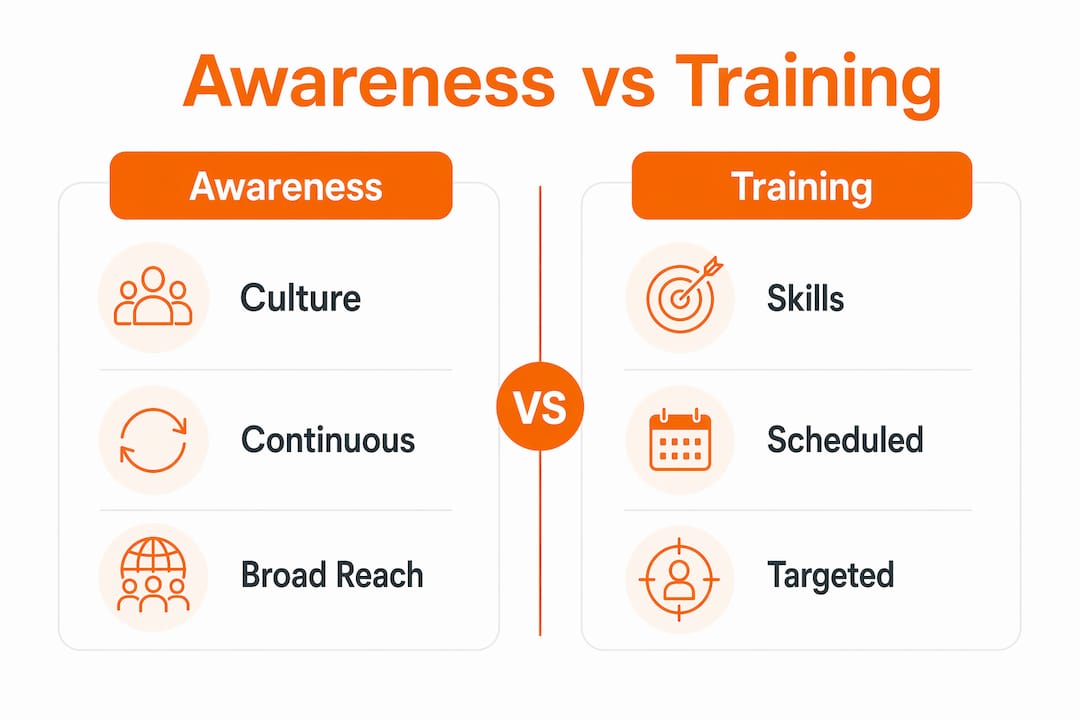
The three layers map directly to the lifecycle. Awareness runs continuously and shapes the reporting culture that makes every other layer work. Training delivers the procedural skills employees need to handle phishing attempts, MFA prompts, and device security decisions correctly. Education goes deeper for roles with elevated risk: executives need to recognize business email compromise (BEC), finance teams need wire-transfer verification protocols, and IT staff need incident-response playbooks.
Phishing simulations sit at the intersection of awareness and training. They measure culture (will someone report?) and skill (will someone click?). Microlearning modules belong in training. Tabletop exercises, where a team walks through a breach scenario in real time, are education for the people who will actually manage the response.
Each layer should produce distinct measurement signals:
- Awareness: rising incident report-to-IT rate, improved culture survey results
- Training: declining phishing click rates, faster remediation after a failed simulation
- Education: role competency check scores, reduced human-error incidents in high-risk departments
How to build your program using a lifecycle approach
NIST SP 800-50 Rev.1 makes the lifecycle requirement explicit: plan, deploy, measure, and improve. Skipping any phase is what turns a program into a compliance checkbox.
Here is a practical, phase-by-phase breakdown with owners and minimum deliverables:
-
Plan — establish baseline and stakeholders (Months 1–2). Identify your program owner (typically a security awareness manager or CISO delegate), map your audience segments by role and risk level, and run an unannounced phishing simulation to establish a baseline click rate. Document your compliance requirements (SOC 2, HIPAA, PCI DSS, ISO 27001) and set measurable objectives tied to those requirements.
-
Deploy pilot — small-scope launch with clear success criteria (Months 2–3). Select a representative pilot group of a modest number of employees across two or three departments. Launch your first training module, run a themed simulation, and collect reporting-rate and click-rate data. Define what “success” looks like before you start: a target click-rate reduction, a minimum reporting rate, or a remediation-time threshold.
-
Organization-wide rollout (Months 3–6). Expand to all staff using the pilot’s lessons. Introduce role-based content tracks for executives, finance, IT, HR, and general staff. Automate remediation training triggers for employees who fail simulations.
-
Measure — build your KPI dashboard (Month 4 onward). Track phishing click rates, credential submission rates, report-to-IT rates, time-to-remediation, and incident volumes attributed to human error. Map these to a board-facing human-risk curve.
-
Role-based deepening (Months 6–9). Add advanced content for high-risk roles: BEC scenarios for finance, supply-chain risk modules for procurement, and incident-response tabletops for IT. Benchmark against SANS maturity model stages.
-
Improve — executive review and iteration (Month 12). Present a board-level report showing human-risk reduction against the baseline. Use cohort analysis to identify departments still above acceptable risk thresholds. Adjust content, cadence, and simulation themes based on data.
12-month milestone callout:
- Month 1: Baseline simulation run; stakeholder map complete
- Month 3: Pilot results reviewed; rollout plan approved
- Month 6: Full deployment; role-based tracks live
- Month 9: Mid-year KPI review; simulation themes rotated twice
- Month 12: Board-level risk report delivered; program iteration planned
The baseline simulation is the single most important early step. Without it, you have no yardstick. Run it unannounced, using a realistic but fair scenario, before any training is delivered.
What should your program actually cover, and for whom?
The content question is where most programs go generic. A role matrix prevents that.
| Audience | Content Types | Priority Topics | Escalation Action |
|---|---|---|---|
| Executives | Briefings, BEC simulations, tabletops | BEC, deepfake voice fraud, board-level reporting | Escalate to CISO; verify wire requests via callback |
| Finance | Scenario-based modules, wire-transfer drills | BEC, invoice fraud, vendor impersonation | Dual-approval protocol; report to security team |
| IT/Security | Deep courses, incident-response playbooks | Privileged access, supply-chain risk, SIEM alerts | Initiate IR plan; escalate per runbook |
| HR | Targeted modules, policy awareness | Social engineering, employee data handling, phishing | Report to security; do not share employee data verbally |
| Vendors/Contractors | Onboarding modules, policy acknowledgment | Access hygiene, secure file sharing, MFA | Report anomalies to vendor liaison |
| General Staff | Microlearning, phishing simulations | Phishing, MFA, password hygiene, device security | Report suspicious email; do not click; call IT |
Recommended cadence by role:
| Role | Microlearning | Phishing Simulations | Deep Training |
|---|---|---|---|
| General Staff | Monthly | Quarterly | Annual |
| Finance/HR | Monthly | Monthly | Semi-annual |
| IT/Security | Bi-weekly | Monthly | Quarterly |
| Executives | Monthly briefing | Quarterly | Annual tabletop |
| Vendors | Onboarding + quarterly | Quarterly | Annual |
Quarterly training with monthly microlearning and simulated practice yields better retention than annual training alone. The research is consistent on this point: spaced repetition and hands-on practice change behavior; a single annual module does not.
Sample topics prioritized by impact:
- Phishing and spear-phishing recognition
- MFA setup, use, and bypass-attempt recognition
- Password hygiene and credential management
- Device security for remote and hybrid workers
- BEC and wire-transfer fraud
- Secure vendor and contractor handling
- Supply-chain risk indicators
- Incident reporting procedures and escalation paths
For remote and hybrid teams, deliver content through asynchronous LMS modules, short video microlearning, and email-based simulations. Avoid formats that require synchronous attendance as the primary delivery mechanism. For multilingual workforces, localize at minimum the phishing simulation templates and the incident-reporting procedure, since those two touch points have the highest behavioral stakes.
How to launch a pilot and scale without losing momentum
Start small, measure everything, and expand only on evidence. That is the reliable path from pilot to organization-wide program.
Pilot checklist:
- Define scope: 50–200 employees across two or three departments with varied risk profiles
- Set success criteria before launch: target click-rate reduction, minimum reporting rate, remediation completion rate
- Assign a dedicated program owner with at least 20% of their time allocated to the pilot
- Select your platform: an LMS with phishing simulation capability, or a dedicated security awareness platform
- Run a baseline simulation before any training content is delivered
- Deliver one training module and one themed simulation within the pilot window
- Collect data for 6–8 weeks before reviewing results
SANS maturity model benchmarks provide a useful reference for staffing. A program serving fewer than 1,000 employees typically requires at least one dedicated awareness professional. Larger organizations with complex role matrices or regulated environments need more.
Budget drivers to plan for:
- Platform licensing (per-seat or flat-fee, depending on vendor model)
- Content localization for multilingual or international workforces
- Staffing: program manager, content developer, and data analyst (can be fractional)
- Simulation complexity: custom scenarios cost more than template-based ones
- Integrations: SIEM, ticketing systems, HR information systems, and LMS connectors
Stakeholder communications by milestone:
- Executives (Month 1): Frame the program as a business risk reduction initiative. Present breach-economics scenarios showing the cost of a phishing-enabled incident versus the cost of the program. Tie to compliance requirements.
- HR and Legal (Month 2): Confirm data handling for simulation results, employee notification policies, and any union or labor considerations for monitoring.
- Business-unit leaders (Month 3): Share pilot scope, expected disruption (minimal), and what you will report back. Ask for a departmental champion.
- All staff (Month 3): Communicate the program’s purpose in plain language. Avoid framing it as surveillance. Emphasize that the goal is to help employees recognize real threats, not to catch them failing.
Securing executive buy-in early is the single biggest predictor of program longevity. Programs that live only in the security team’s budget get cut first.

How do you actually prove your program is working?
Completion rates tell you who clicked “finish.” They tell you nothing about whether anyone changed their behavior. That distinction is where most programs fail their first board review.
“Effective program metrics extend beyond completion rates to include KPIs that reflect behavior changes and real responses to threats — including reporting rates, remediation times, and incident volumes attributable to human error.” — Trend Micro
The KPIs that actually indicate behavior change:
- Phishing click rate: percentage of employees who click a simulated phishing link; track by cohort and role
- Credential submission rate: percentage who enter credentials after clicking; a more severe signal than click rate alone
- Report-to-IT rate: percentage of simulated (and real) phishing emails reported; rising rate signals a healthy reporting culture
- Time-to-remediation: how long it takes an employee who fails a simulation to complete corrective training
- Incident volume attributed to human error: tracked via your SIEM or incident-response platform; declining volume is the clearest proof of ROI
- Role-based risk scores: per-employee or per-cohort scores combining simulation outcomes, OSINT exposure, and incident-readiness indicators
- Reporting culture indicators: culture survey results, voluntary security tip submissions, and near-miss reports
Mature programs combine phishing simulation results, OSINT exposure, and incident-response readiness into a single human-risk score per employee. That score drives targeted coaching rather than blanket retraining.
Board-facing dashboard fields:
- Human-risk curve: aggregate risk score over time versus baseline
- Phishing click rate trend: monthly, by department
- Report-to-IT rate trend: monthly
- Incident volume attributed to human error: quarterly
- Compliance training completion: by framework requirement
- Remediation completion rate: percentage of failed-simulation employees who completed corrective training within 72 hours
Measurement do/don’t list:
- Do establish a baseline before any training, so you have a real comparison point
- Do segment data by role and department to identify high-risk cohorts
- Do run cohort analysis to track the same group over time, not just aggregate snapshots
- Don’t report completion rates as the primary metric to the board
- Don’t use a single simulation theme all year; habituation will suppress click rates without changing actual behavior
- Don’t interpret a low click rate in Month 1 as success; it may mean the simulation was too easy
Aligning your dashboard to compliance frameworks (SOC 2, HIPAA, PCI DSS) gives executives a second reason to fund the program: board-level reporting tied to audit requirements is far easier to justify than a standalone training budget.
How do you keep employees from tuning out your simulations?
Habituation is the silent killer of simulation programs. When employees see the same phishing template every quarter, they stop engaging with it as a real threat signal and start pattern-matching to the test. Your click rate drops, but your actual vulnerability does not.
The fix is continuous rotation with real threat intelligence driving the scenario design. Rotating simulation themes quarterly and varying delivery channels prevents employees from recognizing the test format rather than the threat.
Practical rotation tactics:
- Rotate themes quarterly: Q1 invoice fraud, Q2 IT helpdesk impersonation, Q3 HR/benefits update, Q4 executive wire request. Align themes to seasonal threat patterns (tax season, open enrollment, year-end financial close).
- Vary delivery channels: email is the baseline, but add voice (vishing) simulations for finance and executive audiences, and SMS (smishing) for mobile-heavy workforces.
- Use industry-specific threat intelligence: pull scenarios from current threat reports. AI-driven attacks and deepfake voice fraud are now realistic enough to include in executive simulations.
- Run A/B tests on simulation realism: send two variants of the same scenario to matched cohorts and compare click rates. The higher-click variant reveals which social-engineering cues are most effective against your workforce.
- Trigger remediation automatically: employees who fail a simulation should receive a brief, targeted coaching module within 24 hours, not a generic retraining assignment weeks later.
- Track signal quality over time: if your click rate is declining but your reporting rate is flat, the simulations may be getting easier, not the workforce smarter. Increase difficulty before declaring success.
Pro Tip: Use automation to personalize remediation. An employee who clicked a credential-harvesting link needs different coaching than one who clicked a malware-delivery link. Platforms that trigger role-specific remediation based on simulation failure type reduce operational overhead and produce better behavior-change outcomes than one-size-fits-all retraining.
Automation is often the difference between a program that stalls at pilot scale and one that reaches every employee consistently. AI-generated scenario updates, automated remediation triggers, and risk-score recalculation after each simulation event are what allow a small security team to run a program that feels personalized at scale.
Which standards and toolkits should you build your program on?
U.S. organizations have three authoritative anchors, each serving a different function in the program lifecycle.
-
NIST SP 800-50 Rev.1 is the lifecycle authority. It defines the plan-deploy-measure-improve framework, specifies role-based training requirements, and provides scalable guidance for organizations from small agencies to large enterprises. Use it in the planning phase to structure your program architecture and in board reporting to demonstrate alignment with federal standards. The full publication includes measurement guidance tied directly to behavior change outcomes.
-
CISA Cybersecurity Awareness Program is the practical toolkit for content and communications. CISA’s program resources include ready-to-use awareness materials, phishing guidance, and campaign toolkits organized around four core behaviors: using strong passwords, enabling MFA, recognizing phishing, and updating software. These are free, government-produced, and designed for U.S. organizations of any size. Use them in the deploy phase for general-staff awareness content and in executive briefings to show alignment with federal priorities.
-
SANS Security Awareness provides the maturity model and benchmarking framework. The SANS maturity model stages programs from “compliance-focused” through “metrics-driven” to “culture-embedded,” giving you a benchmark for where your program sits and what the next stage requires. SANS also publishes staffing benchmarks and annual threat reports that inform simulation content. Use the maturity model in your annual board review to show program progression.
“Programs that use real-world tradecraft to shape simulations — drawing from current threat intelligence including AI-driven attacks — consistently outperform those relying on outdated or generic scenarios.” — NIST SP 800-50 Rev.1
Practical toolkits and playbooks to adapt:
- Phishing simulation playbook: document your simulation calendar, theme rotation schedule, escalation path for real phishing reports received during a simulation window, and coaching trigger logic. CISA’s phishing guidance provides a starting template.
- Executive briefing template: a one-page board report showing human-risk curve, compliance status, and program ROI in breach-economics terms. Adapt from NIST SP 800-50 Rev.1 measurement guidance.
- Incident reporting procedure card: a single-page reference for all staff showing exactly how to report a suspicious email, call, or text. Laminated physical cards for in-office staff; digital versions pinned in Slack or Teams for remote workers.
- New-hire onboarding module: a 15–20 minute baseline hygiene module covering MFA, password management, phishing recognition, and incident reporting. Deliver within the first week of employment.
For smaller organizations (under 500 employees), CISA’s free toolkit is sufficient for awareness content. Larger organizations with regulated data environments should layer NIST SP 800-50 Rev.1 governance on top and use SANS benchmarks to justify staffing and budget requests.
Key Takeaways
Effective security awareness programs succeed when they treat behavior change as the primary output, not training completion, and when they operate as a continuous lifecycle rather than an annual event.
| Point | Details |
|---|---|
| Lifecycle over events | Align your program to NIST SP 800-50 Rev.1’s plan-deploy-measure-improve cycle for sustained impact. |
| Role-based content | Map content and simulations to actual threat exposure by job function, not a single curriculum for all staff. |
| KPIs beyond completion | Track phishing click rates, report-to-IT rates, remediation times, and human-error incident volumes to prove behavior change. |
| Simulation rotation | Rotate themes quarterly and vary channels (email, voice, SMS) to prevent habituation and preserve signal quality. |
| Logmeonce as a platform complement | Logmeonce’s MFA, SSO, and identity management capabilities directly support the authentication hygiene behaviors your program teaches. |
What most security leaders get wrong about program implementation
The most common implementation surprise is not the technology. It is the gap between what leaders expect from a training platform and what actually drives behavior change at scale.
Programs that stall almost always share the same root cause: they were designed as content-delivery projects, not behavior-change initiatives. The security team selects a platform, loads modules, sends simulations, and reports completion rates. Twelve months later, the phishing click rate has barely moved, and the board asks why the budget should be renewed.
A few patterns show up repeatedly. One organization runs a rigorous pilot with strong results, then hands the program to HR for organization-wide rollout without maintaining security team ownership of the simulation calendar. Within two quarters, simulations become predictable, click rates drop for the wrong reasons, and the reporting rate never improves. Another organization invests heavily in content but skips the baseline simulation, so they have no comparison point for the board review and cannot demonstrate ROI.
Lessons that hold across programs of every size:
- Staffing is a program risk, not a budget line. A program with no dedicated owner degrades within six months. Even a 20% FTE allocation to a named program manager outperforms a committee with shared responsibility.
- Change management is not optional. Employees who feel surveilled disengage. Frame the program as a skill-building initiative from day one, communicate the purpose clearly, and celebrate reporting behavior publicly.
- Governance cadence matters. Quarterly KPI reviews with a named executive sponsor keep the program funded and visible. Annual reviews are too infrequent to catch drift before it becomes a problem.
- Realistic timelines prevent premature failure. Meaningful behavior change takes 6–12 months of consistent reinforcement. Programs evaluated at the 90-day mark on behavior metrics almost always look like failures, even when they are working.
How platform capabilities can strengthen your awareness program
Security awareness programs generate a lot of data: simulation results, remediation completion rates, risk scores, and incident reports. Without the right platform infrastructure, that data sits in spreadsheets and never reaches the board in a form that justifies the budget.
Logmeonce’s cybersecurity platform complements awareness program goals in ways that matter operationally. Its MFA and single sign-on capabilities directly reinforce the authentication hygiene behaviors your training teaches. When employees learn to use MFA correctly in training and then encounter it as a daily workflow requirement enforced by the platform, the behavior sticks. That alignment between what the program teaches and what the technology requires is where most organizations leave impact on the table.
Beyond authentication, Logmeonce’s password management capabilities address one of the highest-frequency failure points in any awareness program: credential hygiene. Employees who complete password hygiene training but still reuse passwords across accounts are a persistent risk. A platform that enforces strong, unique credentials at the point of use closes the gap between training intent and actual behavior.
For program owners, the reporting and identity management features support the board-facing dashboards described earlier: authentication event logs, MFA adoption rates, and access anomalies all feed the human-risk picture. To see how these capabilities map to your program’s KPIs, visit the Logmeonce cybersecurity page and review the platform’s identity and reporting features.
Useful sources and further reading
-
NIST SP 800-50 Rev.1 — The authoritative U.S. government lifecycle framework for cybersecurity and privacy learning programs. Use it for program architecture, measurement guidance, and board-level governance alignment. Published 2024.
-
CISA Cybersecurity Awareness Program — Free, government-produced awareness materials, phishing guidance, and campaign toolkits for U.S. organizations of any size. Use in the deploy phase for general-staff content and executive communications.
-
SANS Security Awareness resources — Maturity model, staffing benchmarks, and annual threat reports. Use for benchmarking program maturity and justifying staffing and budget decisions.
-
Huntress: Best practices for security awareness training programs — Practical guidance on microlearning cadence, spaced repetition, and embedding training into daily workflows rather than annual events.
-
Petronella Tech: NIST 800-50 blueprint — Practitioner-level walkthrough of applying NIST SP 800-50 to build a human-risk scoring model and targeted remediation program.
-
Trend Micro: How to build an effective security awareness program — KPI selection guidance and dashboard design for proving program impact beyond completion rates.
-
Logmeonce cybersecurity resources — Platform capabilities including MFA, SSO, and identity management that support the authentication hygiene behaviors effective awareness programs teach. Relevant for organizations evaluating platform options to complement their training program.
Recommended
- Why Cybersecurity Awareness Is Vital to Your Business – LogMeOnce
- Security Posture Assessment: A 2026 Guide for IT Leaders
- Professional IT Security Tips Everyone Can Benefit From


