


 Password Manager
 Identity Theft Protection

 Team / Business
 Enterprise
 Government
 MSP
MSP


TL;DR:
- A security posture assessment evaluates an organization’s cybersecurity defenses across people, processes, and technology. It produces a risk-scored roadmap to guide strategy, rather than just a list of vulnerabilities.
A security posture assessment is the structured, holistic evaluation of an organization’s cybersecurity defenses to measure how effectively it can prevent, detect, and respond to threats. Unlike a point-in-time vulnerability scan, this process maps the maturity of people, processes, and technology against recognized frameworks like NIST CSF 2.0 and ISO 27001:2022. Third-party breaches account for 30% of all security incidents, and global ransomware attacks grew 32% year over year in 2025 with 7,419 recorded incidents. Those numbers make a clear case: knowing your current security state is not optional. A thorough organizational security evaluation gives leadership the evidence needed to act, budget, and prioritize with confidence.
What does a security posture assessment actually cover?
Organizations frequently confuse a security posture assessment with a vulnerability scan or a penetration test. Each serves a different purpose, and mixing them up leads to gaps that attackers exploit.
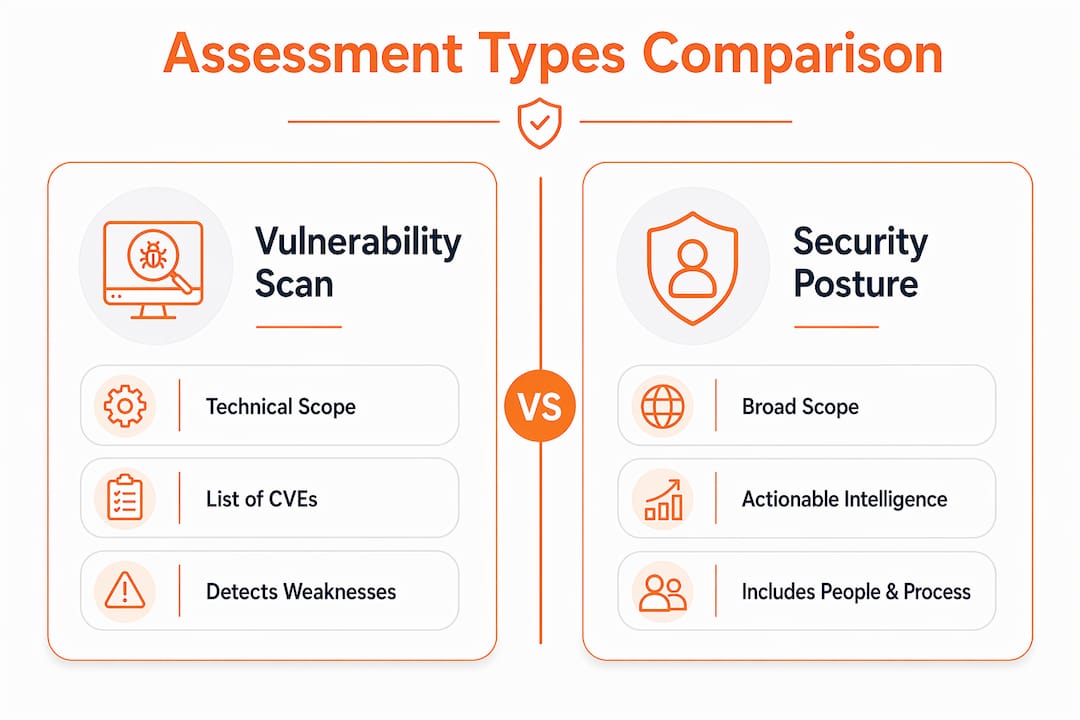
A vulnerability scan identifies technical weaknesses in systems, such as unpatched software or open ports. A penetration test goes further by actively exploiting those weaknesses to prove they are real risks. A security risk evaluation evaluates vulnerabilities alongside existing threats and controls to rank risks by priority. A security posture assessment sits above all three. It maps people, processes, and technology holistically against mature frameworks recognized by boards and cyber insurers, not just technical teams.
The outputs differ significantly too. A vulnerability scan produces a list of CVEs. A security posture assessment produces a risk-scored roadmap, an executive summary, and a gap analysis tied to business objectives. Think of it as a “gut check” of your current versus desired cybersecurity position, acting as a strategic roadmap rather than a simple audit report.
| Activity | Scope | Primary output | Framework alignment |
|---|---|---|---|
| Vulnerability scan | Technical systems | CVE list | Minimal |
| Penetration test | Targeted systems | Exploitation report | Minimal |
| Compliance audit | Regulatory controls | Pass/fail checklist | Single standard |
| Security posture assessment | People, process, technology | Risk-scored roadmap | NIST CSF 2.0, ISO 27001:2022, CIS Controls |
Pro Tip: Before scheduling a full assessment, confirm that your scope includes third-party access and cloud environments. Leaving those out creates a false sense of security from day one.
What are the core components of a thorough assessment?
A well-structured IT security posture evaluation covers six primary domains. Each domain contributes a distinct layer of risk intelligence.
- Asset discovery. You cannot protect what you do not know exists. This phase catalogs every device, application, cloud workload, and third-party connection.
- Governance review. Policies, roles, and accountability structures are examined to confirm that security responsibilities are formally assigned and enforced.
- Identity and access management. This domain checks whether least-privilege principles, multi-factor authentication, and access reviews are in place across all user types.
- Cloud security configuration. Misconfigured storage buckets and overpermissioned service accounts are among the most common entry points for attackers.
- Threat modeling. The assessment maps likely attack paths based on your industry, data types, and known threat actor behavior.
- Configuration and patch controls. Baseline hardening standards are compared against actual system states to find drift.
The methodology typically follows a six-phase process: scoping, data collection, gap analysis, risk scoring, reporting, and roadmap creation. Risk scoring is where the assessment becomes genuinely useful. Risk scoring prioritizes findings by likelihood of exploitation and business impact, factoring in regulatory scope and asset criticality. That translation from raw findings to business-weighted priorities is what separates a useful assessment from a document that sits in a drawer.
Regulatory compliance is a major driver of assessments. 59% of organizations cite regulation and compliance as their primary reason for starting a security risk reduction program. That motivation is understandable, but compliance alone does not equal security. The most effective assessments use regulatory requirements as a floor, not a ceiling.

The hardest challenges in practice are asset discovery and people evaluation. Shadow IT, unregistered cloud resources, and third-party access are routinely missed in initial inventories. Assessing whether employees actually follow security policies, and whether they have the bandwidth to remediate findings, requires interviews and behavioral observation, not just technical scans. These human factors are where many assessments fall short.
How do you turn assessment results into real security improvements?
Assessment findings only create value when they drive change. The most common failure mode is treating the report as the finish line rather than the starting line.
Effective remediation starts with risk context. Mapping technical vulnerabilities against business criticality is the key to securing executive buy-in and prioritizing where to spend limited resources. A critical vulnerability in a system that processes no sensitive data ranks lower than a medium vulnerability in your core financial platform. That business-weighted lens changes every prioritization decision.
From there, build a time-phased remediation roadmap with three horizons:
- Immediate (0–30 days). Address critical findings with high likelihood of exploitation and direct business impact. Examples include unpatched internet-facing systems and accounts with no MFA.
- Short-term (30–90 days). Tackle high-severity gaps that require coordination across teams, such as identity governance improvements or cloud configuration remediation.
- Strategic (90+ days). Address structural issues like policy rewrites, security awareness programs, and architecture changes that require planning and budget cycles.
Avoid the single biggest pitfall in this space: treating the assessment as a one-time checkbox exercise. Successful organizations implement continuous, repeatable processes that treat the assessment as a living document guiding ongoing improvement. Threat actors do not pause between your annual reviews. Your security program should not either.
Pro Tip: Present remediation findings in business language to leadership. Replace “unpatched CVE-2024-XXXX” with “an unpatched system that could allow an attacker to access customer payment data.” That framing gets budget approved.
The most valuable outcome of a security risk assessment is actionable intelligence that enables cost-effective investments and evidences due diligence to stakeholders. Boards, insurers, and regulators all respond to documented evidence of a structured, repeatable security program.
What tools and best practices make assessments more effective?
The right tools and practices reduce the time and cost of assessments while improving the quality of findings. Starting with a self-assessment is a practical first step for teams that have not run a formal evaluation before.
Quick self-assessment tools can identify common security gaps across governance, identity, and cloud domains in 5–10 minutes. These are not substitutes for a full assessment, but they surface the most obvious gaps before you invest in a deeper engagement. Logmeonce offers cybersecurity resources that support this initial gap identification process.
Best practices for running effective assessments include:
- Involve diverse stakeholders. IT, security, legal, HR, and business unit leaders each hold pieces of the risk picture. Assessments that exclude non-technical stakeholders miss governance and process gaps.
- Use authoritative frameworks. NIST CSF 2.0, ISO 27001:2022, and CIS Controls provide standardized scoring that boards, insurers, and regulators recognize. Assessments mapped to these frameworks carry more weight than custom scoring systems.
- Document your asset inventory rigorously. Use automated discovery tools alongside manual interviews to capture shadow IT, personal devices, and third-party integrations. Review the NIST 800 information security policies framework for asset classification guidance.
- Set a clear assessment cadence. Annual assessments are the minimum for most organizations. High-risk industries, or organizations undergoing major technology changes, benefit from quarterly reviews of key domains.
- Communicate findings in layers. Technical teams need detailed findings. Executives need risk-weighted summaries. Regulators need evidence of process. One report rarely serves all three audiences well.
The frequency question deserves direct attention. A network security review conducted once a year misses the threat environment that exists between reviews. The most mature security programs run continuous monitoring alongside periodic formal assessments, using the formal assessment to validate what continuous monitoring reveals.
Key Takeaways
A security posture assessment is the most complete picture of organizational cyber risk available, and treating it as a living program rather than an annual report is what separates resilient organizations from reactive ones.
| Point | Details |
|---|---|
| Scope beyond technical scans | Assessments cover people, processes, and technology, not just CVEs or system configurations. |
| Risk scoring drives prioritization | Weight findings by business impact and likelihood, not just technical severity. |
| Compliance is a floor, not a ceiling | 59% of organizations start assessments for compliance reasons, but the best programs go further. |
| Asset discovery is the hardest step | Shadow IT and third-party access are routinely missed and must be actively hunted. |
| Treat it as a living program | One-time assessments lose value quickly. Continuous, repeatable processes deliver lasting improvement. |
Why most security assessments fail before they start
The most common reason a security posture assessment delivers little value is not a lack of tools or budget. It is a lack of strategic intent. Teams run the assessment to satisfy a compliance requirement or an insurer’s checklist, then file the report and move on. That approach produces documentation, not security.
What I have seen work consistently is treating the assessment as the opening move in a longer game. The findings are not the product. The behavior change they drive is the product. When a CISO presents a risk-scored roadmap to the board and secures budget for identity governance improvements, that is the assessment doing its job. When the same report sits in a shared drive unread, the assessment failed regardless of its technical quality.
The threat environment makes this urgency concrete. Ransomware grew 32% year over year in 2025. That is not a trend that pauses while organizations debate whether to act on their findings. The professional IT security tips that matter most are not technical. They are organizational: assign ownership, set deadlines, and review progress quarterly.
The other shift worth making is from compliance-driven to intelligence-driven assessments. Compliance frameworks tell you what controls you should have. A well-run assessment tells you which missing controls represent the highest actual risk to your specific organization, given your threat profile, your data, and your industry. Those are different questions with different answers. The organizations that ask the second question consistently outperform those that only ask the first.
— Mike
Logmeonce and your security posture improvement
Building a stronger security posture requires more than a one-time review. It requires the right tools working continuously across your identity, access, and data layers.

Logmeonce provides a suite of cybersecurity solutions designed for organizations that take identity security seriously. From password management benefits that reduce credential-based risk to multi-factor authentication and single sign-on, Logmeonce addresses the identity and access management gaps that assessments most commonly surface. Weak or reused credentials remain one of the top attack vectors across every industry. Logmeonce’s cybersecurity platform gives IT teams and business leaders the controls needed to close those gaps and maintain them over time.
FAQ
What is a security posture assessment?
A security posture assessment is a holistic evaluation of an organization’s cybersecurity defenses across people, processes, and technology, measured against frameworks like NIST CSF 2.0 or ISO 27001:2022. It produces a risk-scored roadmap rather than a simple list of technical vulnerabilities.
How is it different from a vulnerability scan?
A vulnerability scan identifies technical weaknesses in systems. A security posture assessment evaluates those weaknesses alongside governance, identity, cloud controls, and human factors to produce a business-weighted risk picture.
How often should organizations run a security posture assessment?
Annual assessments are the minimum standard for most organizations. High-risk industries or organizations undergoing major technology changes benefit from reviewing key domains quarterly and running continuous monitoring between formal assessments.
What frameworks are used in a security posture assessment?
The most widely recognized frameworks are NIST CSF 2.0, ISO 27001:2022, and CIS Controls. Assessments mapped to these standards carry weight with boards, cyber insurers, and regulators.
What is the biggest challenge in running an effective assessment?
Asset discovery is consistently the hardest phase. Shadow IT, unregistered cloud resources, and third-party access points are routinely missed, which creates blind spots that undermine the entire assessment’s accuracy.
Recommended


