


 Password Manager
 Identity Theft Protection

 Team / Business
 Enterprise
 Government
 MSP
MSP


TL;DR:
- Password cracking involves testing guesses to recover passwords from hashed data. Strong defenses include using slow hashing algorithms, unique salts, and multi-factor authentication to prevent account breaches.
Password cracking is the process of recovering passwords by systematically testing guesses against stored hashed credentials to gain unauthorized access to protected systems. Security professionals call this practice “credential recovery” in ethical contexts, but attackers use the same techniques to breach accounts at scale. Understanding how password cracking works is not optional knowledge for anyone responsible for digital security. The risks are concrete, the methods are well-documented, and the defenses are available to anyone willing to apply them.
What is password cracking and how does it work technically?
Password cracking targets stored password hashes, not plain text passwords. Reputable systems store passwords as one-way hashed outputs, meaning the system never saves your actual password. When you log in, the system hashes your input and compares it to the stored hash. Attackers who steal a database of hashes must reverse that process by guessing millions of inputs until one produces a matching hash.

Salts are a critical piece of this picture. A salt is a unique random string added to each password before hashing. Salting forces attackers to attack each password individually rather than running one bulk operation against the entire database. Without salts, a single precomputed lookup table could crack thousands of passwords simultaneously.
The distinction between online and offline cracking matters enormously. Online attacks guess passwords directly against a live login form. They are slow, noisy, and trigger lockouts. Offline cracking against stolen hashes is silent and far faster. Attackers can test billions of guesses against a stolen database without triggering a single alarm.
Hardware determines cracking speed. Modern cracking setups exceed billions of hash checks per second using consumer-grade GPUs. That speed means an eight-character password using only lowercase letters falls in seconds. Length and complexity are not just best practices. They are the primary barrier between your account and a cracked credential.
Pro Tip: A password of 16 or more characters with mixed character types takes exponentially longer to crack than a 10-character password, even with the same character set. Length beats complexity every time.
Key terms every security professional should know:
- Hash function: A one-way algorithm that converts a password into a fixed-length string
- Salt: A unique random value added to each password before hashing to prevent bulk attacks
- Rainbow table: A precomputed table of hash-to-password mappings used to reverse hashes quickly
- Key derivation function (KDF): A slow, memory-intensive hashing algorithm designed to make cracking expensive
- Offline attack: Testing guesses against a stolen hash database without interacting with the live system
What are the common password cracking techniques used by attackers?
Attackers follow a layered strategy. They start with the fastest methods and escalate only when those fail. Attackers rarely use pure brute force due to its inefficiency. Dictionary and hybrid attacks using common password lists come first.
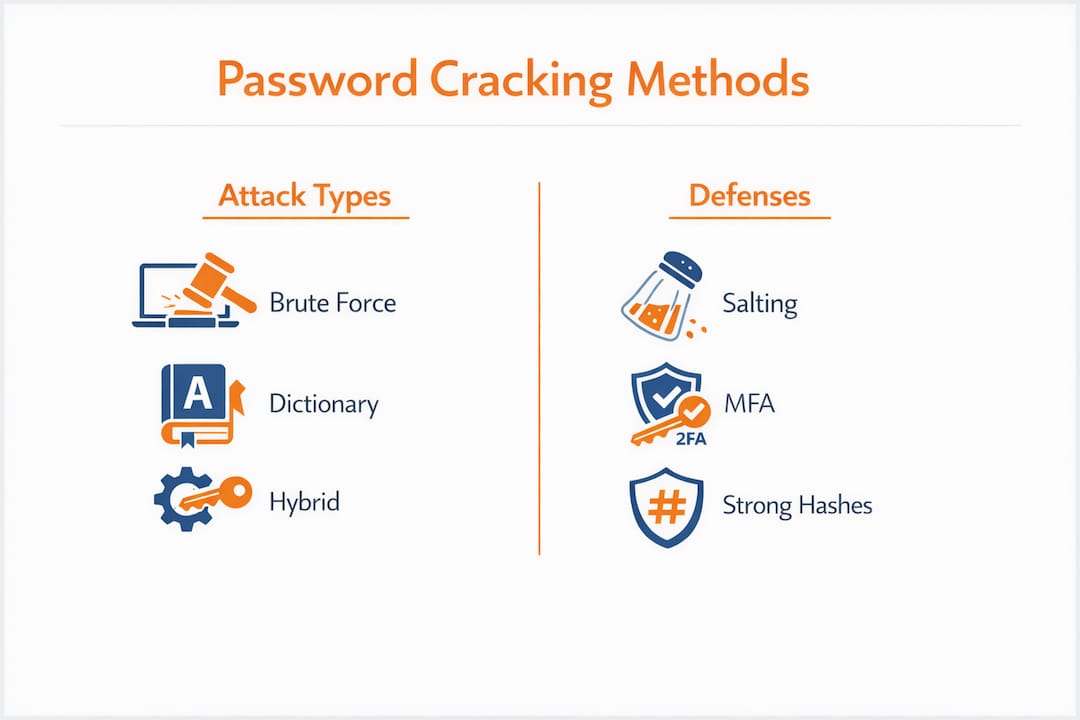
Brute force vs. dictionary vs. hybrid attacks
| Attack type | Method | Speed | Best used against |
|---|---|---|---|
| Brute force | Tests every possible character combination | Slowest | Short passwords with no pattern |
| Dictionary | Tests words from a known password list | Fast | Common or predictable passwords |
| Hybrid | Combines dictionary words with number/symbol variations | Very fast | Passwords like “Password1!” |
| Credential stuffing | Reuses breached username/password pairs | Instant | Accounts with reused passwords |
Dictionary attacks rely on lists like RockYou.txt, a real-world dataset of over 14 million passwords leaked from a 2009 breach. Attackers use RockYou.txt and transformation rules before resorting to brute force. A transformation rule might take the word “dragon” and test “Dragon1”, “dr@gon”, and “DRAGON!” automatically. This hybrid approach cracks the majority of real-world passwords without ever running a full brute force sweep.
Rainbow tables represent a different angle. A rainbow table is a precomputed list of hashes mapped back to their original passwords. The attack is fast when it works. Rainbow tables are ineffective against salted hashes because each unique salt requires a completely separate table. Building a distinct table for every salt in a modern database is computationally infeasible. Salting effectively kills this attack vector.
Credential stuffing deserves special attention. Attackers take username and password pairs from one breach and test them automatically against other services. This attack does not crack anything. It exploits password reuse directly. The weak password cost to organizations from credential stuffing runs into millions of dollars annually in account takeover fraud.
How do modern defenses protect against password cracking?
The strongest defenses operate at multiple layers simultaneously. No single control stops every attack type.
Slow hashing algorithms are the most underappreciated defense. KDFs like Argon2id deliberately make each password guess computationally expensive and memory-intensive. The industry shift from fast algorithms like MD5 to slow KDFs means that even a powerful GPU cluster takes years to crack a well-hashed password. The shift to slow, memory-hard hashing is one of the most significant advances in password storage security.
Key defenses every system should implement:
- Argon2id or bcrypt for password storage: These KDFs add deliberate computational cost to each hash check, slowing attackers dramatically
- Unique salts per password: Prevents rainbow table attacks and forces individual cracking of each credential
- Multi-factor authentication (MFA): MFA blocks access even when an attacker successfully cracks a password
- Account lockout policies: Limit online guessing attempts to slow brute force attacks against live systems
- Breach monitoring: Alert users when their credentials appear in known data breaches
MFA is the single most effective control against cracked passwords reaching live accounts. Credential stuffing and password spraying exploit reused passwords at scale. MFA stops that exploitation cold because the attacker needs a second factor they do not have. Enabling two-factor authentication on every account is the highest-return security action available to any individual or organization.
Pro Tip: Check whether your password storage system uses MD5 or SHA-1. Both are fast hashing algorithms with no built-in cost factor. Migrate to Argon2id or bcrypt immediately if either is in use.
What practical steps can individuals and organizations take?
Knowing how attacks work is only useful if it changes behavior. These steps directly reduce cracking risk.
-
Use a password manager. Tools like Logmeonce generate and store long, random, unique passwords for every account. A password manager eliminates the reuse problem entirely. Password managers are not perfectly unhackable, but they are far safer than human-generated passwords.
-
Create passwords of 16 or more characters. Length is the primary driver of cracking resistance. A 16-character random password with mixed characters takes modern hardware far longer to crack than any shorter alternative. Learn how to create strong passwords that hold up against real attacks.
-
Never reuse passwords across accounts. Reuse turns one breach into many. When attackers obtain credentials from one site, they test them everywhere. Unique passwords per account contain the damage from any single breach.
-
Enable MFA on every account that supports it. Prioritize email, banking, and work accounts first. Even SMS-based MFA stops the majority of automated credential stuffing attacks.
-
Monitor for breaches proactively. Services that scan the dark web for your credentials give you advance warning before attackers act. Respond to any breach notification by changing the affected password immediately and auditing any accounts that shared that password.
-
Audit password age and complexity regularly. Passwords that were strong three years ago may now fall within reach of modern cracking hardware. Review and rotate credentials on a schedule, especially for privileged accounts.
Password safety best practices for organizations go beyond individual hygiene. Enforce password policies at the system level, require MFA for all remote access, and store credentials only with approved KDFs.
Key Takeaways
Password cracking succeeds most often against short, reused, or weakly hashed passwords. The combination of long unique passwords, salted KDF hashing, and MFA stops the vast majority of real-world attacks.
| Point | Details |
|---|---|
| Offline cracking is the real threat | Attackers test billions of guesses against stolen hashes with no alerts triggered. |
| Salting defeats rainbow tables | Unique salts force individual cracking of each credential, making bulk attacks infeasible. |
| Slow KDFs are non-negotiable | Argon2id and bcrypt make each guess expensive, protecting even moderately strong passwords. |
| MFA stops cracked passwords | Even a successfully cracked password cannot access an MFA-protected account without the second factor. |
| Password reuse multiplies risk | One breached credential becomes a master key when the same password is used across multiple accounts. |
The arms race nobody talks about honestly
The conversation about password cracking usually focuses on attack techniques. What gets less attention is how dramatically the defensive side has improved, and how few organizations have actually adopted those improvements.
I have seen enterprise systems still storing passwords with MD5 in 2025. MD5 is a fast hash with no cost factor. A modern GPU cluster cracks MD5-hashed passwords at a rate that makes any password under 12 characters essentially worthless. The technology to fix this has existed for years. Argon2id won the Password Hashing Competition in 2015. The gap between what is available and what is deployed is the real security problem.
The other misconception I keep encountering is that users think password length is optional if they add symbols. A nine-character password with symbols is still a nine-character password. Cracking hardware does not care about your exclamation point. It cares about the total search space, which is determined primarily by length.
User education matters, but it has limits. You cannot educate your way out of a system that stores passwords in MD5. Technical controls at the storage layer are not optional extras. They are the foundation. Everything else, including MFA and password managers, builds on top of that foundation.
The risks of a weak password are not abstract. They show up as account takeovers, data breaches, and financial fraud. The defenses are known. The only question is whether you apply them before or after an incident.
— Mike
Logmeonce and stronger password security
Password cracking is a solved problem for organizations that apply the right controls. Logmeonce brings those controls together in one place.
Logmeonce generates long, random, unique passwords for every account and stores them behind encrypted vaults. Its built-in MFA integration means that even if a credential is ever exposed, attackers cannot use it without the second factor. The platform covers individuals, small businesses, and large enterprises with the same core protection. Explore Logmeonce cybersecurity solutions to see how password management, MFA, and dark web monitoring work together. You can also review the full password management benefits to find the right plan for your needs.
FAQ
What is password cracking in simple terms?
Password cracking is the process of recovering a password by testing guesses against stored hash data until a match is found. Attackers use this method to gain unauthorized access to accounts and systems.
Is password cracking illegal?
Password cracking is illegal when used without authorization. Security professionals use the same techniques legally to test and strengthen defenses, but unauthorized attempts can lead to criminal prosecution.
What are the most common password cracking methods?
Dictionary attacks, hybrid attacks, brute force, and credential stuffing are the most common methods. Attackers start with dictionary attacks using lists like RockYou.txt before escalating to more exhaustive techniques.
How does salting protect against password cracking?
Salting adds a unique random value to each password before hashing. Each salt requires a distinct attack, making bulk rainbow table attacks computationally infeasible and forcing attackers to crack each password individually.
What is the best defense against password cracking?
The best defense combines long unique passwords, slow KDF hashing like Argon2id, and multi-factor authentication. MFA is particularly critical because it blocks account access even when a password is successfully cracked.
Recommended


