


 Password Manager
 Identity Theft Protection

 Team / Business
 Enterprise
 Government
 MSP
MSP


Finding reliable ways to distinguish between a legitimate user and a sophisticated impostor has never felt more urgent for global enterprises. As digital identity grows beyond simple credentials and faces rising fraud risks, cybersecurity managers are challenged by complex requirements across jurisdictions. Understanding the true scope of digital identity verification and the persistent misconceptions surrounding its implementation can reveal which solutions actually strengthen security, support compliance, and protect user trust.
Key Takeaways
| Point | Details |
|---|---|
| Digital Identity Complexity | Digital identity verification is a multi-layered process that extends beyond traditional methods, adapting to individual needs and regulatory environments. |
| Core Verification Methods | Key methods include biometric analysis, document checking, and behavioral analytics, each with distinct security and user experience levels. |
| Regulatory Compliance | Organizations must navigate complex data protection regulations, requiring transparent data handling and robust user consent mechanisms. |
| Implementation Risks | Common pitfalls include over-reliance on single verification methods and a lack of inclusivity, necessitating adaptive security strategies. |
Defining Digital Identity Verification and Misconceptions
Digital identity represents far more than a simple online version of physical documentation. It is a sophisticated construct enabling secure interactions within our increasingly interconnected technological ecosystem. Digital identity dilemmas reveal the complexity of establishing reliable digital representations of individual identities, highlighting challenges beyond traditional identification methods.
At its core, digital identity verification involves validating an individual’s authentic online persona through comprehensive authentication processes. This goes well beyond username and password combinations, incorporating multiple layers of verification such as biometric data, behavioral analytics, and contextual information. The goal is creating a robust, trustworthy mechanism that confirms a person’s claimed digital identity while protecting against fraudulent attempts.
Several persistent misconceptions cloud understanding of digital identity systems. Many individuals assume digital identity is uniform across platforms, when in reality, human-centric digital identity models emphasize personalized control and privacy. These systems recognize that identity verification isn’t a one-size-fits-all approach but a nuanced process adapting to specific user needs and regulatory environments.
Pro tip: Always use multi-factor authentication and regularly audit your digital identity credentials to maintain robust online security.
Types and Methods of Identity Verification
Identity verification encompasses a sophisticated array of techniques designed to authenticate an individual’s digital presence. Verifiable Digital Credentials represent a critical foundation in this process, supporting multiple verification approaches across diverse technological environments.
Public agencies and private organizations typically employ several core identity verification methods. These include biometric verification, which analyzes unique physical characteristics like fingerprints or facial recognition; document verification, which validates government-issued identification; and digital identity verification techniques such as videoconferencing and intergovernmental data matching. Each method offers distinct advantages and potential limitations in establishing authentic digital identities.
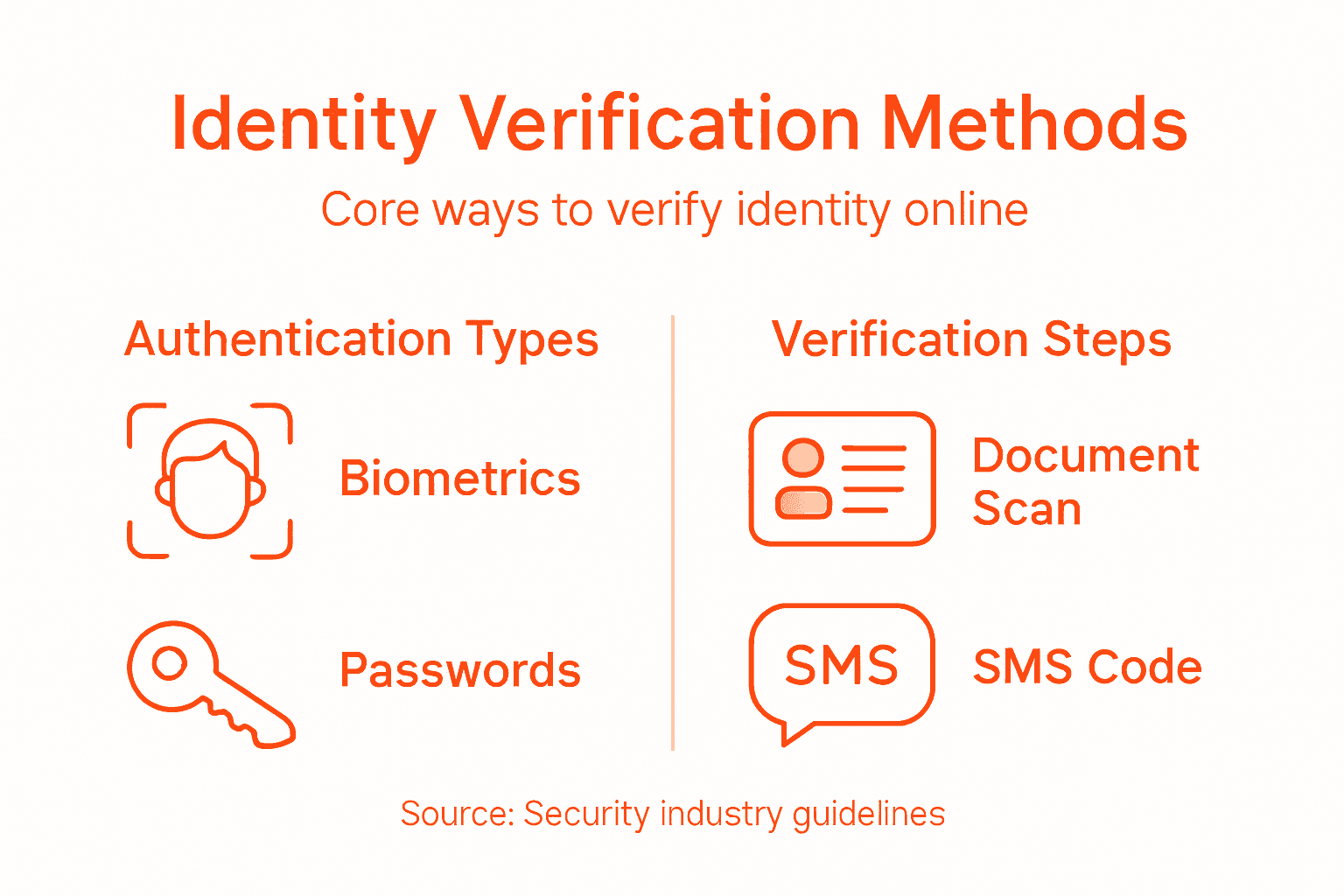
The verification landscape is characterized by three primary categories of authentication: something you know (passwords, security questions), something you have (mobile devices, security tokens), and something you are (biometric data). Advanced systems increasingly combine these approaches, creating multi-factor authentication protocols that significantly reduce the potential for identity fraud. This layered approach ensures robust verification by requiring multiple independent proof points before granting digital access.
Pro tip: Select identity verification methods that balance robust security with seamless user experience, prioritizing techniques that offer strong authentication without creating unnecessary friction.
Here’s a comparison of common identity verification methods and their unique business impacts:
| Verification Method | Security Level | User Experience | Business Impact |
|---|---|---|---|
| Biometric Analysis | High | Fast, minimal effort | Reduces fraud, boosts trust |
| Document Checking | Medium | Sometimes slow, manual | Enhances compliance, ensures accuracy |
| Device Authentication | Moderate | Seamless, device-dependent | Improves accessibility, supports mobility |
| Behavioral Analytics | High | Passive, continuous | Detects anomalies, prevents misuse |
How Digital Identity Verification Works
Digital identity verification is a sophisticated process that transforms complex authentication into a streamlined, secure mechanism. Digital identity verification techniques typically involve a multi-layered approach that combines technological sophistication with rigorous validation protocols.

The verification workflow generally encompasses three critical stages. First, data collection occurs, where an individual submits personal information and supporting documentation. Second, verification systems cross-reference submitted data against multiple authoritative databases, checking for consistency and authenticity. Credential issuance protocols then cryptographically encode verified identity attributes, creating a secure digital representation that can be selectively shared and independently validated.
Modern verification systems leverage advanced technologies like artificial intelligence, machine learning, and blockchain to enhance accuracy and reduce fraud risks. These technologies enable real-time document analysis, behavioral biometric assessment, and sophisticated pattern recognition. By integrating multiple verification channels – including live video interactions, automated document scanning, and comprehensive database checks – these systems create a robust framework that balances security, privacy, and user experience.
Pro tip: Always maintain updated and consistent personal information across different platforms to streamline your digital identity verification process and minimize potential authentication challenges.
Compliance, Privacy, and Regulatory Demands
Digital identity verification must navigate an increasingly complex landscape of global regulatory requirements that prioritize user privacy and data protection. Digital identity standards have become critical frameworks for ensuring transparency, security, and individual rights across technological ecosystems.
Key regulatory frameworks like the General Data Protection Regulation (GDPR) and Electronic Identification, Authentication and Trust Services (eIDAS) mandate stringent protocols for data handling. These regulations require organizations to implement robust consent mechanisms, provide clear data usage transparency, and enable users to control their personal information. Government-issued digital credentials must incorporate cryptographic protections that ensure data integrity while maintaining comprehensive audit trails.
Compliance demands extend beyond mere technical implementation. Organizations must develop comprehensive privacy governance strategies that address multifaceted regulatory requirements across different jurisdictions. This involves creating adaptive identity verification systems capable of meeting diverse legal standards, implementing granular access controls, and maintaining meticulous documentation of identity validation processes. Advanced cryptographic techniques and zero-knowledge proof technologies are increasingly being deployed to minimize personal data exposure while satisfying regulatory mandates.
Pro tip: Conduct regular privacy impact assessments and maintain flexible identity verification frameworks that can quickly adapt to evolving regulatory landscapes.
Below is a summary of key regulatory frameworks shaping digital identity verification:
| Regulation | Coverage Region | Main Focus | Impact on Verification |
|---|---|---|---|
| GDPR | European Union | Data protection, privacy | Requires explicit consent, transparency |
| eIDAS | Europe | Electronic identification | Enables cross-border authentication |
| CCPA | California, USA | Consumer privacy rights | Mandates user control over data |
| HIPAA | United States | Health information security | Sets strict identity protocols for healthcare |
Risks, Challenges, and Common Implementation Pitfalls
Digital identity verification confronts numerous complex challenges that can compromise system effectiveness and user trust. Digital identity system challenges emerge from technical, governance, and policy intersections that demand sophisticated, nuanced approaches to mitigation.
Organizations frequently encounter several critical implementation pitfalls. These include over-reliance on single verification methods, inadequate privacy protections, and failure to design inclusive systems that accommodate diverse user populations. Identity verification implementation risks are particularly acute in scenarios involving vulnerable populations, where technological barriers can create unintentional exclusion.
The most significant risks stem from potential vulnerabilities in authentication processes. Sophisticated threat actors continuously develop advanced techniques to exploit system weaknesses, including social engineering, biometric spoofing, and complex identity fraud schemes. Successful mitigation requires continuous technological adaptation, robust multi-factor authentication strategies, and proactive threat monitoring that anticipates emerging attack vectors rather than simply responding to known vulnerabilities.
Pro tip: Implement a comprehensive risk assessment framework that includes regular penetration testing, user experience audits, and adaptive security protocols to stay ahead of evolving digital identity verification challenges.
Strengthen Your Digital Identity with LogMeOnce Solutions
The challenges of digital identity verification highlighted in this article reveal the urgent need for reliable, multi-layered security measures that protect you from identity fraud and data breaches. Whether you face the complexity of managing biometric data or require seamless multi-factor authentication, it is crucial to deploy a system that balances strong security with a smooth user experience. LogMeOnce offers comprehensive cybersecurity solutions designed to address these specific pain points by integrating passwordless MFA, encrypted cloud storage, and advanced identity management tools that empower individuals and organizations alike.

Discover how LogMeOnce can help you reduce identity verification risks and comply with evolving privacy regulations by providing a flexible platform tailored to your security needs. Visit LogMeOnce today to explore our innovative features and start a free trial. Take control of your digital identity verification now and ensure trust and security with every login.
Frequently Asked Questions
What is digital identity verification?
Digital identity verification is the process of validating an individual’s online persona through comprehensive authentication methods that go beyond simple username and password combinations. It involves various techniques, including biometric data, behavioral analytics, and contextual information, to ensure a secure digital identity.
What are the types of identity verification methods?
Identity verification methods include biometric verification (like fingerprints or facial recognition), document verification of government-issued IDs, and digital identity verification techniques, such as video conferencing and data matching. Each method has its advantages and limitations depending on the context of use.
How does digital identity verification enhance online security?
Digital identity verification enhances online security by employing multi-layered authentication processes. This includes combining different forms of verification, such as something you know (passwords), something you have (tokens), and something you are (biometrics), to significantly reduce the risk of identity fraud.
What are the key challenges in implementing digital identity verification systems?
Key challenges include over-reliance on single verification methods, inadequate privacy protections, and the need for inclusive systems that serve diverse populations. Organizations must also continuously adapt to emerging threats and implement robust multi-factor authentication to mitigate risks.
Recommended


