


 Password Manager
 Identity Theft Protection

 Team / Business
 Enterprise
 Government
 MSP
MSP


Managing digital access for every employee can quickly spiral out of control as your organization grows. For IT managers, balancing convenience with security is a constant challenge when users need timely access to critical apps while compliance requirements keep getting stricter. Adopting user provisioning methods that automate identity management not only strengthens your security posture but also minimizes manual errors and accelerates onboarding, giving your business the edge it needs.
Key Takeaways
| Point | Details |
|---|---|
| User Provisioning | A systematic process that manages user accounts, ensuring secure access control across various organizational platforms. |
| Provisioning Methods | Various methods including Manual, Automated, Role-Based, and Cloud-Based provisioning each have distinct advantages and disadvantages. |
| Lifecycle Steps | Key stages include Account Creation, Access Assignment, Ongoing Management, and Account Deprovisioning for effective identity management. |
| Security Risks | Inadequate user provisioning can lead to unauthorized access, compliance issues, and potential financial loss, highlighting the need for rigorous management. |
Defining User Provisioning in Cybersecurity
User provisioning is a critical cybersecurity process that systematically manages digital identities across organizational platforms. At its core, user provisioning manages the lifecycle of user accounts by creating, updating, and removing access rights for employees and systems.

The process involves multiple strategic components that ensure secure and efficient identity management. This includes authenticating user credentials, assigning appropriate role-based permissions, and controlling access levels across different applications and networks. Organizations implement user provisioning to maintain robust security protocols, preventing unauthorized system access while streamlining user onboarding and offboarding processes.
Under the broader umbrella of Identity and Access Management (IAM), user provisioning defines access rights and permissions for each organizational digital identity. It acts as a critical security checkpoint, ensuring that users have precisely the access they need – no more, no less. Key activities include creating user accounts, establishing initial permissions, modifying access rights during role changes, and promptly revoking credentials when employees depart.
Pro tip: Implement automated user provisioning workflows to reduce manual errors and accelerate onboarding while maintaining stringent security standards.
Types of User Provisioning Methods
User provisioning encompasses several strategic methods that organizations employ to manage digital identities and access controls. These approaches vary based on organizational complexity, technological infrastructure, and specific security requirements.
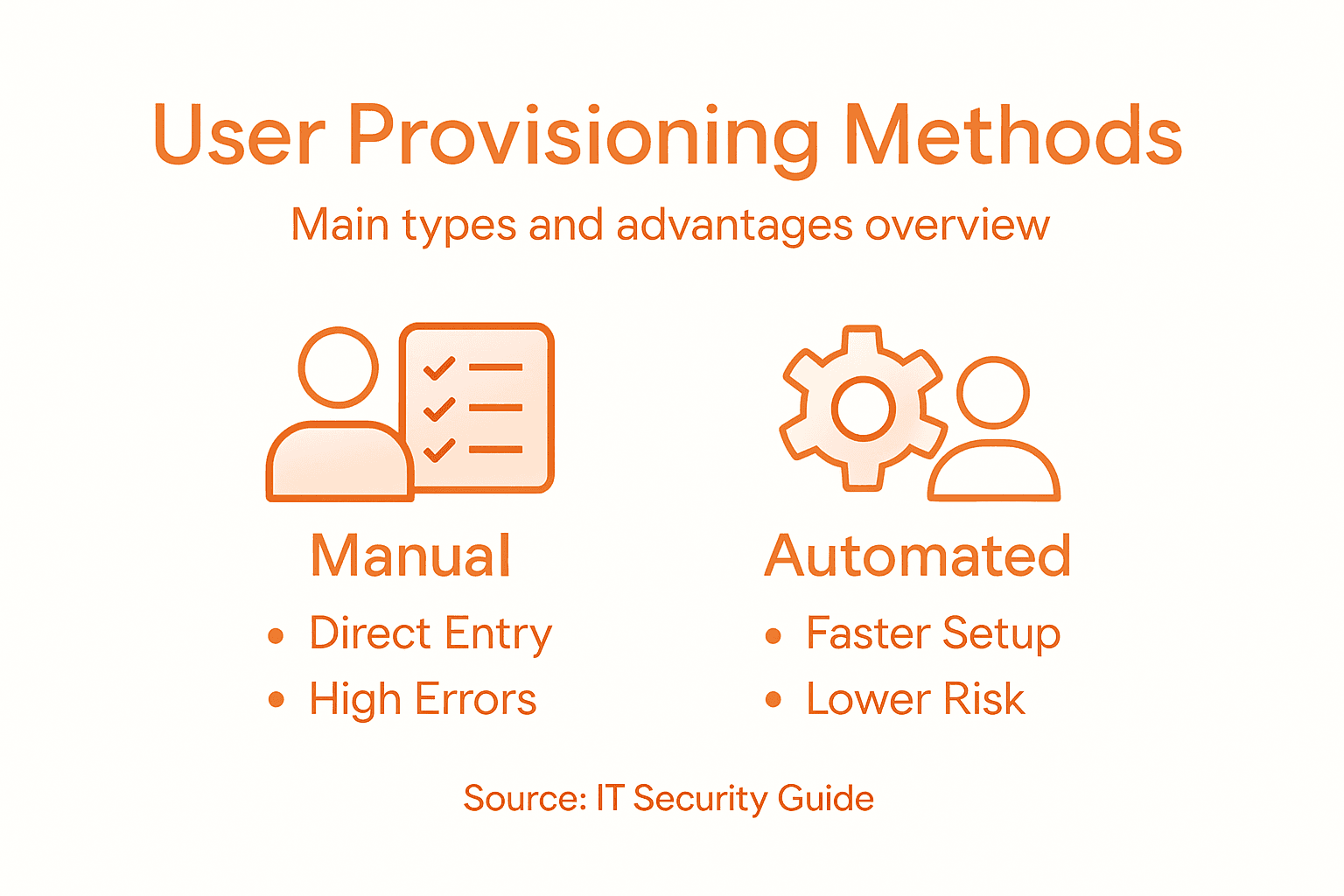
Manual Provisioning represents the traditional approach where IT administrators individually create and manage user accounts. This method involves directly configuring access rights, permissions, and credentials through administrative interfaces. While straightforward for small organizations, manual provisioning becomes increasingly complex and error-prone as workforce size and technological complexity expand.
Automated Provisioning emerges as a more sophisticated alternative, leveraging software platforms to streamline identity management processes. These systems can automatically create, modify, and disable user accounts across multiple platforms simultaneously. Automated solutions integrate with human resources systems, enabling seamless onboarding and offboarding by synchronizing employee status changes with corresponding access permissions.
Role-Based Provisioning represents a nuanced approach that assigns access rights based on predefined organizational roles. Instead of configuring individual permissions, administrators establish standardized access templates corresponding to specific job functions. This method ensures consistent access management, reduces administrative overhead, and minimizes potential security vulnerabilities caused by manual configuration errors.
Cloud-Based Provisioning has gained significant traction as organizations increasingly adopt distributed technological environments. These approaches enable centralized identity management across multiple cloud platforms, allowing seamless access control for remote and hybrid workforces. Cloud provisioning solutions provide flexibility, scalability, and enhanced security monitoring capabilities.
Pro tip: Implement a hybrid provisioning strategy that combines automated workflows with periodic manual review to maintain optimal security and operational efficiency.
Here is a comparison of common user provisioning methods and their advantages and disadvantages:
| Provisioning Method | Main Advantage | Main Disadvantage |
|---|---|---|
| Manual Provisioning | Simple for small organizations | Prone to human error |
| Automated Provisioning | Reduces administrative workload | Requires initial setup effort |
| Role-Based Provisioning | Ensures standardized access control | Needs careful role definition |
| Cloud-Based Provisioning | Centralized access across platforms | Dependent on cloud reliability |
Key Steps in the Provisioning Lifecycle
The user provisioning lifecycle represents a comprehensive framework for managing digital identities from initiation to termination. This systematic approach ensures robust security, compliance, and operational efficiency across organizational technology ecosystems.
Account Creation marks the initial stage of the provisioning lifecycle. During this phase, organizations collect essential user information, verify identity credentials, and establish baseline access permissions. Administrators typically generate unique user profiles by integrating data from human resources systems, ensuring accurate personal and professional details are captured. This foundational step involves generating login credentials, setting initial access levels, and configuring primary system permissions.
Access Assignment follows account creation, focusing on mapping user roles to specific technological resources. Organizations implement role-based access control strategies, aligning individual user permissions with job responsibilities. This nuanced approach prevents over-privileging by granting precisely targeted access rights. Administrators meticulously define permission matrices that balance operational requirements with security protocols, ensuring users can perform essential tasks without exposing systems to unnecessary risks.
Ongoing Management represents the dynamic phase of the provisioning lifecycle, involving continuous monitoring and adjustment of user access rights. This stage requires regular review of user accounts, tracking changes in organizational roles, and promptly modifying permissions to reflect current job responsibilities. Periodic access audits help identify potential security vulnerabilities, unauthorized access attempts, and outdated user credentials that might compromise system integrity.
Account Deprovisioning serves as the final critical stage, responsible for securely removing user access when employees leave the organization or change roles. This process involves systematically revoking all system permissions, disabling user accounts, and archiving relevant user data for compliance purposes. Effective deprovisioning prevents potential security breaches by ensuring former employees cannot retain unauthorized system access.
Pro tip: Implement an automated workflow that triggers immediate access revocation during employee offboarding to minimize potential security gaps.
The following table summarizes key provisioning lifecycle steps and their specific focus:
| Lifecycle Step | Main Focus | Outcome Achieved |
|---|---|---|
| Account Creation | Gather identity and set access | Unique profiles, initial permissions |
| Access Assignment | Map roles to resources | Job-specific permissions granted |
| Ongoing Management | Monitor and update access | Rights adjusted to role changes |
| Account Deprovisioning | Remove all access | Secure offboarding, compliance |
Security Risks and Compliance Implications
User provisioning introduces complex security challenges that demand sophisticated risk management strategies. Organizations must navigate a intricate landscape of potential vulnerabilities, balancing operational efficiency with robust cybersecurity protocols. Remote work security challenges have exponentially increased the complexity of managing digital identities and access controls.
Unauthorized Access Risks represent the most immediate threat in user provisioning processes. Poorly managed identity systems can create significant security gaps, allowing malicious actors to exploit unmonitored or improperly configured user accounts. These vulnerabilities can emerge through multiple vectors: abandoned user credentials, overly broad access permissions, delayed account deactivation, and insufficient authentication protocols. Each unaddressed vulnerability potentially exposes sensitive organizational data to unauthorized intrusion.
Compliance frameworks like GDPR, HIPAA, and PCI-DSS impose stringent requirements on how organizations manage user identities and access controls. Data privacy laws mandate comprehensive documentation, regular access audits, and transparent user management practices. Organizations must implement robust tracking mechanisms that demonstrate precise control over user permissions, ensuring they can provide detailed accountability in the event of a regulatory audit or potential security investigation.
The financial and reputational consequences of inadequate user provisioning can be devastating. A single overlooked access point can lead to substantial data breaches, potentially resulting in significant monetary penalties, legal liabilities, and irreparable damage to organizational trust. Cybersecurity experts estimate that unauthorized access incidents can cost organizations millions of dollars in direct and indirect damages, underscoring the critical importance of meticulous user identity management.
Pro tip: Conduct quarterly comprehensive access reviews to identify and immediately remediate potential security gaps in your user provisioning ecosystem.
Modern Automation and Integration Approaches
Modern user provisioning has dramatically transformed with advanced technological capabilities that enable seamless, intelligent identity management across complex organizational ecosystems. Automated provisioning protocols have revolutionized how businesses manage digital identities, creating more efficient and secure workflows.
Cloud-Based Integration represents a critical advancement in user provisioning strategies. These sophisticated systems leverage Application Programming Interfaces (APIs) to create dynamic, real-time connections between human resources platforms, identity management systems, and enterprise applications. By establishing automated synchronization mechanisms, organizations can instantly propagate user status changes, role modifications, and access permissions across multiple technological environments without manual intervention.
The System for Cross-domain Identity Management (SCIM) 2.0 protocol has emerged as a standardized approach to streamline user provisioning processes. This framework enables organizations to develop interoperable identity management solutions that can communicate seamlessly across different platforms and cloud services. SCIM simplifies complex identity management tasks by providing a universal language for creating, updating, and deleting user accounts, reducing potential configuration errors and security vulnerabilities.
Workflow Automation takes user provisioning beyond simple account management, incorporating intelligent decision-making processes that adapt to organizational changes. These advanced systems can automatically trigger provisioning actions based on predefined rules, such as automatically generating access credentials when an employee changes departments or initiating account deactivation protocols during employee offboarding. Machine learning algorithms increasingly enhance these workflows, providing predictive capabilities that anticipate and proactively address potential identity management challenges.
Pro tip: Implement a centralized identity governance platform that supports multi-system integration and provides comprehensive visibility into user access across your entire technological infrastructure.
Strengthen Your User Provisioning with LogMeOnce Advanced Cybersecurity Solutions
Managing user provisioning effectively is vital to prevent unauthorized access and protect sensitive data. This article highlights key challenges such as maintaining precise access controls, automating workflows, and ensuring timely deprovisioning to reduce security risks. Organizations aiming to eliminate human error and adapt to evolving roles can benefit from innovative solutions that combine automation with robust identity governance.
Secure your digital identities with LogMeOnce, a trusted platform that integrates passwordless multi-factor authentication, single sign-on, and encrypted cloud storage. Our comprehensive cybersecurity suite empowers businesses to streamline user provisioning workflows while maintaining full compliance with industry standards. Experience seamless synchronization with HR systems and enjoy centralized access management to protect your resources from unauthorized use.

Don’t wait for security breaches to reveal gaps in your provisioning processes. Explore how LogMeOnce can transform your identity management today. Visit LogMeOnce to start a free trial and take control of your organization’s access security now.
Frequently Asked Questions
What is user provisioning in cybersecurity?
User provisioning is the process of managing digital identities across organizational platforms by creating, updating, and removing access rights for users. It ensures secure and efficient identity management throughout the user account lifecycle.
Why is user provisioning important for organizations?
User provisioning is crucial for maintaining robust security protocols, preventing unauthorized access, and streamlining user onboarding and offboarding processes. It helps organizations ensure that users have the appropriate access they need to perform their jobs without compromising sensitive data.
What are the main types of user provisioning methods?
The main types of user provisioning methods include Manual Provisioning, Automated Provisioning, Role-Based Provisioning, and Cloud-Based Provisioning. Each method has its own advantages and disadvantages, catering to different organizational needs and complexities.
What are the key steps in the user provisioning lifecycle?
The key steps in the user provisioning lifecycle are Account Creation, Access Assignment, Ongoing Management, and Account Deprovisioning. Each step focuses on effectively managing user identities and access rights to ensure security and compliance.
Recommended
- Consumer Top Features – LogMeOnce
- Enterprise Password Management – LogMeOnce
- Password Manager – LogMeOnce
- Enterprise Password Management | Identity Management| LogMeOnce


