


 Password Manager
 Identity Theft Protection

 Team / Business
 Enterprise
 Government
 MSP
MSP


Remote work expansion has exposed many businesses to new vulnerabilities, making unauthorized access attempts more frequent and unpredictable. For IT security professionals in mid-sized companies, understanding brute force attack methods is essential to defending systems and safeguarding sensitive data from theft. This article offers an analysis of brute force strategies such as dictionary attacks, credential stuffing, and hybrid techniques, equipping professionals with knowledge to strengthen authentication protocols and reduce the risk of identity compromise.
Key Takeaways
| Point | Details |
|---|---|
| Understanding Brute Force Attacks | Brute force attacks utilize various methods to systematically guess passwords, targeting weak authentication protocols. |
| Financial and Operational Risks | Successful attacks can lead to significant financial losses, reputational damage, and operational disruptions for businesses. |
| Prevention Strategies | Implementing multi-factor authentication and strong password policies can significantly mitigate the risk of brute force attacks. |
| Continuous Adaptation Required | Organizations must continuously adapt their cybersecurity measures to effectively combat evolving brute force threats. |
Defining Brute Force Attack Methods
A brute force attack represents a persistent cybersecurity threat where attackers methodically attempt to gain unauthorized system access by systematically testing multiple password combinations. Cyberattack researchers have documented that these attacks leverage computational power to rapidly cycle through potential credentials.

Unlike sophisticated hacking techniques requiring complex code or advanced exploits, brute force attacks rely on straightforward trial-and-error methodologies. Attackers use specialized software tools designed to generate and test thousands of password permutations per second, targeting systems with weak authentication protocols. Computational research indicates that the attack’s success directly correlates with password complexity and the attacker’s available computing resources.
Typical brute force attack strategies include:
- Dictionary attacks: Using predefined word lists containing common passwords
- Credential stuffing: Leveraging leaked username/password combinations from previous data breaches
- Hybrid attacks: Combining dictionary words with numerical variations and special characters
- Automated password generation: Using algorithms to create systematic password variations
Pro tip: Implement multi-factor authentication and utilize complex, randomly generated passwords with at least 16 characters to significantly reduce brute force attack vulnerabilities.
Types of Brute Force Attacks Explained
Brute force attacks represent a sophisticated spectrum of cyber intrusion techniques, each designed to exploit different authentication vulnerabilities. Cybersecurity researchers have identified multiple strategic approaches that attackers leverage to compromise system security, ranging from simplistic to highly nuanced methodologies.
The primary categories of brute force attacks include:
- Classic Brute Force Attack
- Systematically attempts every possible password combination
- Most time and resource-intensive method
- Highest probability of detection by security systems
- Dictionary Attack
- Uses predefined lists of common passwords
- Targets weak, predictable password patterns
- Significantly faster than classic brute force approaches
- Hybrid Attack
- Combines dictionary words with numerical variations
- Adds special characters to increase password guessing complexity
- Adapts standard dictionary approaches with intelligent modifications
- Reverse Brute Force Attack
- Starts with a common password
- Tests that password against multiple potential usernames
- Exploits human tendency to reuse passwords across platforms
- Credential Stuffing
- Utilizes stolen login credentials from previous data breaches
- Attempts those credentials across multiple platforms
- Relies on users’ habit of password reuse
- Rainbow Table Attack
- Uses precomputed hash tables to accelerate password cracking
- Bypasses traditional computational limitations
- Particularly effective against poorly salted password storage
Pro tip: Implement robust password policies requiring complex, unique passwords and enable multi-factor authentication to dramatically reduce the effectiveness of these brute force attack strategies.
Here’s a direct comparison of major brute force attack types and their detection challenges:
| Attack Type | Detection Difficulty | Speed of Attack | Common Targets |
|---|---|---|---|
| Classic Brute Force | Easy to detect | Slowest | Any login system |
| Dictionary | Moderate | Faster | Weak password systems |
| Hybrid | Difficult | Fast | Business accounts |
| Reverse Brute Force | Challenging | Moderate | User portals |
| Credential Stuffing | Difficult | Very fast | Financial platforms |
| Rainbow Table | Hardest | Extremely fast | Poorly protected data |
How Brute Force Attacks Compromise Businesses
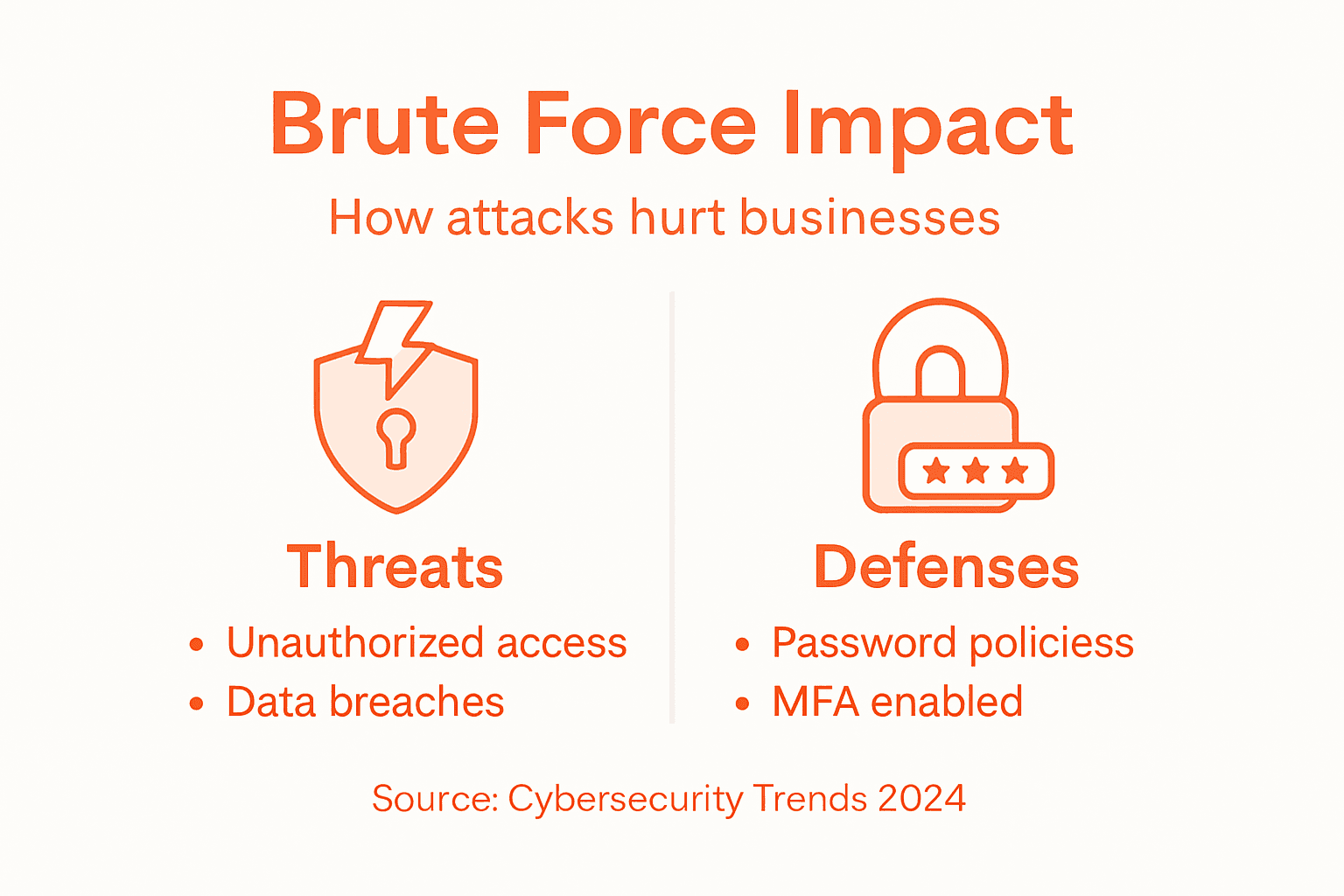
Businesses face unprecedented cybersecurity challenges as brute force attacks increasingly target organizational vulnerabilities. Regulatory researchers highlight significant risks associated with unauthorized system access, which can devastate operational integrity and corporate reputation.
The financial and operational impacts of successful brute force attacks are multifaceted:
-
Direct Financial Losses
- Potential theft of financial data
- Costs of system recovery and forensic investigations
- Potential ransom payments
- Business interruption expenses
-
Reputational Damage
- Loss of customer trust
- Potential legal liability
- Negative media exposure
- Decreased market valuation
-
Operational Disruptions
- Compromised internal communication systems
- Potential shutdown of critical infrastructure
- Interrupted business processes
- Compromised employee productivity
Understanding the nuanced techniques attackers employ is crucial for developing robust defense mechanisms. Remote work environments have exponentially increased potential entry points, making comprehensive authentication strategies more critical than ever. Attackers systematically probe network vulnerabilities, exploiting even minimal security weaknesses to gain unauthorized access and potentially compromise entire organizational ecosystems.
Pro tip: Implement comprehensive multifactor authentication protocols and conduct regular penetration testing to identify and mitigate potential brute force attack vulnerabilities before they can be exploited.
To summarize, here are business areas most impacted by brute force attacks and strategic mitigation approaches:
| Business Area | Impact of Decryption | Recommended Defense |
|---|---|---|
| Financial Operations | Loss, ransom, downtime | Multi-factor protocols |
| Brand Reputation | Trust, legal fallout | Crisis management |
| IT Infrastructure | System outage, disruption | Penetration testing |
| Employee Productivity | Workflow interruption | Security training |
Real-World Impacts on Identity and Data
Brute force attacks represent a devastating threat to personal and organizational identities, capable of causing catastrophic data breaches and long-lasting financial consequences. Cybersecurity researchers document the profound vulnerabilities that emerge when attackers successfully compromise individual and corporate digital identities.
The spectrum of identity and data risks includes:
-
Personal Identity Compromise
- Unauthorized access to financial accounts
- Credit score destruction
- Potential legal identity theft
- Social media account takeovers
-
Financial System Vulnerabilities
- Fraudulent transaction generation
- Bank account hijacking
- Cryptocurrency wallet infiltration
- Investment account manipulation
-
Professional Identity Threats
- Corporate email account breaches
- Intellectual property exposure
- Professional networking profile compromises
- Internal communication system infiltration
Digital identities have become complex ecosystems containing interconnected personal and professional information. When attackers successfully breach these systems, the ripple effects extend far beyond immediate financial losses. Victims often face years of potential identity restoration efforts, psychological stress, and complicated legal challenges that can fundamentally disrupt their personal and professional trajectories.
Pro tip: Implement comprehensive identity monitoring services and utilize unique, complex passwords for each digital account to minimize potential breach impacts.
Preventing Brute Force Attacks Effectively
Defending against brute force attacks requires a comprehensive, multilayered security approach that combines technological solutions and strategic user education. Advanced research demonstrates that proactive cybersecurity strategies can dramatically reduce the risk of unauthorized system access.
Key prevention strategies include:
- Authentication Reinforcement
- Implement multi-factor authentication
- Enforce strong password complexity requirements
- Use biometric verification when possible
- Limit consecutive login attempts
- Network and System Protections
- Deploy intelligent intrusion detection systems
- Configure automatic account lockout mechanisms
- Utilize advanced rate limiting technologies
- Implement CAPTCHA challenges for suspicious login attempts
- User Behavior Monitoring
- Track login patterns and geographic access points
- Use machine learning algorithms for anomaly detection
- Create real-time alert systems for suspicious activities
- Develop comprehensive user access logs
Modern cybersecurity demands continuous adaptation. Organizations must recognize that brute force prevention is not a static process but an ongoing commitment to evolving defensive technologies. By integrating intelligent monitoring systems, robust authentication protocols, and user education programs, businesses can create resilient digital environments that effectively resist unauthorized access attempts.
Pro tip: Conduct regular security audits and penetration testing to identify and address potential vulnerabilities before attackers can exploit them.
Fortify Your Business Against Brute Force Threats Today
Brute force attacks expose critical vulnerabilities that can disrupt your business operations, damage your reputation, and compromise sensitive data. With attackers using techniques like credential stuffing and hybrid attacks, relying solely on traditional passwords leaves your organization at risk. You need a powerful, user-friendly solution that goes beyond basic security measures to protect your digital identity and maintain business continuity.
Discover how LogMeOnce delivers comprehensive cybersecurity solutions tailored to the challenges outlined in this article. From multi-factor authentication to encrypted cloud storage and passwordless MFA, our platform empowers you to lock down access with ease. Don’t wait for an attack to expose your weaknesses. Take action now and explore how LogMeOnce’s innovative security features provide peace of mind. Learn more at LogMeOnce solutions and start your free trial to experience proactive protection against brute force attacks.
Frequently Asked Questions
What is a brute force attack?
A brute force attack is a cybersecurity threat where attackers systematically attempt to gain unauthorized access by testing numerous password combinations. This method relies on trial-and-error rather than sophisticated hacking techniques.
How do brute force attacks threaten businesses?
Brute force attacks can lead to unauthorized access, resulting in financial losses, operational disruptions, and reputational damage. Compromised systems can disrupt business processes and erode customer trust.
What strategies can businesses implement to prevent brute force attacks?
Businesses can prevent these attacks by enforcing multi-factor authentication, implementing strong password policies, deploying intrusion detection systems, and conducting regular security audits and penetration testing.
What are the different types of brute force attacks?
The types of brute force attacks include classic brute force attacks, dictionary attacks, hybrid attacks, reverse brute force attacks, credential stuffing, and rainbow table attacks. Each type employs different methods to exploit password vulnerabilities.
Recommended
- blogs – LogMeOnce
- 7 Cyber Threats That Target Small Business – LogMeOnce
- Biggest Hacker Attacks in History – LogMeOnce
- What Should You Do After a Password Breach? – LogMeOnce


