


 Password Manager
 Identity Theft Protection

 Team / Business
 Enterprise
 Government
 MSP
MSP


Every american enterprise faces the sobering reality that just one undetected login anomaly can undermine months of meticulous security work. When a single suspicious access attempt can escalate into a full-blown breach, IT professionals know the stakes are high. This overview reveals how advanced detection strategies help organizations separate true risks from harmless deviations, making it possible to spot and stop emerging threats before they disrupt business.
Key Takeaways
| Point | Details |
|---|---|
| Login anomalies indicate security risks | Unauthorized access attempts that deviate from normal patterns should be investigated immediately. |
| Automated detection enhances security | Configuring alerts for unusual login behaviors allows for rapid response and minimizes potential breaches. |
| Behavioral analytics improve threat detection | Leveraging advanced machine learning models helps identify subtle deviations in user behavior, enhancing security efficiency. |
| Compliance and risk management are critical | Documenting anomalies is essential for audits and helps protect against regulatory penalties. |
Defining Login Anomalies in Enterprise Security
Login anomalies represent unauthorized or suspicious access attempts that deviate from established user behavior patterns within an organization’s network. These deviations signal potential security risks that demand immediate investigation and response. User and Entity Behavior Analytics (UEBA) frameworks have emerged as sophisticated tools for detecting these critical security signals by analyzing complex login interactions.
In enterprise environments, login anomalies can manifest through multiple indicators, including unusual login times, accessing networks from unexpected geographic locations, multiple failed authentication attempts, or login attempts from unrecognized devices. Behavioral pattern recognition becomes crucial in distinguishing between legitimate user actions and potential security threats. The dynamic anomaly detection models developed by cybersecurity researchers help organizations establish baseline behaviors and quickly identify statistically significant deviations.
Critical login anomaly indicators often include:
- Logins from unusual geographic locations
- Access attempts outside standard work hours
- Multiple unsuccessful authentication attempts
- Login from unfamiliar IP addresses or device types
- Sudden changes in access frequency or duration
- Rapid sequential login attempts from different locations
Pro Tip: Login Anomaly Detection: Configure automated alerts for login attempts that deviate from established user behavior baselines, ensuring real-time monitoring and rapid incident response capabilities.
Key Types of Suspicious Login Behaviors
Cybersecurity professionals recognize multiple categories of suspicious login behaviors that signal potential security threats within enterprise networks. Unauthorized access attempts represent critical indicators that demand immediate scrutiny and comprehensive analysis. These behaviors extend beyond simple password failures, encompassing complex patterns of digital intrusion and potential system compromise.
The most prevalent suspicious login behaviors can be categorized into several distinct risk profiles. Geographic anomalies occur when login attempts originate from unexpected locations, such as foreign countries or regions inconsistent with an employee’s typical work pattern. Time-based irregularities include login attempts during non-standard hours, like midnight access from an account normally used during business hours. Network security teams must also monitor for:
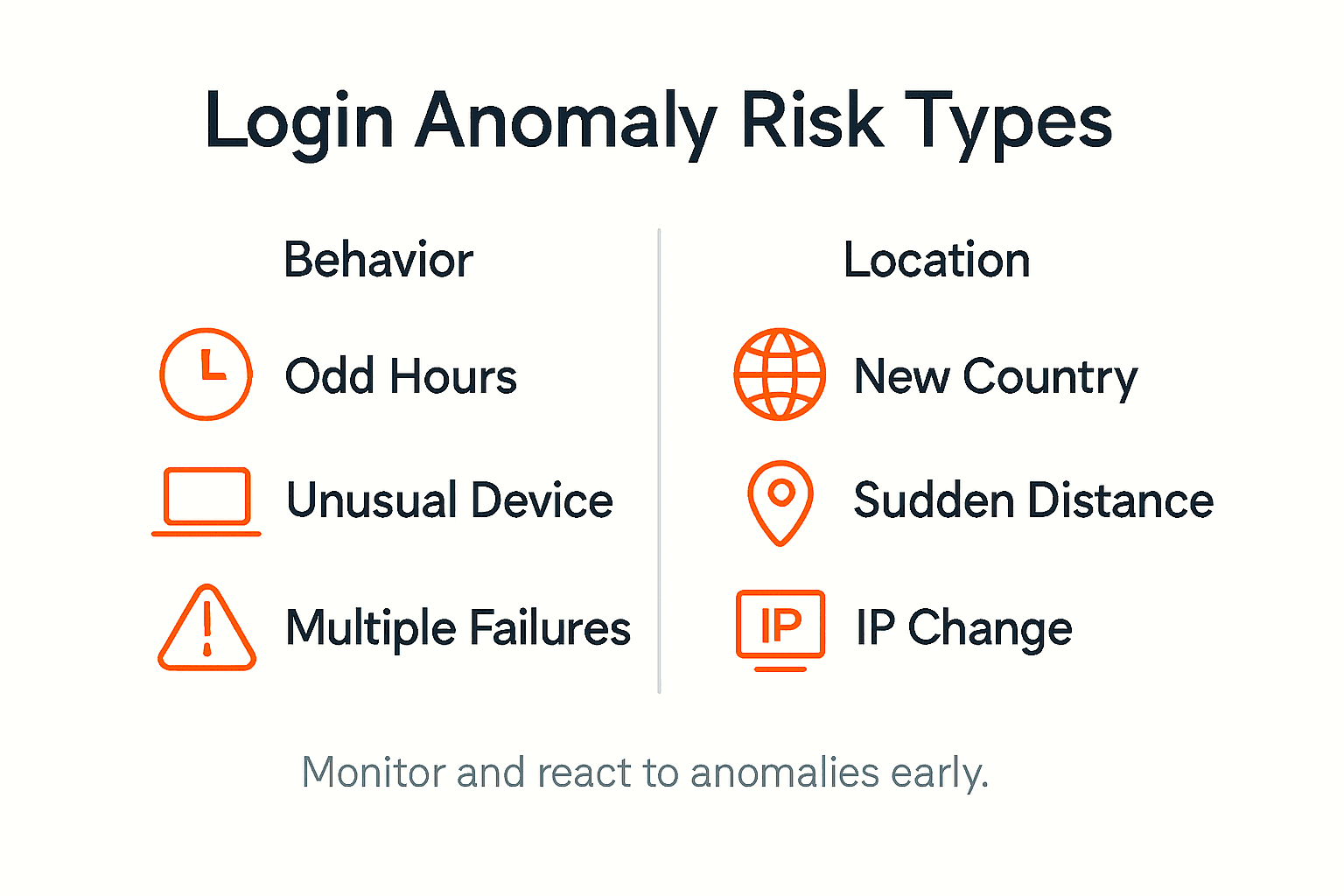
Here’s how suspicious login behaviors can impact enterprise security outcomes:
| Suspicious Behavior Type | Security Risk Introduced | Typical Response Action |
|---|---|---|
| Geographic inconsistency | Increased chance of data exfiltration | Enforce access controls and geofencing |
| Time-based irregularity | Possible insider threat or credential theft | Require additional authentication checks |
| Device recognition anomaly | Risk of unauthorized device access | Device registration or immediate lockout |
| Multiple credential failures | Brute force attacks likely | Temporary account lock and alerting |
- Repeated login failures from multiple IP addresses
- Simultaneous login attempts from different geographic regions
- Login attempts using retired or dormant user credentials
- Connections from unknown or unregistered devices
- Rapid succession of login attempts indicating potential brute force attacks
- Access attempts using outdated or compromised authentication credentials
Pro Tip: Threat Detection Strategy: Implement multi-factor authentication and real-time login monitoring systems that automatically flag and isolate suspicious access attempts before they can penetrate critical network infrastructure.
How Login Anomaly Detection Works
Login anomaly detection represents a sophisticated cybersecurity approach that leverages advanced machine learning algorithms to identify potentially malicious network access attempts. Self-attentive models designed to learn log representations enable security teams to distinguish between legitimate user behaviors and suspicious login activities with unprecedented precision. These intelligent systems analyze multiple dimensions of login data simultaneously, creating complex behavioral profiles that can detect even subtle deviations from expected access patterns.

The core mechanism of login anomaly detection involves creating baseline behavioral models for each user within an organization. These models incorporate historical login characteristics such as typical access times, geographic locations, device types, and network access patterns. Advanced network analysis techniques help identify suspicious login sequences that might indicate unauthorized lateral movement within enterprise networks, tracking how potential attackers might attempt to escalate their system access.
Key components of login anomaly detection systems include:
- Machine learning algorithms that continuously update user behavior profiles
- Real-time comparison of current login attempts against established baselines
- Contextual analysis of login metadata beyond simple credential verification
- Risk scoring mechanisms that assign threat levels to suspicious activities
- Automated alerting and potential access blocking for high-risk login attempts
- Integration with broader security information and event management (SIEM) platforms
Pro Tip: Behavioral Monitoring Strategy: Develop granular, user-specific login behavior models that adapt dynamically to changing work patterns while maintaining strict security thresholds for anomalous access attempts.
Impact on Threat Prevention and Breach Response
User and Entity Behavior Analytics (UEBA) frameworks have revolutionized enterprise cybersecurity by transforming login anomaly detection from a passive monitoring process into an active threat prevention mechanism. These sophisticated systems do more than simply flag suspicious activities; they provide actionable intelligence that enables organizations to preemptively identify and neutralize potential security breaches before significant damage occurs. By generating explainable results that reconstruct the origin of anomalies, security teams can develop more targeted and effective response strategies.
The impact of advanced anomaly detection extends across multiple dimensions of organizational security. Predictive threat modeling allows enterprises to anticipate potential attack vectors by analyzing intricate patterns of login behaviors. Advanced detection systems achieving over 94.5% accuracy dramatically reduce false positive rates, enabling security professionals to focus on genuine threats rather than getting overwhelmed by unnecessary alerts. These systems create a proactive defense mechanism that continuously adapts to emerging attack methodologies.
Critical impact areas of login anomaly detection include:
The table below summarizes the business benefits of deploying advanced login anomaly detection systems:
| Business Benefit | Description | Organizational Outcome |
|---|---|---|
| Reduced breach risk | Early threat detection prevents intrusions | Lower likelihood of data compromise |
| Improved compliance | Automated logging supports audits | Fewer regulatory penalties |
| Faster incident response | Real-time alerts accelerate containment | Less downtime and financial loss |
| Adaptive security posture | Models learn and respond to new threats | Stronger long-term protection |
- Rapid identification of potential unauthorized access attempts
- Minimizing breach response time through immediate threat detection
- Providing comprehensive forensic evidence for security investigations
- Reducing financial and reputational risks associated with data breaches
- Creating adaptive security models that learn from each detected anomaly
- Supporting compliance requirements across different regulatory frameworks
Pro Tip: Threat Mitigation Strategy: Implement a multi-layered anomaly detection approach that combines machine learning algorithms with human expertise, ensuring comprehensive and intelligent security monitoring.
Compliance, Costs, and Risk Management Considerations
Enterprise organizations face increasingly complex challenges in managing cybersecurity risks while maintaining regulatory compliance. User Behavior Analytics (UBA) has emerged as a critical tool for identifying potential security threats by systematically analyzing user interactions and login patterns. This approach not only enhances security posture but also provides documented evidence to demonstrate due diligence in protecting sensitive organizational data.
The financial implications of implementing robust login anomaly detection systems extend beyond direct security costs. Risk mitigation strategies powered by advanced anomaly detection can significantly reduce potential breach-related expenses, including legal fees, regulatory penalties, and reputation damage. Anomaly-based intrusion detection systems play a crucial role in monitoring system activity and providing comprehensive documentation for compliance audits across various regulatory frameworks such as GDPR, HIPAA, and PCI DSS.
Key compliance and risk management considerations include:
- Documenting and tracking all login anomalies for audit purposes
- Establishing clear escalation protocols for suspicious access attempts
- Maintaining comprehensive logs of security interventions
- Implementing transparent reporting mechanisms for stakeholders
- Developing adaptive security policies based on detected anomalies
- Ensuring consistent alignment with industry-specific regulatory requirements
Pro Tip: Compliance Documentation Strategy: Create a standardized incident response template that automatically captures and categorizes login anomalies, facilitating seamless reporting and continuous improvement of security protocols.
Strengthen Your Defenses With Advanced Login Anomaly Solutions
Login anomalies pose a serious challenge to enterprise cybersecurity by exposing networks to unauthorized access and potential data breaches. This article highlights critical threats such as unusual login times, unfamiliar geographic locations, and multiple failed authentication attempts that compromise organizational security. If you are seeking to proactively detect and respond to these suspicious behaviors, understanding the power of machine learning–driven login anomaly detection is essential.

Take control of your security posture today by exploring LogMeOnce’s comprehensive cybersecurity solutions. With features like passwordless multi-factor authentication, cloud encryption, and real-time anomaly monitoring, LogMeOnce provides adaptive and user-specific protection strategies that align perfectly with your need to minimize breach risks and accelerate incident response. Visit our homepage to learn how to safeguard your enterprise against evolving login threats and ensure compliance with industry standards. Don’t wait until suspicious login activity causes damage—act now to secure your digital identity.
Frequently Asked Questions
What are login anomalies and why are they important for cybersecurity?
Login anomalies are unauthorized or suspicious access attempts that deviate from established user behavior patterns. They are crucial for cybersecurity as they signal potential security risks that could expose sensitive data or systems to breaches.
How do organizations detect login anomalies?
Organizations detect login anomalies using advanced User and Entity Behavior Analytics (UEBA) frameworks, which analyze user login patterns against established baselines. These systems can identify unusual login times, geographic locations, and device types.
What indicators suggest a possible login anomaly?
Indicators of login anomalies include logins from unusual geographic locations, attempts outside standard work hours, multiple failed logins, and connections from unrecognized devices. Monitoring these factors helps organizations identify potential security threats.
How can businesses respond to detected login anomalies?
Businesses can respond to detected login anomalies by implementing multi-factor authentication, configuring automated alerts, and establishing clear protocols for suspicious activities. This proactive approach enhances their overall security posture and helps prevent potential breaches.
Recommended
- What Should You Do After a Password Breach? – LogMeOnce
- Best Cybersecurity Tools to Use In 2025 – LogMeOnce
- Biggest Hacker Attacks in History – LogMeOnce
- Schedule Login – LogMeOnce


