


 Password Manager
 Identity Theft Protection

 Team / Business
 Enterprise
 Government
 MSP
MSP


Nearly 80 percent of data breaches involve stolen or compromised credentials, making this one of the most pressing security risks facing american businesses and individuals today. A single leaked password can give cybercriminals instant access to sensitive information, financial accounts, and private data. Understanding how compromised credentials occur and the damage they unleash can help you protect your digital life and avoid costly consequences.
Key Takeaways
| Point | Details |
|---|---|
| Compromised Credentials Risk | Compromised credentials can lead to significant financial and reputational damage for individuals and organizations alike. |
| Common Exposure Methods | Credentials can be compromised through phishing, data breaches, malware, and credential stuffing due to password reuse. |
| Detection Techniques | Advanced detection tools utilize behavioral analytics, anomaly detection, and real-time monitoring to identify potential credential breaches. |
| Mitigation Strategies | Organizations should implement multi-factor authentication, enforce strong password policies, and conduct regular security assessments to reduce risks. |
Defining Compromised Credentials and Their Risks
In the digital security landscape, compromised credentials represent a critical vulnerability that can expose individuals and organizations to significant cyber risks. Credentials are considered compromised when unauthorized parties gain access to login information, including usernames, passwords, or authentication tokens that grant entry to protected systems, networks, or accounts.
The risks associated with compromised credentials are multifaceted and potentially devastating. Hackers can exploit stolen login information to gain unauthorized access, potentially leading to identity theft, financial fraud, data breaches, and widespread system infiltration. When credentials are leaked, cybercriminals can impersonate legitimate users, access sensitive personal or corporate information, and cause substantial financial and reputational damage. In fact, according to LogMeOnce’s guide on password breaches, immediate action is crucial after credential compromise.
Compromised credentials can occur through various methods, including:
- Phishing attacks that trick users into revealing login information
- Data breaches exposing stored user credentials
- Malware that captures keystrokes and login details
- Social engineering techniques targeting human vulnerabilities
- Weak password practices that make credentials easy to guess
Understanding these risks is the first step in developing a robust cybersecurity strategy. By recognizing how credentials become compromised, organizations and individuals can implement proactive measures to protect their digital identities and prevent unauthorized access.
 Password protection strategies play a crucial role in mitigating these potential security threats and maintaining the integrity of personal and professional digital ecosystems.
Common Sources and Exposure Methods
Credential compromise emerges through a complex landscape of digital vulnerabilities, with attackers leveraging sophisticated techniques to breach security systems. Wikipedia highlights one particularly dangerous method known as credential stuffing, where cybercriminals use automated login requests with stolen username-password combinations to gain unauthorized account access.
The primary sources of credential exposure include:
- Public data breaches revealing massive sets of login credentials
- Phishing websites designed to capture user login information
- Keylogging malware that records keystrokes in real time
- Dark web marketplaces selling stolen account credentials
- Social engineering tactics manipulating users into revealing sensitive information
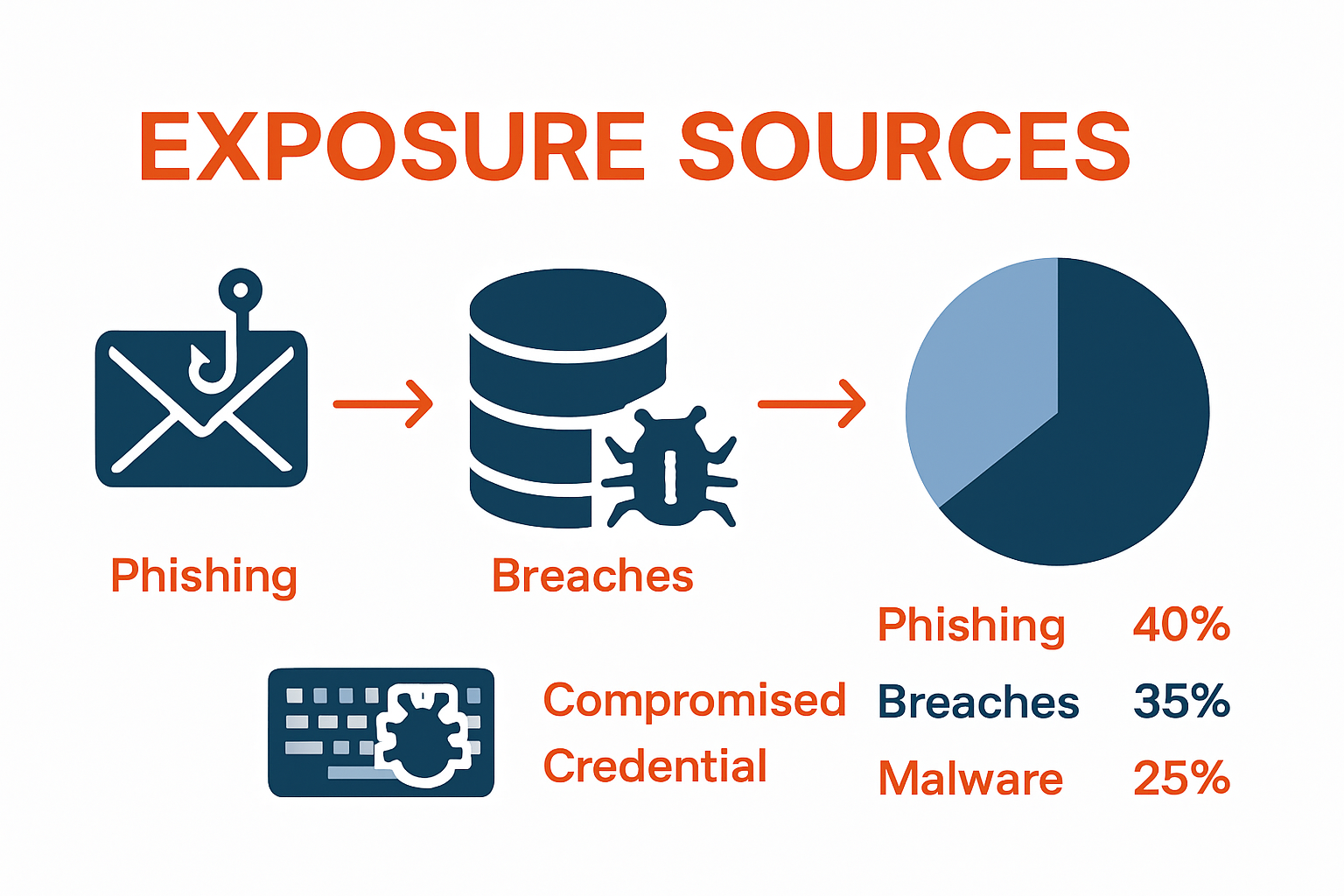
One advanced attack strategy is credential stuffing, which exploits users’ common habit of reusing passwords across multiple platforms. As ScienceDirect research indicates, this method has become increasingly sophisticated, with attackers developing privacy-invasive protocols to validate and exploit stolen account credentials without detection.
Understanding these exposure methods is crucial for developing robust defensive strategies. Organizations and individuals must adopt comprehensive security approaches that include unique password generation, multi-factor authentication, regular credential audits, and proactive monitoring of potential data breach sources. Lock and Key: Understanding the Risks of a Weak Password provides additional insights into creating stronger credential protection mechanisms.
How Detection Tools Find Breaches
Credential breach detection represents a sophisticated technological approach that combines multiple advanced strategies to identify and prevent unauthorized access. Modern detection tools leverage complex algorithms and behavioral analytics to uncover potential security vulnerabilities before they can be fully exploited.
Key mechanisms for detecting compromised credentials include:
- Real-time network traffic monitoring
- Anomaly detection in user login patterns
- Dark web credential scanning
- Behavioral biometric analysis
- Machine learning-powered threat intelligence
ArXiv research highlights a particularly innovative approach using behavioral analytics, specifically keystroke dynamics, to distinguish between legitimate users and potential attackers. This method analyzes unique typing patterns, creating a biometric signature that can detect unauthorized access attempts even when correct login credentials are used.
Comprehensive breach detection tools typically integrate multiple detection strategies, creating a multi-layered security approach. SOS: What to Do After a Data Breach suggests that modern detection mechanisms go beyond traditional password checks, incorporating advanced techniques like continuous authentication, risk scoring, and predictive threat modeling to provide robust protection against increasingly sophisticated cyber threats.
Impact on Business, Users, and Compliance
Credential compromise represents a multifaceted threat with far-reaching consequences that extend well beyond immediate security breaches. Organizations face complex challenges when addressing the potential fallout from unauthorized access and stolen login information, requiring comprehensive strategies to mitigate risks and protect critical digital assets.
RECO research reveals that compromised credentials can trigger substantial organizational risks, including:
- Significant financial losses
- Severe reputational damage
- Operational disruptions
- Potential regulatory penalties
- Substantial mitigation and recovery expenses
For individual users, the impact can be equally devastating, potentially resulting in identity theft, financial fraud, and extensive privacy violations. Businesses must navigate a complex landscape of compliance requirements, with many industries mandating strict protocols for detecting and responding to credential breaches.
Why Cybersecurity Awareness Is Vital to Your Business underscores the critical importance of proactive security measures. Organizations must develop robust incident response plans, implement comprehensive monitoring systems, and create a culture of cybersecurity awareness to effectively mitigate the potential consequences of compromised credentials and maintain the trust of both users and stakeholders.
Mitigating Risks and Strengthening Security
Security hardening requires a comprehensive, multilayered approach to effectively protect organizational and individual digital assets from credential compromise. By implementing strategic defense mechanisms, organizations can significantly reduce their vulnerability to unauthorized access and potential data breaches.
Key strategies for mitigating credential-related risks include:
- Implementing robust multi-factor authentication
- Enforcing strong password complexity requirements
Carnegie Mellon University research highlights the critical importance of developing sophisticated credential abuse auditing systems that can detect and prevent unauthorized access attempts. These advanced systems go beyond traditional security measures, creating dynamic defense mechanisms that adapt to evolving cyber threats.
How to Increase Remote Work Security to Protect Sensitive Data emphasizes that modern security strategies must incorporate continuous monitoring, real-time threat detection, and proactive risk management. Organizations should develop comprehensive security protocols that include regular security assessments, employee training programs, and advanced technological solutions designed to identify and neutralize potential credential compromise attempts before they can cause significant damage.
Strengthen Your Defense Against Compromised Credentials Today
Compromised credentials pose a serious threat that can lead to financial loss, identity theft, and detrimental reputational damage. This article highlights critical challenges such as credential stuffing, phishing, and weak password practices that expose sensitive information to cybercriminals. Protecting your users and business requires advanced detection tools and proactive security measures like multi-factor authentication and behavioral analytics.

Take control of your cybersecurity with LogMeOnce’s comprehensive solutions built to detect and prevent credential compromise before it disrupts your operations. Discover how our passwordless MFA, encrypted cloud storage, and dark web monitoring empower you to safeguard identities and maintain compliance. Do not wait until a breach happens; visit LogMeOnce now to start your free trial and experience modern security designed to adapt to evolving threats. Learn more about password management strategies and why cybersecurity awareness is vital to your business to stay ahead of attackers.
Frequently Asked Questions
What are compromised credentials?
Compromised credentials are login information, such as usernames and passwords, that have been accessed by unauthorized parties. This can lead to significant cyber risks, including identity theft and data breaches.
How do compromised credentials occur?
Compromised credentials can happen through various methods, including phishing attacks, data breaches, malware infections, and social engineering techniques. Weak password practices also contribute to these vulnerabilities.
What are the risks associated with compromised credentials?
The risks include identity theft, financial fraud, data breaches, and damage to reputation. Unauthorized access to sensitive information can lead to severe consequences for individuals and organizations.
How can I detect if my credentials have been compromised?
Detecting compromised credentials can involve using detection tools that monitor network traffic, analyze user login patterns, and scan the dark web for leaked information. Utilizing anomaly detection and behavioral analytics can also help identify unauthorized access attempts.
Recommended
- What Should You Do After a Password Breach? – LogMeOnce
- Identity Theft Protection – LogMeOnce
- Lock and Key: Understanding the Risks of a Weak Password
- Identity Theft Protection & Dark Web Scan – LogMeOnce


