


 Password Manager
 Identity Theft Protection

 Team / Business
 Enterprise
 Government
 MSP
MSP


Most organizations underestimate the risks of weak identity verification, yet nearly half of reported breaches in American companies are linked to compromised credentials. For IT security managers, this means outdated methods can leave critical systems exposed and compliance efforts at risk. This overview addresses key misconceptions and outlines robust identity verification strategies, helping you strengthen protection and meet global regulatory demands with confidence.
Key Takeaways
| Point | Details |
|---|---|
| Identity Verification is Essential | Identity verification is a critical process that uses advanced methods to confirm an individual’s identity, protecting against fraud. |
| Myths about Verification | Common misconceptions include the belief that basic document checks are sufficient; effective verification requires multi-layered approaches. |
| Technological Integration | Combining documentary, biometric, and digital validation techniques enhances the security of identity verification processes. |
| Regulatory Compliance | Organizations must navigate complex regulatory requirements that impact identity verification practices, emphasizing security and privacy. |
Identity Verification Defined and Common Myths
Identity verification is a sophisticated digital security process designed to confirm an individual’s claimed identity with high accuracy and reliability. At its core, identity verification involves systematically validating an individual’s personal information against authoritative sources to ensure authenticity. Identity verification services are used by businesses to match user-provided details with a real person’s verified identity, creating a robust defense against potential fraud and misrepresentation.
The process typically involves multiple sophisticated validation techniques, including documentary verification, biometric comparisons, and knowledge-based authentication. Unlike simple username and password checks, modern identity verification employs advanced methods such as comparing government-issued identification documents, cross-referencing personal information databases, and conducting live biometric checks. Physical in-person verification and biometric comparisons represent the strongest methods for ensuring that the verified identity genuinely belongs to the individual presenting the evidence.
Despite its importance, several common myths persist about identity verification. Many people incorrectly believe that basic document scanning or manual checks are sufficient for robust identity protection. In reality, effective identity verification requires complex, multilayered approaches that combine technological sophistication with rigorous validation protocols. Fraudsters continuously develop more advanced techniques, which means verification methods must constantly evolve to stay ahead of potential security threats.
Pro Tip: Always use multi-factor identity verification strategies that combine document validation, biometric checks, and real-time authentication to maximize security and minimize potential fraud risks.
Main Methods and Technologies Explained
Identity verification encompasses a diverse range of sophisticated technological approaches designed to authenticate an individual’s identity with precision and reliability. Identification systems primarily fall into two core categories: foundational ID systems like national registries and civil records, and functional ID systems tailored to specific purposes such as voter registration or travel documentation.
The primary methods of identity verification include documentary verification, biometric authentication, and digital validation techniques. Documentary verification involves thoroughly examining physical identification documents like passports, driver’s licenses, and government-issued IDs. Biometric authentication takes this process further by incorporating advanced technologies such as facial recognition, fingerprint scanning, voice analysis, and iris matching. These methods create multiple layers of security by comparing physical characteristics against stored digital records.
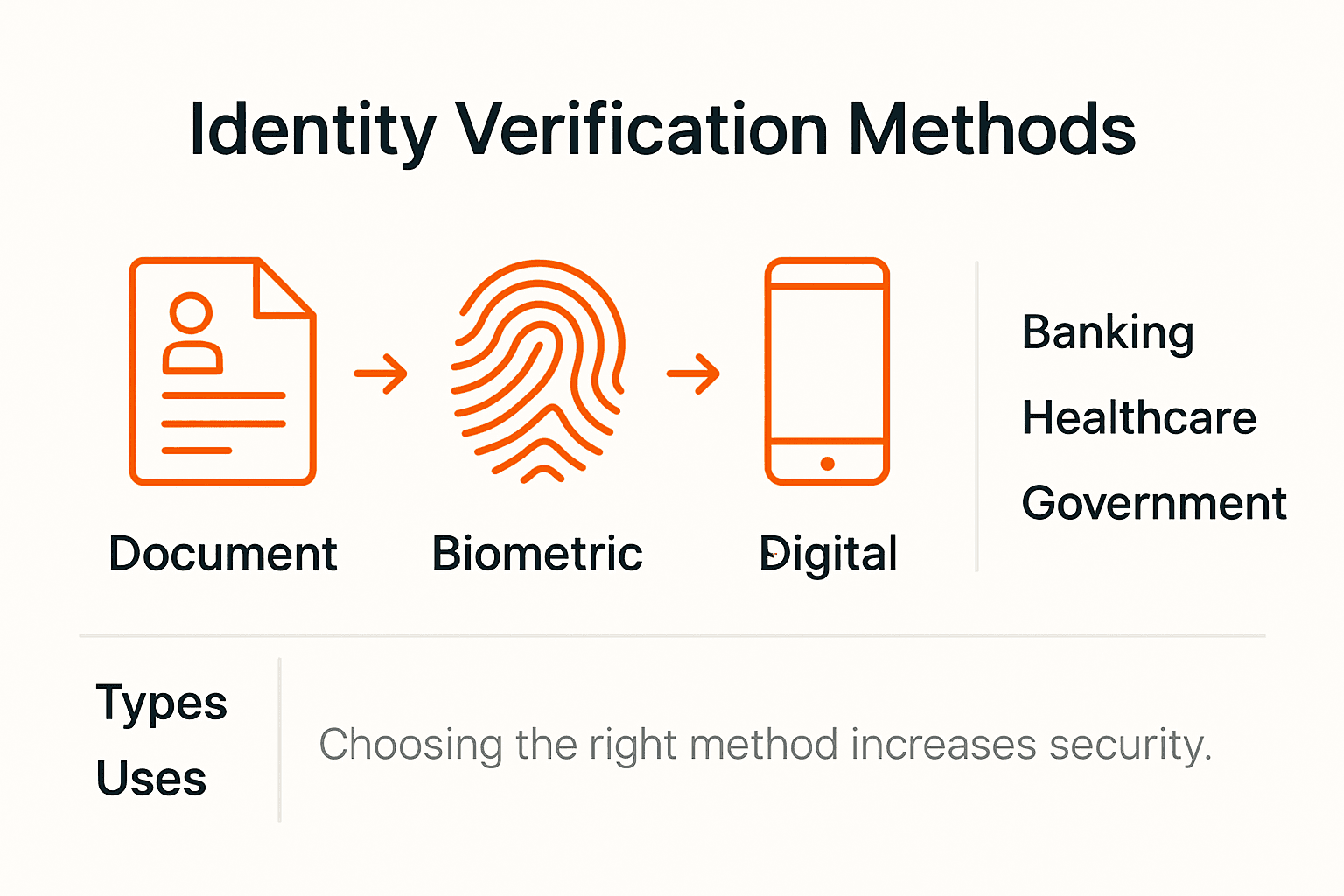
Digital identity technologies have revolutionized verification processes by integrating artificial intelligence and machine learning algorithms. These advanced systems can rapidly cross-reference information from multiple authoritative databases, detect potential fraud patterns, and validate identities with unprecedented speed and accuracy. Modern verification approaches often combine multiple technologies – such as knowledge-based authentication questions, live document scanning, and real-time biometric comparisons – to create comprehensive security protocols that are significantly more robust than traditional manual checking methods.
Pro Tip: Implement a multi-layered identity verification strategy that integrates documentary, biometric, and digital validation techniques to maximize security and minimize potential authentication vulnerabilities.
Here’s a comparison of key identity verification methods, highlighting their strengths and weaknesses:
| Method | Strengths | Weaknesses | Best Use Case |
|---|---|---|---|
| Documentary Verification | Widely accepted; straightforward | Prone to forgery; manual errors | Basic onboarding and compliance |
| Biometric Authentication | Difficult to fake; fast results | Privacy concerns; device required | High-security transactions |
| Digital Validation | Real-time analysis; scalable | Dependent on data accuracy | Large-scale and remote access |
Applications in Business and Security Sectors
Identity verification plays a critical role in securing organizational operations across various business and government sectors. Identity and access management (IAM) systems serve as the foundational infrastructure for managing user identities, access privileges, and ensuring that only authorized personnel can interact with sensitive information and critical systems.

In the financial services sector, identity verification is paramount for preventing fraud, managing compliance requirements, and protecting both institutional and customer assets. Banks, insurance companies, and financial technology firms rely on robust verification processes to authenticate customer identities, prevent money laundering, and meet strict regulatory standards. These organizations implement sophisticated multi-factor authentication methods that combine document verification, biometric checks, and real-time database validations to create comprehensive security frameworks.
Digital identity systems have transformed government service delivery by enabling secure, equitable access to online services while maintaining stringent privacy protections. Governments worldwide are increasingly adopting advanced identity verification technologies to streamline service delivery, ensure beneficiary authentication, and create more efficient digital infrastructure. These systems are particularly crucial in managing social services, healthcare access, voting processes, and other critical citizen interactions that require precise identity confirmation.
Pro Tip: Develop a comprehensive identity verification strategy that integrates multiple authentication layers, continuously updates security protocols, and balances user experience with robust protection mechanisms.
The following table summarizes how identity verification benefits key business sectors:
| Sector | Main Benefit | Implementation Challenge | Typical Technology |
|---|---|---|---|
| Financial | Fraud prevention | Regulatory compliance | Multi-factor authentication |
| Government | Secure service access | Balancing privacy and security | Digital identity systems |
| Healthcare | Protect patient records | Data interoperability | Role-based access controls |
Compliance Requirements and Regulatory Impact
Identity verification has become increasingly complex from a regulatory standpoint, with organizations facing intricate compliance challenges across multiple jurisdictions. International legal frameworks now mandate comprehensive approaches to digital identity management that prioritize rights-based protocols, data protection, and cross-border interoperability of verification systems.
In the financial sector, regulations like the Bank Secrecy Act, Know Your Customer (KYC) rules, and Anti-Money Laundering (AML) guidelines impose stringent identity verification requirements. These regulations compel financial institutions to implement robust authentication processes that go beyond simple document checks. Organizations must now develop sophisticated verification mechanisms that can detect potential fraud, validate customer identities in real-time, and maintain detailed audit trails of all identity verification activities.
Global privacy regulations such as the European Union’s General Data Protection Regulation (GDPR) and the California Consumer Privacy Act (CCPA) have further complicated identity verification landscapes. These laws mandate not just secure verification processes, but also require organizations to obtain explicit consent, provide transparency about data usage, and ensure individuals can access and control their personal information. This regulatory environment demands that identity verification technologies balance security imperatives with individual privacy rights, creating a complex operational challenge for businesses across industries.
Pro Tip: Develop a flexible identity verification strategy that can dynamically adapt to evolving regulatory requirements while maintaining robust security and privacy protections.
Risks, Limitations, and Best Practices
Identity verification technologies face significant challenges that require sophisticated mitigation strategies. Identity management systems must continuously address complex risks including credential theft, insider threats, and potential data breaches that could compromise sensitive organizational information.
The primary risks in identity verification include social engineering attacks, biometric data manipulation, and increasingly sophisticated fraudulent techniques. Cybercriminals continually develop advanced methods to bypass traditional authentication protocols, exploiting vulnerabilities in document verification, facial recognition, and knowledge-based authentication systems. Organizations must implement multi-layered security approaches that combine technological solutions with human expertise to detect and prevent potential identity fraud attempts.
Best practices for robust identity verification involve comprehensive strategies that balance security with user experience. This includes implementing continuous monitoring systems, developing role-based access controls, and creating automated identity lifecycle management protocols. Organizations should prioritize adaptive authentication methods that can dynamically assess risk levels, utilize machine learning algorithms to detect anomalous behavior, and maintain flexible verification processes that can quickly respond to emerging threat landscapes. Additionally, regular security audits, employee training programs, and proactive vulnerability assessments are critical components of a comprehensive identity verification risk management approach.
Pro Tip: Develop a dynamic identity verification strategy that combines advanced technological solutions with continuous learning and adaptive security protocols to stay ahead of evolving fraud techniques.
Strengthen Your Security with Advanced Identity Verification Solutions
The article highlights the critical challenges businesses face today in implementing strong identity verification that keeps pace with evolving fraud and compliance demands. If you are seeking to protect your organization from sophisticated identity threats and regulatory pressures while improving user trust and operational efficiency, LogMeOnce offers the comprehensive cybersecurity tools you need. From multi-factor authentication to passwordless access and encrypted cloud storage, our solutions seamlessly integrate multiple verification layers such as biometric authentication and real-time validation, mirroring the proactive strategies detailed in the article.

Don’t let identity fraud or regulatory complexity put your business at risk. Experience how LogMeOnce can empower you with innovative, easy-to-use, and flexible identity management technologies designed for diverse sectors including government, finance, and healthcare. Visit LogMeOnce now to explore our range of solutions and start your free trial. Secure your digital future today by combining robust identity verification with user-friendly cybersecurity tools that rise above manual and outdated methods described in the article.
Frequently Asked Questions
What is identity verification?
Identity verification is a digital security process that confirms an individual’s claimed identity by validating their personal information against authoritative sources to ensure authenticity.
Why is identity verification important for security?
Identity verification is crucial for preventing fraud, protecting sensitive information, and ensuring compliance with regulations in various sectors, including finance and healthcare.
What are the common methods used in identity verification?
Common methods include documentary verification (examining IDs), biometric authentication (facial recognition, fingerprint scanning), and digital validation techniques that incorporate AI and machine learning for real-time analysis.
How can organizations improve their identity verification processes?
Organizations can improve identity verification by implementing multi-layered security strategies, using advanced technologies, continuously monitoring for anomalies, and adapting to evolving regulatory requirements.
Recommended
- How to Prevent Identity Theft Online – LogMeOnce
- Say Goodbye to Passwords with LogMeOnce PasswordLess Authentication
- How Two Factor Authentication (2FA) Can Keep Your Accounts Safe


