


 Password Manager
 Identity Theft Protection

 Team / Business
 Enterprise
 Government
 MSP
MSP


TL;DR:
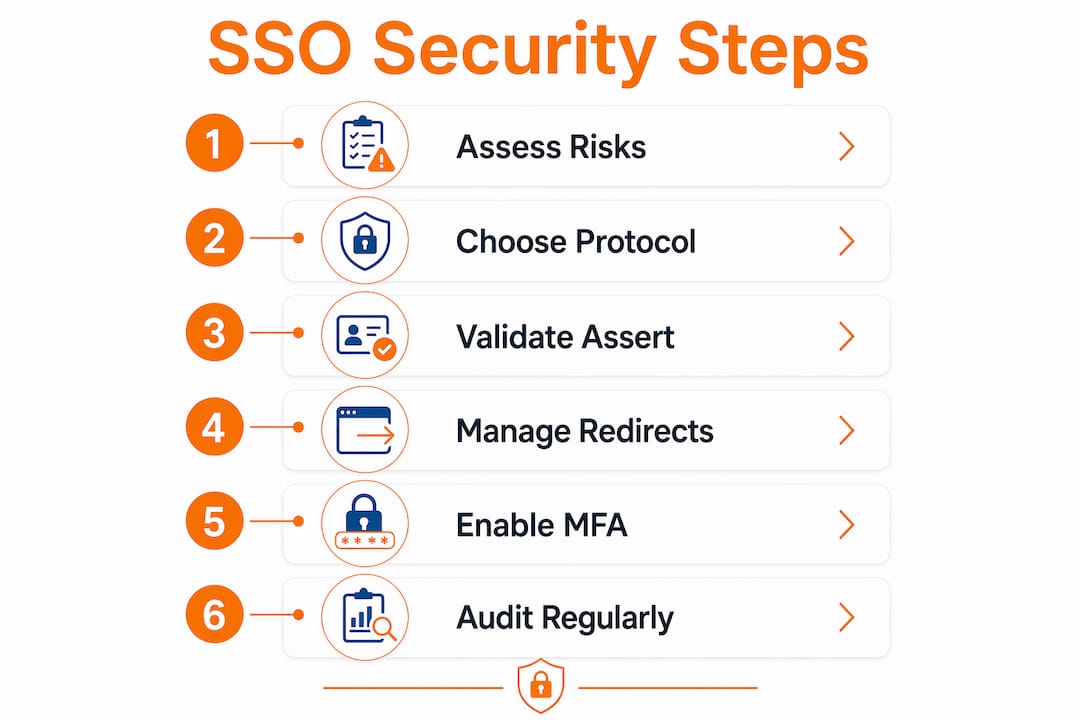
- Securing SSO depends on protecting the central Identity Provider as it controls access to all connected applications. Implementing phishing-resistant MFA methods like FIDO2/WebAuthn and enforcing strict validation of tokens and assertions strengthen security. Continuous monitoring, regular audits, and automated lifecycle management prevent stale access and minimize vulnerability risks.
Single sign-on (SSO) security for applications is defined as the set of controls that protect a centralized authentication system from being exploited to gain unauthorized access across every connected application. The Identity Provider (IdP) is the most critical asset in any SSO deployment. Compromise it, and every application it serves is exposed. Industry standards including SAML 2.0, OAuth 2.0, and OpenID Connect (OIDC) form the technical backbone of modern SSO, but protocols alone do not make a system secure. Phishing-resistant MFA methods like FIDO2/WebAuthn, strict token validation, and disciplined lifecycle governance are what separate a well-secured SSO deployment from a liability.
What are the common SSO security vulnerabilities in enterprise applications?
SSO creates a single point of failure by design. That trade-off is acceptable only when the IdP and its surrounding controls are hardened to match the risk. A compromised IdP grants an attacker access to every application the IdP serves. Security professionals call this the “master key” problem. The blast radius of a single credential theft scales with the number of connected applications.
The most dangerous SSO vulnerabilities fall into five categories:
- XML Signature Wrapping (XSW) attacks. SAML assertion forgery through improper signature validation lets attackers craft assertions that grant them unauthorized access. Multiple documented XSW variants exploit service providers that validate the signature but not the signed content’s position in the XML document.
- Token leakage via OAuth/OIDC redirects. Tokens exposed in browser histories, referrer headers, or server logs become usable by anyone who finds them. Insecure redirect handling is the most common cause.
- Stale session persistence. Disabling a user account in the IdP does not automatically revoke active sessions or API keys in connected applications. This gap allows terminated employees or compromised accounts to retain access long after the IdP record is deactivated.
- Excessive OAuth scopes. Default configurations often grant far more permissions than an application needs. If that token is stolen, the attacker inherits every permission it carries.
- Shadow IT and unregistered applications. Applications connected to the IdP without formal review bypass access controls and audit logging entirely.
Pro Tip: Audit every application registered in your IdP quarterly. Unregistered or forgotten apps are the most common source of unmonitored access paths.
How can organizations securely implement SAML and OIDC protocols?
Protocol choice shapes the attack surface. SAML 2.0 is the dominant standard for enterprise web applications, particularly legacy systems. OAuth 2.0 paired with OIDC is the preferred choice for modern APIs and mobile applications. Each protocol has distinct validation requirements that, when skipped, create exploitable gaps.

For SAML deployments, strict assertion validation is non-negotiable. The service provider must verify the signature, the signing certificate, the audience restriction, and the issuer field on every assertion. Skipping any of these checks opens the door to XSW attacks. Service-provider-initiated flows are safer than IdP-initiated flows because they include a request ID that can be matched against the response, blocking unsolicited assertion injection.
For OAuth 2.0 and OIDC, the most critical control is redirect URI management. Pre-registering exact redirect URIs and rejecting any request that does not match prevents token interception and CSRF. Wildcard URIs and pattern-matched URIs are dangerous. The state parameter must be used and validated on every authorization request to block cross-site request forgery.
The table below summarizes the key validation requirements by protocol:
| Validation requirement | SAML 2.0 | OAuth 2.0 + OIDC |
|---|---|---|
| Signature verification | Required on every assertion | Required on ID tokens |
| Audience restriction | Must match SP entity ID | Must match client ID |
| Issuer validation | Must match IdP metadata | Must match authorization server |
| Redirect URI control | Not applicable | Exact pre-registration required |
| Replay protection | InResponseTo matching | State and nonce parameters |
Pro Tip: Never use wildcard redirect URIs in production OAuth applications. A single misconfigured URI can expose tokens across your entire application portfolio.
What are the best practices for IdP and administrator account protection?
The IdP deserves the highest security priority in your environment. Every control that protects a critical server applies here, plus identity-specific hardening. Hardware-backed MFA using FIDO2 or WebAuthn is the baseline requirement for all administrator accounts. SMS and email one-time passwords are vulnerable to interception and should not be accepted for privileged access.
Effective IdP hardening requires several layered controls:
- Network access restriction. Limit IdP admin console access to specific IP ranges or VPN endpoints. Attackers who steal credentials cannot use them from arbitrary locations.
- Separate admin identities. Administrators should use dedicated accounts for IdP management, never their daily-use accounts. This limits the exposure of privileged credentials to routine browsing and email.
- Centralized key and secret management. Store signing certificates and secrets in a dedicated secrets manager with audit logging. Every access event should be recorded.
- Annual certificate rotation. Rotate SAML signing certificates on a fixed schedule and immediately after any suspected incident. Stale certificates are a silent risk.
- Breached password monitoring. Continuous breached password protection integrated with your directory catches exposed credentials before they are reused against the IdP.
Logmeonce supports phishing-resistant MFA methods including hardware key authentication, giving security teams a practical path to enforce these controls without building custom infrastructure. Managed IdP platforms that are regularly audited carry lower risk than self-hosted alternatives for organizations without a dedicated security team.
How does lifecycle management improve SSO security for applications?
The most overlooked failure in SSO deployments is assuming that disabling a user in the IdP revokes all access. It does not. Persistent tokens, API keys, and long-lived sessions in connected applications remain valid until they are independently revoked. This gap is the primary cause of prolonged unauthorized access after employee termination or account compromise.
A sound lifecycle management program addresses this through four practices:
- Automate deprovisioning with SCIM. The System for Cross-domain Identity Management (SCIM) protocol enables real-time account revocation across connected applications the moment an identity event occurs. Manual deprovisioning processes are too slow and too error-prone.
- Conduct periodic access certification. Quarterly entitlement reviews catch role creep, where users accumulate permissions over time that no longer match their job function. Access that is not actively certified should be revoked.
- Enforce step-up authentication. Step-up MFA requires re-authentication when a user accesses a sensitive application, even if an active SSO session exists. This limits lateral movement if a low-risk application session is compromised.
- Log and alert on federation events. Every authentication event, token issuance, and assertion validation should be logged. Anomalies such as logins from new geographies or unusual access times should trigger alerts.
The table below maps lifecycle events to required security actions:
| Lifecycle event | Required action | Recommended method |
|---|---|---|
| Employee termination | Immediate account disable and token revocation | SCIM + session invalidation API |
| Role change | Access recertification for new and old roles | Automated workflow with manager approval |
| Contractor offboarding | Remove all application entitlements | Time-bound access with auto-expiry |
| Suspected compromise | Force re-authentication across all sessions | Emergency session revocation |
Logmeonce’s enterprise identity management platform includes centralized controls that support these lifecycle workflows, reducing the manual effort required to maintain a clean access state.
What operational controls sustain a strong SSO security posture?
Secure SSO implementation is not a one-time project. Configuration drift, new application integrations, and evolving attack techniques require continuous monitoring and regular testing. A prioritized mitigation program can reduce detection and containment time from days to hours. That difference determines whether a token theft becomes a minor incident or a full breach.
Operational controls that sustain SSO security include:
- Continuous assertion validation telemetry. Monitor SAML and OIDC assertion flows in real time. Unexpected assertion volumes, unusual issuers, or failed validations are early indicators of attack.
- Regular configuration audits. Test SAML and OIDC flows against known attack patterns on a quarterly basis. Automated scanning tools can detect misconfigured redirect URIs, weak signing algorithms, and missing audience restrictions.
- Incident response playbooks. Define specific response procedures for a compromised IdP, stolen tokens, and misconfigured applications. Teams that rehearse these scenarios respond faster when incidents occur.
- User and administrator education. Phishing remains the primary vector for credential theft that leads to SSO compromise. Regular training on recognizing phishing attempts and protecting hardware keys reduces human risk.
- Forensic log retention. Retain authentication logs for a minimum period aligned with your regulatory requirements. Investigations into SSO incidents frequently require log data from weeks or months before the detected event.
Organizations without dedicated security operations capacity benefit from outsourcing SSO monitoring to a managed detection and response provider. The faster the mean time to respond, the smaller the damage from any SSO-related incident.
Key Takeaways
Securing SSO requires protecting the Identity Provider as the highest-priority asset, enforcing phishing-resistant MFA, validating every token and assertion, and automating lifecycle management to prevent stale access.
| Point | Details |
|---|---|
| IdP is the crown jewel | Compromise of the Identity Provider exposes every connected application simultaneously. |
| FIDO2 MFA is non-negotiable | Hardware-backed authentication blocks phishing attacks that bypass SMS and email OTP. |
| Validate every assertion | SAML XSW attacks and OAuth token leakage both exploit skipped validation steps. |
| Automate deprovisioning | Disabling a user in the IdP does not revoke tokens; SCIM-based revocation closes the gap. |
| Monitor continuously | Real-time telemetry and quarterly audits catch configuration drift before attackers do. |
The part of SSO security most teams get wrong
After working through SSO deployments across organizations of different sizes, the pattern I see most often is this: teams invest heavily in the initial SSO rollout and then treat it as finished. The IdP gets configured, applications get connected, and the project closes. Six months later, terminated employees still have active tokens, redirect URIs have drifted from their registered values, and no one has reviewed the OAuth scopes granted to third-party integrations.
SSO is not a product you deploy. It is an access hub that multiplies your governance requirements with every application you connect. The more applications you add, the more critical your lifecycle management becomes. I have seen organizations where a single misconfigured redirect URI in a low-priority application became the entry point for a token theft that reached their core ERP system.
The second pattern I see is teams that deploy SSO and consider MFA “handled” because the IdP supports it. Supporting MFA and enforcing phishing-resistant MFA for every user, including contractors and service accounts, are very different things. FIDO2 hardware keys are the only MFA method I trust for administrator accounts. Everything else is a workaround.
The future of SSO security points toward continuous verification rather than session-based trust. Zero-trust architectures that require step-up authentication for every sensitive action, regardless of session state, are where the industry is heading. Organizations that build that discipline now will adapt far more easily than those still relying on perimeter-based session trust.
— Mike
How Logmeonce strengthens your SSO security foundation
SSO security depends on the quality of the identity controls surrounding it. Logmeonce provides a cybersecurity platform built around phishing-resistant MFA, passwordless login, and centralized identity governance that directly addresses the risks covered in this article.

Logmeonce supports FIDO2/WebAuthn hardware key authentication, giving your team the phishing-resistant MFA layer that SSO deployments require. Its centralized dashboard gives administrators visibility into authentication events and access states across connected applications. For organizations managing complex identity environments, Logmeonce’s password management benefits extend to protecting the privileged credentials that guard your IdP. Explore the platform to see how it fits your SSO security requirements.
FAQ
What is the biggest security risk in SSO deployments?
The Identity Provider is the single most critical risk point. A compromised IdP grants attackers access to every connected application, making IdP hardening and phishing-resistant MFA the highest-priority controls.
Does disabling a user in the IdP revoke all application access?
No. Disabling an account in the IdP does not automatically revoke active tokens, API keys, or persistent sessions in connected applications. SCIM-based deprovisioning and session invalidation APIs are required to close this gap.
What MFA method is most effective for SSO security?
FIDO2/WebAuthn hardware keys are the most effective MFA method for SSO environments. SMS and email OTP are vulnerable to interception and should not be used for administrator or high-risk application access.
How do SAML XSW attacks work?
XML Signature Wrapping attacks exploit service providers that validate a SAML signature without verifying the signed content’s position in the document. Attackers insert a forged assertion alongside a valid signed element, tricking the SP into granting unauthorized access.
How often should SSO configurations be audited?
SSO configurations, including redirect URIs, OAuth scopes, and SAML signing certificates, should be audited at least quarterly. Certificate rotation should also occur annually and immediately after any suspected security incident.


