


 Password Manager
 Identity Theft Protection

 Team / Business
 Enterprise
 Government
 MSP
MSP


TL;DR:
- Modern phishing attacks are highly personalized, AI-generated, and designed to bypass traditional defenses.
- Building layered security with email authentication protocols, phishing-resistant MFA, and regular staff training is essential for effective prevention.
A single email lands in your accounting department’s inbox. It looks like it’s from your cloud vendor, asking for login credentials to resolve an urgent billing issue. One click later, your network credentials are gone, and a threat actor has a foothold inside your systems. For small and medium businesses and government agencies, this scenario plays out every single day, and the consequences range from operational downtime and regulatory fines to complete data compromise. This guide walks you through exactly what modern phishing looks like, how to build layered defenses, and which practical steps you can take right now to protect your organization from attacks that grow more convincing by the month.
Key Takeaways
| Point | Details |
|---|---|
| Adopt layered defenses | Combining technical solutions and human training is proven to stop more phishing attacks than using either alone. |
| Prioritize strong email controls | Email authentication protocols like SPF, DKIM, and DMARC with rejection policies prevent most spoofed emails. |
| Implement phishing-resistant MFA | Modern MFA with hardware keys or passkeys drastically reduces the success rate of phishing. |
| Run continuous staff training | Regular, role-based phishing simulations keep employees alert and clicking less. |
| Measure and adapt | Consistently test your defenses and update strategies as phishing tactics evolve. |
Understanding modern phishing threats
Phishing is no longer just a badly worded email asking you to wire money to a foreign prince. Today’s attacks are engineered with precision, personalization, and increasingly, artificial intelligence. For SMBs and government agencies, understanding the real threat landscape is the first requirement for defending against it.
Modern phishing affects organizations across every size and sector. The damage is not just financial. A successful phishing attack can expose sensitive constituent data, disrupt government services, trigger compliance violations, and permanently damage the trust you’ve built with customers or citizens. Recovery costs often dwarf the initial loss.
What makes modern phishing so dangerous is the shift toward methods that evade traditional defenses:
- AI-generated emails that are grammatically flawless, contextually aware, and personalized using data scraped from LinkedIn or company websites
- QR code and CAPTCHA phishing, where attackers embed malicious links inside images that automated scanners can’t read
- Legitimate platform abuse, where attackers route phishing content through trusted services like Microsoft SharePoint or Google Drive, allowing messages to pass DMARC checks because they originate from real Microsoft domains
- Short-lived phishing sites with operational lifetimes of 16 to 24 hours, meaning they expire before blocklists can update
AI-driven phishing now accounts for 86% of all detected phishing attacks, according to KnowBe4 research. That number reframes the entire problem. Legacy defenses built around known signatures and static blocklists weren’t designed for adversaries who generate novel, polished attack content at machine speed.
This is also why reviewing cybersecurity tips for small businesses isn’t a one-time exercise. The threat model shifts constantly, and your defenses need to shift with it. A firewall and a spam filter that worked well in 2020 may be completely inadequate against today’s AI-crafted spear phishing campaigns.
Prerequisites: Building your anti-phishing foundation
Before you deploy advanced tooling, you need to get your baseline right. Many organizations jump straight to expensive solutions without establishing the foundational controls that actually stop most attacks. Here’s what your anti-phishing foundation must include.
Email authentication protocols
The three protocols you must configure are SPF (Sender Policy Framework), DKIM (DomainKeys Identified Mail), and DMARC (Domain-based Message Authentication, Reporting and Conformance). Together, they prevent domain spoofing, which is when attackers send email that appears to come from your own domain. CISA’s CPG Report 2.0 specifically recommends setting DMARC to a reject policy, not just monitor or quarantine. Many organizations stop at monitoring and never enforce the policy, which means spoofed emails still reach inboxes.
| Protocol | What it does | Minimum setting |
|---|---|---|
| SPF | Lists authorized mail servers for your domain | Publish with ~all hardening |
| DKIM | Cryptographically signs outgoing emails | Enable with 2048-bit keys |
| DMARC | Enforces SPF/DKIM and provides reporting | Set to "p=reject` |
Workforce readiness
Technology alone cannot close the human vulnerability gap. Your staff needs to know what phishing looks like, how to report it, and who to contact when something feels off. Establish a single, simple reporting path, whether that’s a dedicated email alias, a button in your email client, or a ticketing system. Update your employee contact directories regularly so impersonation attempts are easier to spot.
Free resources from CISA and the FTC offer training materials and checklists at no cost. These are practical quick wins, especially for agencies and SMBs with limited security budgets.
Pro Tip: Pair your DMARC rollout with password protection best practices review. A domain that can’t be spoofed but uses weak passwords is still wide open.
Step-by-step: Rolling out layered defenses
No single control stops phishing. The organizations that consistently repel attacks use a layered approach, meaning they stack technical controls, process controls, and human training so that an attacker must defeat multiple independent defenses simultaneously. Here’s how to build those layers in a logical sequence.
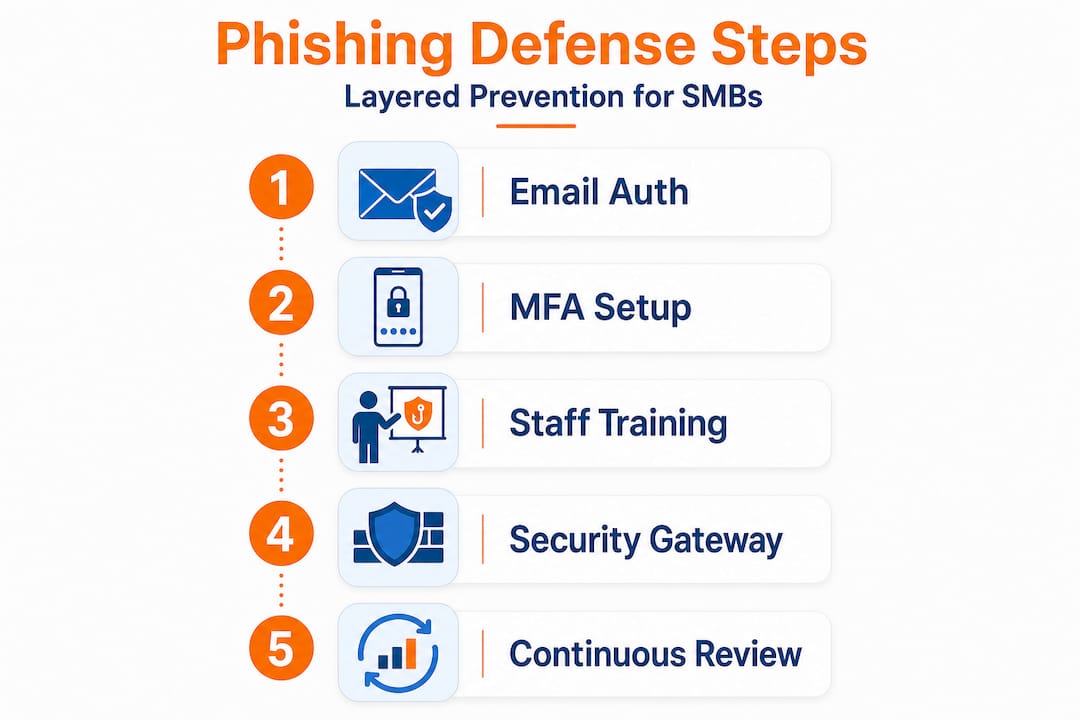
Step 1: Enforce email authentication. Configure SPF, DKIM, and DMARC as described above. Move your DMARC policy to reject as quickly as your mail flow allows. Monitor the DMARC aggregate reports for several weeks to catch legitimate sending sources before flipping the enforcement switch.
Step 2: Deploy phishing-resistant MFA. This is arguably the single most impactful technical control available to SMBs and agencies right now. Phishing-resistant MFA uses FIDO/WebAuthn standards, hardware security keys, or passkeys. It does not use SMS or email one-time codes, which are vulnerable to interception through SIM swapping and adversary-in-the-middle attacks. The business benefits of two-factor authentication are well established, but the critical detail is choosing the right type of MFA. Standard TOTP apps are better than SMS, but FIDO keys are better still.
Step 3: Train and test staff regularly. CISA recommends conducting phishing simulations with role-based content and ongoing updates, not just an annual compliance checkbox exercise. Finance staff should see wire fraud simulations. HR staff should see credential harvesting attempts. IT staff should see technical pretexts. This targeted approach makes training stick.
Step 4: Configure your email security solution. A cloud-based email security gateway adds scanning, sandboxing, and URL rewriting on top of your email provider’s native filters. Layered technical controls aligned with the NIST Cybersecurity Framework’s Identify-Protect-Detect-Respond model provide measurably better outcomes than relying on any single tool.
| Control | Strength | Limitation |
|---|---|---|
| DMARC reject policy | Blocks domain spoofing | Does not stop lookalike domains |
| Phishing-resistant MFA | Blocks credential theft | Requires device enrollment effort |
| Email security gateway | Scans links and attachments | Can miss novel or obfuscated content |
| Simulated phishing | Builds human threat literacy | Risk of simulation fatigue if overdone |
Pro Tip: When rolling out multi-factor authentication across your organization, start with privileged accounts and remote access users first. These accounts carry the highest risk and deliver the fastest risk reduction per user enrolled.
Empirical research on phishing training shows that role-based, frequent programs consistently outperform annual training in reducing click rates. However, the research also warns against simulation fatigue. If employees see phishing simulations too frequently, or feel they are being punished for clicks rather than educated, engagement drops and the program loses its effectiveness. The right cadence is roughly monthly simulations with immediate, constructive feedback rather than blame.
For government agencies and SMBs that want to implement tools for scalable business security, it is worth mapping each technical control to a specific threat scenario. This helps justify budget and ensures you are not deploying tools without clear purposes.
Testing effectiveness and avoiding common pitfalls
Setting up your anti-phishing stack is necessary but not sufficient. You need to verify that it actually works, and you need to understand where the gaps are before attackers find them.
“The question is never whether your controls are deployed. The question is whether they’re working. Most organizations don’t find out the answer until after a breach.”
Key metrics to track include:
- Phishing email click rate from simulated campaigns, broken down by department and role
- Blocked email volume from your email gateway, reviewed for false positives
- Employee-reported suspicious emails, which indicate active participation in your security culture
- Time to report, meaning how quickly employees flag suspicious messages after receiving them
- DMARC aggregate report data, showing whether your domain is being spoofed externally
One of the most common pitfalls is over-reliance on signature-based detection. VBSpam Q2 2025 testing showed that email security solutions achieved over 90% spam catch rates, which sounds excellent until you realize that advanced threats, particularly JavaScript embedded in .htm and .svg file attachments, routinely evade signature-based detection. The 10% that gets through often represents the most dangerous, targeted attacks.
Another overlooked pitfall is neglecting the human reporting loop. If employees report suspicious emails and never hear back, they stop reporting. Acknowledge every report, even if it turns out to be legitimate mail. That feedback loop builds the culture of vigilance that technical tools alone cannot create.
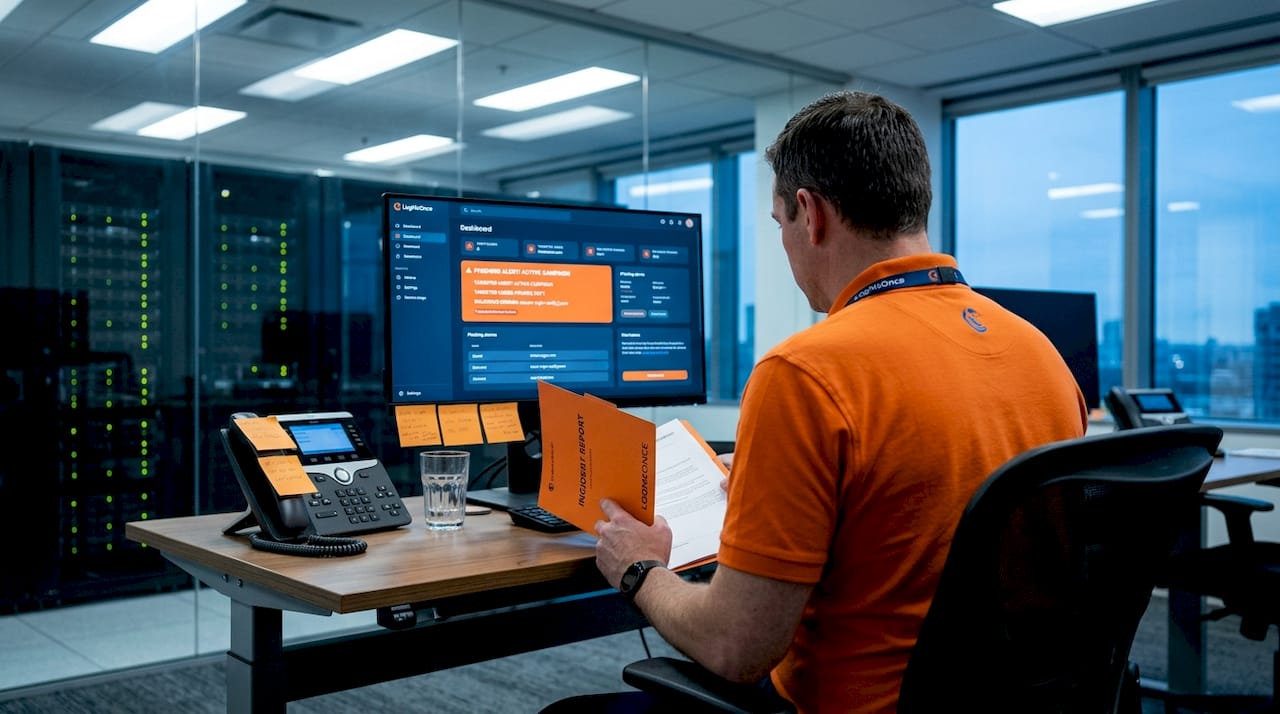
CISA’s SMB resources benchmark that layering Integrated Cloud Email Security (ICES) tools on top of native email filters adds 0.24 to 13.7% efficacy improvement. That range sounds wide because the actual gain depends heavily on your existing configuration and threat profile. Use it as a motivation to layer rather than a guaranteed outcome.
Reviewing IT security tips periodically helps ensure your baseline doesn’t drift as software updates and configuration changes accumulate over time.
Maintaining resilience: Continuous improvement and future-proofing
Phishing prevention is not a project with a finish line. It is an ongoing program that requires consistent attention, measurement, and adjustment. Here is how to sustain and strengthen your defenses over time.
- Integrate phishing controls into your broader cybersecurity policy, aligned with frameworks like NIST CSF guidelines, so that anti-phishing measures are formally documented, budgeted, and reviewed on a regular schedule
- Update training content frequently, because email authentication and employee training must evolve in response to new attack techniques, not just annual compliance calendars
- Monitor emerging threats by subscribing to threat intelligence feeds from CISA, your email security vendor, and information sharing groups in your sector
- Leverage peer networks, such as sector-specific Information Sharing and Analysis Centers (ISACs), to get early warning about phishing campaigns targeting your industry before they hit your inbox
- Conduct annual policy reviews that formally assess whether your current toolset addresses threats that didn’t exist when you last updated your controls
Pro Tip: Explore best cybersecurity tools that offer automated policy enforcement and threat intelligence integration, reducing the manual burden on small security teams while keeping your defenses current.
AI and machine learning are accelerating on both sides of the phishing problem. Attackers use generative AI to craft more convincing messages at scale. Defenders are deploying AI-based behavioral analysis that flags anomalous email patterns even without a known bad signature. Staying informed about both trends helps you make smarter tooling decisions as the market evolves.
Why simple fixes fall short—and where true prevention starts
Here’s an uncomfortable truth that most security articles avoid: a lot of organizations are investing real money in anti-phishing tools and still getting breached. The reason isn’t that the tools don’t work. It’s that they treat phishing prevention as a configuration task rather than a continuous organizational behavior.
The organizations that consistently succeed don’t have the flashiest tools. They have a culture where employees actually feel responsible for security, where reporting a suspicious email is celebrated rather than ignored, and where leadership demonstrates that security is a priority through budget, time, and genuine engagement. That culture doesn’t come from software. It comes from consistent, visible investment in people.
The contrarian take worth considering is this: your weakest link isn’t your email filter. It’s the employee who has never seen a well-crafted spear phishing email and wouldn’t recognize one if it arrived on a Monday morning before coffee. No vendor tool fixes that gap. Regular simulation, immediate feedback, and role-relevant training do.
Technical quick fixes like deploying a new email gateway also invite a false sense of security. When a new tool is deployed, security teams often stop monitoring as closely because they assume the tool is handling it. Attackers know this. That post-deployment window is frequently when sophisticated campaigns land.
Real-world business security lessons show repeatedly that the most resilient organizations treat their security stack as a hypothesis to be tested, not a solution that has been solved. They simulate attacks against their own defenses, measure results honestly, and improve based on data rather than assumptions.
True phishing prevention creates a culture of skepticism and verification. It means employees who pause before clicking, confirm wire transfer requests by phone, and report anything unusual without fear of embarrassment. That culture is built through consistent leadership, education, and recognition, not by purchasing another tool.
Take your anti-phishing defenses further with LogMeOnce
If you want to supercharge these defenses and simplify your team’s security stack, here’s where to start.
LogMeOnce offers a suite of cybersecurity solutions designed specifically for SMBs and government agencies that need enterprise-grade protection without enterprise-grade complexity. From phishing-resistant MFA using passwordless and FIDO-based authentication to single sign-on, dark web monitoring, and encrypted cloud storage, LogMeOnce brings multiple critical defenses into one manageable platform. Whether your team is rolling out MFA for the first time or looking to consolidate a fragmented security stack, LogMeOnce provides the tools, the support, and the flexible plans to match your organization’s scale and budget. Start with a free trial and see the difference a cohesive identity security platform makes.
Frequently asked questions
What is the most important step to prevent phishing attacks?
Deploying phishing-resistant MFA using FIDO/WebAuthn or hardware keys, combined with ongoing phishing simulations, consistently deliver the largest measurable reduction in phishing risk for organizations of any size.
How do email authentication protocols help stop phishing?
SPF, DKIM, and DMARC work together to verify that incoming email genuinely originates from your stated domain, and setting DMARC to reject blocks spoofed messages before they reach your employees’ inboxes.
Are email security solutions alone enough to prevent phishing?
No. While email security tools catch over 90% of spam, sophisticated attacks using obfuscated attachments and legitimate platforms routinely bypass filters, making human training and layered controls essential.
How often should phishing training take place?
Role-based, frequent training consistently outperforms annual programs in reducing click rates, with monthly simulations and immediate feedback being more effective than infrequent, generic sessions.
What is an effective quick win for SMBs starting phishing prevention?
Enforcing DMARC and rolling out MFA are the highest-impact starting points, with CISA and FTC offering free tools and checklists that help small teams implement both quickly without significant upfront cost.
Recommended


