


 Password Manager
 Identity Theft Protection

 Team / Business
 Enterprise
 Government
 MSP
MSP


TL;DR:
- Password sharing increases the risk of data breaches by expanding the attack surface and enabling credential reuse. Secure sharing methods with password managers and MFA are essential to mitigate vulnerabilities and prevent unauthorized access. Implementing strong policies, breach screening, and privileged account management further strengthens organizational cybersecurity defenses.
Password sharing is a direct pathway to data breaches, exposing credentials to unauthorized users who can exploit them through credential stuffing, brute-force attacks, and dark web resale. The link between password sharing and data breaches is not theoretical. In 2026, Dashlane confirmed that attackers brute-forced their 2FA system to steal encrypted vaults from personal-plan customers, demonstrating that even hardened platforms are not immune when authentication controls are weak. Tools like password managers, two-factor authentication (2FA), and NIST-aligned credential policies form the primary defense. Without them, shared passwords become open invitations.
How does password sharing increase the risk of data breaches?
Password sharing multiplies the attack surface of any account. Every additional person who holds a credential is another potential point of compromise, whether through phishing, device theft, or careless storage.
Credential stuffing and password reuse remain among the top causes of data breaches globally. When a shared password leaks from one service, attackers run automated scripts testing that same credential across hundreds of other platforms. A single shared Netflix login stored in a group chat can cascade into a compromised bank account if the same password appears elsewhere.
“Shared credentials are not just a convenience risk. They are a structural vulnerability. Once a password leaves one person’s control, the organization loses the ability to audit, revoke, or trace access.”
Weak master passwords compound the problem. The 2026 Dashlane incident showed that encrypted vaults are unreadable without the customer’s master password, but attackers who obtain a vault can attempt offline cracking indefinitely. If the master password is short or common, decryption becomes a matter of time, not skill.
The dark web accelerates this cycle. Stolen credentials from one breach are packaged and sold within hours, feeding the next wave of credential stuffing attacks. Shared passwords that appear in even one breach database become liabilities for every account they protect.
- Shared credentials remove individual accountability, making it impossible to trace which user triggered a breach
- Plaintext sharing via email or messaging apps leaves credentials exposed in server logs and message histories
- Reused shared passwords across multiple services multiply the blast radius of any single compromise
- Weak or common master passwords allow offline cracking of stolen encrypted vaults
Secure sharing vs. risky practices: what is the difference?
Not all password sharing carries the same risk. The method of sharing determines whether credentials stay protected or become a liability the moment they leave your hands.
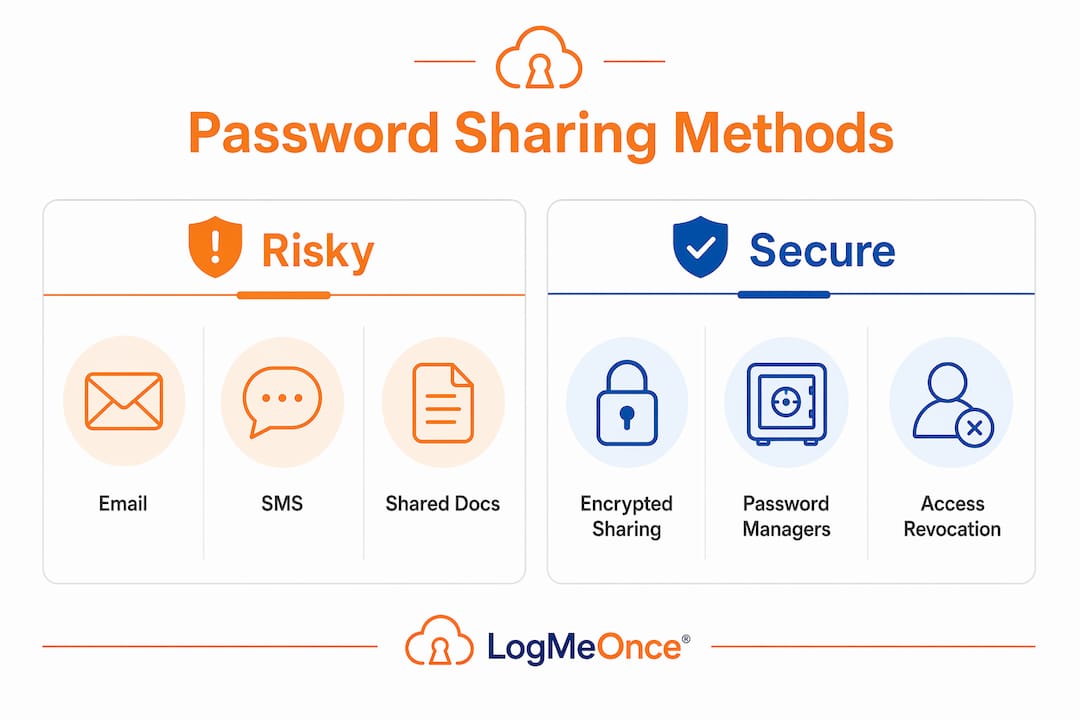
Insecure methods include sending passwords via SMS, email, Slack, or writing them in shared documents. These channels store credentials in plaintext on servers outside your control, accessible to platform administrators, subpoenaed by courts, and exposed in platform-level breaches. Messaging apps like WhatsApp and Telegram encrypt messages in transit, but message histories sitting on a device or cloud backup are not protected at rest in the same way an encrypted vault is.
Secure methods use enterprise password managers that share encrypted credential references rather than the passwords themselves. The recipient gains access to the account without ever seeing the raw password. Features like audit trails, time-limited access, and role-based permissions mean you can revoke access instantly and know exactly who used a credential and when.
| Method | Encryption | Audit trail | Revocable | Risk level |
|---|---|---|---|---|
| Email or SMS | None | No | No | Critical |
| Messaging apps | In transit only | No | No | High |
| Shared spreadsheet | None | No | No | Critical |
| Enterprise password manager | End-to-end | Yes | Yes | Low |
| Privileged Access Management (PAM) | End-to-end | Full session recording | Yes | Minimal |
NIST SP 800-63B mandates removing forced password rotations and complexity rules, focusing instead on length, breach screening, and MFA integration. This guidance shifts the burden from memorability to verifiability. Password managers align directly with this standard by generating long, unique credentials and checking them against known breach databases on creation.
For businesses managing privileged accounts, standard password managers are not enough. Privileged Access Management tools add session recording, automated credential rotation, and detailed auditing that standard managers cannot provide. Any organization handling sensitive customer data or regulated information should treat PAM as a baseline requirement, not an optional upgrade.
Pro Tip: Never share a password directly. Use a password manager’s built-in sharing feature so the recipient accesses the account without seeing the credential. This keeps the password revocable and auditable at all times.
What roles do password managers and 2FA play in preventing breaches?
Password managers solve the root cause of most credential-related breaches: password reuse. By generating and storing a unique, complex password for every account, they eliminate the chain reaction that turns one leaked credential into ten compromised accounts. Password managers provide encrypted vaults, breach alert integrations, and support for strong passwords that no human could memorize or type consistently.

Two-factor authentication operates as the second line of defense when a password is already compromised. The UK’s NCSC states that 2SV is the most important first-line defense against account takeover, even when a password has been stolen. This means 2FA does not just add security. It fundamentally changes the economics of an attack by requiring physical access to a device or biometric confirmation.
However, 2FA is not foolproof. The 2026 Dashlane breach demonstrated that attackers can bypass 2FA through rapid automated guessing of time-based codes. Dashlane’s encryption limited the damage because stolen vaults remained unreadable without the master password. This outcome underscores a critical lesson: 2FA and encryption must work together, not as standalone controls.
Here is how to layer these defenses effectively:
- Use a password manager to generate a unique password of at least 16 characters for every account
- Enable 2FA on the password manager itself using an authenticator app, not SMS, since SMS codes are vulnerable to SIM-swapping attacks
- Set a strong master password that is a passphrase of four or more unrelated words, screened against known breach lists
- Enable breach monitoring alerts so you are notified the moment a stored credential appears in a known data leak
- For business accounts, require hardware security keys such as YubiKey for privileged access, since physical keys cannot be remotely intercepted
Pro Tip: Avoid using SMS as your 2FA method for high-value accounts. Authenticator apps like Google Authenticator or hardware keys provide significantly stronger protection against SIM-swap and brute-force attacks.
Password managers must also implement modern key derivation algorithms like Argon2 to slow down offline cracking attempts after a breach. When evaluating a password manager, check whether the vendor publishes its cryptographic architecture. Transparency here is a signal of trustworthiness. Learn more about password manager security before committing to a platform.
Best practices for individuals and businesses to prevent breaches
Preventing data breaches tied to password sharing requires both technical controls and behavioral change. Technology without policy fails. Policy without enforcement fails faster.
For individuals:
- Use a password manager to create and store a unique password for every account, eliminating reuse entirely
- Enable 2FA on every account that supports it, prioritizing email, banking, and cloud storage accounts
- Never share passwords through email, SMS, or messaging apps. Use a manager’s encrypted sharing feature instead
- Check your credentials against breach databases using services like Have I Been Pwned, and change any compromised passwords immediately
- Understand the dangers of weak passwords before setting a master password, since a weak master credential undermines every other protection
For businesses:
The NCSC recommends using unique passwords per account and enabling password manager integration to ease credential management at scale. For teams, this means deploying an enterprise password manager with role-based access, audit logging, and encrypted credential sharing built in.
| Recommendation | Who it applies to | Priority |
|---|---|---|
| Deploy enterprise password manager | All businesses | Critical |
| Enable 2FA on all accounts | Individuals and businesses | Critical |
| Screen passwords against breach databases | All users | High |
| Implement PAM for privileged accounts | Enterprises and regulated industries | High |
| Train staff on credential sharing risks | All businesses | High |
| Review password policies against NIST SP 800-63B | IT and compliance teams | Medium |
Staff training deserves special attention. Most credential-sharing incidents in organizations begin with convenience, not malice. An employee shares a login to help a colleague meet a deadline. That credential then sits in a Slack message, a shared inbox, or a sticky note. A formal policy that explains why encrypted sharing matters, backed by tools that make it easy, removes the friction that drives insecure behavior.
NIST SP 800-63B also requires checking new passwords against known breached password lists. Organizations that integrate this check into their identity systems catch compromised credentials before they become active vulnerabilities, rather than discovering them after a breach.
Key takeaways
Password sharing and data breaches are directly linked: every uncontrolled credential handoff creates an exploitable gap that encryption, 2FA, and access auditing must close together.
| Point | Details |
|---|---|
| Password sharing multiplies attack surface | Each additional credential holder adds a new potential point of compromise or leakage. |
| 2FA is necessary but not sufficient | The 2026 Dashlane breach showed 2FA can be bypassed; encryption and strong master passwords must back it up. |
| Secure sharing requires a password manager | Encrypted sharing with audit trails and revocation controls eliminates the risks of plaintext credential handoffs. |
| NIST SP 800-63B sets the standard | Breach-list screening, long passphrases, and MFA integration are the current baseline for credential security. |
| Businesses need PAM for privileged accounts | Standard password managers lack the session recording and automated rotation that regulated environments require. |
Why password sharing is still the most underestimated risk in cybersecurity
I have spent years watching organizations invest heavily in firewalls, endpoint detection, and threat intelligence platforms, then lose sensitive data because someone shared a login over Slack. The technical controls were solid. The human behavior was not.
Password sharing persists because it feels harmless. Sharing a streaming service password with a family member and sharing a database admin credential with a colleague feel like the same act. They are not. The consequences differ by orders of magnitude, but the habit is identical. That cognitive gap is where most breaches begin.
What I find most telling about the 2026 Dashlane incident is not that it happened. It is that the damage was contained precisely because the encryption held. Dashlane’s architecture meant that stolen vaults were useless without the master password. That is the correct design philosophy: assume the perimeter will fail, and build so that failure is survivable. Most organizations have not applied that logic to credential sharing at all.
The cultural shift required here is harder than any technical deployment. People need to understand that a shared password is not just a convenience. It is a shared liability. Until that framing becomes standard in security training, no amount of tooling will close the gap completely. The organizations that get this right combine strong tools with clear, enforced policies and regular training that treats credential hygiene as a professional standard, not an IT suggestion.
Explore what is 2FA if your team has not yet standardized on authenticator-based verification. It is the single highest-return security investment most organizations have not fully deployed.
— Mike
Protect your accounts with LogMeOnce
LogMeOnce gives individuals and businesses the tools to eliminate the risks that come from uncontrolled credential sharing. Its cybersecurity platform combines encrypted password management, passwordless MFA, dark web monitoring, and single sign-on into one system designed for both personal users and enterprise teams. Encrypted credential sharing with full audit trails means your team never needs to send a password through email or chat again. LogMeOnce password management also includes breach alerts and 2FA enforcement, so every account stays protected even when credentials are shared across roles or departments. Start a free trial and see how much of your current exposure disappears within the first week.
FAQ
What is the connection between password sharing and data breaches?
Password sharing exposes credentials to unauthorized users, increasing the risk of credential stuffing, unauthorized access, and dark web exposure. Each additional person holding a password creates a new potential point of compromise.
How does credential stuffing work?
Credential stuffing uses automated scripts to test stolen username and password combinations across multiple platforms. It succeeds because people reuse passwords, meaning one leaked credential can unlock dozens of accounts.
Is two-factor authentication enough to prevent breaches from shared passwords?
2FA significantly reduces breach risk but is not a complete defense on its own. The 2026 Dashlane incident showed attackers can brute-force time-based 2FA codes, making strong master passwords and encryption equally critical.
What is the safest way to share a password with a colleague?
Use a password manager’s built-in encrypted sharing feature, which grants access without revealing the raw credential. This keeps the password revocable, auditable, and protected from plaintext exposure in messaging or email logs.
What does NIST recommend for password security in 2026?
NIST SP 800-63B recommends screening passwords against known breach databases, using long passphrases instead of complex short passwords, eliminating forced rotation unless a breach is confirmed, and integrating MFA across all systems.
Recommended
- The Best Password Manager Tips You Need to Know
- Password Reuse: Convenient, But Dangerous – LogMeOnce
- What Should You Do After a Password Breach? – LogMeOnce


