


 Password Manager
 Identity Theft Protection

 Team / Business
 Enterprise
 Government
 MSP
MSP


An OTP is a single-use possession factor inside MFA: pair it with a password and you have two-factor authentication; use TOTP or a hardware token rather than SMS wherever the risk warrants it. RFC 6238 defines the time-based algorithm most authenticator apps implement today, and NIST SP 800-63B explicitly discourages SMS delivery for high-assurance authentication. Logmeonce supports TOTP-based MFA as part of its identity protection platform.
Key facts to anchor your decisions:
- Six-digit TOTP codes carry roughly a 1-in-1,000,000 guessability window per code — strong against brute force, weak against real-time phishing.
- Standard code lifetime: 30–120 seconds depending on configuration. A 30-second expiry is the recommended default per RFC 6238.
- SMS OTP is a possession factor, but a fragile one. Treat it as legacy for anything beyond low-risk flows.
Immediate action: deploy TOTP authenticator apps or hardware tokens for all privileged access; restrict SMS OTP to low-risk flows with compensating controls; audit your current MFA channels this week.
How OTP multi-factor authentication works under the hood
A one-time password is exactly what the name says: a credential valid for a single login or transaction, then dead. That single-use property is what separates it from a static password, which stays valid until someone changes or steals it.
The lifecycle has six steps. First, provisioning: the server generates a shared secret (for TOTP/HOTP) or prepares a delivery mechanism (for SMS/email). Second, generation: the client or server computes the code using the shared secret and a moving factor. Third, delivery: for out-of-band channels like SMS or email, the server sends the code to the user’s registered device. Fourth, entry: the user types the code into the authentication prompt. Fifth, validation: the server recomputes the expected code and compares; on match, it grants access. Sixth, invalidation: the code is immediately marked used and cannot be replayed.

Industry norms set 6-digit codes as the standard length, with expiry windows commonly set to 30 seconds, and configurable up to 120 seconds for time-based methods. That TTL is not arbitrary. A 30-second window is short enough to limit real-time relay attacks while long enough that a user with average typing speed can enter the code without a race against the clock. Longer windows (up to 120 seconds) are sometimes used in enterprise deployments to accommodate users on slow connections or shared workstations, but every extra second widens the interception window.
HOTP vs. TOTP: which algorithm fits your deployment?
Both HOTP and TOTP derive codes from an HMAC operation over a shared secret and a moving factor. The difference is what that moving factor is.
HOTP (HMAC-based OTP, RFC 4226) uses an event counter. Each time the user requests a code, the counter increments. The server tracks its own counter and accepts codes within a small look-ahead window to handle counter drift. HOTP codes do not expire by time, which makes them useful for hardware tokens that lack a real-time clock, offline scenarios, or situations where the user may generate several codes before connecting to the server.
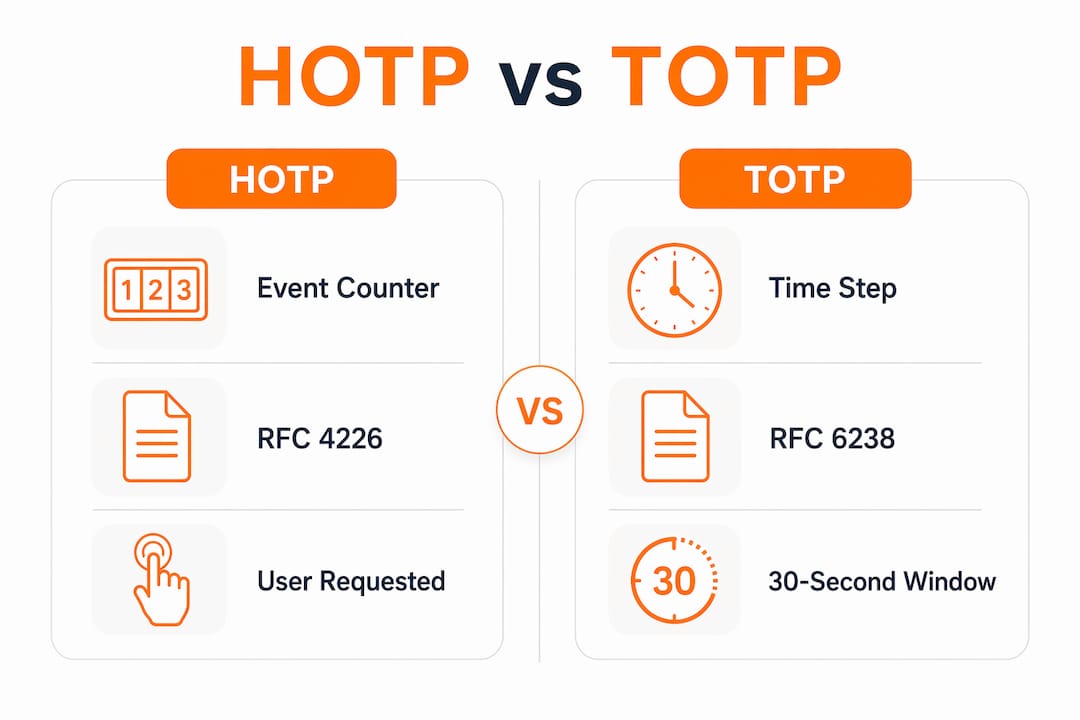
TOTP (RFC 6238) replaces the counter with a time step, typically 30 seconds. Both client and server compute the same code independently as long as their clocks are synchronized. RFC 6238 recommends accepting at most one adjacent time step on either side to handle clock skew, which means a server may accept a code from the previous or next 30-second window. Accepting more than one adjacent step widens the attack surface and should be avoided.
| Attribute | HOTP (RFC 4226) | TOTP (RFC 6238) |
|---|---|---|
| Moving factor | Event counter | Unix time / time step |
| Code expiry | No time limit | 30 seconds (default, configurable up to 120 seconds in some environments) |
| Clock dependency | None | Requires synchronized clocks |
| Resynchronization | Counter look-ahead | Accept ±1 adjacent step |
| Best fit | Offline hardware tokens | Authenticator apps, cloud MFA |
| Primary risk | Counter desync; codes valid until used | Clock drift; shared-secret exposure |
Hash algorithm choices matter here. RFC 6238 permits HMAC-SHA1 (the default), HMAC-SHA-256, and HMAC-SHA-512. Most authenticator apps still use SHA-1 for compatibility, but SHA-256 or SHA-512 is preferable for new deployments.
Key operational notes:
- Store shared secrets in an HSM or encrypted key vault. If a database breach exposes TOTP seeds, an attacker can generate valid codes indefinitely without ever phishing a user.
- Log detected clock drifts to inform resynchronization decisions rather than silently widening the acceptance window.
- Enforce single-use: once a TOTP code validates, mark it consumed for that time step even if the window has not expired.
What delivery channel you choose changes your threat model entirely
The algorithm is only half the story. How the code reaches the user determines which attacks are viable.
| Channel | Threat vectors | Risk level |
|---|---|---|
| SMS / voice | SIM swap, SS7 interception, number porting | Weak |
| Email OTP | Account compromise, phishing, server-side interception | Weak–Acceptable |
| TOTP authenticator app | Device malware, seed exfiltration at provisioning | Acceptable |
| Push notification | Device compromise, push fatigue/MFA bombing | Acceptable |
| Hardware token (OATH HOTP/TOTP) | Physical theft, seed exfiltration at manufacture | Strong |
| FIDO2 / security key | Physical theft (no remote attack surface) | Strongest |
SMS OTP is the weakest delivery channel in common use. SS7 routing weaknesses allow a motivated attacker to intercept messages at the carrier level without touching the target’s device. SIM swap attacks — where an attacker convinces a carrier to port a victim’s number — require no technical sophistication and have been used to compromise high-value accounts repeatedly. NIST SP 800-63B discourages SMS for out-of-band authentication in high-risk contexts for exactly these reasons.
Adversary-in-the-middle (AiTM) attacks are the threat that cuts across every software-based OTP channel. A reverse proxy phishing kit sits between the user and the real site, relaying credentials and OTP codes in real time. Because OTPs are not domain-bound, the attacker’s proxy receives a valid session token before the user even realizes something is wrong. This is the structural weakness that FIDO2/WebAuthn solves.
Compensating controls for channels you cannot immediately replace: bind OTP delivery to a registered device identifier, add device health checks (MDM enrollment, OS patch level), and layer adaptive authentication signals (IP reputation, geolocation velocity, behavioral baselines) to trigger step-up challenges when risk is elevated.

Advantages and disadvantages of OTP-based MFA
OTPs are not a monolith. The risk profile of a TOTP app is meaningfully different from SMS, and both differ from a hardware token. That said, some properties are common across all OTP types.
Advantages:
- Eliminates credential-stuffing risk for the second factor: a stolen static password alone is not enough to authenticate.
- Broad compatibility: TOTP is supported by virtually every major identity provider, VPN gateway, and cloud platform.
- No secret for the user to memorize: the code is ephemeral and generated on demand.
- Low friction for TOTP apps once enrolled: users open an app, read a 6-digit code, and type it. The whole interaction takes under 10 seconds.
- Hardware tokens add a physical possession requirement that is hard to replicate remotely.
Disadvantages:
- Not inherently phishing-resistant. A convincing fake login page can relay a TOTP code in real time before it expires.
- SMS OTP is particularly exposed to SIM swap and SS7 attacks, which security guidance has flagged for years.
- Shared-secret risk: if the TOTP seed is exfiltrated from the server, the attacker does not need the user’s device at all.
- Recovery flows are a common weak point. Security questions or email-based recovery can undermine a strong OTP policy entirely.
- Clock drift and device loss create real support burden, especially at scale.
Where OTP fits well: consumer-facing logins, payment confirmation, low- to mid-risk internal systems, and any context where FIDO2 adoption is not yet feasible. Where to prefer alternatives: privileged admin access, executive accounts, systems handling regulated data, and any environment that has seen phishing or AiTM incidents.
OTP, 2FA, and MFA: getting the terminology right
These three terms are used interchangeably in marketing copy, but they mean different things in security policy.
Multi-factor authentication requires two or more independent factor categories: something you know, something you have, or something you are. Two instances of the same category do not qualify. A password plus a security question is two knowledge factors — that is not MFA regardless of what a vendor calls it.
Two-factor authentication (2FA) is a specific case of MFA using exactly two factors from two different categories. An OTP paired with a password is 2FA: the password is a knowledge factor, the OTP is a possession factor. Add a biometric and you have three-factor authentication.
Where OTP fits: it is almost always a possession factor (you possess the device that generates or receives the code). The exception is an OTP delivered to an email account where the attacker already has the password — in that scenario, the OTP and the password are effectively the same factor because compromising one compromises both.
A common compliance mistake is treating any second step as MFA. Requiring a PIN plus an SMS code sent to the same phone number the PIN was set up on is not meaningfully stronger than a single factor if the attacker controls the phone. Policy language should specify independent factor categories, not just “two steps.”
Pro Tip: When writing MFA policy, reference the NIST SP 800-63B definition of factor categories explicitly. It forces reviewers to evaluate whether proposed factors are genuinely independent, which catches weak implementations before they reach production.
Standards and parameters every implementer should know
Getting the parameters right matters as much as choosing the right algorithm. Here is a numbered checklist tied to the relevant standards.
- Follow RFC 4226 for HOTP and RFC 6238 for TOTP. These are the IETF standards that define the algorithms. Any library or platform claiming OATH compliance should implement them correctly; verify with test vectors from the RFCs before deploying.
- Set code length to 6 digits minimum; 8 digits for high-assurance contexts. Six digits is the industry standard; 8 digits reduces guessability further at modest usability cost.
- Use a 30-second time step for TOTP. RFC 6238 recommends 30 seconds as the standard default; expiry windows up to 120 seconds exist in some configurations but widen the interception window.
- Accept at most one adjacent time step for clock skew. RFC 6238 is explicit on this: larger windows increase attack surface. Log detected drifts rather than silently expanding the window.
- Enforce single-use invalidation. Once a code validates, mark it consumed for that time step. Replay within the same window must fail.
- Set strict attempt limits. OWASP recommends treating OTPs with password-like hygiene: rate-limit attempts, lock after repeated failures, and alert on anomalous patterns.
- Never log OTP values. Logs are often less protected than the authentication system itself. An OTP in a log file is an OTP waiting to be replayed.
- Store TOTP secrets in an HSM or encrypted key vault. A database breach that exposes seeds lets an attacker generate valid codes without any user interaction.
- Review NIST SP 800-63B for SMS guidance. The guidance discourages SMS as an out-of-band authenticator for high-assurance authentication levels. Document your rationale if you keep SMS for any user segment.
Deployment best practices that actually hold up in production
Policy decisions before you touch a single config file: define which user segments require MFA enforcement (start with admins and privileged roles), which channels are permitted for each segment, and what the recovery path looks like. Recovery is where most OTP deployments leak security — a weak account recovery flow can bypass the strongest second factor.
Operational controls to build in from day one:
- Rate-limit OTP attempts at the application layer, not just the identity provider. Defense in depth applies here.
- Implement adaptive authentication: trigger step-up challenges based on IP reputation, device health, geolocation velocity, and time-of-day anomalies. Risk-based triggers reduce friction for normal logins while catching suspicious ones.
- Monitor for SIM-swap indicators: sudden carrier changes, number porting requests, or authentication failures from new devices for SMS-enrolled users.
- Invalidate OTPs immediately on use, not just on expiry.
- Audit mobile device security posture for any user receiving TOTP codes on a phone, since a compromised device negates the possession factor.
Enrollment and provisioning hygiene: QR code seeds for TOTP should be displayed once and never stored as an image. Confirm enrollment by requiring the user to enter a valid code before activating the factor. Provide backup codes (single-use, stored hashed) for device loss, but treat them as emergency access, not a routine fallback.
Pro Tip: Document your recovery path as a threat model, not just a support flow. Ask: “If an attacker controls the user’s phone number and email, can they still recover the account?” If the answer is yes, your OTP policy has a hole.
When to migrate away from OTPs toward phishing-resistant authentication
OTPs are not the end state for high-risk access. FIDO2/WebAuthn binds credentials to the origin domain, which means a phishing proxy cannot relay them — the browser refuses to authenticate against a domain that does not match the registered credential. That structural property is what makes OTPs vulnerable to AiTM attacks and what FIDO2 eliminates.
Criteria that should trigger a migration evaluation:
- Any privileged or admin account currently protected only by password plus SMS OTP.
- A documented phishing incident or AiTM attempt against your environment.
- Regulatory or compliance requirements that reference phishing-resistant authentication (FedRAMP High, CISA guidance, Executive Order 14028 for federal agencies).
- SIM-swap incidents affecting users in your organization.
- Expansion of remote access to sensitive systems where device-bound credentials are feasible.
A practical pilot plan:
- Scope the pilot to a small group of IT admins (10–25 users).
- Provision FIDO2 security keys or enable passkeys on supported platforms.
- Run parallel opt-in: users can authenticate with either TOTP or the new method during the pilot.
- Track authentication success rates, fallback frequency, and support ticket volume.
- Design a secure fallback for lost keys (a second registered key, not a return to SMS).
- After 30–60 days, review metrics and expand to the next user segment.
Interoperability is a real concern. Not every VPN client, legacy application, or cloud service supports FIDO2 natively. For systems that cannot support hardware-backed authentication yet, TOTP remains the acceptable interim choice. The goal is to eliminate SMS OTP first, then migrate privileged access to FIDO2, then address the broader user population as platform support matures.
Key Takeaways
OTP-based MFA reduces credential-stuffing risk significantly, but TOTP or hardware tokens must replace SMS for any high-value authentication flow to avoid SIM-swap and AiTM exposure.
| Point | Details |
|---|---|
| TOTP is the secure default | Use RFC 6238 TOTP with a 30-second time step (configurable up to 120 seconds if needed); accept at most one adjacent step for clock skew. |
| SMS OTP is legacy | SIM swap and SS7 attacks make SMS a weak possession factor; restrict it to low-risk flows only. |
| Protect server-side secrets | Store TOTP seeds in an HSM or encrypted vault; a leaked seed lets attackers generate valid codes indefinitely. |
| OTP alone is not MFA | OTP paired with a password is 2FA; MFA requires two or more independent factor categories per NIST SP 800-63B. |
| Logmeonce supports the full stack | Logmeonce provides TOTP-based MFA, identity protection, and passwordless options to cover both current OTP deployments and phishing-resistant migration paths. |
The real role of OTPs in a layered security strategy
The security industry has a habit of declaring technologies dead before organizations are actually ready to replace them. OTPs are not dead. They are, however, frequently misdeployed.
The mistake most teams make is treating OTP as the destination rather than a waypoint. You add TOTP to your VPN, check the MFA box on your compliance audit, and move on. What you have actually done is raise the bar against opportunistic attackers, which is real and meaningful progress. What you have not done is protected against a targeted adversary running an AiTM kit, and that gap matters more every year as phishing toolkits become commoditized.
The practical path forward is not to rip out OTPs tomorrow. It is to layer them correctly. Combine TOTP with device posture checks and adaptive authentication signals so that a valid code from an unmanaged device in an unusual location triggers a step-up challenge rather than silent access. Treat SMS as a legacy channel with a documented sunset date, not a permanent option. Move your highest-risk users — admins, executives, anyone with access to production infrastructure — to hardware-backed or FIDO2 methods on a defined timeline.
OTPs will remain part of the authentication stack for most organizations for years, simply because of the breadth of systems that support them and the cost of replacing them everywhere at once. The goal is to use them where they are appropriate, protect them correctly, and have a clear plan for where they are not enough.
Logmeonce makes the transition from OTP to phishing-resistant MFA practical
Most organizations are not starting from zero. They have SMS OTP on some systems, TOTP on others, and a handful of legacy apps that barely support any second factor. The real challenge is not understanding what to do — it is having the tooling to do it without a six-month integration project.

Logmeonce covers the full range: TOTP-based multi-factor authentication, passwordless login, single sign-on, and identity protection with dark web monitoring. For teams ready to move privileged access off SMS OTP, Logmeonce provides the MFA policy controls and adaptive authentication triggers to enforce stronger factors for high-risk user segments while keeping friction low for everyone else. The cybersecurity platform also handles password management and encrypted cloud storage, so you are not stitching together separate tools to cover the identity stack. Start by auditing your current MFA channels inside Logmeonce, then use the platform’s policy controls to enforce TOTP or hardware-backed authentication where it matters most.
Useful sources for implementers
- RFC 4226 (HOTP) — The IETF standard defining the HMAC-based OTP algorithm; required reading before implementing any counter-based token.
- RFC 6238 (TOTP) — Extends RFC 4226 with time-based moving factors; defines the 30-second default step, adjacent-window policy, and hash algorithm options.
- NIST SP 800-63B — The authoritative U.S. federal guidance on authenticator assurance levels; covers SMS deprecation rationale and requirements for each assurance level.
- OWASP MFA Cheat Sheet — Practical implementation checklist covering attempt limits, secret storage, logging hygiene, and TOTP-specific handling recommendations.
- MDN OTP Security Reference — Developer-focused documentation on OTP mechanics, delivery channels, and the AiTM vulnerability that makes domain-binding critical.
- FTC Two-Factor Authentication Guide — Plain-language overview of factor categories and channel options; useful for user-facing training materials and policy documentation.
- Logmeonce MFA Resources — Product-specific guidance on deploying TOTP and passwordless authentication within the Logmeonce platform.

Nicole’s, journey in the tech industry is marked by a passion for learning and an unwavering commitment to excellence. Whether it’s delving into the latest software developments or exploring innovative computing solutions, Nicole’s expertise is evident in her insightful and informative writing style. Her ability to connect with readers through her words makes her a valuable asset in any technical communication endeavor.


