


 Password Manager
 Identity Theft Protection

 Team / Business
 Enterprise
 Government
 MSP
MSP


TL;DR:
- Insider threats cause significant financial damage and are difficult to detect because insiders operate within legitimate access boundaries. Implementing behavioral analytics, machine learning, and privacy-aware policies can improve detection, but organizational infrastructure and trust are crucial for success. Continuous, adaptive systems that integrate technical controls with psychological profiling and clear communication are essential to effectively mitigate insider risks.
Insider threats are among the most financially damaging and hardest to catch security risks any organization faces. Average losses hit $17.4 million per incident, yet many security teams still treat insider risk as a secondary concern behind external attackers. The reality is that insiders operate within legitimate access boundaries, which makes their actions appear normal without the right context. This article walks you through how to detect insider threats using behavioral analytics, machine learning, psychological profiling, and structured detection programs built specifically for corporate environments.
Key Takeaways
| Point | Details |
|---|---|
| Behavior analytics are non-negotiable | UEBA tools flag anomalies when user activity deviates more than 3 standard deviations from their baseline. |
| Intent matters as much as activity | Analyzing communication sentiment separates malicious actors from frustrated employees who make mistakes. |
| Feature engineering beats raw data | Deriving semantic signals like after-hours USB use improves model accuracy and reduces false positives significantly. |
| Forecasting adds a 7-day advantage | Behavioral drift analysis can predict insider risk up to a week before a breach occurs. |
| Surveillance without transparency backfires | Clear policies and employee communication are required to maintain trust while monitoring for insider threats. |
Building the foundation for detection
Before any detection tool delivers reliable results, you need the right organizational infrastructure in place. Without it, even the most advanced system generates noise instead of signal.

Start with log completeness. You need identity logs, endpoint telemetry, network traffic data, and application access records feeding into a centralized location. Gaps in any of these create blind spots that malicious insiders can exploit. The same applies to your access control documentation: you cannot detect abnormal privilege use if you have never mapped what normal looks like for each role.
Security policies must be clearly defined and communicated before monitoring begins. Employees should understand what constitutes acceptable use, what systems are monitored, and what the consequences of policy violations are. This is not just a legal requirement in many jurisdictions. Transparent policies and communication are what prevent a detection program from eroding the organizational trust it depends on.
Key data sources to collect and integrate:
- Identity and access management logs (login times, privilege escalations, failed authentications)
- Endpoint activity logs (USB device connections, file transfers, print jobs)
- Network flow data (data volumes, external destinations, off-hours traffic spikes)
- Email and collaboration platform metadata (external forwarding, bulk downloads, attachment behavior)
- Application logs tied to sensitive systems (ERP, HR platforms, source code repositories)
Pro Tip: Set your baseline collection period to at least 90 days before enabling anomaly detection. Shorter windows produce baselines that flag seasonal or project-driven behavior as suspicious.
Core insider threat detection methods
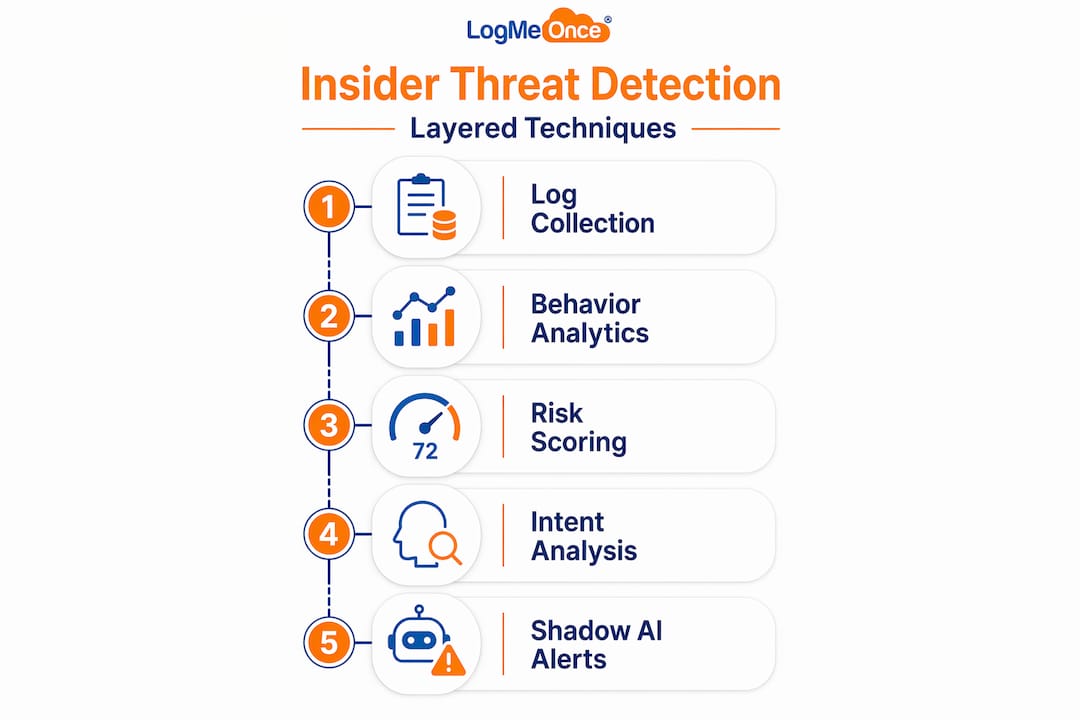
Understanding how to spot insider threats requires layering multiple detection techniques rather than relying on any single approach. Each method catches a different class of risk.
UEBA and anomaly scoring
User and Entity Behavior Analytics is the current foundation of most enterprise insider threat programs. UEBA flags anomalies when activity exceeds the peer group average by 3 standard deviations. What makes this useful is the comparison layer: it is not just your historical baseline but also how your behavior compares to colleagues in similar roles. A finance analyst downloading 400MB of customer records is suspicious. The same analyst downloading that much data every quarter before an audit cycle is not.
UEBA reduces alert fatigue by prioritizing pattern-based, high-confidence anomalies instead of rule-triggered alerts. This matters operationally. Teams drowning in low-fidelity alerts stop investigating them, and that is exactly the gap insider threats exploit.
Machine learning risk scoring
Modern insider threat detection methods go beyond threshold rules. ML models assign dynamic risk scores to users based on feature combinations, updating continuously as behavior evolves. Behavioral drift from baseline activity can forecast breach risk up to 7 days in advance, giving security teams time to intervene before data leaves the organization.
The key distinction between drift-based models and traditional rule-based approaches is that drift detection identifies gradual behavioral change over time rather than isolated anomalies. An insider planning exfiltration rarely acts in a single dramatic event. The pattern builds gradually: more frequent late-night logins, incremental increases in external email forwarding, subtle changes in system access frequency.
Psychological profiling for intent analysis
Intent analysis is where identifying insider threats gets genuinely difficult. Two employees can perform nearly identical actions with completely different motivations. Analyzing communication tone and sentiment in emails, chat logs, and support tickets helps distinguish a disgruntled employee planning exfiltration from a frustrated one venting to a colleague.
Advanced frameworks incorporate the OCEAN personality model (Openness, Conscientiousness, Extraversion, Agreeableness, Neuroticism) to cluster users into behavioral risk profiles. This is not about labeling people. It is about understanding which intervention strategies work for which psychological profiles. Matching interventions to user profiles improves prevention outcomes by 18% compared to applying the same response to every flagged user.
Detecting Shadow AI risks
Unauthorized AI tool use is now the third most common cause of non-malicious insider data loss. Employees uploading sensitive documents to consumer AI tools, using unapproved code generators, or feeding proprietary data into public language models all represent insider threat vectors that did not exist three years ago. Detection requires monitoring for data uploads to uncategorized or newly registered domains, not just known exfiltration destinations.
Here is a comparison of the primary insider threat detection methods:
| Method | Detection strength | Weakness | Best used for |
|---|---|---|---|
| Rule-based monitoring | High for known patterns | Misses novel behavior | Compliance violations |
| UEBA anomaly scoring | High for behavioral drift | Requires baseline period | Privileged user monitoring |
| ML risk scoring | Predicts emerging threats | Needs quality training data | High-risk role populations |
| Intent and sentiment analysis | Catches motivation early | Privacy and legal constraints | Disgruntlement signals |
| Shadow AI monitoring | Catches non-malicious loss | Domain categorization lag | Data exfiltration to AI tools |
Pro Tip: Run UEBA alongside intent analysis rather than sequentially. A medium-confidence behavioral anomaly combined with negative communication sentiment is a far stronger signal than either indicator alone.
Implementing detection step by step
Rolling out an insider threat detection program without a structured approach leads to tool sprawl and analyst burnout. Follow this sequence:
-
Define your crown jewels. Catalog the data and systems whose compromise would cause the most harm: intellectual property, customer PII, financial records, source code. Detection resources should concentrate on access to these assets first.
-
Engineer semantic features from raw logs. Do not feed raw data directly into detection models. Forty semantic features engineered from nearly 900 raw features significantly outperform models trained on unprocessed logs. Build indicators like "after_hours_usb_connections
,external_bcc_count,privilege_escalation_rate, andweekend_login_frequency`. -
Establish per-user and per-role behavioral baselines. Calculate baselines across a minimum 90-day window, segmented by role, department, and access tier. Do not compare a developer’s repository access patterns to an HR analyst’s.
-
Integrate communication analysis. Connect your detection platform to email and collaboration metadata. Flag users whose communication sentiment scores shift significantly over a two-week window, especially in combination with elevated access anomalies.
-
Automate alert triage with SOAR integration. Route high-confidence alerts to your Security Orchestration, Automation and Response platform for immediate case creation. Medium-confidence alerts should trigger enrichment workflows that pull in additional context before reaching an analyst.
-
Tune sensitivity quarterly. Track your false positive rate weekly during the first three months. Adjust feature weights and thresholds based on what analysts are closing as benign. The goal is a precision rate above 80% on escalated alerts.
Detection metrics to track from day one:
| Metric | Target | Review frequency |
|---|---|---|
| Alert precision rate | Above 80% | Weekly (first quarter) |
| Mean time to escalate | Under 4 hours | Weekly |
| False positive closure rate | Below 20% | Monthly |
| Behavioral drift detection lead time | 5 to 7 days pre-incident | Quarterly |
| Escalation prevention rate | Trending upward | Quarterly |
Common pitfalls in detecting insider threats
Even well-funded detection programs fail for predictable reasons. Knowing these in advance is the difference between a program that works and one that creates liability without results.
The most common failure mode is alert fatigue. When analysts receive hundreds of low-confidence alerts daily, they start closing tickets without investigation. This is not a personnel problem. It is a tuning problem. UEBA’s value comes specifically from reducing this noise, but only when it is configured against accurate, role-segmented baselines.
Single-day impulsive insider events are genuinely hard to catch with behavioral analytics. An employee who decides on a Monday morning to exfiltrate data and does it that afternoon leaves almost no drift signature. This is where security policies and monitoring layers like DLP rules and egress controls matter independently of behavioral models.
Privacy and cultural concerns are real constraints, not just compliance checkboxes. Surveillance that employees experience as intrusive and opaque damages retention and creates the very resentment that elevates insider risk.
“Improperly implemented insider threat detection can erode employee trust. Transparent policies and open communication are what keep a detection program from becoming the threat it was designed to prevent.”
Other pitfalls to monitor actively:
- Treating all insider threats as malicious. The majority involve negligence or policy ignorance, not intent.
- Failing to update baselines after organizational changes like mergers, layoffs, or role shifts.
- Relying solely on technical controls while ignoring HR signals like performance issues or access disputes.
- Underestimating AI-powered threat actors who can shrink your defense window from months to hours.
Measuring whether detection actually works
A detection program without measurement is not a program. It is a hope.
The most useful metrics for evaluating insider threat detection effectiveness go beyond simple alert counts. Track ROC-AUC scores on your ML models to measure how well they separate true threats from benign anomalies. Monitor your escalation prevention rate: how often does detection lead to intervention before data leaves the environment?
Behavioral drift tracking also functions as an early warning system for your program’s health. If your model’s average detection lead time is shrinking from 7 days to 2 days, that is a signal your features are degrading or your population’s behavior has shifted enough to require retraining. Behavioral drift analysis can forecast risk 7 days in advance when the model is performing well, giving you that benchmark to defend.
Pilot programs on known historical incident data are invaluable for calibration. If you have documented past insider incidents, run your current model against that historical data and measure what it would have caught and when.
Pro Tip: Build a “preventability quotient” into your quarterly reports: for each detected incident, document how many days before the event the first anomaly signal appeared. This metric demonstrates program value to leadership more convincingly than raw alert counts.
My take on where insider threat detection is heading
I’ve spent years watching organizations invest heavily in detection tools only to find that the tools outlast the processes supporting them. The pattern I’ve seen most consistently is this: security teams deploy UEBA, get excited about the behavioral data, and then treat every anomaly as equally actionable. Within six months, analysts are exhausted, the program is deprioritized, and the organization is less safe than when it started.
What I’ve learned is that detection without intervention design is incomplete. Knowing that a user is drifting toward risky behavior is only useful if you have a calibrated response ready. That is where psychological profiling earns its place. Not as a way to surveil employees more aggressively, but as a way to respond more precisely and with less collateral damage to morale.
The most significant shift I see coming is the adoption of AI-to-combat-AI strategies. Organizations need ML in security operations not because it is a trend but because threat actors are already using generative AI to accelerate attacks. Your detection program needs to match that speed. Static rules and manual correlation simply cannot.
The organizations that will handle insider threats best over the next five years are the ones that treat detection as a continuous, adaptive system rather than a deployment project with a go-live date. That mindset shift is harder than any technology implementation.
— Mike
Protect your organization with Logmeonce
Behavioral analytics and monitoring strategies are only as strong as the access controls underneath them. If credentials are weak, shared, or unmanaged, insider threat detection starts at a disadvantage.

Logmeonce addresses this gap directly. Its cybersecurity platform integrates AI-based identity protection, passwordless multi-factor authentication, and dark web monitoring into a single solution built for enterprises managing insider risk at scale. Strong credential hygiene removes one of the most exploited vectors in both malicious and negligent insider incidents. Pair that with two-factor authentication enforcement across all privileged accounts, and you close the access layer gaps that allow insiders to operate undetected. Explore how Logmeonce fits into your detection architecture today.
FAQ
What are the first signs of insider threats to watch for?
Early signs of insider threats include after-hours access to sensitive systems, unusual data download volumes, and privilege escalation requests that fall outside normal job duties. Behavioral drift in communication tone is also a documented early indicator.
How do UEBA tools help detect insider threats?
UEBA tools compare current user activity against historical baselines and peer group patterns, flagging anomalies that exceed 3 standard deviations from normal. This approach prioritizes high-confidence alerts and significantly reduces false positive rates compared to rule-based systems.
How far in advance can behavioral AI detect insider risk?
Behavioral AI models using drift analysis can forecast insider breach risk up to 7 days before an incident occurs, giving security teams time to intervene before any data leaves the organization.
How do you balance insider threat monitoring with employee privacy?
Transparent policies, clear communication about what is monitored and why, and limiting data collection to work-related systems are the core practices for balancing detection with privacy. Organizations that communicate their monitoring programs openly report fewer employee trust issues and better program outcomes.
What makes insider threats harder to detect than external attacks?
Insiders already have legitimate access to systems and data, which means their actions do not trigger perimeter defenses. Without behavioral context and intent analysis, their activity looks indistinguishable from normal work, making detection dependent on pattern deviation rather than unauthorized access signals.
Recommended
- Professional IT Security Tips Everyone Can Benefit From
- How to Increase Remote Work Security to Protect Sensitive Data


