


 Password Manager
 Identity Theft Protection

 Team / Business
 Enterprise
 Government
 MSP
MSP


Federated identity solutions let an identity provider vouch for a user’s identity across multiple applications and organizations, so employees or customers sign in once and access dozens of connected systems without a separate password for each. The business payoff is fewer credentials to steal, faster onboarding, and centralized control over who gets access to what. Standards like SAML and OpenID Connect, along with NIST’s assurance guidance, define how that trust actually gets built and verified.
TL;DR:
- Federated identity reduces attack surfaces by ensuring RPs never store or transmit user credentials, enabling easier deactivation and stronger security per trust level.
- Protocol selection depends on context: SAML is legacy-focused for enterprise web apps, while OIDC/OAuth 2.0 suits modern web, mobile, and API integrations, with workload federation handling non-human actors.
- Federation models vary from centralized IdPs to user-controlled wallets and federation proxies, often requiring trust management and pseudonymous identifiers to prevent activity correlation.
- Federation assurance levels from NIST specify increasing cryptographic protections from signed assertions (FAL1) to holder-of-key tokens (FAL3), impacting infrastructure complexity and key management.
- Browser-based FedCM offers privacy benefits and improved user experience by eliminating third-party cookies, but adoption depends on vendor support and gradual integration.
What Is Federated Identity, and How Does the Handshake Work?
Federated identity runs on a simple division of labor. The Identity Provider (IdP) authenticates the user and holds the credentials. The Relying Party (RP), sometimes called the service provider, is the application the user actually wants to reach. A Credential Service Provider (CSP) may sit behind the IdP, managing the actual issuance of credentials, while a federation authority governs the trust agreements that let RPs accept assertions from a given IdP in the first place.
The flow itself is predictable once you’ve seen it once. A user tries to reach an application. The RP redirects them to their IdP. The user authenticates, often with a password plus a second factor. The IdP packages proof of that authentication into a signed assertion or token and sends it back. The RP validates the signature, checks the claims inside, and establishes a session, all without ever seeing the user’s actual password.
What that token looks like depends on the protocol. A SAML assertion is an XML document carrying the user’s identity and attributes, digitally signed by the IdP. An OIDC ID token is a compact JSON Web Token that does the same job for modern web and mobile apps. An OAuth 2.0 access token is a separate artifact used specifically for authorizing API calls, not for asserting identity, a distinction that trips up a surprising number of engineers building their first federated integration.
The security upside is concrete: the RP never stores or transmits the user’s primary credential, which shrinks the attack surface dramatically. If an attacker compromises one downstream application, they don’t get a password they can replay against the IdP or any other connected system. Administration gets simpler too, since deactivating one account at the IdP cuts off access everywhere at once, instead of requiring an admin to hunt through a dozen disconnected systems.
SAML, OIDC, or Workload Federation: Which Protocol Fits?
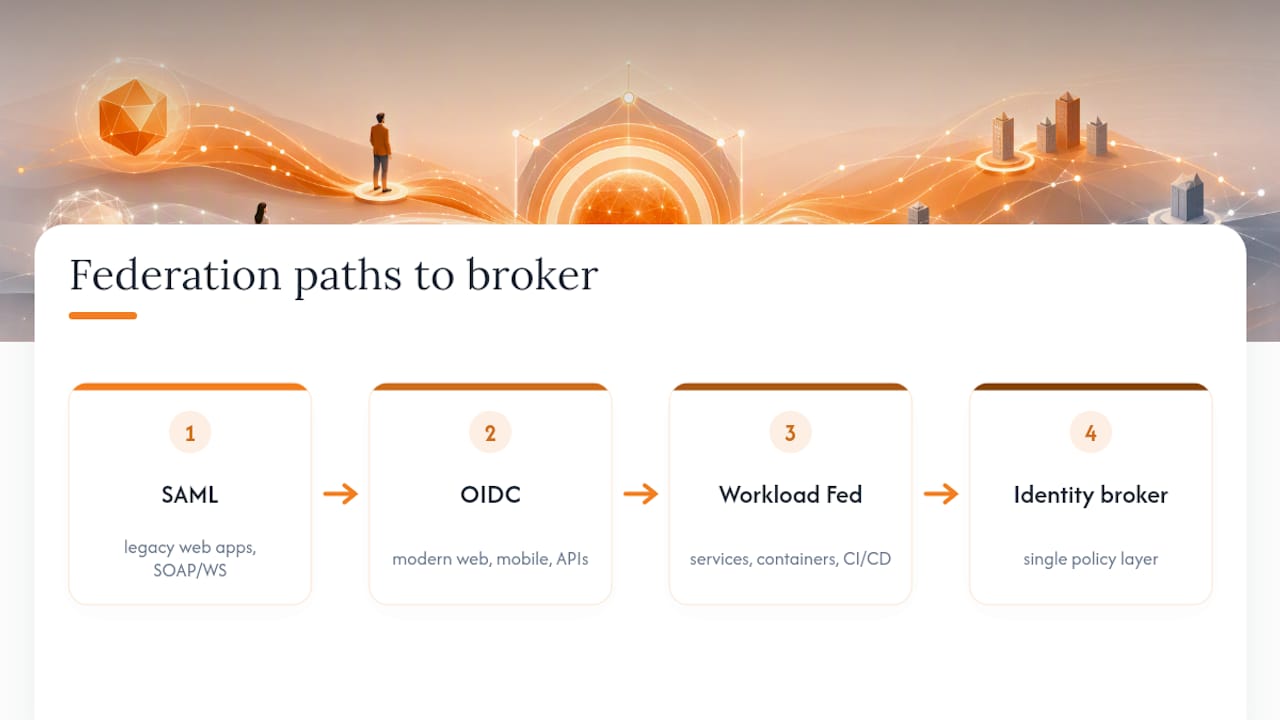
Protocol choice depends almost entirely on what you’re connecting and when it was built. SAML 2.0 remains the default for legacy enterprise web applications, particularly anything with SOAP or WS-* integrations already wired into it, and it still offers granular per-service-provider signing options that some regulated environments require.
OIDC/OAuth 2.0 is the recommended pairing for anything new: modern web apps, mobile clients, single-page applications, and API-first architectures. OIDC handles the “who is this user” question while OAuth 2.0 governs “what can this token access,” and separating those concerns cleanly is a big part of why OIDC has become the default for greenfield builds.
A third category matters increasingly for cloud-native teams: workload identity federation, which issues short-lived tokens to non-human actors, services, containers, and CI/CD pipelines, so they can authenticate to cloud resources without a long-lived secret sitting in a config file somewhere. Microsoft’s federated identity pattern documents this kind of delegation well, showing how claims-based access control lets an external IdP issue tokens that an application transforms into its own internal claims.
Most enterprises don’t get to pick just one. A realistic environment runs SAML for the ten-year-old HR system, OIDC for the new customer portal, and workload federation for the Kubernetes cluster, all at once. An identity broker or gateway that normalizes these disparate protocols into a single policy layer saves architects from rebuilding trust relationships for every new app, and it’s often the difference between a six-month migration and a multi-year one.
Which Federation Model Fits Your Architecture?
Not every organization needs the same trust structure. A general-purpose IdP centralizes authentication for many RPs under one roof, the model most enterprises default to because it’s simpler to operate and audit. Subscriber-controlled wallets flip that model, letting the individual hold and present their own credentials rather than relying on a central authority to broker every transaction, a pattern gaining traction in consumer and government identity schemes where user control matters more than administrative convenience.
Between the IdP and the RP, a federation proxy or broker can sit in the middle, translating protocols, chaining multiple upstream IdPs together, or enforcing a consistent policy layer across systems that were never designed to talk to each other. Open-source projects like Weft ID illustrate the pattern well: aggregating several upstream IdPs behind SAML, OAuth, and SCIM provisioning so downstream apps see one consistent interface instead of a dozen inconsistent ones.
None of this works without formal trust agreement management, the governance layer that defines which federation authority vouches for which IdPs and under what conditions an RP will accept their assertions. NIST also recommends pairwise pseudonymous identifiers, unique subject identifiers issued per RP rather than one identifier reused everywhere, which stops different relying parties from correlating a user’s activity across services they were never meant to share data with.
What Do NIST’s Federation Assurance Levels Actually Require?
NIST SP 800-63C defines federation as the preferred model whenever an IdP and RP sit in different security domains, and it grades the strength of that trust across three Federation Assurance Levels. NIST SP 800-63C lays out FAL1 as the baseline: a signed assertion, no additional cryptographic binding, suitable for lower-risk applications. FAL2 requires the assertion to be encrypted, not just signed, protecting attribute data in transit even if it’s intercepted. FAL3 adds holder-of-key requirements, binding the assertion to a cryptographic key the subscriber controls, so a stolen token alone isn’t enough for an attacker to impersonate the user.
Jumping from FAL1 to FAL3 isn’t a checkbox in an admin console. It changes how your infrastructure handles key management, session binding, and token validation at an architectural level, which is exactly why treating it as “just another setting” tends to blow up implementation timelines.
Regardless of which FAL you target, the assertion itself needs baseline protections: digital signatures to prevent tampering, encryption where attribute data is sensitive, transport security end to end, and replay resistance so a captured token can’t be reused after the fact. Operationally, that means monitoring IdP logs for anomalous assertion issuance, rotating signing keys on a defined schedule, and having an incident response plan ready for the day an IdP itself gets compromised, because when that happens, every RP trusting it inherits the blast radius.
What Is FedCM, and Why Should Architects Care?
Browsers are quietly rewriting how federated sign-in works. FedCM, the Federated Credential Management API, is a browser-mediated approach where the browser itself brokers the exchange between RP and IdP instead of relying on third-party cookies and redirect chains. The W3C FedCM specification defines the accounts, identity assertion, and disconnect endpoints that make this possible, while Chrome’s implementation shows what it looks like in practice: a one-tap sign-in prompt mediated by the browser, with the user’s consent required before any account information moves.
The privacy case is straightforward. As third-party cookies disappear across major browsers, redirect-based federation flows that depended on them start breaking, and FedCM closes that gap while cutting the tracking surface IdPs previously had into a user’s browsing activity.
Browser support isn’t universal yet, so the sensible approach is progressive enhancement rather than a hard cutover. Start with non-critical relying parties, test token exchange reliability, and expand toward higher-assurance workflows only once the pattern proves stable. FedCM is protocol-agnostic, meaning it can sit alongside your existing OAuth setup, exchanging authorization codes for tokens under the hood while the user just sees a faster sign-in prompt. The practical first step is asking your IdP vendor directly whether they expose FedCM endpoints yet, because a surprising number don’t.
How Do You Evaluate a Federated Identity Vendor?
Procurement conversations around federated identity solutions tend to skip straight to price and miss the questions that actually determine whether a deployment succeeds. Work through these before signing anything:
- Integration maturity: Does the vendor support both SAML and OIDC natively, with prebuilt connectors for your existing apps and SCIM for automated provisioning and deprovisioning?
- Assurance and compliance: Can they demonstrate support for the FAL your risk tier requires, with audit logging and any relevant independent certifications?
- Operational lifecycle: How is key management handled, what SLA backs uptime, and how much engineering effort does onboarding a new relying party actually take?
- Privacy features: Does the platform support pairwise pseudonymous identifiers and give administrators granular control over which attributes get released to which RP?
- Cost structure: Is pricing per user, per app, or tiered by feature set, and what’s the realistic total cost once migration effort gets factored in?
- Migration path: Does the vendor offer bridging tools or a broker approach for organizations still running SAML apps that can’t be rewritten overnight?
Pro Tip: Ask any federation vendor for a live demo of their SCIM deprovisioning flow, not just provisioning. Onboarding a new hire always works in the sales demo. Watching how fast access actually disappears when someone leaves is the test that matters.
How LogMeOnce Supports a Federated Identity Architecture
The described architecture for federated identity involves centralized authentication with strong assurance, suitable for personal, business, enterprise, and government environments. Its passwordless MFA capability replaces static credentials with biometric and cryptographic authentication, which fits naturally into a federated flow where the RP never needs to see a password at all. Enterprise and government teams evaluating FICAM-aligned identity and access management can pair that authentication strength with single sign-on across connected applications, reducing the credential sprawl that federation is designed to eliminate in the first place.
Why Do Federated Identity Providers Struggle to Interoperate?
Two IdPs that both claim SAML or OIDC support don’t automatically work together, and this is where a lot of federation projects lose weeks they didn’t budget for. Attribute naming is rarely standardized: one IdP might send a user’s department as department, another as ou, and a third buries it inside a custom claim namespace entirely. Without an attribute mapping layer, the RP either breaks or silently misreads the data.
Metadata exchange creates its own friction. SAML federations rely on XML metadata describing endpoints, certificates, and supported bindings, and a mismatch in how two IdPs format or refresh that metadata can quietly break trust without throwing an obvious error. OIDC’s discovery documents solve some of this more gracefully, but custom claims and non-standard scopes still vary enough between providers to require manual reconciliation.
Certificate and key rotation policies rarely align across organizations either. When Provider A rotates a signing key on a quarterly schedule and Provider B does it annually with manual notification, someone eventually misses an update and assertions start failing validation with no clear error message pointing to the cause.
The practical fix is a normalization layer, whether that’s a commercial identity broker or a purpose-built proxy, that absorbs these inconsistencies before they reach your applications. Building that translation logic into every individual RP instead is the single most common reason multi-provider federation projects stall out mid-implementation.
What Role Does Identity Governance Play in Federation?
Federation without governance is just distributed risk. Identity Governance and Administration, usually shortened to IGA, is the discipline of tracking who has access to what, why they have it, and when that access should expire, and federated environments make every one of those questions harder to answer.
The core problem is visibility. When authentication happens at a central IdP but authorization decisions get made independently at each RP, nobody has a single view of what a user can actually do across the entire connected ecosystem unless governance tooling explicitly builds that view. Access certification, the periodic review of who still needs their current permissions, becomes significantly more complex once ten relying parties are each interpreting the same identity attributes through their own local policy.
Provisioning and deprovisioning need to be automated and auditable across every connected RP, not just the IdP itself. SCIM handles the mechanics of pushing account creation and removal to downstream systems, but IGA is the policy layer deciding what should get provisioned, to whom, and under what approval workflow. Skip that layer and federation just makes it faster to grant excessive access at scale, which is a worse outcome than the slow, siloed access sprawl it was supposed to replace.

Regular attestation cycles, tied to HR events like role changes or terminations, close the loop that federation alone leaves open. The IdP proves who someone is. IGA governs what they’re allowed to do with that proof, and skipping it is how federated environments accumulate orphaned accounts nobody remembers to remove.
What Do Real Federated Identity Deployments Look Like?
Higher education runs one of the oldest and most instructive federation models in production. Universities have used federated identity for years to let students and researchers use one campus login to access library databases, research computing clusters, and partner institution systems, all governed by a shared trust framework among participating schools rather than a single central authority.
Healthcare systems lean on federation to let clinicians move between affiliated hospitals and clinics without a separate login at each facility, while still enforcing HIPAA-driven access controls at the relying party level based on the clinician’s role and current assignment.
Enterprise software vendors use it constantly for business-to-business integrations: a company’s employees authenticate against their own corporate IdP, and that identity federates into a partner’s procurement portal, expense system, or supply chain platform without the partner ever managing a separate password for that employee. This is also where Microsoft’s federated identity pattern shows up constantly in practice: cloud-hosted SaaS applications delegating authentication entirely to whichever IdP the customer organization already runs internally.
Government agencies deploy federation to connect citizens and contractors to multiple public services through one credential, under strict FICAM guidance that governs which identity providers agencies are permitted to trust and at what assurance level, given the sensitivity of the data typically involved.
Does Federated Identity Actually Improve the User Experience?
Fewer passwords to remember is the obvious win, but the deeper usability gain is fewer moments where a user gets stuck. Every additional login screen is a drop-off point, and federation collapses most of those into a single authentication event at the start of a session.
Session persistence across federated applications matters more than most teams plan for upfront. If a user authenticates once and then has to re-authenticate at every third application they touch that day because session lifetimes weren’t coordinated, federation has technically succeeded while still delivering an experience users will complain about.
Redirect flows themselves are a usability liability, even when they work correctly. A user watching their browser bounce between three different domains before landing on the app they wanted is a moment of confusion, and it’s part of why FedCM’s browser-mediated, one-tap approach is such a meaningful shift and not just a technical footnote.
Attribute release prompts need careful design too. Asking a user to approve which pieces of their identity get shared with a new relying party is good privacy practice, but a confusing or overly technical consent screen just trains users to click through anything, which defeats the purpose. Clear, plain-language consent screens that explain what’s being shared and why outperform legally thorough but unreadable ones every time, and it’s an area where good design work in the flow pays off directly in fewer support tickets down the line.
What Goes Wrong When Enterprises Deploy Federated Identity?
The most common failure isn’t technical, it’s scope creep during migration. Teams plan to federate five applications and discover, halfway through, that a sixth legacy system has undocumented dependencies on the old local authentication method, and the whole timeline slips while someone reverse-engineers a decade-old integration.
Attribute mapping mismatches are the second recurring pitfall, already touched on in the interoperability discussion, but they deserve a direct callout here because they’re often discovered in production rather than testing. A relying party expecting a role claim that the IdP sends as groups will silently grant the wrong access level rather than throwing an obvious error, which makes this class of bug far more dangerous than a simple outage.
Single points of failure are the risk enterprises most often underestimate going in. Centralizing authentication at one IdP is the whole point of federation, but it also means an IdP outage takes down access to every connected relying party simultaneously, so the availability and redundancy planning for that one system now carries far more weight than it used to.
Session and token lifetime misconfiguration causes friction in both directions: tokens that expire too quickly generate a flood of re-authentication complaints, while tokens that live too long become a lingering security exposure if a device is lost or a session is hijacked. And underestimating change management rounds out the list. Employees who’ve spent years typing a familiar password often resist a federated single sign-on flow that feels unfamiliar, even when it’s objectively more secure, and skipping user communication during rollout is a reliable way to generate a support ticket spike that has nothing to do with the technology actually failing.
What Should Security Architects Prioritize First?
Start with assurance, not features. Map your highest-risk transactions to the FAL they actually require before comparing vendors. Pilot FedCM on a low-stakes relying party, measure sign-in completion rate and support tickets, and only escalate to production once both hold steady for a full quarter.
— Mike
Get Enterprise-Ready Identity Without the Integration Headache
Most federated identity projects stall not because the standards are unclear, but because stitching SAML, OIDC, and MFA together across a growing app portfolio takes more engineering time than most teams have budgeted. Logmeonce is built to shortcut that: single sign-on and passwordless MFA that slot into your existing authentication flow instead of forcing a rebuild.

For businesses scaling access across teams, the Business and Enterprise plans start at $7.99 per user per month and include the SSO and provisioning controls that make federation manageable instead of chaotic. Government and public-sector teams working under FICAM requirements can review how identity and access management capabilities map to those compliance standards directly. If you’re still scoping the project, start with a free Premium account to see how passwordless authentication feels before committing your architecture to it.
Sources
- NIST SP 800-63C — Digital Identity Guidelines: Federation and Assertions
- FedCM: A privacy-preserving identity federation API — Chrome Developers
- Federated Credential Management API — W3C
- Federated identity pattern — Microsoft Learn
FAQ
What Is a Federated Identity Service?
A federated identity service is a system that lets one identity provider authenticate a user and pass proof of that authentication, called an assertion or token, to other applications so the user doesn’t need a separate login for each one. It relies on trust agreements between the identity provider and each relying party, governed by protocols like SAML and OIDC.
What Are the Top Identity Providers Enterprises Use?
Enterprise identity providers span cloud platform vendors, dedicated identity and access management vendors, and specialized authentication providers like Logmeonce, each offering different combinations of SSO, MFA, and provisioning support. The right choice depends on which protocols your existing applications require and what assurance level your risk tier demands, more than on brand recognition alone.
Is Federated Identity the Same as Single Sign-On?
Not exactly. Single sign-on describes the user experience of logging in once to reach multiple applications, while federated identity is the underlying trust architecture, often spanning separate organizations, that makes that experience possible across security domains. SSO can also exist within a single organization without federation, using one shared internal directory instead.
How Do You Know If an Identity Provider Is Trustworthy?
Check whether the provider supports recognized standards like SAML 2.0 and OIDC, publishes clear documentation on the Federation Assurance Level it supports per NIST SP 800-63C, and offers audit logging you can independently review. A legitimate provider will also be transparent about its key rotation practices and incident response process for a compromised credential.
What Types of Identity Providers Exist?
Identity providers generally fall into general-purpose IdPs that centralize authentication for many relying parties, subscriber-controlled wallets that put credential control in the user’s hands, and federation brokers that sit between multiple upstream IdPs and downstream applications. Government, enterprise, and consumer contexts tend to favor different models depending on how much central control versus user autonomy the use case demands.


