


 Password Manager
 Identity Theft Protection

 Team / Business
 Enterprise
 Government
 MSP
MSP


TL;DR:
- Federated authentication enables a trusted identity provider to authenticate users once and share verified credentials across multiple services. Choosing the correct protocol, such as SAML 2.0 or OpenID Connect, is essential to ensure integration and security. Continuous governance, local validation, and active management of tokens and keys are crucial for maintaining a secure federation environment.
Federated authentication is defined as a system where a trusted Identity Provider (IdP) authenticates a user once, then passes verified credentials to multiple Service Providers (SPs) without requiring separate logins. This model powers single sign-on solutions across enterprise environments and consumer platforms alike. The three core federated authentication methods rely on protocols: SAML 2.0, OpenID Connect (OIDC), and OAuth 2.0. Tools like Google Sign-In and RSA ID Plus demonstrate how identity federation techniques work at scale, letting users move across dozens of applications with one authenticated session. The security and operational implications of getting this right go far beyond convenience.
What are the main federated authentication methods and their protocols?
The core protocols for federated authentication are SAML 2.0, OpenID Connect, and OAuth 2.0. Most new implementations as of Q2 2026 prioritize OIDC and SAML 2.0. Each protocol takes a different technical approach, and choosing the wrong one for your environment creates integration debt fast.

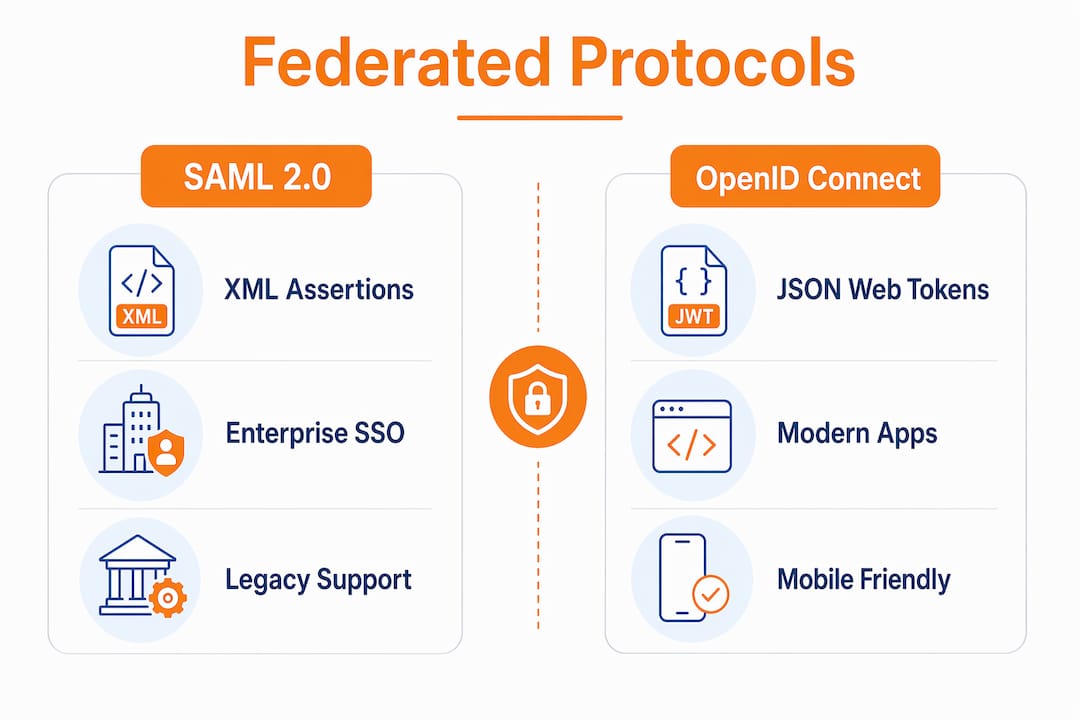
SAML 2.0 is XML-based and built for enterprise single sign-on. It passes assertions between an IdP and an SP using signed XML documents. SAML works well with legacy enterprise apps, on-premises systems, and government platforms that predate the modern web. Its verbosity is a tradeoff: more expressive, but heavier to parse and debug.
OpenID Connect (OIDC) is JSON-based and designed for modern web and mobile applications. It runs on top of OAuth 2.0 and returns an ID token (a JSON Web Token, or JWT) that carries user identity claims. OIDC is the protocol behind Google Sign-In and most consumer-facing identity federation today.
OAuth 2.0 is an authorization framework, not a full authentication protocol. It delegates access rights using access tokens, allowing an application to act on a user’s behalf without exposing credentials. OAuth 2.0 is almost always paired with OIDC when authentication is required.
| Protocol | Token format | Primary use case | Strengths |
|---|---|---|---|
| SAML 2.0 | XML assertion | Enterprise SSO, legacy apps | Mature, broad enterprise support |
| OpenID Connect | JSON Web Token (JWT) | Web and mobile apps | Lightweight, developer-friendly |
| OAuth 2.0 | Access token | Authorization delegation | Flexible, widely adopted |
Pro Tip: If your organization runs a mix of legacy on-premises apps and modern SaaS, deploy a provider that supports both SAML 2.0 and OIDC natively. Forcing one protocol onto every app creates unnecessary friction and misconfiguration risk.
How does multi-factor authentication integrate with federated flows?
Authentication methods within federated flows are not all equal, and the protocol needs to communicate which method was used. This is where Authentication Methods Reference (AMR) claims become critical. AMR claims signal to the receiving application exactly how the user authenticated at the IdP. That signal lets the application enforce its own access policy based on authentication strength.
Common AMR values include:
- pwd: password-based authentication
- mfa: multi-factor authentication was performed
- hwk: a hardware-bound key (such as a FIDO2 security key) was used
- swk: a software-bound key was used
- sms: SMS one-time password was used
- tel: telephone-based verification
These values matter because a user who authenticated with only a password carries a different risk profile than one who used a FIDO2 hardware key plus biometrics. Google’s OIDC implementation includes both auth_time and amr claims, enabling applications to enforce step-up authentication and fine-grained access controls based on that context. This is not a theoretical feature. A financial services application can read the AMR claim and require a hardware key before granting access to transaction records, even if the user already has an active federated session.
RSA ID Plus demonstrates this in practice. It supports federated SSO with MFA options including FIDO, biometrics, OTP, and adaptive access controls, integrating with Active Directory and Azure AD across cloud, hybrid, and on-premises deployments. That breadth of MFA options matters because different user populations carry different risk levels.
Pro Tip: Do not configure your SP to accept any authenticated session from the IdP without checking the AMR claim. A session authenticated with only SMS OTP should not grant the same access as one authenticated with a FIDO2 key. Build that logic into your authorization layer, not just your IdP policy.
Logmeonce supports passwordless MFA options that align with this model, letting organizations move beyond passwords while maintaining strong authentication signals across federated sessions.
What are the key security considerations in federated authentication?
Federated authentication changes the security boundary fundamentally. Certificates, token lifetimes, signing keys, and claim transformation become operational controls, not just plumbing. Authorization remains local to each application, but the authentication decision is delegated. That delegation is where most security failures originate.
The most common mistake is blind trust in IdP assertions. Receiving systems must independently validate:
- Audience restriction: The token must be issued specifically for your application. A token issued for App A should never be accepted by App B.
- Token expiry: Expired tokens must be rejected, regardless of the IdP’s session state.
- Claim scope: Only the claims your application needs should be accepted. Excess claims create attack surface.
- Signature verification: The token’s signature must be verified against the IdP’s current public key, not a cached or hardcoded one.
Federated authentication must be treated as part of a Zero Trust architecture with continuous governance, key rotation, and trust chain management. Post-compromise trust chain management is the critical operational control most organizations skip. (Federated Authentication Glossary)
Zero Trust principles apply directly here. No federated assertion should be trusted by default. Every token validation is an opportunity to enforce policy. Key rotation schedules, offboarding procedures for relying parties, and claim transformation rules all require active management. An IdP that gets compromised poisons every SP that trusts it. That is not a hypothetical: supply chain attacks on identity infrastructure have become a documented threat vector.
Risk-based and step-up authentication add another layer. If a user’s behavior deviates from baseline (unusual location, new device, off-hours access), the SP should trigger a step-up challenge rather than relying on the existing federated session. Logmeonce’s Zero Trust identity model supports this pattern, treating every access request as a verification event rather than a one-time trust grant.
Enterprise password management practices also intersect here. Deprovisioning a user at the IdP does not automatically revoke active tokens at every SP. Organizations need explicit token revocation policies and short token lifetimes to close that gap.
What should organizations consider when deploying federated authentication?
Selecting a federated authentication provider is a long-term architectural decision. Misconfiguration is the leading cause of vulnerabilities in otherwise correctly implemented federated SSO. The protocol is rarely the problem. The configuration is.
The table below summarizes the key deployment considerations:
| Consideration | What to evaluate |
|---|---|
| Protocol support | Does the provider support SAML 2.0, OIDC, and OAuth 2.0? |
| Pre-configured connectors | Are connectors available for your SaaS and legacy apps? |
| MFA options | Does the provider support FIDO2, biometrics, OTP, and adaptive access? |
| Token validation controls | Can you configure audience restriction, expiry, and claim scope per app? |
| Hybrid deployment | Does the provider support cloud, on-premises, and hybrid environments? |
Pre-configured application connectors reduce integration effort significantly. Providers offering thousands of pre-built connectors eliminate the manual attribute mapping work that consumes engineering time and introduces errors. For organizations with large SaaS portfolios, this is a practical differentiator, not a marketing point.
Balancing security with user experience requires deliberate configuration choices. Overly aggressive session timeouts frustrate users and push them toward workarounds. Overly permissive policies create risk. The right answer is adaptive: short-lived tokens for high-risk applications, longer sessions for low-sensitivity tools, and step-up authentication triggered by behavioral signals.
Logmeonce provides two-factor authentication and single sign-on capabilities designed for organizations that need both security depth and deployment flexibility. For government and regulated industries, Logmeonce also supports FICAM-aligned identity management, which maps directly to the governance requirements federated deployments demand.
My take: federation is governance, not just configuration
Key Takeaways
Federated authentication methods require continuous governance, correct protocol selection, and local token validation to deliver both security and operational reliability.
| Point | Details |
|---|---|
| Protocol selection matters | Choose providers supporting SAML 2.0 and OIDC to cover both legacy and modern apps. |
| AMR claims drive access policy | Use authentication method signals to enforce step-up authentication at the application layer. |
| Local validation is non-negotiable | Always validate audience, expiry, and claim scope independently at each service provider. |
| Zero Trust applies to federation | Treat every federated assertion as untrusted until validated; rotate keys and offboard relying parties actively. |
| Pre-configured connectors reduce risk | Providers with large connector libraries cut manual mapping errors and accelerate deployment. |
My take: federation is governance, not just configuration
Most organizations treat federated authentication as a one-time infrastructure project. They pick a protocol, configure the IdP, test a handful of apps, and declare it done. That framing is wrong, and it creates real exposure.
Federation is an ongoing trust relationship. Every new application you add to the federation extends your attack surface. Every IdP you trust becomes a potential entry point. I have seen organizations with technically correct SAML implementations get compromised because they never reviewed their relying party list or rotated signing keys after a vendor change.
The AMR claim discussion is where I see the biggest gap in practice. Most teams configure their IdP to emit AMR values but never build the SP-side logic to act on them. That is the equivalent of installing a lock and leaving the key in the door. The signal is there. Use it.
Zero Trust is not a product you buy. It is a posture you maintain. For federated authentication, that means short token lifetimes, continuous behavioral monitoring, and explicit revocation workflows. It also means auditing your federation metadata regularly. Stale metadata with outdated certificates is a quiet vulnerability that rarely gets caught until something breaks.
The organizations that get this right treat their IdP configuration as a living document, reviewed quarterly, tested against real attack scenarios, and updated as the application portfolio changes. That discipline separates secure deployments from ones that are one misconfiguration away from a breach.
— Mike
How Logmeonce supports your federated authentication strategy
Federated authentication works best when the underlying identity platform handles MFA, SSO, and access governance in one place. Logmeonce delivers exactly that combination for organizations that need depth without complexity.

Logmeonce’s password management benefits extend into federated environments, giving IT teams centralized control over credentials, MFA enforcement, and session policies. The platform supports passwordless authentication, adaptive access controls, and cybersecurity monitoring that aligns with Zero Trust principles. Whether you are deploying SAML 2.0 for legacy enterprise apps or OIDC for modern SaaS, Logmeonce provides the governance layer your federated authentication strategy requires. Explore the full platform to see how it fits your environment.
FAQ
What is federated authentication?
Federated authentication is a system where a trusted Identity Provider authenticates a user once and passes verified credentials to multiple Service Providers, eliminating the need for separate logins per application.
How does SAML 2.0 differ from OpenID Connect?
SAML 2.0 uses XML-based assertions and targets enterprise and legacy applications, while OpenID Connect uses JSON Web Tokens and is designed for modern web and mobile environments.
What are AMR claims and why do they matter?
AMR (Authentication Methods Reference) claims are values in an identity token that signal how a user authenticated, such as password, MFA, or hardware key. Applications use these signals to enforce step-up authentication and granular access controls.
What is the biggest security risk in federated authentication deployments?
Blind trust in IdP assertions is the primary risk. Receiving systems must independently validate token audience, expiry, and claim scope rather than accepting any assertion the IdP issues.
How does Zero Trust apply to federated authentication?
Zero Trust requires treating every federated assertion as unverified until locally validated. This means short token lifetimes, continuous key rotation, behavioral monitoring, and explicit revocation workflows for every relying party in the federation.


