


 Password Manager
 Identity Theft Protection

 Team / Business
 Enterprise
 Government
 MSP
MSP


TL;DR:
- Dark web scanning involves continuous monitoring of hidden forums and breach databases to detect exposure of personal data after it occurs. It provides timely alerts that enable users to respond swiftly, reducing the window for criminal activity, but cannot prevent the original theft. Combining ongoing monitoring with strong passwords, MFA, and credit freezes offers the most effective layered defense against identity theft.
Dark web scanning is defined as the continuous monitoring of hidden internet forums, breach databases, and underground marketplaces for your exposed personal information. Services like LifeLock, Experian, and Aura use this technology to alert you when your email address, Social Security number, or passwords appear in stolen data sets. The critical distinction every user must understand: dark web scanning detects exposure after it happens. It cannot prevent the original theft. What it can do is shrink the window between breach and your response, which is where real identity protection lives.
Can dark web scanning protect identity from theft?
Dark web scanning protects identity by functioning as an early-warning intelligence layer, not a shield. The moment your credentials surface in a breach dump or marketplace listing, a monitoring service sends you an alert so you can act before a criminal does. Monitoring is threat intelligence, not prevention. That framing matters because it sets accurate expectations and drives faster, smarter responses.

The industry term for this practice is “dark web monitoring,” and it covers a spectrum from one-time scans to continuous, automated surveillance. A one-time scan checks your identifiers against a snapshot of known breach data. Continuous monitoring, by contrast, runs those checks around the clock against freshly compiled records. Continuous monitoring outperforms one-time scans because data breaches and leaks are ongoing events, not isolated incidents.
The practical value is speed. Attackers often exploit stolen credentials within hours of a breach appearing on the dark web. A monitoring service that alerts you the same day gives you a fighting chance to change passwords and freeze credit before fraudulent accounts are opened. Without monitoring, you might not discover the exposure for months, by which point the damage is done.
How does dark web scanning work to detect exposed data?
Dark web monitoring works by collecting and indexing data from hidden forums, paste sites, criminal marketplaces, and breach databases, then matching that data against identifiers you provide, such as your email address, phone number, or Social Security number. Monitoring matches identifiers against breach databases, not through live scanning of every dark web page in real time. That distinction is important for setting realistic expectations.
Experian, for example, scans 600,000 dark web pages daily to detect compromised personal information and notify users. That scale illustrates how resource-intensive the process is, and why no service can guarantee 100% coverage. Private channels, encrypted chat groups, and invitation-only forums remain largely inaccessible to automated tools.
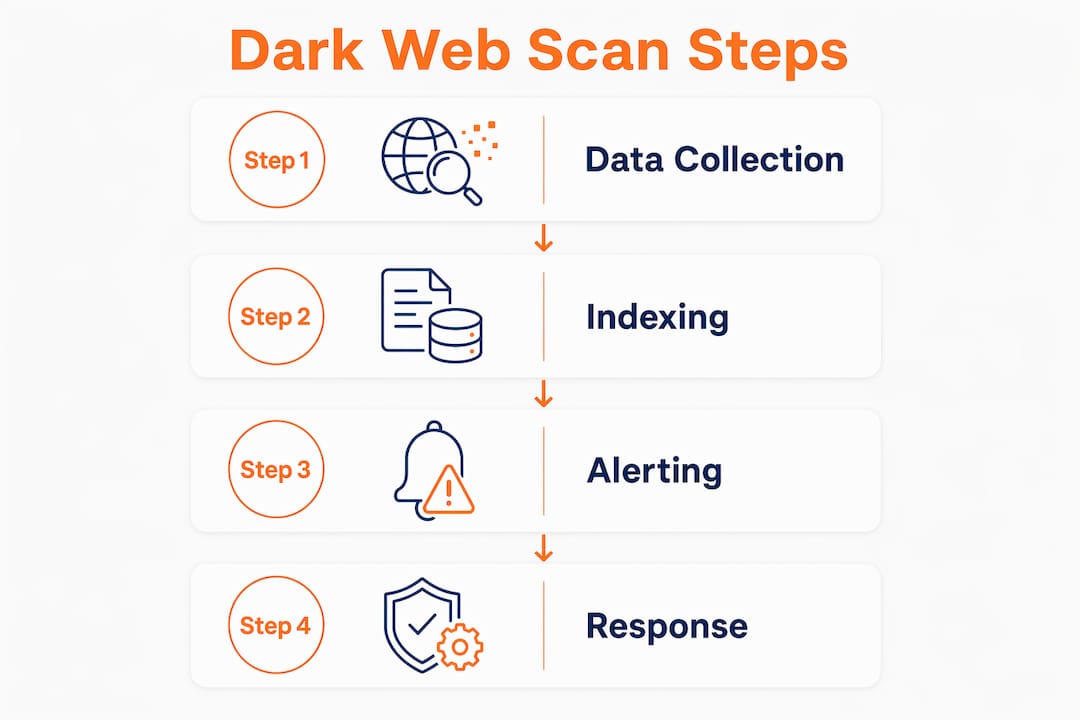
Here is how one-time scans compare to continuous monitoring:
| Feature | One-time scan | Continuous monitoring |
|---|---|---|
| Frequency | Single check at a point in time | Ongoing, often daily or real-time |
| Coverage | Existing breach databases only | New breaches as they are indexed |
| Alert speed | None after initial report | Immediate notification on new finds |
| Best for | Quick initial check | Long-term identity protection |
| Cost | Often free or low cost | Subscription-based |
The technical limitations are real. Most services rely on compiled leaked records rather than live crawling. CAPTCHAs, constantly rotating .onion addresses, and private invite-only communities all restrict what automated tools can reach. No service scans every dark web site live due to access and technical challenges. Knowing this helps you treat alerts as strong signals, not absolute proof of safety when no alert arrives.
What to do immediately when your data is found on the dark web
When a dark web monitoring alert arrives, your response speed determines how much damage you prevent. Follow these steps in order, prioritizing accounts directly tied to the exposed credentials.
- Change the compromised password immediately. Use a unique, complex password for that account and any other account where you reused the same credentials. Attackers test stolen passwords across multiple platforms within minutes.
- Enable multi-factor authentication (MFA) on the affected account. MFA blocks unauthorized access even when a password is known. Tools like Google Authenticator, Microsoft Authenticator, or LogMeOnce’s built-in MFA make this fast to set up.
- Place a fraud alert with the three major credit bureaus. Equifax, Experian, and TransUnion each allow you to place a free fraud alert that requires lenders to verify your identity before opening new accounts.
- Consider a credit freeze. A freeze is stronger than a fraud alert. Credit freezes reduce new account fraud by blocking lenders from accessing your credit file entirely until you lift the freeze.
- Contact affected financial institutions directly. If banking credentials or card numbers were exposed, call your bank immediately to flag the account and request new card numbers.
- Monitor your accounts for unusual activity. Set up transaction alerts on all financial accounts and review statements weekly for at least 90 days after an exposure event.
One critical fact shapes all of these steps: data on the dark web cannot be removed. Once your information is out there, it circulates indefinitely. Your only leverage is making that data useless by changing credentials and locking down credit before anyone acts on it.
Pro Tip: Prioritize accounts in cascading order. Start with email, since a compromised email account lets attackers reset passwords on every other service linked to it. Then move to financial accounts, then social media.
How effective is dark web scanning as an identity protection tool?
Dark web scanning is effective as one layer in a defense-in-depth security model, not as a standalone solution. Monitoring works best alongside MFA and credential rotation, not as a replacement for those controls. Treating it as your only protection creates a false sense of security.
The realistic value proposition breaks down into three areas:
- Early detection: Alerts arrive faster than you would discover a breach on your own, often days or weeks sooner.
- Prioritized response: Knowing exactly which credentials were exposed lets you focus your response rather than scrambling to change every password you own.
- Reduced fraud window: The shorter the gap between exposure and your response, the less time attackers have to act on stolen data.
The limitations are equally clear. Scanning cannot prevent the original breach at a retailer, healthcare provider, or financial institution. It cannot remove your data from criminal forums. And alerts should be correlated with other signals before triggering major escalations, since not every alert represents an active, imminent threat.
“Speed of response after alert detection is the key factor in preventing fraud and identity theft following exposure.” — Experian
The most dangerous misconception is believing that a monitoring service that has not sent an alert means your data is safe. Absence of an alert reflects the limits of what any service can index, not a clean bill of health for your personal information.
What features should you look for in a dark web monitoring service?
Choosing a dark web monitoring service comes down to five criteria that separate genuinely protective tools from superficial ones.
- Breadth of data sources: The service should index criminal forums, paste sites, breach databases, and marketplace listings, not just a single data feed.
- Alert speed and clarity: Alerts should arrive within hours of detection and specify exactly what data was found, where, and what to do next.
- Integration with credit monitoring: Bundled identity theft services that combine dark web monitoring with credit bureau alerts and fraud alerts provide more complete protection than monitoring alone.
- Identity restoration support: Look for services that offer dedicated case managers or reimbursement coverage if identity theft does occur.
- Data security of the service itself: The service stores your most sensitive identifiers. Verify it uses encryption and has a clear privacy policy before handing over your Social Security number.
Here is a quick comparison of three widely used services:
| Service | Key strength | Notable limitation |
|---|---|---|
| LifeLock | Broad identity restoration support | Higher cost at premium tiers |
| Experian | Deep credit bureau integration | Primarily email and SSN monitoring |
| Aura | Real-time alerts and family plans | Newer service with less track record |
LogMeOnce’s dark web email scan adds another layer by checking whether your email credentials have surfaced in known breach data, integrating that intelligence directly into its password management platform.
How dark web scanning fits into a broader identity security strategy
Dark web scanning is one instrument in a larger security toolkit. Relying on it alone is like installing a smoke detector but skipping the fire extinguisher. The following practices, combined with monitoring, create genuine defense-in-depth.
Use a password manager. Unique, complex passwords for every account are the single most effective way to limit the blast radius of any one breach. Tools like LogMeOnce generate and store these automatically, removing the human tendency to reuse passwords.
Enable MFA everywhere it is offered. Even if a password is stolen and appears on the dark web, MFA blocks the attacker at the login screen. Prioritize MFA on email, banking, and any account tied to financial data.
Review your credit reports regularly. AnnualCreditReport.com provides free reports from all three major bureaus. Reviewing them quarterly catches fraudulent accounts that monitoring services might miss.
Practice safe browsing. Phishing emails and fake login pages are the most common delivery mechanism for credential theft. A combination of browser security extensions and skepticism about unsolicited links reduces your exposure at the source.
Pro Tip: Combine dark web monitoring alerts with LogMeOnce’s identity theft protection tools to get a unified view of your exposure across breach data, password health, and MFA status in one dashboard.
The benefits of dark web monitoring for businesses apply equally to individuals: the earlier you know, the more control you retain over the outcome.
Key takeaways
Dark web scanning protects identity by detecting exposed credentials early and enabling fast, targeted responses that limit fraud before it starts.
| Point | Details |
|---|---|
| Scanning detects, not prevents | Monitoring alerts you after exposure; it cannot stop the original data breach. |
| Response speed is everything | Acting within hours of an alert closes the window attackers need to exploit stolen data. |
| Data cannot be removed | Once on the dark web, your information stays there; mitigation is the only option. |
| Continuous beats one-time | Ongoing monitoring catches new breaches as they emerge, not just historical ones. |
| Layered security is required | Combine monitoring with MFA, strong passwords, and credit freezes for real protection. |
Why dark web scanning is worth it, but not enough on its own
I have spent years watching people treat dark web monitoring as a checkbox rather than a tool. They sign up, see no alerts for six months, and conclude they are safe. That conclusion is wrong, and it is the most common mistake I see.
The honest reality is that no service indexes everything. Private Telegram channels, closed forums, and freshly compromised data sets often circulate for days before any monitoring tool picks them up. An alert is a confirmed signal. No alert is not a clean record.
What I have found actually works is treating every alert as a fire drill, not a fire. When an alert arrives, you run the response checklist fast and completely, regardless of whether the exposed data looks “minor.” A leaked email address combined with a reused password is enough to compromise a bank account. I have seen it happen.
The other misconception worth addressing directly: some services market themselves with language that implies they can clean your data from the dark web. Legitimate services provide monitoring and support actions, not removal. Any service claiming otherwise is misleading you.
My recommendation is continuous monitoring paired with a password manager and MFA on every critical account. That combination does not make you invulnerable, but it makes you a significantly harder target than the average person. In security, that gap matters enormously.
— Mike
Strengthen your identity protection with LogMeOnce
Dark web monitoring tells you when your data has been exposed. What you do next determines whether that exposure becomes a crisis or a near miss.
LogMeOnce combines password management, MFA, and encryption in a single platform designed to close the gaps that dark web alerts reveal. When a monitoring service flags a compromised credential, LogMeOnce lets you update that password instantly, verify your MFA coverage, and audit which accounts share the same credentials. That integrated response is faster and more thorough than managing each tool separately. Explore LogMeOnce’s identity theft protection and dark web scan features to see how continuous monitoring fits into a complete security setup.
FAQ
What does dark web scanning actually do?
Dark web scanning monitors hidden forums, breach databases, and criminal marketplaces for your personal information and sends an alert when a match is found. It detects exposure after a breach occurs but cannot prevent the original theft.
Is dark web scanning effective at stopping identity theft?
Dark web scanning is effective as an early-warning tool that shortens the time between exposure and your response, which directly reduces fraud risk. It is not a standalone solution and works best alongside MFA, strong passwords, and credit monitoring.
Can dark web monitoring remove my data from the dark web?
No. Once your data appears on the dark web, it cannot be removed. Legitimate monitoring services provide alerts and guidance on mitigation steps like password changes and credit freezes, not data deletion.
How often should I run a dark web scan?
Continuous monitoring is more effective than periodic one-time scans because new breaches occur daily. A subscription-based service that monitors around the clock provides far better coverage than a manual check every few months.
What information should I monitor on the dark web?
Prioritize monitoring your primary email address, Social Security number, phone number, and any financial account numbers. Your email address is the highest-priority identifier because it serves as the recovery mechanism for most other accounts.
Recommended
- Dark web email scan – LogMeOnce
- Identity Theft Protection & Dark Web Scan – LogMeOnce
- The Benefits of Dark Web Monitoring for Businesses – LogMeOnce


