


 Password Manager
 Identity Theft Protection

 Team / Business
 Enterprise
 Government
 MSP
MSP

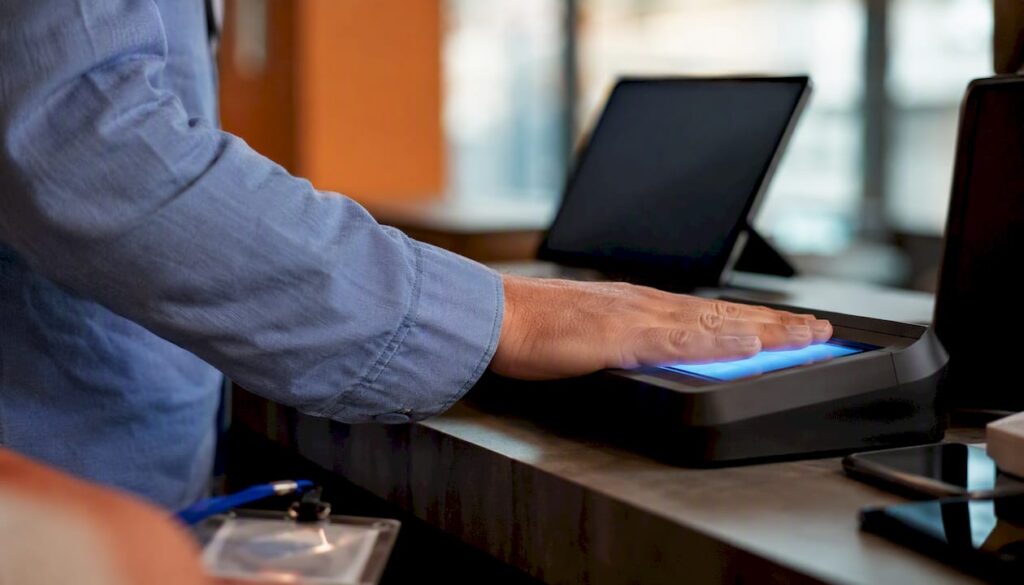
Biometric authentication methods use physiological or behavioral characteristics — fingerprints, iris patterns, facial geometry, voice, and more — to verify identity automatically, as defined by NIST. The practical verdict: biometrics offer strong, nontransferable identity signals and genuine convenience, but they introduce unique risks around template permanence and privacy that demand deliberate design. They work best as one layer in a broader identity strategy, not as a standalone solution.
Quick takeaways:
- Biometrics lower friction and raise the bar against credential theft, but a compromised biometric template cannot be changed the way a password can.
- IBM’s taxonomy covers the major modalities: fingerprint, face, iris, voice, palm/vein, and behavioral signals like keystroke dynamics.
- CSIS analysts note there is no single best biometric; the right choice depends on your security-versus-friction trade-off and the specific use case.
- Template protection (on-device storage, encryption, cancellable transforms) and presentation-attack detection (PAD) are non-negotiable for any serious deployment.
Key Takeaways
Biometric authentication methods are most effective when paired with template protection, presentation-attack detection, and a secure fallback, making system design as important as modality selection.
| Point | Details |
|---|---|
| Match modality to risk | Iris for high-security access, fingerprint for consumer devices, behavioral for continuous session monitoring. |
| Require PAD and template protection | Demand ISO/IEC 30107-3 PAD validation and cancellable or encrypted templates from every vendor. |
| Prefer on-device storage | Secure enclave storage keeps templates off servers and limits breach exposure significantly. |
| Plan fallbacks from day one | PIN, hardware token, or supervised manual verification must be at least as secure as the primary biometric path. |
| Logmeonce unifies the stack | Logmeonce combines passwordless biometric login, MFA, and encrypted storage in one platform for teams ready to deploy. |
What are the main biometric authentication methods?
Biometric authentication splits into two broad families: physical biometrics, which measure stable anatomical traits, and behavioral biometrics, which capture patterns in how a person acts over time. The distinction matters operationally because physical traits are easier to enroll and verify in a single interaction, while behavioral signals are better suited to continuous, passive monitoring.
Physical biometrics
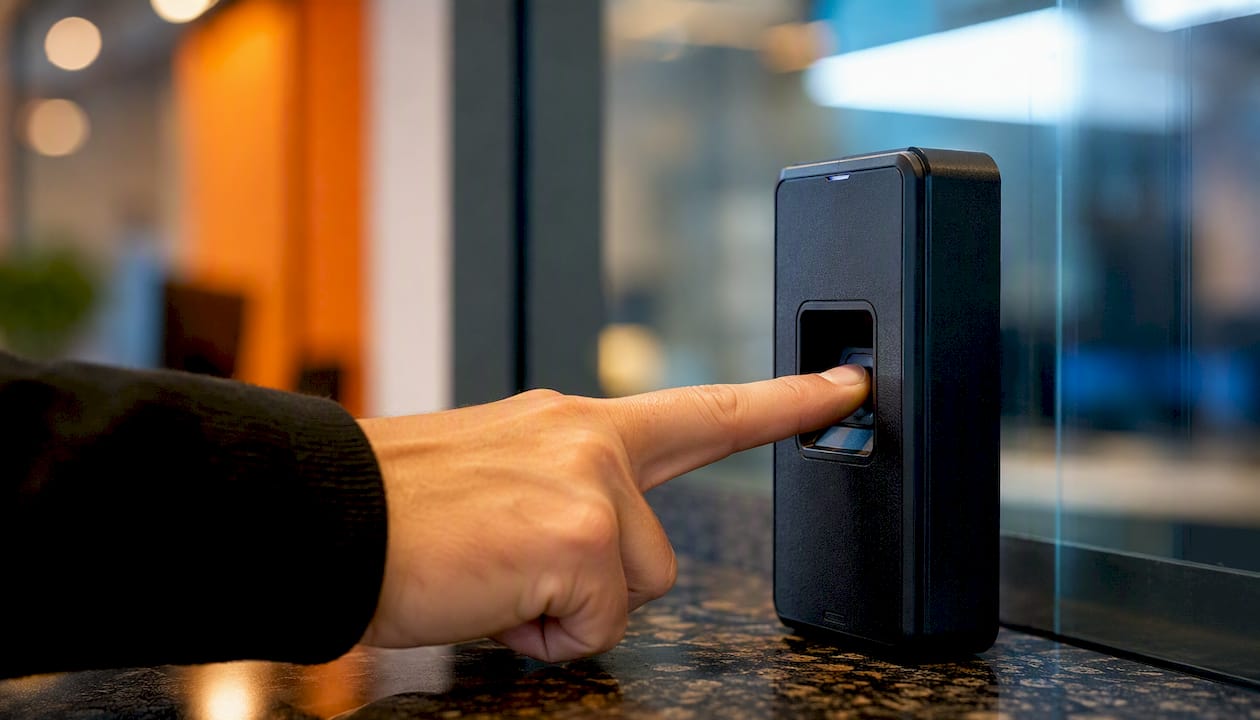
Fingerprint is the most widely deployed modality globally. Optical and capacitive sensors read ridge patterns; in-display ultrasonic sensors work through glass. Pros: mature technology, low cost, fast matching. Cons: performance degrades with wet or damaged skin; contact sensors carry hygiene concerns.
Facial recognition converts a face image into a numerical feature vector and compares it against an enrolled template. Research on face-recognition pipelines shows the process involves detection, alignment, feature extraction (using methods like HOG, SIFT, or CNNs), and matching. Pros: contactless, widely accepted by consumers. Cons: accuracy drops in poor lighting or with occlusion; more sensitive to environmental variation than iris.
Iris recognition captures the unique texture of the iris using near-infrared imaging. Pros: extremely high accuracy, stable across a lifetime, low FAR. Cons: requires cooperative subjects, specialized hardware, and controlled lighting; cost is higher than fingerprint or face.
Retina scanning reads the blood-vessel pattern at the back of the eye. Even more accurate than iris, but the enrollment process is intrusive and slow. Largely limited to classified government and military settings.
Palm vein / finger vein uses near-infrared light to image subcutaneous vein patterns. Pros: contactless, difficult to spoof (veins are internal), hygienic. Cons: specialized readers, higher cost, less mature ecosystem.
Behavioral biometrics
Voice recognition analyzes vocal characteristics: pitch, cadence, accent, and formant frequencies. Pros: works over a phone channel, no special hardware. Cons: susceptible to recording replay attacks and degrades with illness or background noise.
Gait recognition identifies individuals by their walking pattern, captured via camera or accelerometer. Pros: passive, no cooperation needed. Cons: accuracy varies with footwear, terrain, and injury; still maturing for high-security use.
Keystroke dynamics measures typing rhythm: dwell time (how long each key is held) and flight time (the gap between keystrokes). Pros: passive, runs on existing hardware, good for continuous authentication. Cons: sensitive to keyboard type, fatigue, and injury; enrollment requires sustained interaction.
Heartbeat / ECG uses electrocardiogram signals as a biometric. Pros: extremely difficult to spoof, continuous. Cons: requires wearable hardware; still largely in research and specialized deployments.
Multimodal approaches
Combining two or more modalities — for example, face plus iris, or fingerprint plus keystroke — is called multimodal biometrics. Fusion can happen at the score level (averaging or weighting match scores) or at the decision level. The payoff is lower operational FAR without a proportional rise in FRR, plus a natural fallback when one sensor fails. The trade-off is added hardware cost and enrollment complexity.
How does biometric authentication actually work?
Every biometric system follows the same four-stage flow: enrollment → template generation → storage → matching. Understanding each stage is where you find the failure points and the attack surfaces.
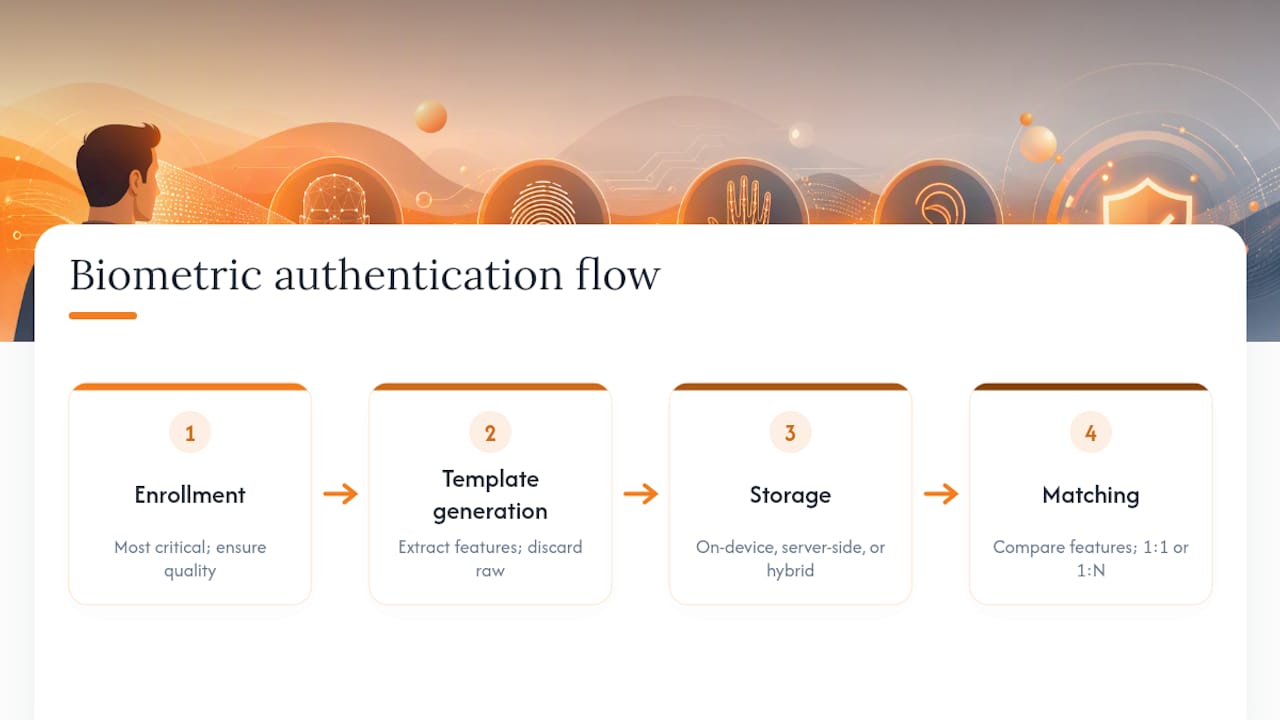
Enrollment is the first and most critical stage. A sensor captures one or more samples of the biometric trait. Quality matters here more than anywhere else: a poor enrollment sample produces a noisy template that drives up FRR for the life of the account. Systems should reject low-quality captures at enrollment rather than accept them and pay the operational cost later.
Template generation extracts a compact feature representation from the raw sample. For fingerprints, this means identifying minutiae points (ridge endings and bifurcations). For faces, it means computing a high-dimensional embedding vector using a CNN. The raw image is typically discarded; only the template is retained. This is where feature-extraction method choices (classical SIFT/HOG versus deep CNN embeddings) affect both accuracy and computational cost.
Template storage is a fork in the road. On-device storage (in a secure enclave like Apple’s Secure Enclave or a TEE on Android) means the template never leaves the device, which limits exposure. Server-side storage enables cross-device and cross-channel authentication but centralizes risk: a breach exposes every enrolled user. Many enterprise deployments use a hybrid: the device holds a device-bound key, and the server holds an encrypted, transformed template.
Matching compares the live sample’s features against the stored template and produces a similarity score. Two modes exist: verification (1:1 match — does this sample match this claimed identity?) and identification (1:N search — who in this database does this sample belong to?). Identification is computationally heavier and statistically harder because the chance of a false match grows with database size.
Accuracy metrics: FAR, FRR, and EER
Biometric systems are probabilistic, not deterministic. NIST’s canonical definitions anchor the three core metrics:
- FAR (False Accept Rate): the proportion of impostor attempts the system incorrectly accepts. A low FAR means the system rarely lets the wrong person in.
- FRR (False Reject Rate): the proportion of genuine attempts the system incorrectly rejects. A low FRR means legitimate users rarely get locked out.
- EER (Equal Error Rate): the operating point where FAR equals FRR. It is a single-number summary of a system’s inherent accuracy, useful for comparing systems before threshold tuning.
FAR and FRR move in opposite directions as you adjust the matching threshold. Tighten it and FAR drops while FRR rises; loosen it and the reverse happens. Choosing the right operating point is a risk decision, not a technical one: a payment system tolerates a higher FRR to keep FAR near zero, while a consumer phone unlock can accept a higher FAR to minimize user frustration.
What security and privacy risks do biometric systems carry?
Biometrics reduce the risk of credential stuffing and phishing, but they introduce a category of risk that passwords do not: permanence. You can reset a password; you cannot re-issue a fingerprint. That asymmetry shapes the entire threat model.
Common threats
- Presentation attacks (spoofing): an attacker presents a fake artifact — a printed photo, a silicone fingerprint, a 3D-printed face mask — to fool the sensor. This is the most common active attack against deployed systems.
- Template inversion: given a stored template, an adversary attempts to reconstruct a usable biometric sample. Mathematically feasible for some modalities if templates are stored as raw feature vectors without protection.
- Replay attacks: a captured biometric signal (a recorded voice, a stored image) is replayed to the sensor or injected into the data stream between sensor and matcher.
- Sensor-level capture: a compromised or counterfeit sensor captures raw biometric data before it reaches the secure processing pipeline.
- Dataset bias: training data that underrepresents certain demographics produces systems with higher FAR or FRR for those groups, creating both security gaps and fairness failures.
- Linkage and tracking: the same biometric trait used across multiple systems allows cross-system tracking of individuals without their knowledge.
Template protection
Because biometric traits are permanent, modern systems store transformed or encrypted templates rather than raw images. ISO/IEC 24745 identifies irreversibility and cancelability as the two core properties any template-protection scheme must satisfy. Practical approaches include:
- Encryption at rest and in transit: minimum baseline; does not address template inversion if the encryption key is also compromised.
- On-device secure enclaves: hardware-isolated execution environments (ARM TrustZone, Apple Secure Enclave) that process and store templates without exposing them to the main OS.
- Cancellable biometrics: a repeatable, non-invertible transform is applied to the raw template before storage. If the transformed template is compromised, a new transform parameter is issued and a new template generated from the same biometric. The original trait is never recoverable from the stored data.
- Biometric cryptosystems (fuzzy vaults, fuzzy commitments): bind a cryptographic key to the biometric template so the key is only recoverable with a genuine match, and no usable template is stored at all.
Privacy best practices
Collect only the biometric data the use case strictly requires. Use ephemeral templates for one-time verification where possible. Prefer on-device storage when the threat model allows it. Apply strong encryption to anything stored server-side. Design every deployment with revocability in mind from day one, not as an afterthought.
How does liveness detection stop spoofing attacks?
Presentation-attack detection (PAD) reduces spoofing risk, but it adds cost and complexity and trades off against user convenience. No PAD system is perfectly foolproof; the goal is to raise the cost of a successful attack above what an adversary is willing to spend for the target asset.
Hardware PAD techniques include:
- Multi-spectral imaging: illuminates the finger or face with multiple wavelengths to detect subsurface tissue properties that a printed or silicone artifact cannot replicate.
- Depth sensors (structured light, time-of-flight): verify that the presented face has genuine 3D geometry rather than a flat photo or screen replay.
- Near-infrared (NIR) imaging: detects vascular patterns and skin reflectance properties invisible to standard cameras.
- Heartbeat / pulse detection: some face-recognition systems check for a pulse signal in skin color variation across frames, which a static photo cannot produce.
Software PAD techniques include:
- Active challenge-response: the system asks the user to blink, turn their head, or smile. Harder to defeat than passive checks, but adds friction.
- Texture and reflection analysis: ML classifiers trained to distinguish real skin texture from printed paper, silicone, or screen pixels.
- Liveness scoring with deep learning: end-to-end CNN models trained on large spoof-attack datasets produce a continuous liveness score rather than a binary pass/fail.
Hardware PAD is stronger and harder to defeat with software-only attacks, but it requires specific sensors and raises device cost. Software PAD can be updated remotely as new attack types emerge, but it can be brittle across lighting conditions, camera quality, and demographic variation. For high-security deployments, the right answer is usually both: hardware sensors with software classifiers running on top.
Pro Tip: Validate your PAD implementation against open evaluation frameworks. NIST’s FRVT (Face Recognition Vendor Test) and ISO/IEC 30107-3 define standardized attack presentations and metrics for PAD testing. A vendor who cannot point to third-party PAD evaluation results is a vendor whose liveness claims are unverified.
Where does each biometric method fit in real-world use cases?
CSIS analysts are direct on this point: there is no single best biometric. Match the method to the risk level, the friction budget, and the operating environment.
Consumer device unlock (smartphones, laptops): fingerprint and face dominate here because they are fast, embedded in hardware, and familiar. On-device template storage via secure enclave keeps the privacy exposure low. Fallback to PIN or password is standard and expected.
Payment authorization: fingerprint is the most common modality for in-app and point-of-sale payments. The transaction value determines how much friction is acceptable; high-value payments often layer biometric with a second factor. Contactless face-based payment is growing in retail kiosks.
Border control and national ID: iris recognition is the modality of choice for high-assurance identification because its FAR is extremely low and the trait is stable across decades. The DHS uses facial recognition at ports of entry for traveler verification against passport photos, combining speed with reasonable accuracy at scale.
Healthcare: vein pattern recognition (finger or palm) is increasingly used for patient identification at point of care because it is contactless and hygienic. Accurate patient ID prevents medication errors and duplicate records. Privacy regulation (HIPAA) requires strict template governance.
Enterprise logical access (VPN, SSO, workstation login): fingerprint and face are common, often combined with a hardware token or smart card as a second factor. Behavioral biometrics (keystroke, mouse dynamics) are gaining ground for continuous authentication after initial login, detecting session hijacking without re-prompting the user.
High-security physical access (data centers, labs): iris or multimodal (iris + fingerprint) with hardware PAD. The cost of specialized hardware is justified by the asset value being protected.
Fallback mechanisms matter as much as the primary method
Every biometric deployment needs a fallback for when the sensor fails, the user’s trait changes (injury, illness, aging), or enrollment quality was insufficient. PIN, password, hardware token, or supervised manual verification are all valid fallbacks depending on the security context. The fallback path must be at least as secure as the primary path, or attackers will simply target it instead.
| Use case | Recommended modality | Contactless | Cost/complexity | Privacy note |
|---|---|---|---|---|
| Consumer device unlock | Fingerprint, face | Face yes, fingerprint no | Low | On-device enclave preferred |
| Payment authorization | Fingerprint, face | Face yes | Low to medium | Ephemeral match; no server template |
| Border control / national ID | Iris, face | Yes | High | Government-controlled template store |
| Healthcare patient ID | Palm vein, fingerprint | Palm vein yes | Medium | HIPAA-governed; strict retention limits |
| Enterprise SSO / VPN | Fingerprint, face + token | Face yes | Medium | Federated identity; audit logs required |
| High-security physical access | Iris, multimodal | Yes | High | Minimal retention; hardware PAD required |
How do you choose the right biometric for your project?
The decision rule is simple to state and harder to execute: pick the modality that meets your required assurance level while minimizing user friction and privacy exposure. Everything else is implementation detail.
Work through these questions in order before committing to a modality or vendor:
- What is the asset value and threat model? High-value assets (financial transactions, classified access) justify iris or multimodal with hardware PAD. Consumer convenience use cases can tolerate fingerprint or face with software PAD.
- What FAR and FRR are acceptable? Get vendor-supplied FAR/FRR figures for your expected population size and operating conditions, not just their best-case lab numbers. Ask for EER as a baseline comparison.
- How will templates be stored and protected? Demand a clear answer: on-device secure enclave, server-side encrypted, or cancellable transform. Vague answers about “industry-standard security” are a red flag.
- Has PAD been independently validated? Ask for third-party PAD evaluation results, ideally against ISO/IEC 30107-3 attack types. A vendor who cannot produce these has not tested against real spoofing scenarios.
- What is the fallback mechanism? Confirm the fallback path exists, is documented, and is at least as secure as the primary biometric path.
- Does the system accommodate accessibility needs? Users with disabilities, injuries, or conditions that affect biometric capture need an alternative path that does not degrade their security posture.
- Is there an audited privacy policy and a data-retention limit? Biometric data collected without a clear retention and deletion policy is a regulatory liability, particularly under Illinois BIPA, Texas CUBI, and Washington My Health MY Data Act.
Red flags to walk away from
- Opaque template handling (“we protect your data with best practices” with no technical specifics).
- No PAD testing or third-party evaluation of liveness detection.
- Single undisclosed vendor for both sensor and matcher with no interoperability path.
- No consent flow or revocation mechanism for enrolled users.
- No accessibility accommodation documented anywhere in the product.
What do implementers need to know before deploying biometrics?
Plan for sensor selection, enrollment quality control, integration with MFA and SSO, and thorough testing under real-world conditions. Lab accuracy numbers rarely survive contact with operational environments.
Sensor selection
- Optical fingerprint sensors: lower cost, work well in controlled conditions, degrade with dirt and moisture.
- Capacitive fingerprint sensors: more reliable than optical for dry or slightly wet fingers; standard in most smartphones.
- Ultrasonic in-display sensors: work through glass and with wet fingers; higher cost; used in premium devices.
- 2D RGB face cameras: widely available, low cost, susceptible to photo spoofing without additional PAD.
- IR + structured light face sensors: add depth information for 3D liveness; significantly more spoof-resistant; higher cost.
- Multispectral iris cameras: highest accuracy and PAD resistance; require near-infrared illumination; specialized hardware.
Environmental factors matter. Outdoor face recognition degrades in direct sunlight. Fingerprint sensors fail with gloves or heavily calloused skin. Iris readers require the subject to be within a narrow distance range. Test in the actual deployment environment, not a controlled lab.
Integration with MFA and SSO
Biometrics work best as one factor in a multi-factor authentication flow, not as a replacement for all other factors. The FIDO2/WebAuthn standard provides a well-tested framework for binding a biometric verification (performed locally on the device) to a cryptographic assertion sent to the server. This architecture keeps the biometric on-device while still providing strong server-side assurance. Logmeonce’s passwordless authentication approach follows this model, using biometric verification as the local unlock for a device-bound credential.
Standards and testing guidance
- NIST SP 800-76 covers biometric specifications for Personal Identity Verification (PIV).
- NIST SP 800-63B defines authenticator assurance levels and places biometrics within the broader identity framework.
- ISO/IEC 19794 series specifies biometric data interchange formats.
- ISO/IEC 24745 defines requirements for biometric information protection, including irreversibility and cancelability.
- ISO/IEC 30107-3 covers PAD testing methodology and metrics.
- BSI TR-03166 provides a technical guideline for biometric authentication systems covering threshold-setting and testing protocols.
Testing checklist before go-live: enrollment quality metrics (reject rate, image quality scores), live operational FAR/FRR monitoring with real users, PAD evaluation against representative attack types, false-match auditing across demographic groups, and accessibility testing with users who have relevant disabilities or conditions.
What recent research is changing biometric authentication?
In the past two to three years, AI and template-protection advances have materially improved both accuracy and privacy, but they have also introduced new attack classes that target the ML models themselves.
Hybrid deep-learning fingerprint models are the clearest example of AI’s impact. A study using a CNN+LSTM architecture reported 99.42% classification accuracy with FAR 0.31% and FRR 0.27% in its experimental dataset. Those numbers reflect a controlled setting, not a live deployment, but the direction is clear: ML pipelines are now central to state-of-the-art fingerprint authentication, and the gap between classical minutiae matching and deep-learning approaches is widening.
Cancellable biometrics with cryptographic protection are moving from research into production. Work on elliptic curve signcryption frameworks shows that combining feature-level transforms with ECC signcryption can achieve non-invertibility and revocability while keeping error rates low. The practical implication: if a transformed template is compromised, a new transform parameter produces a new template from the same biometric, effectively “revoking” the old one without requiring a new enrollment.
On-device secure enclaves are becoming the default for consumer biometrics. Apple’s Secure Enclave, Qualcomm’s SPU, and ARM TrustZone-based TEEs now handle biometric matching in hardware-isolated environments on most flagship devices. The template never touches the main application processor, which dramatically reduces the attack surface compared to server-side storage.
Behavioral biometrics for continuous authentication are gaining traction in enterprise settings. Keystroke dynamics and mouse-movement analysis can run passively in the background after initial login, flagging anomalies that suggest session hijacking or an unauthorized user at the keyboard. The accuracy of these systems has improved substantially with larger training datasets and transformer-based sequence models, though they still require a calibration period and produce more false positives than physical biometrics.
One emerging concern: adversarial attacks on deep-learning biometric models. Carefully crafted perturbations to a fingerprint image or face photo can fool a CNN-based matcher while appearing normal to a human observer. This is an active research area, and any deployment using ML-based matching should monitor for adversarial attack research relevant to its modality.
Why biometrics need a reality check before you deploy them
The security community has spent years arguing about whether biometrics are “better” than passwords. The framing is wrong. Biometrics are not a replacement for passwords; they are a different kind of credential with a different threat model.
A password is a secret you know. You can change it, share it deliberately, or revoke it. A biometric is a trait you are. You cannot change it, and if a template derived from it is compromised, the exposure is permanent unless you have built revocability into the system from the start. Most deployed systems have not.
The practical implication: any organization treating biometrics as a “set it and forget it” security upgrade is building on a fragile foundation. The enrollment quality, the template protection scheme, the PAD implementation, and the fallback mechanism all need the same engineering rigor as the matching algorithm itself.
There is also the bias question, which gets less attention than it deserves. Facial recognition systems trained on non-representative datasets produce measurably higher FAR and FRR for underrepresented demographic groups. That is not just a fairness problem; it is a security problem. A system that disproportionately rejects legitimate users from certain groups will push those users toward less secure fallback paths, undermining the security posture of the entire deployment. Audit your system’s error rates across demographic groups before go-live, not after a complaint.
The distinction between facial recognition (identity verification) and facial characterization (inferring demographic attributes) also matters for legal and ethical compliance. CSIS analysts draw this line clearly: the two technologies carry different bias and privacy risks and should be governed separately. Conflating them in a privacy policy or a vendor contract is a liability.
The teams that get biometrics right treat them as one layer in a defense-in-depth identity strategy: biometric for local device unlock, cryptographic credential for server authentication, behavioral signal for continuous session monitoring, and a PIN or hardware token as a fallback. No single layer carries the whole load.
Pro Tip: When deploying cancellable biometrics, standardize your transform parameters across the organization and store them separately from the transformed templates. That separation is what makes revocation practical: compromise the template, rotate the transform, re-enroll. Without that separation, “cancellable” is a theoretical property, not an operational one.
Logmeonce brings biometric and passwordless security together
Identity security works best when biometrics, MFA, and encrypted credential storage operate as a unified system rather than separate tools bolted together. Logmeonce is built around exactly that architecture: passwordless authentication that uses biometric verification as the local unlock for a device-bound credential, combined with multi-factor authentication, cloud storage encryption, and dark web monitoring in a single platform.

For security teams evaluating biometric integration, Logmeonce removes the need to stitch together separate vendors for MFA, SSO, and credential management. The platform supports Samsung fingerprint reader integration and passwordless photo login, giving you a concrete starting point for a biometric-enabled identity stack. Explore Logmeonce’s full cybersecurity capabilities and start a free trial to see how the platform fits your deployment.
Sources
Standards and reproducible research are the foundation of any credible biometric deployment. These sources give you the canonical definitions, testing frameworks, and technical depth to evaluate vendors and design systems with confidence.
- Csrc
- How Does Facial Recognition Work?
- An alignment-free secure fingerprint authentication integrated with elliptic curve signcryption scheme
- Facial recognition research and methods (review) – Sensors/related article
- What is Biometric Authentication?


