


 Password Manager
 Identity Theft Protection

 Team / Business
 Enterprise
 Government
 MSP
MSP


TL;DR:
- Most organizations believe adding MFA ensures security, but traditional methods like SMS and email are vulnerable to sophisticated attacks. Modern authentication emphasizes cryptographic, device-bound methods such as FIDO2, Windows Hello, and CBA, which resist phishing more effectively. Effective security requires integrating strong authentication, high-assurance recovery, and privilege management into a comprehensive, continuous program.
Most IT teams believe adding multi-factor authentication to their environment means they are protected. They are not entirely wrong, but they are not entirely right either. Traditional MFA methods like SMS codes and email one-time passwords are vulnerable to phishing and relay attacks, creating a false sense of security that sophisticated attackers actively exploit. Authentication security services have evolved well beyond password-plus-OTP combinations, and understanding that gap is the difference between a credential breach and a blocked attacker. This guide breaks down what modern authentication actually requires.
Key Takeaways
| Point | Details |
|---|---|
| Phishing-resistant methods | Use phishing-resistant authentication like Windows Hello for Business and FIDO2 to strengthen security beyond traditional MFA. |
| High-assurance recovery | Implement biometric and government ID verification for secure account recovery that prevents social engineering attacks. |
| Integration with privilege management | Combine authentication strength with dynamic least-privilege controls to reduce risks after identity compromise. |
| Continuous monitoring | Adopt real-time risk analytics and adaptive policies to maintain effective authentication security over time. |
Understanding authentication security services and their importance
Authentication and authorization are foundational terms in identity security, but they are frequently confused in practice. Authentication verifies identity before granting access, while authorization governs what an authenticated identity is permitted to do. These two controls together form the core of enterprise security. Getting either one wrong opens the door to unauthorized access, lateral movement, and data breaches.
Authentication security services exist to answer a specific question: who is trying to access this resource, and can we trust that claim? The answer requires more than a password. It requires policies, cryptographic methods, continuous monitoring, and integration with your broader identity and access architecture.
Here is what strong authentication security services address across the enterprise:
- Identity verification at sign-in, using device-bound credentials or biometrics rather than shared secrets
- Conditional access policies that evaluate risk signals before granting entry
- Machine and AI agent identities, which require the same rigor as human user accounts
- Integration with identity and access management frameworks, including zero trust architecture
- Audit trails and monitoring for detecting anomalous authentication events
Zero trust architecture assumes no identity is inherently trusted, whether inside or outside the network perimeter. Authentication security services are the first enforcement layer in that model. Without strong authentication, zero trust is conceptual rather than operational.
Phishing-resistant authentication: moving beyond traditional MFA pitfalls
Traditional cybersecurity authentication methods improved security when they replaced single-factor passwords, but attackers adapted quickly. SMS OTP codes can be intercepted via SIM swapping. Email-based codes are exposed when email accounts are compromised. Even app-based time-based one-time passwords (TOTP) can be relayed in real time by attackers using adversary-in-the-middle phishing kits. None of these methods verify that the login is happening on the legitimate site.
Phishing-resistant authentication methods like Windows Hello for Business, FIDO2 passkeys, and certificate-based authentication (CBA) use cryptographic key pairs that are bound to the device and the specific domain. An attacker who tricks a user into entering credentials on a fake site gets nothing usable because the credential never leaves the device in a form that can be replayed.
The key distinction: Phishing-resistant methods authenticate the channel and the device, not just the user. This is why they are the recommended baseline for high-security environments.
Here is how the main phishing-resistant options compare:
- Windows Hello for Business: Uses a TPM-backed asymmetric key pair with PIN or biometric unlock. The private key never leaves the device. Ideal for Windows-based enterprise environments.
- FIDO2 passkeys: Cross-platform, browser-native, and increasingly supported across major identity platforms. Users authenticate with a biometric or device PIN. Works across operating systems.
- Certificate-based authentication: Uses X.509 certificates issued by a trusted CA. Common in government and regulated industries, especially for privileged access. Supports advanced multi-factor authentication architectures.
Pro Tip: If your organization is still planning a “phase 2” migration away from SMS OTP, treat phishing-resistant enrollment as the default for new users starting today. Retrofitting is harder than setting the right default.
High-assurance account recovery and preventing social engineering risks
You can deploy the strongest passwordless authentication in the world and still have a critical weak point: account recovery. When a user loses a device or forgets credentials, the process of reclaiming access is exactly where social engineers focus their attention. A convincing phone call to the helpdesk, a fabricated emergency, and a poorly trained support agent can undo months of authentication hardening.

Modern authentication security services treat account recovery as an identity-proofing event, not a convenience workflow. That shift changes everything about how recovery is designed.
Here is a structured approach to high-assurance recovery:
- Remove knowledge-based authentication from recovery. Security questions like “mother’s maiden name” or “first pet” are trivially researched via social media. They add no real assurance.
- Require cryptographic proof or biometric verification. Government ID verification with biometric matching verifies the person, not just the knowledge they can recite.
- Implement identity verification before any helpdesk action. The support agent should not be the decision point. The identity platform should be.
- Log all recovery events as high-risk. Flag them for security review and correlate with recent login anomalies.
- Plan for the lost-device scenario at deployment time. Recovery workflows should be designed before users need them, not improvised during an incident.
- Test recovery processes regularly. Social engineering resilience degrades without reinforcement. Tabletop exercises that simulate fraudulent recovery attempts reveal gaps before attackers do.
Pro Tip: Integrate biometric account recovery solutions early in your authentication roadmap. Organizations that bolt on identity verification after a breach often find the recovery architecture is incompatible with their existing workflows.
Integrating privilege management for comprehensive identity security
Authentication confirms who you are. What happens after authentication determines how much damage a compromised identity can cause. That is why linking authentication assurance to privilege management is not optional in a mature security program. It is the logical next step.
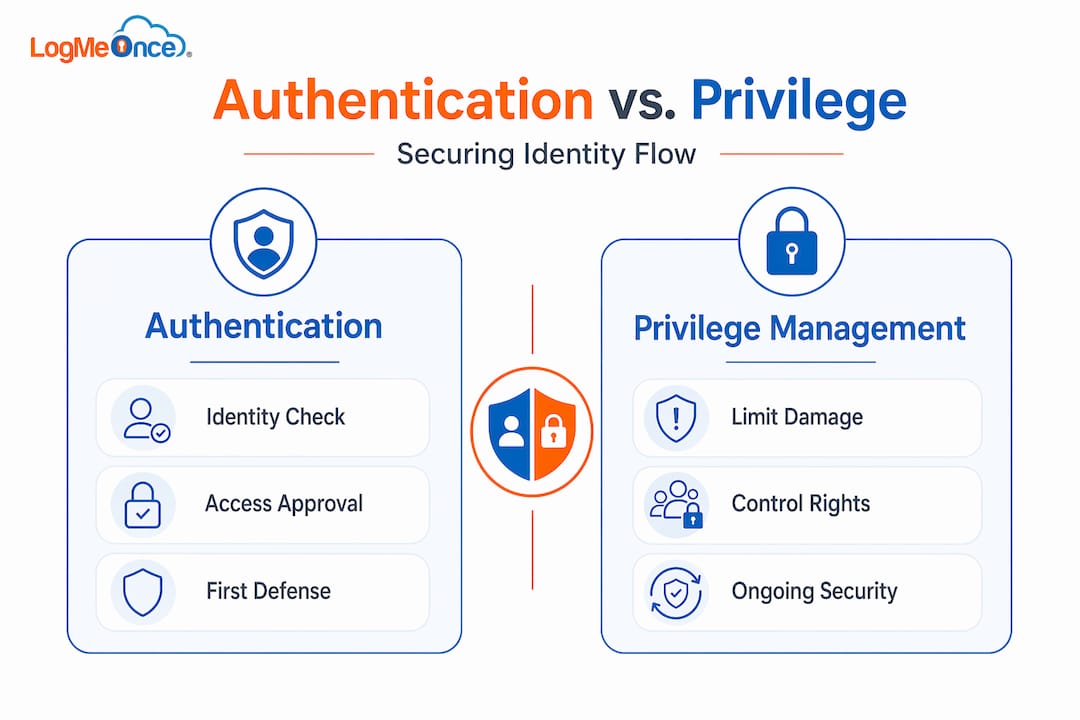
Privileged access management (PAM) traditionally operated as a separate silo from authentication platforms. Modern identity security platforms are collapsing that boundary. The principle is simple: once identity is verified, access should be granted based on what is needed right now, not on standing permissions that were assigned months ago and never reviewed.
Here is how integrated authentication and privilege management compare to the traditional siloed approach:
| Capability | Traditional siloed approach | Integrated identity security |
|---|---|---|
| Privilege assignment | Standing, role-based | Just-in-time, context-aware |
| Authentication scope | Human users | Human, machine, and AI agent identities |
| Risk monitoring | Periodic audits | Continuous real-time analytics |
| Response to anomalies | Manual investigation | Adaptive access controls |
| Attack surface | Broad and persistent | Minimal and dynamic |
Platforms that provide unified discovery, dynamic access, and risk monitoring across all identity types close the gaps that attackers rely on after initial compromise. A credential breach becomes significantly less damaging when the compromised identity has no standing privilege to escalate.
Key capabilities to look for in integrated identity security:
- Discovery across all identity types, including service accounts, machine identities, and AI agents
- Dynamic privilege elevation with session-level controls and automatic revocation
- Continuous identity risk analytics and monitoring feeding into authentication policy decisions
- Unified audit logging spanning both authentication events and privileged actions
Practical steps to implement robust authentication security services
A sound architecture means nothing without disciplined execution. Here is how to move from current state to a production-ready, phishing-resistant identity environment.
Phase 1: Assess and prioritize
- Audit current authentication methods across all applications, VPNs, and privileged access paths.
- Identify where SMS OTP, email codes, or password-only authentication is still in use.
- Map high-risk accounts, including administrators, service accounts, and externally facing identities.
- Document account recovery workflows and evaluate where social engineering risk exists.
Phase 2: Build the roadmap
- Adopt a passwordless and phishing-resistant roadmap aligned with NIST SP 800-63 guidelines for assurance levels.
- Prioritize FIDO2 or Windows Hello for Business for employee-facing authentication.
- Define conditional access policies that enforce stronger authentication for sensitive resources.
Phase 3: Deploy and govern
- Roll out phishing-resistant enterprise password and authentication management in phases, starting with privileged users.
- Implement MFA governance policies including registration enforcement and exception management.
- Integrate authentication platforms with downstream PAM and identity governance tools.
- Establish continuous monitoring for authentication anomalies, failed MFA attempts, and impossible travel signals.
- Conduct regular assurance testing, including simulated phishing and social engineering of recovery workflows.
A detailed posture assessment combined with modern MFA adoption and governance creates a measurable improvement in identity security posture. The organizations that skip the assessment phase invariably find deployment gaps months later.
Why most authentication security strategies miss the mark and how to fix them
Here is an uncomfortable pattern we see repeatedly: organizations invest in multi-factor authentication services, deploy them broadly, and then check “MFA” off the security roadmap as a completed item. Months later, a phishing campaign bypasses their controls entirely. The root cause is almost always the same. They deployed MFA. They did not deploy phishing-resistant MFA.
Overestimating traditional MFA is one of the most common and costly mistakes in enterprise security today. SMS and TOTP codes give users a sense of security that attackers know how to work around. The gap is not hypothetical. Adversary-in-the-middle toolkits capable of relaying TOTP codes in real time are freely available. Treating all MFA as equivalent is a category error.
The second gap is account recovery. Organizations spend considerable effort hardening authentication at sign-in and then route credential recovery through a helpdesk process with minimal identity verification. That is not an edge case. It is an active attack vector that targeted threat actors use specifically because it bypasses technical controls.
The third and least discussed gap is the disconnect between authentication assurance and downstream privilege. Connecting authentication strength to privilege enforcement and continuous risk monitoring is foundational to limiting post-compromise blast radius, yet many organizations treat PAM as a separate project with a separate budget and a separate team. The attacker does not respect those organizational boundaries.
The fix requires treating authentication security not as a feature to deploy but as a program to operate. That means phishing-resistant methods as the default, not the exception. It means identity management best practices that account for recovery workflows and machine identities. And it means continuous monitoring that feeds back into policy, closing gaps as the threat landscape evolves.
Explore LogMeOnce solutions for enhanced authentication security services
Building a phishing-resistant, high-assurance identity program requires authentication service providers that align with modern standards, support FIDO2 and passwordless methods, and integrate with your existing infrastructure.

LogMeOnce cybersecurity solutions are purpose-built for enterprises and government agencies that need rigorous identity protection without complexity. From LogMeOnce two factor authentication that supports phishing-resistant protocols to enterprise-grade password management benefits that simplify credential governance, the platform covers the full authentication lifecycle. Whether you are modernizing a legacy environment or building a zero trust architecture from the ground up, LogMeOnce provides the tools to get there.
Frequently asked questions
What makes phishing-resistant authentication more secure than traditional MFA?
Phishing-resistant authentication uses cryptographic key pairs bound to the device and the specific domain, so even if a user visits a malicious site, no usable credential is exposed. Microsoft recommends methods like Windows Hello for Business and FIDO2 passkeys as the most secure sign-in options available.
How does high-assurance account recovery reduce social engineering risks?
High-assurance recovery replaces helpdesk knowledge questions with biometric matching against government IDs, verifying the actual person rather than information an attacker could research or fabricate. This removes the human judgment call that social engineers rely on.
Why should authentication and privilege management be integrated?
Because a compromised identity with standing privileges can cause far more damage than one with no elevated access. The Idira platform demonstrates how connecting authentication strength with dynamic privilege enforcement directly reduces the attack surface after a credential compromise.
What are key considerations when deploying authentication security services?
Start with a full posture assessment of current authentication methods, then prioritize phishing-resistant and passwordless options for high-risk accounts. Authentication management guidance consistently points to governance policies, continuous monitoring, and privilege integration as the factors that separate a resilient deployment from a checkbox exercise.
Recommended
- The Finesses of Enterprise Password Management
- Password Managers | Business Total Security – LogMeOnce


