


 Password Manager
 Identity Theft Protection

 Team / Business
 Enterprise
 Government
 MSP
MSP


TL;DR:
- Authentication fatigue results from repeated MFA prompts causing users to approve requests reflexively, which attackers exploit through MFA bombing. Reducing prompt volume with solutions like number matching, adaptive authentication, and passkeys helps prevent fatigue and enhances security. Addressing system design issues rather than user training is key to mitigating this security and compliance risk.
Authentication fatigue is defined as the mental exhaustion users experience when bombarded with repeated multi-factor authentication (MFA) prompts, causing them to approve requests without scrutiny. The industry term for its most dangerous form is “MFA fatigue” or “MFA bombing,” and understanding authentication fatigue is now a core competency for any security team. More than 75% of security breaches are linked to human factor errors, with authentication fatigue as a primary attack vector. The average data breach now costs $4.88 million, a figure that reflects how fatigue-driven mistakes translate directly into financial loss. Treating this as a user training problem misses the point entirely. It is a system design failure.
What causes authentication fatigue in enterprise environments?
Authentication fatigue has a clear root cause: prompt volume exceeds human cognitive capacity. When users face repeated authentication challenges throughout the workday, their vigilance degrades. This is not a character flaw. It is a predictable biological response to repetitive, low-stakes decisions.
Several factors accelerate this degradation:
- Repetitive MFA push notifications arrive multiple times per hour across email, VPN, SaaS apps, and internal tools, each demanding active attention.
- Inconsistent security policies across systems force users to remember different authentication rules for different platforms, multiplying cognitive load.
- Notification overload from security tools, ticketing systems, and communication platforms trains users to dismiss alerts reflexively.
- Complex password requirements that change frequently push users toward unsafe shortcuts, including password reuse and weak variations.
- Fragmented identity systems with no single sign-on force repeated logins across the same session, compounding fatigue.
The behavioral result is predictable. Repeated authentication prompts cause vigilance degradation, making users approve requests without scrutiny. That reflex is exactly what attackers target. Security teams that blame users for this behavior are diagnosing the symptom rather than the disease.
Pro Tip: Audit your organization’s total daily authentication prompt volume per user. If the average exceeds 10 prompts per day, your system architecture is generating fatigue, not your users.

How do attackers exploit MFA fatigue in modern attacks?
MFA fatigue attacks follow a deliberate, repeatable workflow. The attacker first obtains valid credentials through phishing, credential stuffing, or a prior breach. With credentials in hand, they trigger repeated MFA push notifications to the target’s device. The goal is not to crack the MFA. The goal is to exhaust the user into approving it.
MFA fatigue attacks flood users with repeated login prompts, aiming to induce approval out of annoyance or confusion. This grants the attacker full network access without breaking a single cryptographic control. The attack is social engineering at the authentication layer.
Security teams should watch for these warning signs:
- Multiple consecutive MFA requests arriving within minutes, especially outside business hours.
- Login attempts from unusual geographic locations or IP addresses not associated with the user’s normal pattern.
- Requests at anomalous times, such as 2:00 AM for a user who never works nights.
- User reports of unexpected MFA prompts they did not initiate.
- Successful logins followed by lateral movement, indicating the attacker gained access and is now escalating privileges.
Once inside, attackers move fast. Lateral movement, data exfiltration, and ransomware deployment can all follow a single fatigue-driven approval. The attack surface is not the MFA technology itself. The attack surface is the human response to prompt overload.
What are the most effective solutions to reduce authentication fatigue?
Reducing authentication fatigue requires changes at the architecture level, not the training level. The most effective solutions shift the burden away from users and onto the system itself.
Phishing-resistant MFA methods
Passkeys and FIDO2 security keys eliminate push notifications entirely. They require physical possession of a device and a biometric or PIN, making them immune to remote MFA bombing. Passwordless authentication removes the approval loop that attackers exploit.
Adaptive authentication
Adaptive authentication reduces user prompt volume by assessing risk contextually. When a user logs in from a known device at a normal time, the system passes them through with minimal friction. When signals indicate elevated risk, such as a new device or foreign IP, the system challenges aggressively. This approach cuts unnecessary prompts without weakening security.
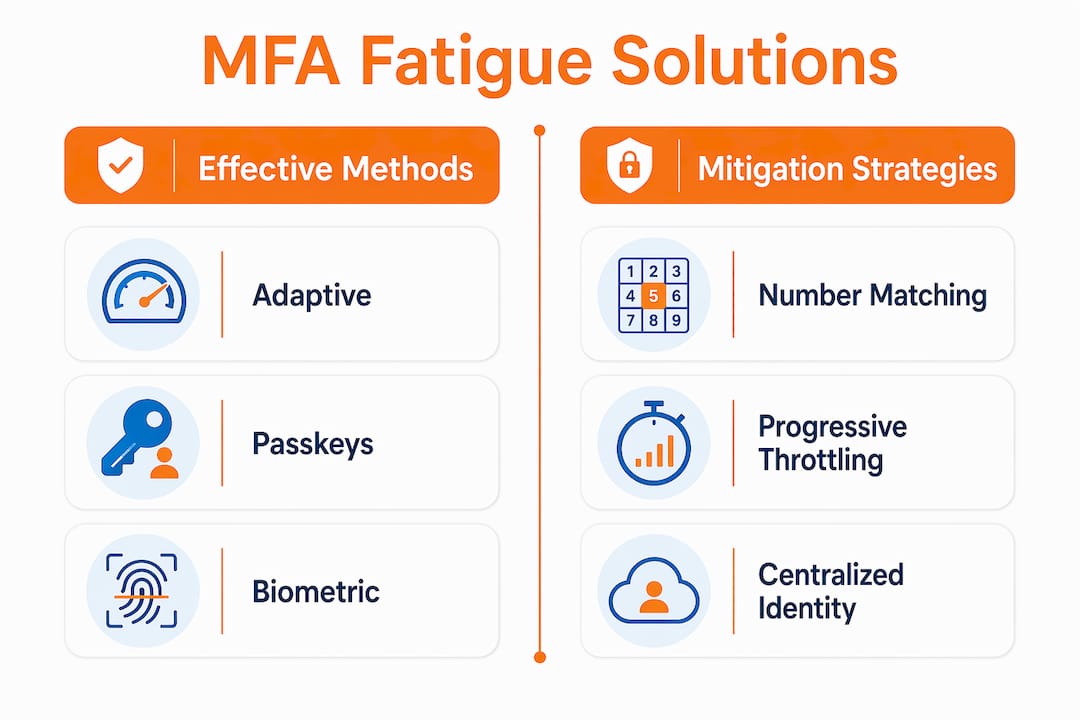
Number matching
Number matching in MFA apps requires users to enter a number displayed on the sign-in screen into their authenticator app. This single change breaks the reflexive “approve” behavior because it demands active cognitive engagement. Security experts treat number matching as an immediate, low-cost mitigation for MFA bombing attacks.
Biometric authentication
Biometric authentication requiring active physical participation breaks the habit-based approval reflex inherent to push notification MFA. A fingerprint scan or face recognition requires a deliberate physical action, not a tap on a notification. This is especially effective for high-privilege access scenarios.
Progressive throttling
Progressive throttling adds exponentially increasing delays after each failed authentication attempt. This is superior to immediate account lockout, which creates denial-of-service conditions and frustrates legitimate users. Throttling degrades the attacker’s ability to spam prompts while keeping accounts accessible.
Pro Tip: Deploy number matching first. It requires no infrastructure change for most enterprise MFA platforms and immediately disrupts the reflexive approval pattern attackers rely on.
The table below compares authentication approaches by their fatigue impact and phishing resistance:
| Authentication method | Fatigue impact | Phishing resistant |
|---|---|---|
| Push notification MFA | High | No |
| Number matching MFA | Medium | Partial |
| Adaptive authentication | Low | Partial |
| Passkeys / FIDO2 | Very low | Yes |
| Biometric (active) | Very low | Yes |
How does authentication fatigue create compliance and governance risk?
Authentication fatigue is not only a security problem. It is a compliance problem. Security fatigue increases compliance risk as employees bypass security protocols due to frustration with complex policies. When users route around controls, the organization’s documented security posture no longer reflects reality.
The governance implications are serious:
- Protocol bypass occurs when users share credentials, disable MFA on personal devices, or approve prompts without verification, all of which violate most regulatory frameworks.
- Audit trail gaps emerge when authentication events are approved reflexively, making it impossible to distinguish legitimate logins from attacker-driven ones.
- Regulatory exposure grows under frameworks like NIST SP 800-63B, which explicitly recommends phishing-resistant authenticators. Organizations still relying on push-only MFA face increasing scrutiny.
- Inconsistent policy enforcement across departments creates uneven security coverage, which regulators and auditors identify as systemic weakness.
Overwhelmed employees circumvent policies, undermining enterprise security and regulatory compliance. The fix is not stricter enforcement. The fix is reducing the friction that drives circumvention in the first place. Governance teams need to treat identity and access management design as a compliance control, not just an IT function.
What future trends are shaping authentication fatigue solutions?
The trajectory of authentication technology points clearly toward lower friction and higher resistance to fatigue attacks. Passkey adoption reached 69% of users by mid-2026, a 30% increase since 2023. That growth rate reflects genuine market demand for authentication that does not exhaust users.
Several trends are accelerating this shift:
Behavioral biometrics analyze typing cadence, mouse movement, and device interaction patterns continuously. When behavior matches the established baseline, the system authenticates silently. When it deviates, the system challenges. This approach makes authentication nearly invisible during normal use.
AI-driven risk scoring processes dozens of signals per login attempt, including device health, network reputation, and session context, to assign a real-time risk score. High-risk scores trigger step-up authentication. Low-risk scores pass users through without interruption. The result is a system that is assertive when it needs to be and invisible when it does not.
Centralized identity platforms reduce prompt volume by consolidating authentication across all enterprise applications into a single session. Users authenticate once and access everything their role permits. This directly addresses the fragmentation that generates fatigue in the first place.
Modern identity management should be invisible when risk is low and assertive when risk is high. That principle is becoming the design standard across the industry, and organizations that adopt it early gain both security and productivity advantages.
Key Takeaways
Authentication fatigue is a system design failure that attackers exploit deliberately, and the most effective countermeasures operate at the architecture level, not the user training level.
| Point | Details |
|---|---|
| Fatigue is architectural | Prompt volume is a security control variable; treat it as one. |
| MFA bombing is targeted | Attackers use valid credentials plus prompt flooding to bypass MFA without breaking encryption. |
| Number matching works immediately | Requiring users to enter a displayed number breaks the reflexive approval loop at low cost. |
| Adaptive auth cuts friction | Contextual risk assessment reduces unnecessary prompts while maintaining strong security. |
| Passkeys eliminate the attack surface | FIDO2-based authentication removes push notifications entirely, making MFA bombing impossible. |
Authentication fatigue is an architecture problem, not a people problem
After years of working in identity security, the pattern I see most often is organizations responding to MFA fatigue attacks by scheduling more user training. That response is understandable and almost entirely ineffective. Training does not override the biology of vigilance degradation. When a user receives their fifteenth authentication prompt of the day, their cognitive state is not a training failure. It is a predictable outcome of a poorly designed system.
The organizations that handle this well share one trait: they treat prompt volume as a security control. They measure it, set thresholds, and engineer their authentication flows to stay below those thresholds. They deploy adaptive authentication so that low-risk logins generate zero friction. They implement number matching as a baseline, not an advanced feature. And they are moving toward passkeys because they understand that eliminating the push notification loop is more durable than any behavioral intervention.
The uncomfortable truth is that most enterprise MFA deployments were designed for security completeness, not for human usability. Those two goals are not in conflict, but they require deliberate design to align. I have seen organizations cut their MFA-related support tickets by a significant margin simply by consolidating fragmented identity systems and enabling adaptive policies. The security posture improved at the same time, because users stopped bypassing controls they found tolerable.
Invest in two-factor authentication architecture that respects cognitive limits. The return is measurable in both security outcomes and user compliance.
— Mike
How Logmeonce addresses authentication fatigue at the system level
Logmeonce is built on the principle that strong authentication should not require constant user effort. Its cybersecurity platform combines passwordless MFA, adaptive authentication, and centralized identity management to reduce prompt volume without weakening access controls.
Logmeonce supports phishing-resistant login methods including biometric authentication and passkey-based access, directly countering the push notification loops that MFA bombing exploits. Its single sign-on architecture consolidates authentication across enterprise applications, cutting the fragmented prompt overload that drives fatigue. For IT teams managing compliance requirements alongside usability demands, Logmeonce offers password management benefits that align security policy with human cognitive capacity. Security teams looking to move beyond reactive MFA configurations will find the platform’s adaptive controls a practical starting point.
FAQ
What is authentication fatigue in cybersecurity?
Authentication fatigue is the mental exhaustion caused by repeated MFA prompts, leading users to approve requests without verification. It is also called MFA fatigue and represents a system design failure rather than a user error.
How do MFA fatigue attacks work?
Attackers obtain valid credentials, then flood the target’s device with push notification MFA requests until the user approves one out of frustration or confusion, granting unauthorized access.
What is the fastest way to stop MFA bombing?
Number matching is the fastest mitigation. It requires users to enter a code displayed on the login screen, breaking the reflexive approval behavior that MFA bombing exploits.
How does adaptive authentication reduce fatigue?
Adaptive authentication challenges users only when risk signals, such as a new device or unusual location, indicate elevated threat. Low-risk logins pass through with minimal friction, cutting unnecessary prompt volume.
Are passkeys effective against authentication fatigue?
Yes. Passkeys eliminate push notifications entirely by using device-bound cryptographic keys and biometrics. This makes MFA bombing structurally impossible and removes the primary source of fatigue-driven approval.
Recommended


