


 Password Manager
 Identity Theft Protection

 Team / Business
 Enterprise
 Government
 MSP
MSP


TL;DR:
- Access control measures verify user identities and enforce system, data, and physical space access. Implementing layered models like RBAC, supplemented by rules and attributes, strengthens security and minimizes risks from insiders and external attackers. Regular reviews, automated onboarding and offboarding, and upgraded physical protocols are essential for effective access management.
Access control measures are the policies, technologies, and processes organizations use to verify user identity and enforce authorized access to systems, data, and physical spaces. The industry standard term for this discipline is access control management, and it sits at the core of every serious security framework, from NIST SP 800-53 to the Canadian Centre for Cyber Security (CCCS) baseline controls. Without structured access restriction techniques, organizations expose themselves to both external attackers and insider threats. This guide gives IT managers and security professionals a practical framework for selecting models, deploying controls, and maintaining them continuously.
What are the key access control models and how do they differ?
Access control models define the rules that determine who gets access to what and under what conditions. Choosing the right model, or combination of models, is the single most consequential decision in any access control program.
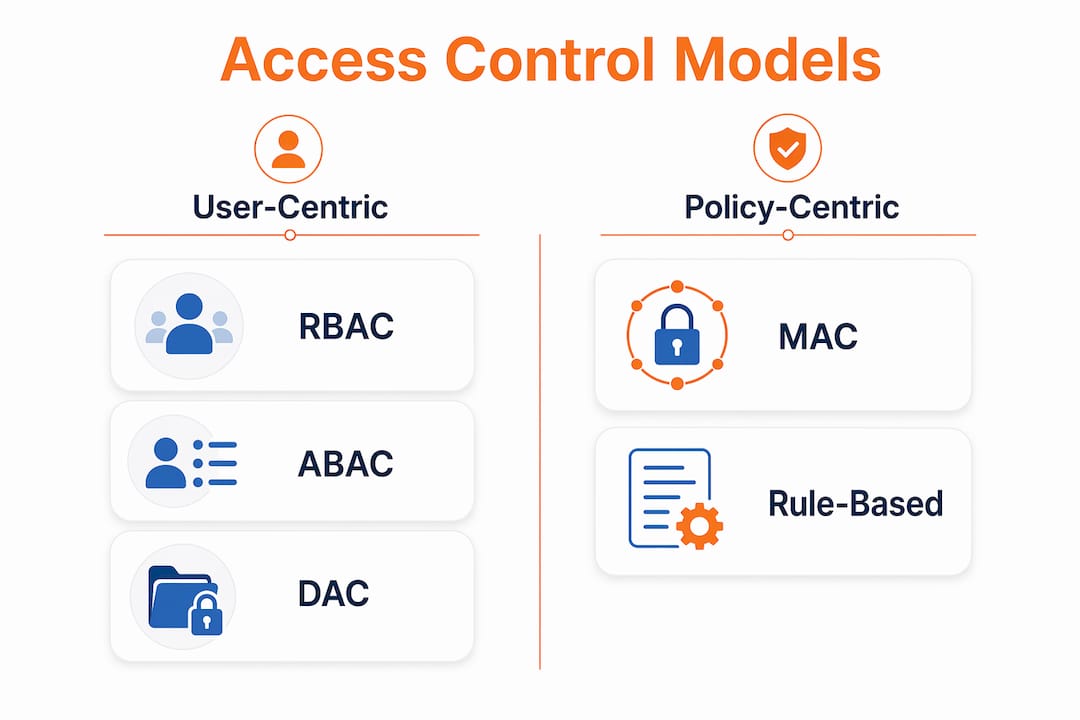
Role-Based Access Control (RBAC) is the most widely deployed model for mid-size and enterprise organizations. It assigns permissions to roles rather than individuals, so a “network engineer” role carries a defined set of rights regardless of which person holds it. This approach reduces administrative overhead and makes audits far easier.
Attribute-Based Access Control (ABAC) extends RBAC by evaluating contextual attributes at the time of each access request. Attributes can include the user’s department, device health, location, and time of day. ABAC is the right choice when you need fine-grained, context-aware decisions that static roles cannot deliver.
Mandatory Access Control (MAC) is used in high-security environments like defense and intelligence agencies. A central authority assigns security labels to both users and resources, and the system enforces access based on label matching. Users cannot override these rules, which makes MAC the most restrictive model available.
Discretionary Access Control (DAC) puts resource owners in charge of granting access. A file owner can share it with any colleague. DAC is flexible but creates risk because individual decisions are inconsistent and hard to audit at scale.
Rule-Based Access Control applies predefined conditions, such as “allow access only between 08:00 and 18:00 on weekdays,” independent of user roles. Layering RBAC with Rule-Based and ABAC controls provides granular, context-sensitive decisions aligned with zero trust principles.
| Model | Typical Use | Key Strength | Key Limitation |
|---|---|---|---|
| RBAC | Mid-size to enterprise | Simple to manage at scale | Lacks context awareness |
| ABAC | Cloud, SaaS environments | Fine-grained, dynamic decisions | Complex to configure |
| MAC | Government, defense | Highest restriction level | Inflexible for business use |
| DAC | Small teams, file shares | Owner-driven flexibility | Inconsistent enforcement |
| Rule-Based | Time or location restrictions | Automated conditional logic | Limited to predefined rules |
Pro Tip: Start with RBAC as your foundation. Add Rule-Based conditions for time and location restrictions, then layer ABAC only after your group structure is stable. Adding ABAC too early creates policy gaps that are difficult to detect.
How to implement access control measures in mid-size organizations
Implementation sequence matters as much as model selection. Organizations that skip the foundation phase and deploy complex conditional policies first end up with overlapping rules and undetected gaps.
Build your group structure first
For organizations with 100 to 1,000 employees, starting with 20–40 RBAC groups mapped to departments and job functions gives you a manageable foundation before layering more complex models. Each group should map to a real business function, such as “finance read-only,” “DevOps production,” or “HR admin.” Avoid creating groups for individuals. That practice defeats the purpose of role-based management and turns your directory into a maintenance burden.

Enforce least privilege from day one
Least privilege means every user account holds only the permissions required for its current function. Nothing more. Assign permissions to roles, not people, and set a default of “deny all” with explicit grants. This approach limits the blast radius of any compromised account.
Establish access review cadences
Access reviews must be performed quarterly for privileged accounts and at least semiannually for standard users, with immediate revocation upon employee departure. This cadence is specified in the CCCS 2026 baseline controls. Quarterly reviews for privileged accounts reflect the higher risk those accounts carry. A compromised admin account can exfiltrate data, alter logs, and disable security controls within minutes.
Integrate with IAM and HR systems
Integrating access control with HR workflows automates permission revocation and updates during role changes and offboarding. Manual audits are insufficient for continuous enforcement. When an employee moves from finance to operations, their finance permissions should revoke automatically, not after the next quarterly review.
- Define your RBAC group structure and map each group to a department and job function.
- Set a default-deny policy and grant permissions explicitly to each role.
- Integrate your identity provider with your HR system for automated provisioning and deprovisioning.
- Connect your identity and access management (IAM) platform to a SIEM tool for real-time visibility.
- Schedule quarterly reviews for privileged accounts and semiannual reviews for standard users.
- Layer Rule-Based and ABAC policies after the RBAC foundation is stable and audited.
Pro Tip: Use scheduled login controls to restrict account access to working hours. This single rule eliminates a large category of after-hours credential misuse without requiring complex ABAC policies.
What technological and physical measures enhance access control security?
Technical and physical controls work together. A strong logical access policy means little if an attacker can walk into a server room unchallenged.
Multi-factor authentication
MFA blocks over 99% of automated credential attacks when enforced across all users, including administrators and remote login endpoints. That figure makes MFA the single highest-return security investment available to most organizations. Deploy it on cloud services, VPN endpoints, admin consoles, and any application that handles sensitive data.
Physical access control systems and OSDP
Physical access controls govern entry to buildings, server rooms, and restricted areas. The OSDP protocol with AES-128 encryption is the recommended global standard for secure communication between access control panels and readers. It replaces the legacy Wiegand protocol, which transmits credentials in plaintext and is trivially vulnerable to replay attacks. If your physical access readers still use Wiegand, that is a known, exploitable gap.
Fail-safe vs. fail-secure design
Fail-safe and fail-secure mechanisms must be chosen deliberately in physical security design to balance life-safety requirements with security needs under power or system failure. A fail-safe door unlocks on power loss, protecting occupants in a fire. A fail-secure door stays locked, protecting assets. The right choice depends on the room’s function and local safety codes. Getting this wrong creates either a safety violation or a physical security gap.
Key technologies that support layered access control:
- Biometrics: Fingerprint, iris, and facial recognition for high-assurance physical and logical access
- Smart cards and PIV credentials: Hardware-backed identity for government and regulated industries
- Passkeys and FIDO2 tokens: Phishing-resistant authentication for cloud and web applications
- Security cameras and audit logs: Physical evidence layer that supports forensic investigation after incidents
Pro Tip: Retire any legacy access reader that uses unencrypted protocols. The upgrade cost is far lower than the incident response cost after a credential replay attack.
How can organizations integrate multiple access control measures for maximum security?
Integration is where most organizations fall short. Individual controls work in isolation but fail to prevent threats that cross boundaries between physical and logical environments.
Use RBAC as the base, then layer upward
RBAC handles the majority of access decisions for most organizations. Rule-Based controls add time and location constraints on top of roles. ABAC handles edge cases where context matters more than role. This layered approach meets diverse organizational needs better than any single model and aligns with zero trust architecture principles.
Automate offboarding and role changes
Insider breaches often result from users retaining access rights from previous roles due to inadequate timely revocation, not malicious intent. Connecting your HR system to your IAM platform so that a termination event triggers immediate deprovisioning across all systems is the most direct fix for this problem. Manual processes introduce delays measured in days or weeks. Automated processes measure in seconds.
Continuous monitoring and audit logging
Every access event should generate a log entry. SIEM platforms correlate these logs and surface anomalies, such as a user accessing systems outside their normal pattern or at unusual hours. Anomaly detection catches both compromised accounts and insider misuse before significant damage occurs.
| Review Type | Frequency | Responsible Party | Action on Finding |
|---|---|---|---|
| Privileged account review | Quarterly | Security team | Revoke excess rights immediately |
| Standard user review | Semiannually | IT and department heads | Remove stale permissions |
| Offboarding check | Immediate on departure | HR and IT jointly | Full deprovisioning within 24 hours |
| Role change audit | On every role change | IAM system (automated) | Update permissions to new role only |
Pro Tip: Automated identity governance tools flag permission creep before it becomes a compliance finding. Set up alerts for any account that accumulates permissions beyond its assigned role definition.
Key takeaways
Effective access control management requires layered models, automated lifecycle enforcement, and continuous review cadences aligned with NIST and CCCS standards.
| Point | Details |
|---|---|
| Start with RBAC | Build 20–40 role groups mapped to departments before adding complex policies. |
| Enforce MFA everywhere | MFA blocks over 99% of automated credential attacks across all user types. |
| Automate offboarding | Connect HR systems to IAM to revoke access within seconds of a role change or departure. |
| Review on schedule | Audit privileged accounts quarterly and standard accounts semiannually per CCCS guidance. |
| Upgrade physical protocols | Replace Wiegand readers with OSDP and AES-128 encrypted devices to close replay attack gaps. |
What I’ve learned from watching access control programs fail
Most access control failures I’ve seen share one trait: the team treated deployment as a finish line. They built the RBAC groups, configured the policies, and moved on. Six months later, permission creep had quietly accumulated across dozens of accounts, and nobody noticed until an audit or an incident forced a review.
The “set it and forget it” mindset is the most dangerous assumption in access control. Permissions are not static. People change roles, take on temporary projects, and leave the organization. Each of those events is an opportunity for excess access to persist if your processes are not automated and your reviews are not scheduled.
The second failure pattern I see consistently is adding complexity too early. Teams read about ABAC and zero trust, get excited, and layer conditional policies on top of an unstable RBAC foundation. The result is a policy set that nobody fully understands, with gaps that are invisible until exploited.
My advice: get your group structure right first. Map every role to a real business function. Enforce least privilege from the start. Then, only after that foundation is stable and audited, add Rule-Based time restrictions and ABAC context policies. Sequence matters more than sophistication.
Physical and logical controls also need to be managed together, not by separate teams with separate review cycles. A user whose logical access is revoked on termination but whose physical badge still works is still a threat. Integration between physical access control systems and your IAM platform is not optional in 2026. It is a baseline requirement.
— Mike
Logmeonce and access control: a practical fit
Logmeonce provides a cybersecurity platform built around the access control challenges IT teams face daily. Its passwordless MFA eliminates credential-based attack vectors without adding friction for end users. The platform’s enterprise password management capabilities integrate with existing identity workflows to support automated provisioning and timely revocation.

For organizations building or hardening their access control programs, Logmeonce’s cybersecurity solutions cover identity management, single sign-on, and dark web monitoring in one platform. The combination of passwordless authentication and automated access governance directly addresses the permission creep and offboarding gaps that create the most common insider risk scenarios.
FAQ
What are access control measures?
Access control measures are the policies, technologies, and processes that verify user identity and enforce authorized access to systems, data, and physical spaces. They include models like RBAC and ABAC, technologies like MFA and smart cards, and operational practices like access reviews and automated offboarding.
What is the most effective access control model for mid-size organizations?
RBAC is the most effective starting point for organizations with 100 to 1,000 employees. Starting with 20–40 role groups mapped to departments provides a manageable foundation before layering more complex models like ABAC.
How often should access rights be reviewed?
Privileged accounts require quarterly reviews and standard user accounts require at least semiannual reviews, per CCCS 2026 baseline guidance. Access must be revoked immediately upon employee departure or role change.
Why is MFA critical for access control?
MFA blocks over 99% of automated credential attacks when enforced across all users, including administrators and remote endpoints. It is the highest-return single security control available to most organizations.
What is the difference between fail-safe and fail-secure in physical access control?
A fail-safe door unlocks on power loss to protect occupants during emergencies like fires. A fail-secure door stays locked to protect assets. The correct choice depends on the room’s function and applicable safety regulations.


