


 Password Manager
 Identity Theft Protection

 Team / Business
 Enterprise
 Government
 MSP
MSP


TL;DR:
- Strong authentication involves verifying a user’s identity using at least two independent factors, significantly reducing unauthorized access. Modern methods like FIDO2/WebAuthn and hardware security keys provide phishing-resistant, adaptive, and cryptographically bound verification, surpassing traditional password or SMS-based systems. Implementing layered MFA strategies aligned with regulations enhances security, user trust, and compliance across organizations.
Strong authentication is defined as the process of verifying a user’s identity using at least two independent factors, making unauthorized access significantly harder to achieve. Unlike a single password, strong authentication methods combine knowledge, possession, and inherence factors to block credential-based attacks like phishing and credential stuffing. Technologies like FIDO2/WebAuthn from the FIDO Alliance and hardware security keys from Yubico represent the current standard for phishing-resistant verification. Passwords alone are increasingly insufficient as attackers exploit reuse, stuffing, and social engineering at scale.
What is strong authentication and how does it work?
Strong authentication, formally known as multi-factor authentication (MFA), requires a user to present at least two independent verification factors before gaining access. The industry term MFA covers everything from basic two-factor authentication (2FA) to advanced adaptive systems that assess risk in real time. The core principle is simple: if one factor is compromised, the attacker still cannot get in without the others.
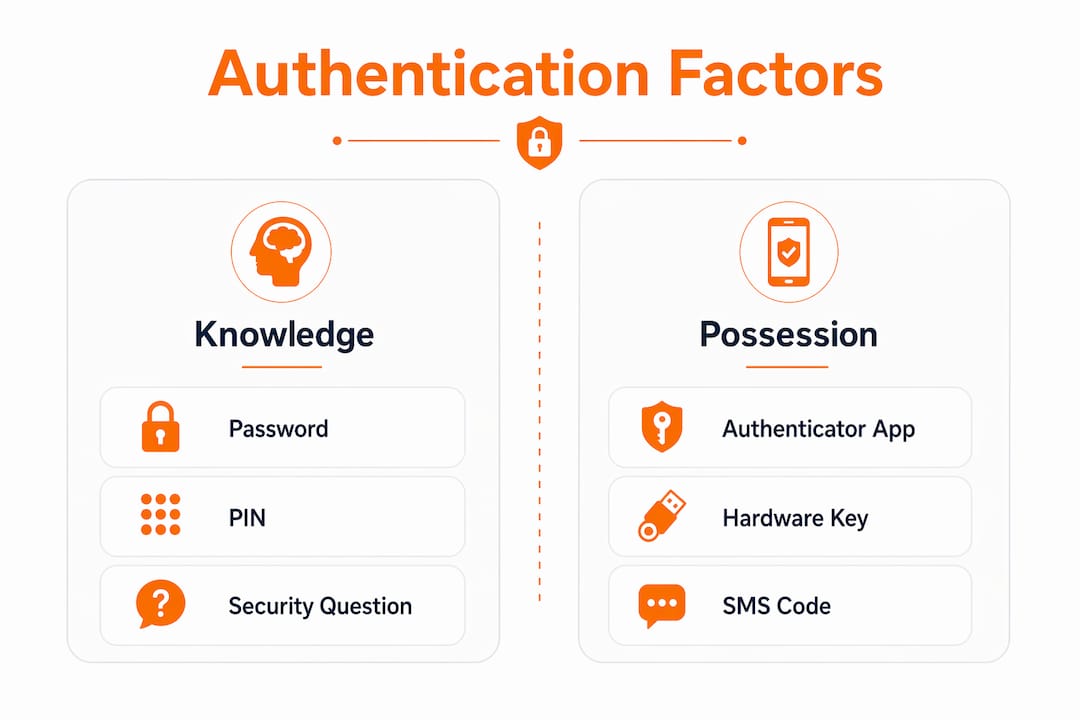
The three recognized factor categories are:
- Something you know: A password, PIN, or security question answer
- Something you have: A hardware security key like a Yubico YubiKey, a smartphone authenticator app like Google Authenticator or Microsoft Authenticator, or a one-time passcode (OTP)
- Something you are: A biometric signal such as a fingerprint, facial recognition, or iris scan
Combining factors from two or more of these categories is what separates strong authentication from a simple password check. A user who enters a password and then approves a push notification on their phone has used two categories. A user who scans their fingerprint and taps a hardware key has used two as well.
| Factor Type | Category | Example |
|---|---|---|
| Password or PIN | Something you know | Login password, 4-digit PIN |
| Hardware security key | Something you have | Yubico YubiKey, Google Titan Key |
| Authenticator app OTP | Something you have | Google Authenticator, Microsoft Authenticator |
| Biometric scan | Something you are | Fingerprint, Face ID, iris scan |
| Smart card | Something you have | Government PIV card, bank chip card |
Pro Tip: Use an authenticator app over SMS codes whenever possible. Authenticator apps generate codes locally on your device, while SMS codes travel over phone networks that attackers can intercept through SIM swapping.
Understanding what is multi-factor authentication also means understanding the difference between 2FA and full MFA. Two-factor authentication uses exactly two factors. MFA uses two or more, and modern implementations often layer three or four factors with adaptive risk checks on top.
How has strong authentication evolved beyond traditional methods?
Password-only authentication is highly vulnerable. Passwords are targeted by phishing, credential stuffing, and reuse attacks at a scale that makes them insufficient for protecting sensitive systems. Early 2FA via SMS OTP was a step forward, but it introduced new weaknesses that attackers quickly learned to exploit.

SMS-based OTPs are vulnerable to SIM swapping, SS7 network interception, and social engineering attacks against mobile carriers. True strong authentication protocols cryptographically bind authentication to the user’s specific domain and device, which eliminates the risk of a stolen code working on a fake site. This is the core advantage of FIDO2 and WebAuthn over SMS.
The most significant evolution in recent years is the shift to phishing-resistant MFA and continuous adaptive authentication. Modern MFA systems now evaluate contextual signals throughout a session, not just at login. These signals include geographic location, device health, network origin, and behavioral patterns. If something looks unusual mid-session, the system triggers an additional verification step.
Three threats that modern strong authentication specifically addresses:
- MFA fatigue attacks: Attackers flood users with push notification requests hoping for an accidental approval. Hardware security keys using FIDO2 dramatically reduce this risk by requiring direct physical interaction with the device.
- Man-in-the-middle attacks: Attackers intercept credentials in transit. Cryptographic binding in FIDO2 keys ties the authentication response to the exact origin domain, so intercepted data is useless on any other site.
- Session hijacking: Adaptive authentication detects anomalous session behavior and re-challenges the user before damage occurs.
Pro Tip: If your organization still relies on SMS OTPs as its primary second factor, treat that as a known gap. Migrate high-privilege accounts to FIDO2 hardware keys first, then work down to standard user accounts.
What regulations require strong authentication for businesses?
Regulations such as PSD2, HIPAA, and NIST SP 800-63 mandate strong multi-factor authentication to protect sensitive data, making compliance a legal requirement for many industries. Failure to implement adequate authentication controls can result in financial penalties, failed security audits, and reputational damage following a breach. These are not theoretical risks. Regulators have levied significant fines against organizations that suffered breaches tied to weak authentication practices.
| Regulation | Sector | MFA Requirement |
|---|---|---|
| PSD2 (EU Payment Services Directive 2) | Financial services | Strong Customer Authentication (SCA) for online payments |
| HIPAA | Healthcare | Access controls and audit logs for protected health information |
| NIST SP 800-63 | Federal and enterprise | Authenticator assurance levels (AAL1, AAL2, AAL3) |
| SOC 2 Type II | Technology and SaaS | MFA for privileged access and sensitive data systems |
| PCI DSS v4.0 | Payment card industry | MFA required for all access to cardholder data environments |
NIST SP 800-63 is particularly detailed. It defines three Authenticator Assurance Levels. AAL1 allows single-factor authentication for low-risk access. AAL2 requires two factors, including at least one cryptographic device. AAL3 requires hardware-based authentication with verifier impersonation resistance. Most enterprise and government systems must meet AAL2 or AAL3. You can review NIST 800 security policies to understand how these levels map to specific technical controls.
Beyond penalties, strong authentication directly improves user trust. Advanced identity verification supported by AI secures sensitive transactions like financial payments and remote contract signing without interrupting user workflows. That combination of security and usability is what regulators and customers both expect.
How to implement strong authentication effectively
Implementing strong authentication is not a single action. It is a layered process that combines the right technology choices with user education and ongoing risk management. The following steps apply to both individuals and organizations.
-
Audit your current authentication state. Identify every system, application, and user account in your environment. Catalog which ones use passwords only, which use SMS 2FA, and which already use app-based or hardware MFA. This baseline tells you where the highest risk sits.
-
Prioritize high-value targets first. Admin accounts, financial systems, and any application storing personal data carry the most risk. Deploy hardware security keys or FIDO2-based authenticators on these accounts before addressing lower-risk systems.
-
Centralize authentication through an OIDC-compliant identity provider. Centralizing through an OIDC provider ensures consistent, auditable identity verification across all applications. The identity provider issues short-lived signed tokens, so downstream services never handle raw credentials directly.
-
Replace SMS OTPs with app-based or hardware authentication. Google Authenticator, Microsoft Authenticator, and Duo Security all generate time-based OTPs locally. Yubico YubiKeys and Google Titan Keys provide hardware-level FIDO2 authentication. Both options are significantly more secure than SMS.
-
Add adaptive and risk-based authentication. Adaptive authentication adjusts verification levels based on user behavior and risk signals. A login from a known device in a familiar location may require only two factors. A login from a new country at 3 a.m. should trigger additional verification automatically.
-
Educate users about MFA fatigue and phishing. Technology alone does not close every gap. Users who understand why they should never approve an unexpected push notification are a meaningful layer of defense. Short, regular training sessions outperform annual compliance videos.
-
Test and audit regularly. Run simulated phishing campaigns to measure how users respond. Review authentication logs monthly for anomalies. Update your authentication policies as new attack techniques emerge.
Pro Tip: Pair your MFA deployment with a password manager. Strong authentication protects the login event, but weak or reused passwords remain a risk if an attacker bypasses MFA through account recovery flows.
Key takeaways
Strong authentication requires at least two independent factors from the knowledge, possession, and inherence categories, and phishing-resistant methods like FIDO2 and hardware security keys provide the highest level of protection available today.
| Point | Details |
|---|---|
| Definition of strong authentication | Verification using two or more independent factors blocks credential-based attacks that passwords alone cannot stop. |
| FIDO2 and hardware keys lead | Phishing-resistant methods like FIDO2/WebAuthn and Yubico YubiKeys outperform SMS OTPs against modern attacks. |
| Compliance is mandatory | PSD2, HIPAA, and NIST SP 800-63 require MFA, and non-compliance carries financial and reputational penalties. |
| Adaptive authentication adds depth | Context-aware systems assess geography, device health, and behavior to trigger step-up verification mid-session. |
| Implementation requires layering | Centralizing via OIDC, replacing SMS, educating users, and auditing regularly are all required for effective deployment. |
Why phishing-resistant MFA is no longer optional
I have spent years watching organizations treat MFA as a checkbox. They deploy SMS-based 2FA, mark the compliance requirement as done, and move on. That approach was defensible five years ago. It is not defensible now.
The attacks targeting MFA today are not theoretical. MFA fatigue campaigns have successfully bypassed push notification systems at major organizations. SIM swapping has compromised SMS OTP accounts at financial institutions and crypto exchanges. The attackers have adapted. Most defenders have not.
What I find most underappreciated is the role of user education in making strong authentication actually work. You can deploy the best FIDO2 hardware keys on the market, and a single employee who hands over their recovery code to a convincing phishing email will undo all of it. The technology and the human layer have to advance together.
The organizations I have seen get this right share one trait: they treat authentication as a foundation for zero trust security, not a standalone feature. Every access decision flows from a verified, cryptographically confirmed identity. That changes how you think about network segmentation, application permissions, and incident response. Authentication is not just a gate at the front door. It is the basis for every trust decision your systems make.
The direction is clear. FIDO2 and passkeys are becoming the default for consumer and enterprise authentication alike. Apple, Google, and Microsoft have all committed to passkey support across their platforms. Organizations that start migrating now will find the transition far smoother than those who wait for a breach to force the issue.
— Mike
Strengthen your security with Logmeonce
Logmeonce provides a complete identity security platform built around strong authentication and password management benefits that work together to protect every account you manage. The platform supports passwordless MFA, single sign-on, and encrypted cloud storage, giving individuals and businesses a single place to enforce the authentication standards covered in this article. Whether you are securing a personal account or rolling out MFA across an enterprise, Logmeonce offers flexible plans with the controls you need. Explore Logmeonce’s full suite to see how centralized identity management reduces your exposure to credential-based attacks without adding friction to your daily workflows.
FAQ
What is the difference between 2fa and strong authentication?
Two-factor authentication uses exactly two verification factors, while strong authentication is a broader standard that requires at least two independent factors and often includes phishing-resistant methods like FIDO2. Strong authentication vs two-factor authentication comes down to the quality and independence of the factors used, not just the count.
What are the best examples of strong authentication?
The strongest examples of strong authentication combine a hardware security key like a Yubico YubiKey with a biometric scan or PIN, using the FIDO2/WebAuthn protocol. This combination is cryptographically bound to the user’s device and domain, making it resistant to phishing and man-in-the-middle attacks.
Is sms-based 2fa considered strong authentication?
SMS-based 2FA is not considered strong authentication by current standards because it is vulnerable to SIM swapping, SS7 interception, and social engineering. NIST SP 800-63 classifies SMS OTP as a restricted authenticator and recommends moving to app-based or hardware alternatives.
What regulations require strong authentication?
PSD2 requires Strong Customer Authentication for online financial transactions, HIPAA requires access controls for protected health information, and NIST SP 800-63 defines authenticator assurance levels for federal and enterprise systems. Non-compliance with these frameworks can result in audits, fines, and breach liability.
How does adaptive authentication differ from standard MFA?
Standard MFA applies the same verification steps every time a user logs in, while adaptive authentication adjusts the required factors based on real-time risk signals like location, device, and behavior. This approach maintains security without adding unnecessary friction to low-risk login events.


