


 Password Manager
 Identity Theft Protection

 Team / Business
 Enterprise
 Government
 MSP
MSP


TL;DR:
- Access management involves layered models like MAC, DAC, RBAC, and ABAC, enforced through AAA controls and least privilege principles. Most organizations adopt hybrid solutions combining baseline roles, context-aware policies, and fine-grained exceptions to prevent permission drift and enhance security. Regular access reviews and lifecycle governance are essential for maintaining an effective, compliant, and scalable access control environment.
Types of access management are the frameworks and methods organizations use to control who can access resources and what actions they can perform. Identity and access management (IAM) sits at the center of every modern security architecture, governing everything from a developer’s read permissions on a production database to a contractor’s temporary access to a cloud storage bucket. The four foundational access control models are Mandatory Access Control (MAC), Discretionary Access Control (DAC), Role-Based Access Control (RBAC), and Attribute-Based Access Control (ABAC). Operational principles like AAA (Authentication, Authorization, Accounting) and least privilege, codified in standards such as NIST SP 800-53 and ISO/IEC 27001, determine how those models get enforced in practice. LogMeOnce and similar platforms translate these models into automated, auditable controls for enterprise environments.
What are the primary types of access control models?
Access control models define who makes the permission decision and on what basis. Getting that boundary wrong is the root cause of most authorization drift and over-permissioning incidents.
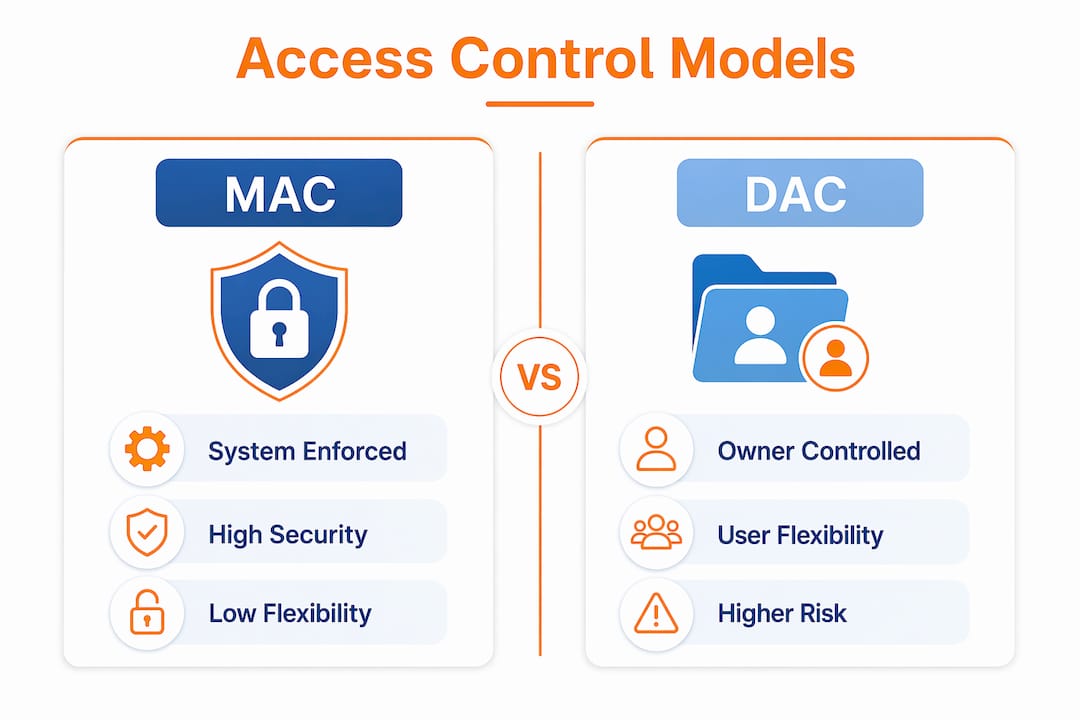
Mandatory Access Control (MAC)
MAC is enforced entirely by the system using fixed security labels. No user or resource owner can override the policy. A file labeled “Top Secret” can only be read by a subject with a matching or higher clearance level. The U.S. Department of Defense and intelligence agencies rely on MAC because human discretion is removed from the equation. The tradeoff is rigidity: changing a label requires administrative action, which makes MAC impractical for environments where access needs shift frequently.
Discretionary Access Control (DAC)
DAC places permission decisions with the resource owner, typically through Access Control Lists (ACLs). A file owner on a Linux system using standard Unix permissions is operating under DAC. The model is flexible and easy to administer at small scale, but it creates serious risk in regulated environments. When individual owners control their own ACLs, permission mismanagement accumulates silently over months. Auditors reviewing a DAC-heavy environment often find dozens of users with access that was never formally revoked.
Role-Based Access Control (RBAC)
RBAC assigns permissions to roles, not individuals. A user inherits access by being assigned a role such as “Finance Analyst” or “Network Engineer.” This model scales well in organizations with stable job functions because adding a new employee means assigning a role rather than configuring individual permissions. RBAC is the most widely deployed model in enterprise environments, forming the permission scaffolding on which most IAM platforms are built. The weakness is role explosion: as organizations grow, the number of roles multiplies until the model becomes nearly as complex as the DAC it replaced.

Attribute-Based Access Control (ABAC)
ABAC evaluates multiple attributes simultaneously: user department, device health, time of day, resource classification, and network location can all factor into a single access decision. This makes ABAC the natural fit for Zero Trust architectures and cloud environments where context changes constantly. RBAC combined with ABAC conditions is the dominant hybrid pattern in production today. RBAC handles the baseline permissions; ABAC adds context-sensitive constraints that prevent role explosion while enabling dynamic, conditional access.
| Model | Decision-maker | Best use case | Key risk |
|---|---|---|---|
| MAC | System (fixed labels) | Government, military, classified data | Inflexibility, high admin overhead |
| DAC | Resource owner (ACLs) | Small teams, file shares | Permission drift, hard to audit |
| RBAC | Role assignment | Enterprise with defined job functions | Role explosion at scale |
| ABAC | Policy engine (multi-attribute) | Cloud, Zero Trust, dynamic environments | Policy complexity, performance overhead |
How do AAA and least privilege enhance access management?
Access management relies on AAA: Authentication confirms identity, Authorization determines what that identity can do, and Accounting logs what it actually did. These three functions are not optional add-ons. They are the operational skeleton that makes any access control model enforceable and auditable.
Authentication is the entry gate. Without strong authentication, the most carefully designed RBAC or ABAC policy is meaningless because the system cannot trust the claimed identity. Multi-factor authentication, passwordless methods, and certificate-based login all strengthen this layer.
Authorization translates the authenticated identity into a permission decision. This is where your chosen access control model executes. NIST AC-3 mandates that authorization enforcement code must be fully implemented and consistently called at every decision point. Policy documents alone do not constitute enforcement. A gap between written policy and deployed code is one of the most common findings in security audits.
Accounting closes the loop. Session logs, privilege-use records, and anomaly alerts feed into SIEM platforms and compliance reports. ISO/IEC 27001 recommends periodic access rights reviews: at minimum bi-yearly for general accounts and quarterly for privileged accounts. These reviews catch stale permissions that authentication and authorization controls never see.
The Principle of Least Privilege extends this framework. NIST AC-6 requires least privilege to apply not just to human users but to system processes and service accounts. Privileged automation accounts that retain standing access between jobs are a persistent attack surface. Lifecycle events such as employee onboarding, role changes, and offboarding must trigger immediate access adjustments.
- Define the minimum permissions required for each role or process before provisioning.
- Automate provisioning and deprovisioning tied to HR system events (join, move, leave).
- Schedule quarterly reviews for privileged accounts and bi-yearly reviews for standard accounts.
- Log every privilege-use event and route alerts for anomalous patterns to your SIEM.
- Apply least privilege to service accounts and CI/CD pipeline credentials, not just human identities.
Pro Tip: Treat service accounts as first-class citizens in your access governance program. A compromised automation account with standing admin rights causes the same damage as a compromised human admin, often faster and with less visibility.
How do organizations implement hybrid access management solutions?
Organizations rarely rely on a single authorization model. The practical reality in most enterprises is a layered architecture: RBAC defines baseline permissions, ABAC policies add context-sensitive conditions, and ACLs handle fine-grained exceptions that neither model covers cleanly.
A common production pattern in financial services looks like this. RBAC assigns a “Trading Desk Analyst” role with read access to market data feeds. An ABAC policy then restricts that access to requests originating from managed devices on the corporate network during business hours. A specific ACL grants one analyst temporary write access to a sandbox environment for a defined project period. Each layer serves a distinct purpose, and none of them alone would achieve the right balance of security and operational flexibility.
The biggest operational challenge in hybrid environments is authorization drift. When the decision-maker boundary is unclear, permissions accumulate through informal requests, emergency exceptions that never get revoked, and role assignments that outlast the job function they were created for. Over-permissioning is the predictable result.
“Effective access management requires technical enforcement code to be fully implemented and consistently called at each authorization decision point. Policy without enforcement leads to gaps.” — NIST 800-53 AC-3
Zero Trust architectures push hybrid access management further by treating every access request as untrusted regardless of network location. ABAC becomes the primary enforcement mechanism because Zero Trust requires continuous verification of device posture, user behavior, and resource sensitivity on every request. Cloud environments on AWS, Azure, and Google Cloud expose native ABAC capabilities through policy engines like AWS IAM Conditions and Azure Attribute-Based Access Control, making it practical to implement context-aware access at scale without building custom policy infrastructure.
For enterprise password management and credential governance, the same hybrid logic applies. Credentials are access artifacts, and their lifecycle must be governed by the same models and reviews that govern permissions.
What criteria should IT pros use when selecting access management solutions?
Selecting the right access control model and supporting platform requires matching your organizational structure, data sensitivity, compliance obligations, and technical environment. No single model fits every organization, and the wrong choice creates either excessive friction or unacceptable risk.
| Criterion | What to evaluate |
|---|---|
| Organizational structure | Stable job functions favor RBAC; dynamic or project-based teams benefit from ABAC |
| Data sensitivity | Classified or regulated data may require MAC; general business data works with RBAC or DAC |
| Compliance requirements | NIST SP 800-53, ISO/IEC 27001, HIPAA, and SOC 2 each specify access control obligations |
| Scalability | RBAC scales with role design discipline; ABAC scales with policy engine performance |
| Integration | Platform must connect to your IdP, HR system, SIEM, and cloud providers |
Regulatory requirements often make the decision for you. A healthcare organization subject to HIPAA needs audit trails and minimum-necessary access controls that align naturally with RBAC plus least privilege enforcement. A defense contractor handling classified data may have no choice but to implement MAC at the system level. For most commercial enterprises, the starting point is RBAC with a roadmap to add ABAC conditions as cloud adoption and Zero Trust maturity increase.
Scalability deserves more attention than it typically receives during vendor selection. RBAC scales predictably if role design is disciplined from the start, but organizations that allow role proliferation end up with hundreds of overlapping roles that are harder to audit than the DAC environment they replaced. ABAC scales with the performance of the policy engine, which becomes a real constraint in high-throughput API environments.
Integration with your identity provider is non-negotiable. Whether you use Microsoft Entra ID, Okta, or Ping Identity, your access management platform must consume identity signals in real time. NIST 800-53 compliance frameworks provide a structured checklist for evaluating whether a platform meets the technical control requirements your organization must satisfy.
Pro Tip: Before evaluating vendors, document your current permission model in writing. Organizations that cannot describe their existing access control logic clearly will replicate its flaws in any new platform they deploy.
Key takeaways
Effective access management requires layering MAC, DAC, RBAC, and ABAC with enforced AAA controls, least privilege governance, and scheduled access reviews to prevent authorization drift.
| Point | Details |
|---|---|
| Four core models | MAC, DAC, RBAC, and ABAC each assign the permission decision to a different authority. |
| Hybrid is the norm | Most enterprises combine RBAC baselines with ABAC conditions and ACL exceptions for precision. |
| Enforcement over policy | NIST AC-3 requires enforcement code at every decision point; written policy alone is insufficient. |
| Least privilege extends to machines | Service accounts and automation credentials require the same lifecycle governance as human identities. |
| Compliance drives model selection | HIPAA, ISO/IEC 27001, and NIST SP 800-53 each specify access control obligations that narrow your options. |
What I’ve learned from managing access models in production
After years of working with enterprise access management, the lesson that keeps proving itself is this: the enforcement layer matters more than the model you choose. I have seen organizations with beautifully documented RBAC policies that were effectively running DAC in practice because no one had wired the authorization checks into the application layer consistently. The model on paper was irrelevant.
The second hard lesson is that RBAC is not a destination. It is a starting point. Every organization I have worked with that deployed RBAC without a plan for ABAC eventually hit the role explosion problem. Roles multiply to handle exceptions, and within two years the role catalog is unmanageable. Building ABAC conditions into the architecture from the beginning, even if you only use a few policies initially, saves significant rework later.
Periodic access reviews are the most underrated control in the entire access management stack. Quarterly reviews of privileged accounts catch the stale permissions and forgotten service accounts that every other control misses. I have seen a single quarterly review surface more actual risk than a full penetration test, because the permissions being found were legitimate credentials that had simply outlived their purpose.
My recommendation for most organizations in 2026 is a layered approach: RBAC as the permission foundation, ABAC for context-sensitive enforcement in cloud and Zero Trust environments, and a governance cadence that treats access reviews as operational discipline rather than compliance theater. The mobile device security layer deserves the same access governance rigor as your servers and cloud workloads.
— Mike
How LogMeOnce supports your access management strategy

LogMeOnce translates the access control models and operational principles covered in this guide into automated, auditable controls for real enterprise environments. The platform supports RBAC and ABAC-aligned permission structures, automates identity lifecycle events triggered by HR system changes, and generates the audit trails that NIST SP 800-53 and ISO/IEC 27001 reviews require. For organizations managing privileged access to sensitive environments, LogMeOnce’s cybersecurity platform provides monitored elevated permissions, passwordless MFA, and single sign-on across cloud and on-premises resources. If your current access management strategy relies on manual reviews and disconnected tools, LogMeOnce consolidates enforcement, governance, and compliance reporting into one platform built for IT and security teams.
FAQ
What are the four main types of access control?
The four main access control models are Mandatory Access Control (MAC), Discretionary Access Control (DAC), Role-Based Access Control (RBAC), and Attribute-Based Access Control (ABAC). Each assigns the permission decision to a different authority: the system, the resource owner, a role assignment, or a multi-attribute policy engine.
What is the difference between RBAC and ABAC?
RBAC assigns permissions based on predefined roles tied to job functions, while ABAC evaluates multiple attributes such as device health, location, and time of day to make dynamic access decisions. Most enterprises use RBAC as the baseline and layer ABAC conditions on top for context-sensitive enforcement.
What does AAA mean in access management?
AAA stands for Authentication, Authorization, and Accounting. Authentication verifies identity, Authorization determines what that identity can access, and Accounting logs all access activity for auditing and compliance purposes.
How often should organizations review access rights?
ISO/IEC 27001 recommends reviewing general account access rights at least bi-yearly and privileged account access quarterly. These scheduled reviews are the primary control for catching stale permissions and over-provisioned accounts that automated controls do not detect.
What is the Principle of Least Privilege?
The Principle of Least Privilege requires that users, processes, and service accounts receive only the minimum permissions needed to perform their function. NIST AC-6 extends this requirement to non-human identities including automation accounts and CI/CD pipeline credentials.


